| 
| |
|
|
This page contains historical photos of Ontario's King's Highway 401 dating from 1985 to 1989. All photographs displayed on
this page were taken by the Ontario Ministry of Transportation, unless specifically noted otherwise. Historical photographs are arranged in approximate chronological
order. Click on any thumbnail to see a larger image!
Please note that all photographs displayed on this
website are protected by copyright. These photographs must not be reproduced, published,
electronically stored or copied, distributed, or posted onto other websites without
my written permission. If you want to use photos from this website, please
email me first for permission. Thank-you!
|
|---|
|
Page 8: Historical King's Highway 401 Photographs (1985 to 1989)


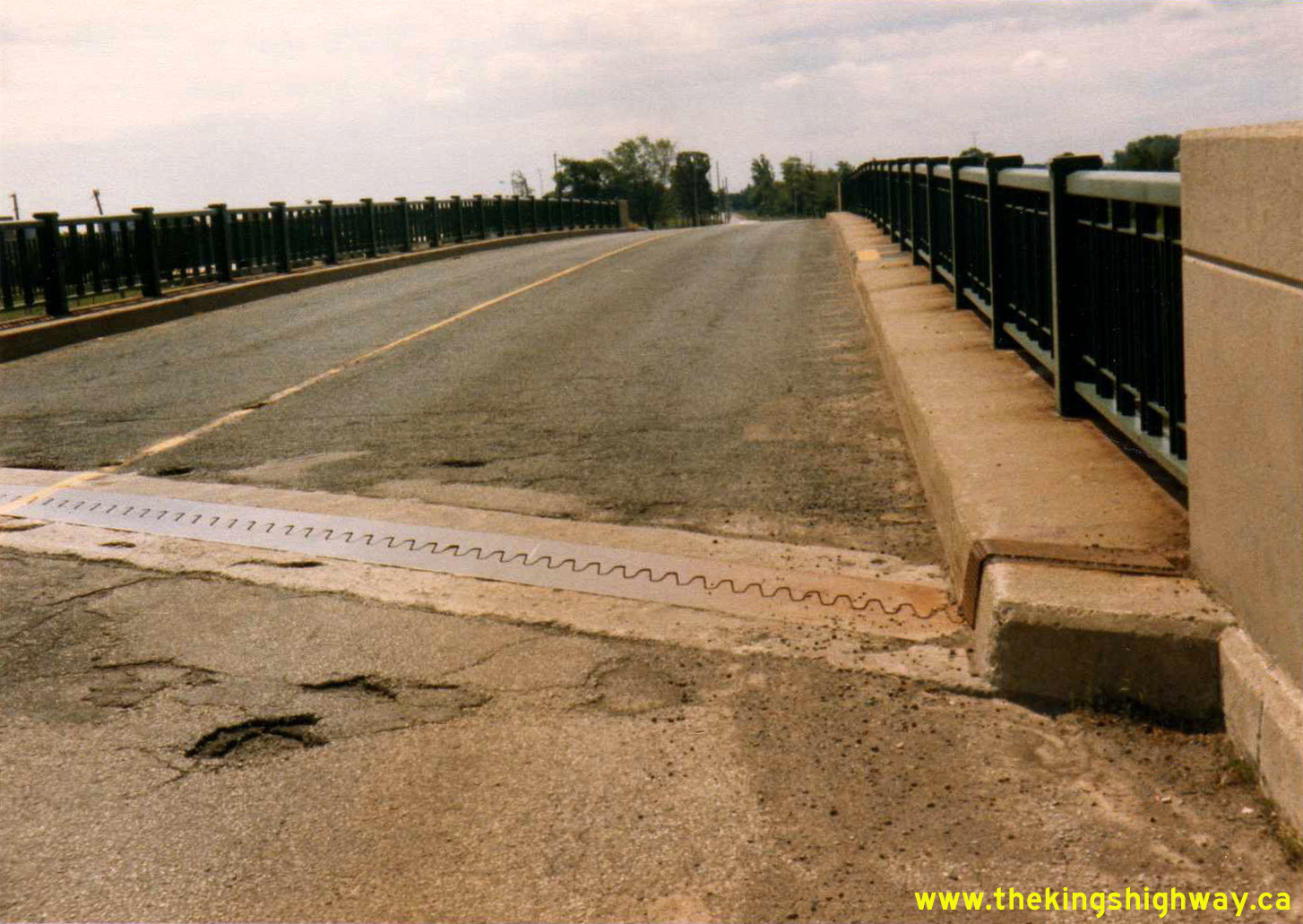
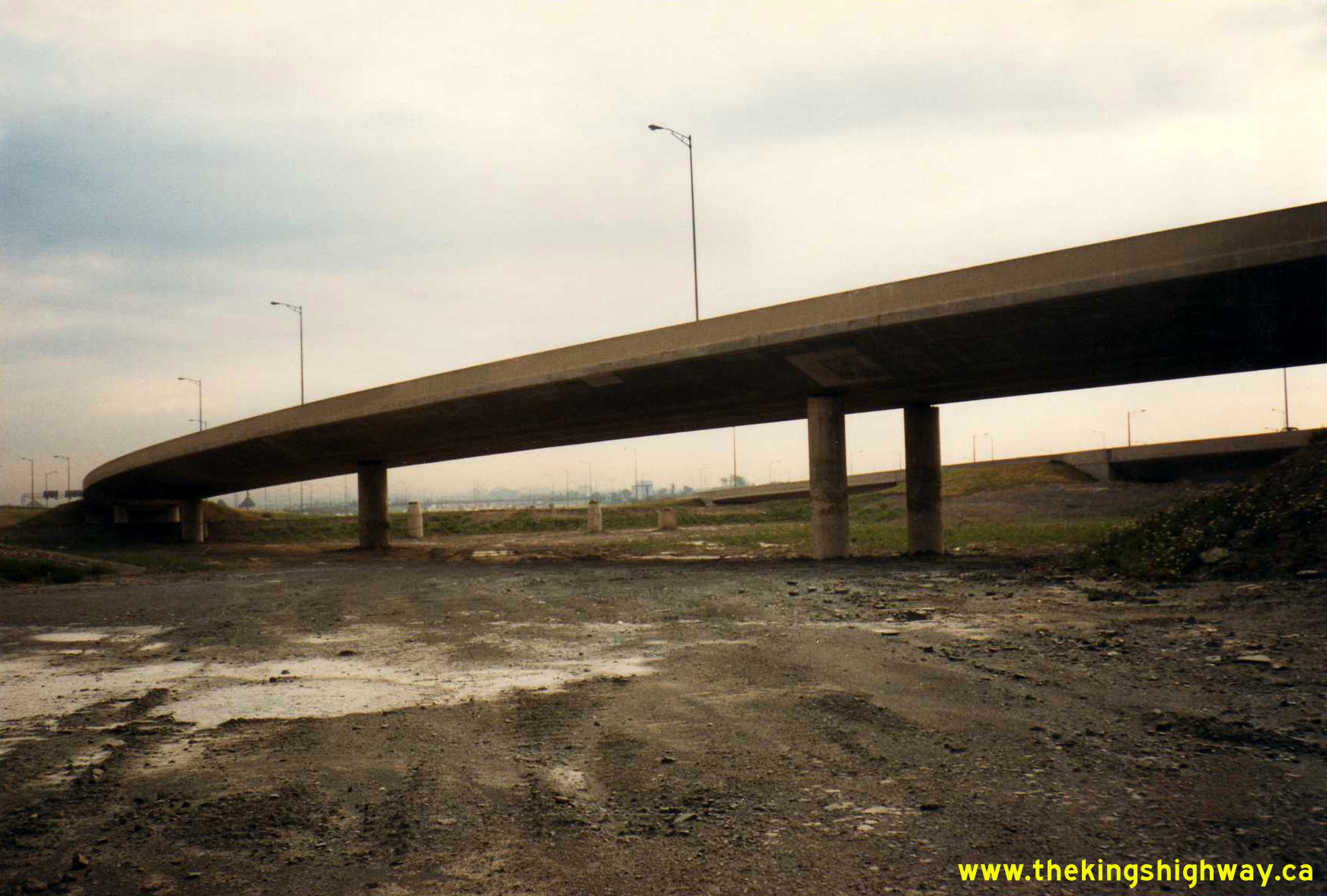
Left - Facing south across the old Trafalgar Township #1 Overpass (Site #10-98) on Hwy 401 in Mississauga in 1985. The structure shown here was originally
constructed in the late 1950s on the Trafalgar & Toronto Township Boundary Road (known today as Winston Churchill Boulevard) as part of the westerly extension of
Hwy 401 from Toronto to Milton. This two-lane structure was built under Contract #1958-141 and was completed in 1959. This structure was demolished and replaced with
a new structure in the late 1980s, when a new interchange was constructed at Hwy 401 and Winston Churchill Boulevard. See an
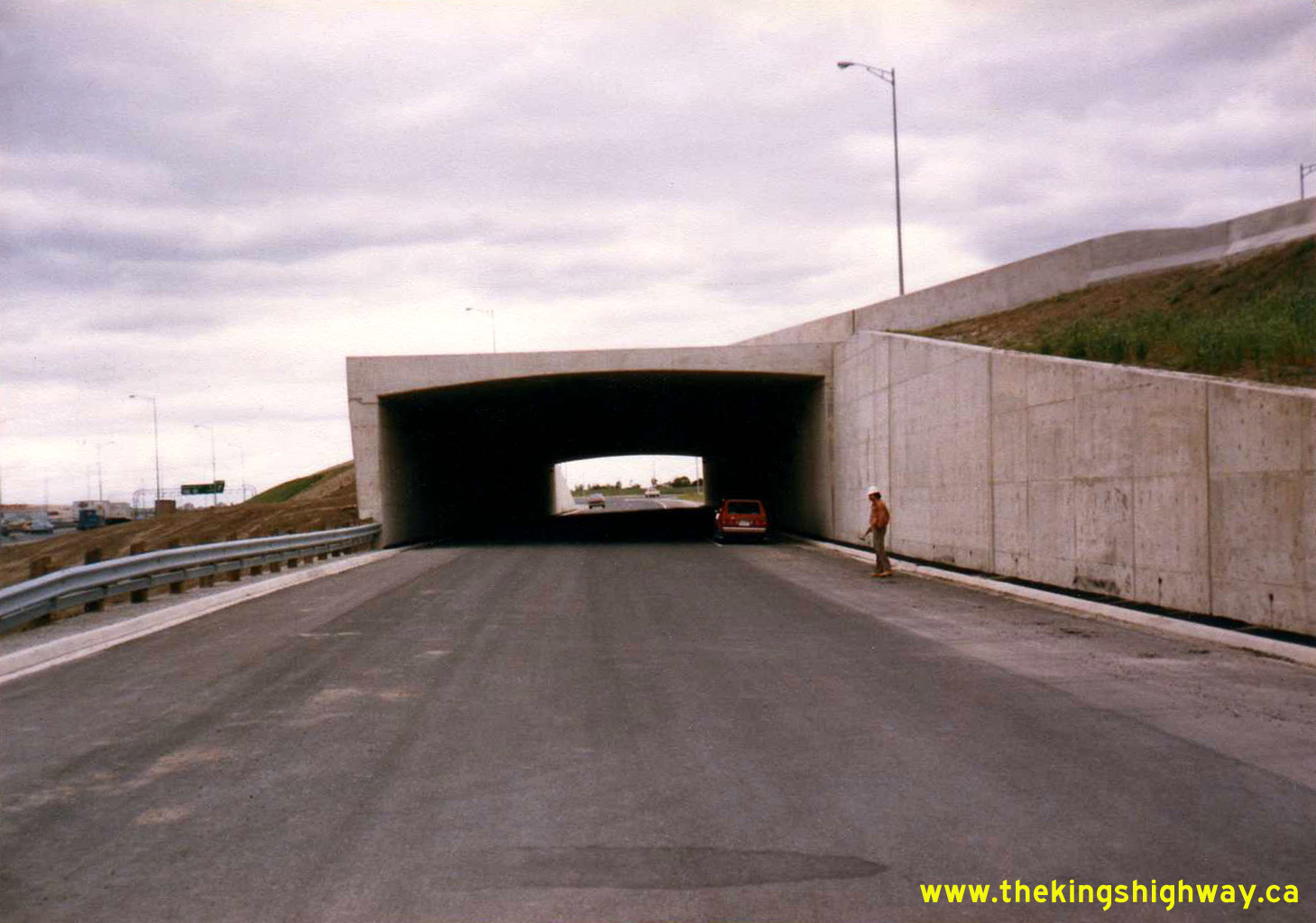
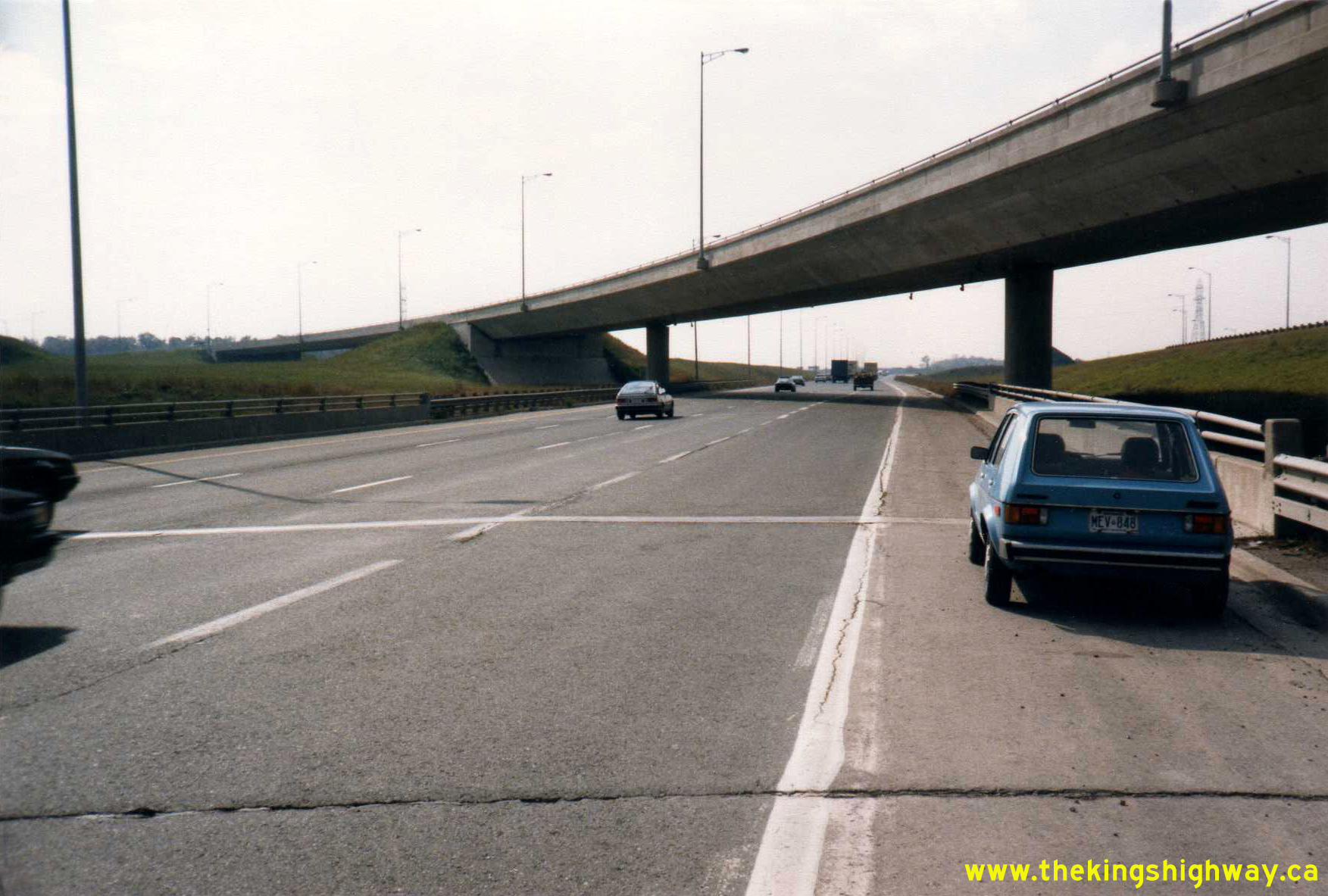
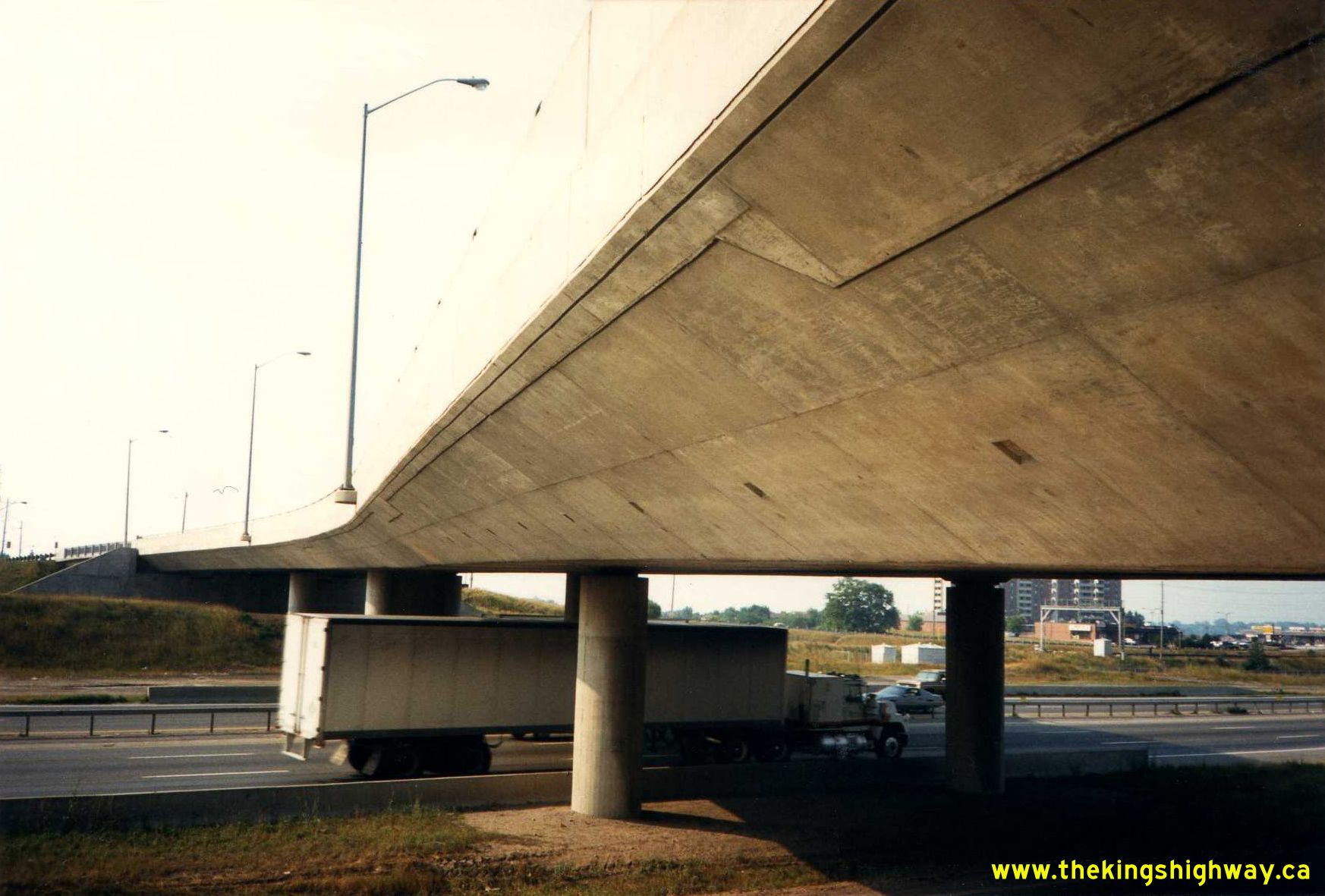
Enlarged Photo Here. Photo taken in June 1985. (Photo courtesy of Ontario Ministry of Transportation - © King's Printer for Ontario, 2011) Right - New Airport Basketweave structure (Site #24-468) on eastbound Hwy 401 in Mississauga, shortly before being opened to traffic in 1985. The Airport Basketweave was constructed in 1984 under Contract #1983-71 and was among the most important new features constructed during the Hwy 401 Express-Collector Lane expansion project through Mississauga. The Airport Basketweave separated the busy traffic weaving area located along Hwy 401 between the Hwy 427 Interchange and the Hwy 403 & Hwy 410 Interchange located to the west. Today, thousands of eastbound Hwy 401 motorists use this tunnel daily to access Hwy 427 and Toronto's Pearson Airport. See an Enlarged Photo Here. Photo taken on June 13, 1985. (Photo courtesy of Ontario Ministry of Transportation - © King's Printer for Ontario, 2011) 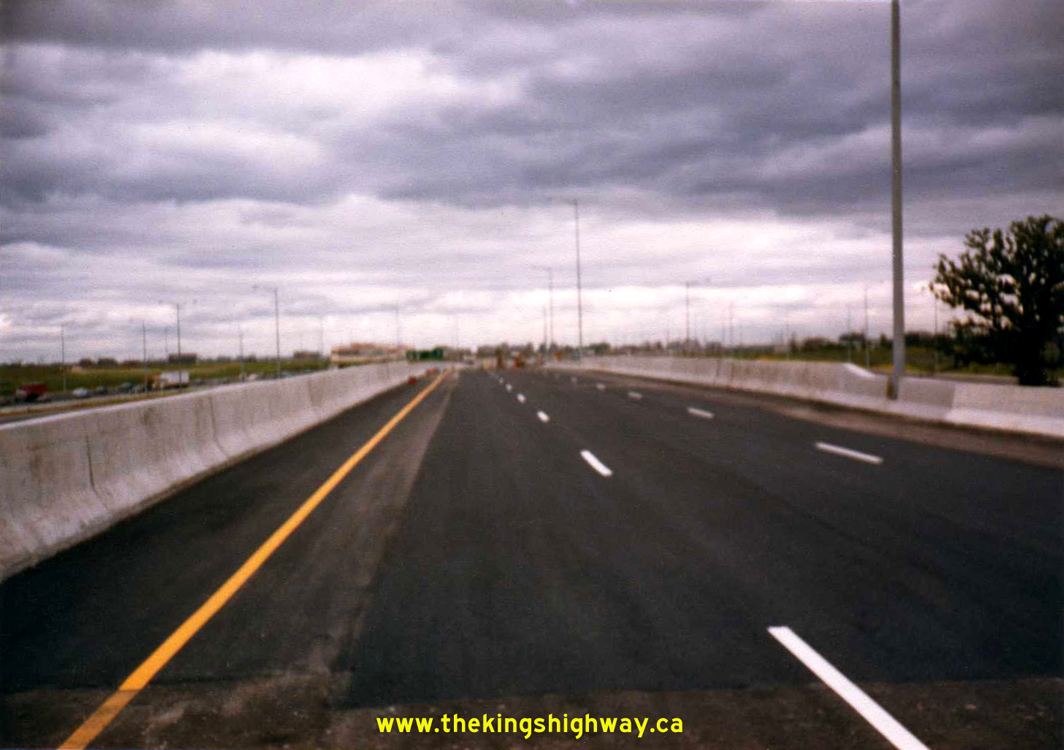
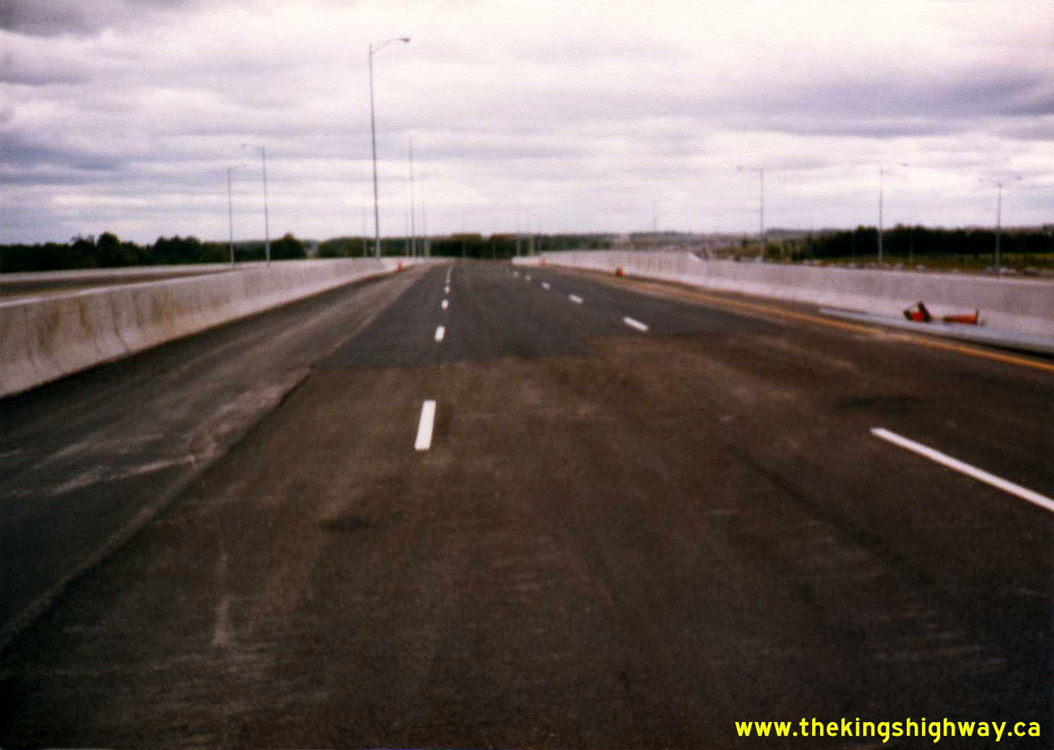
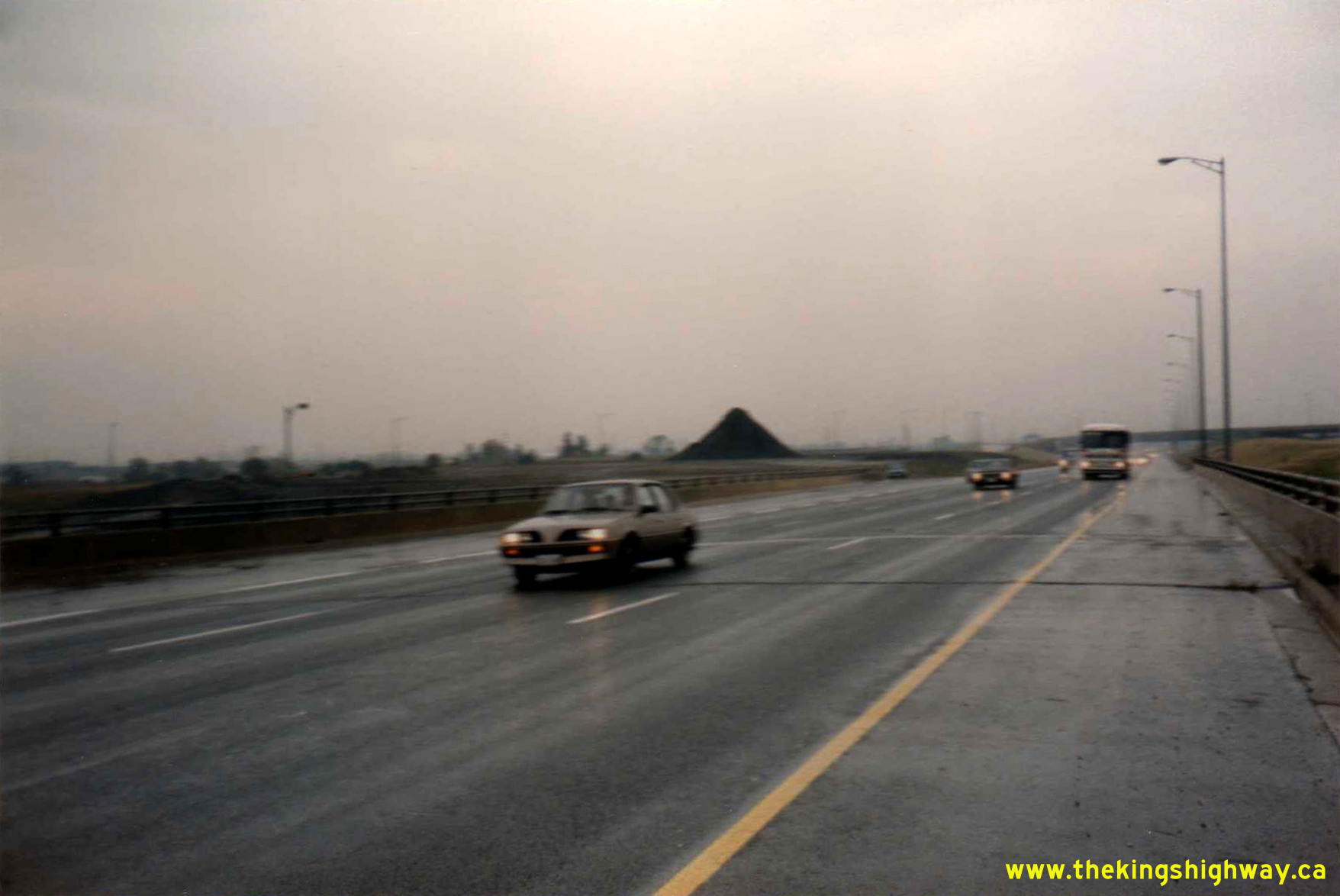
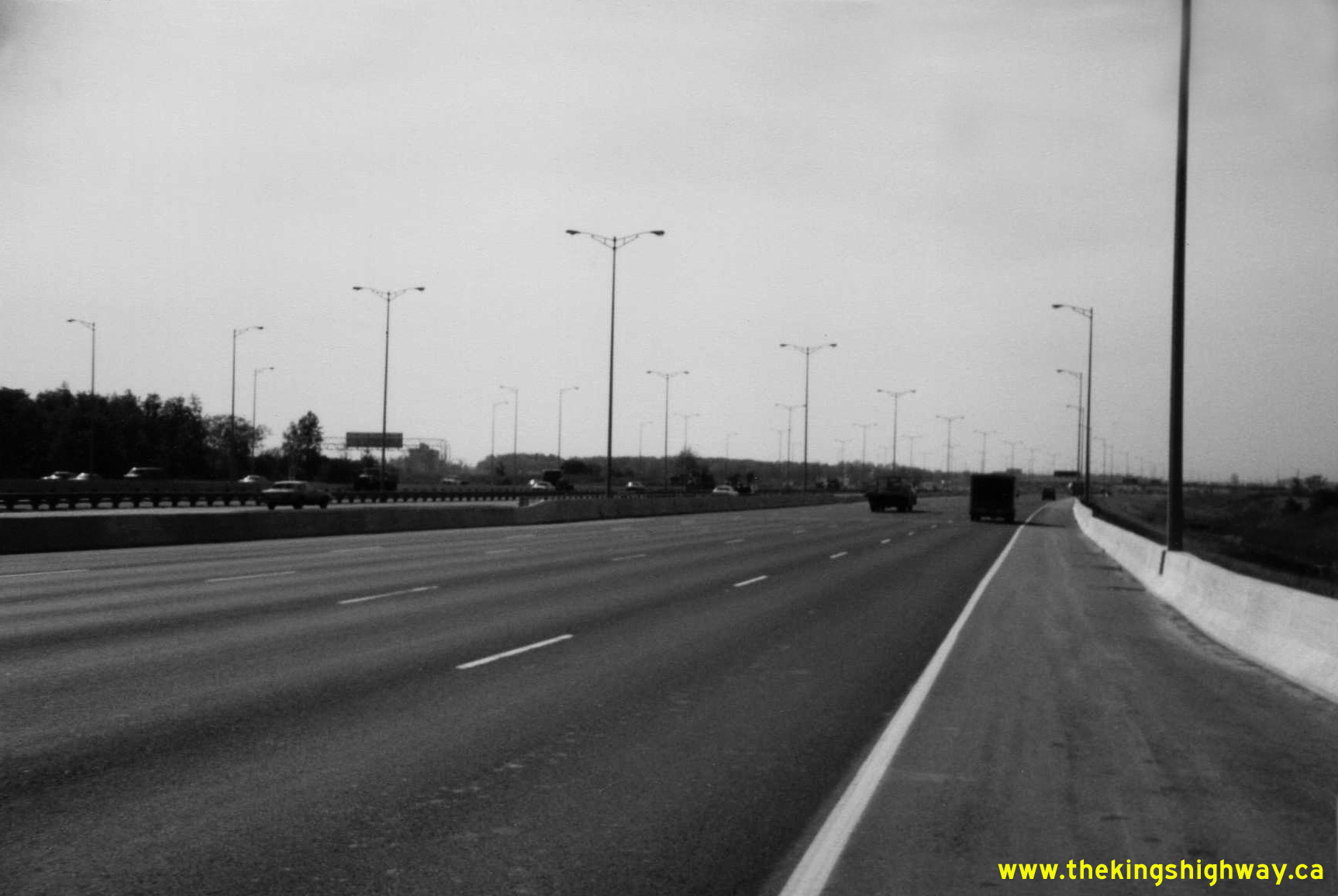
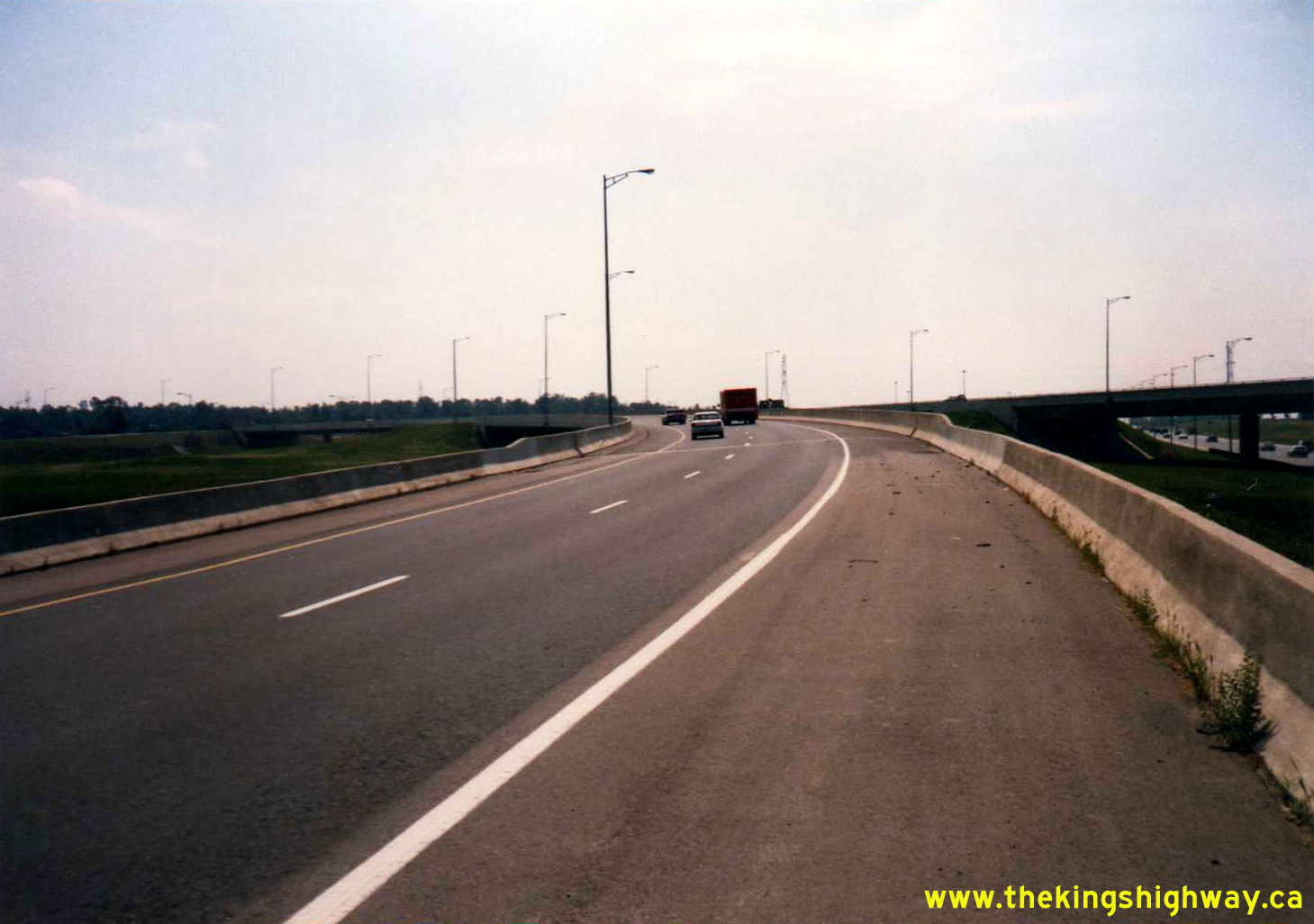
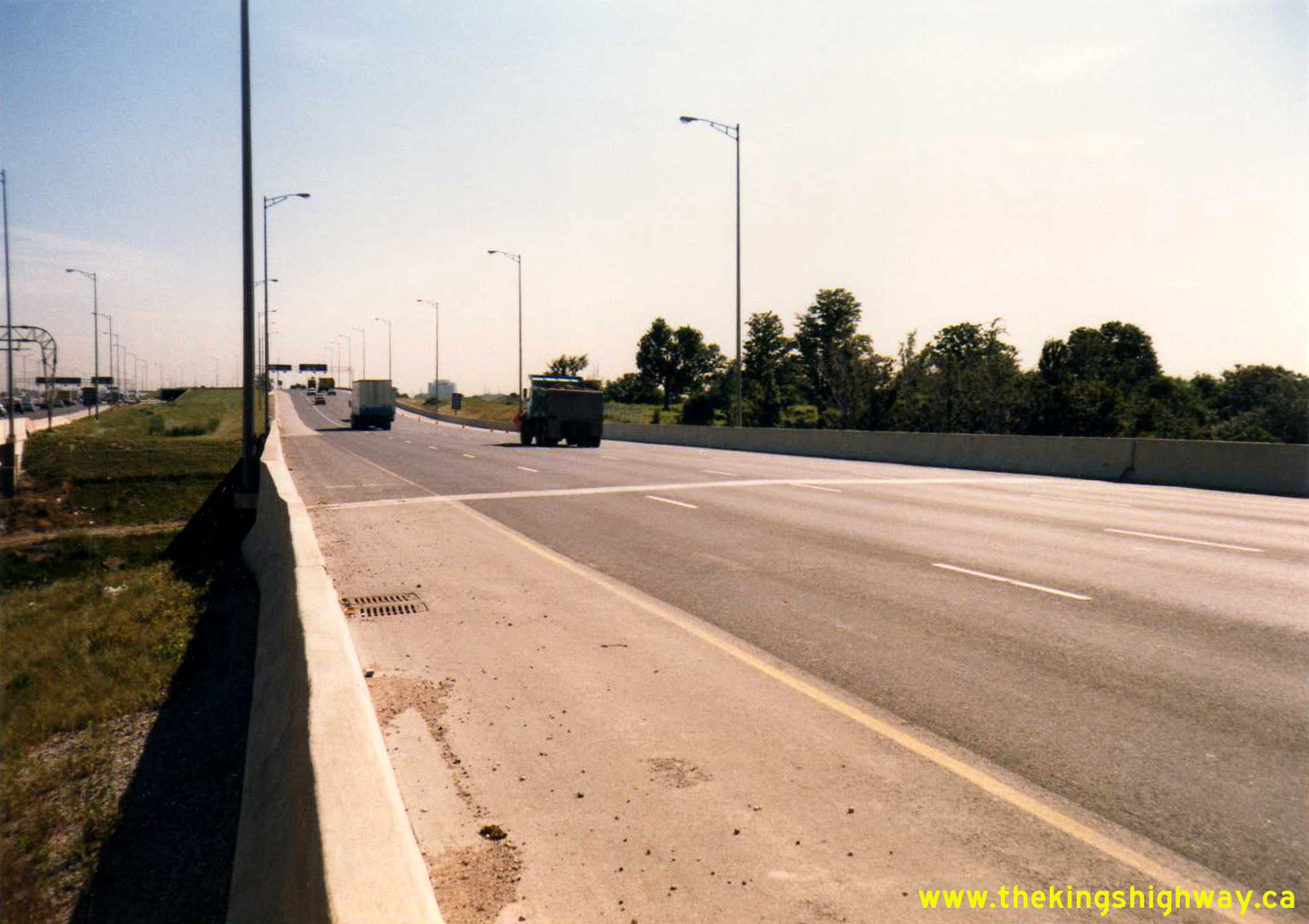
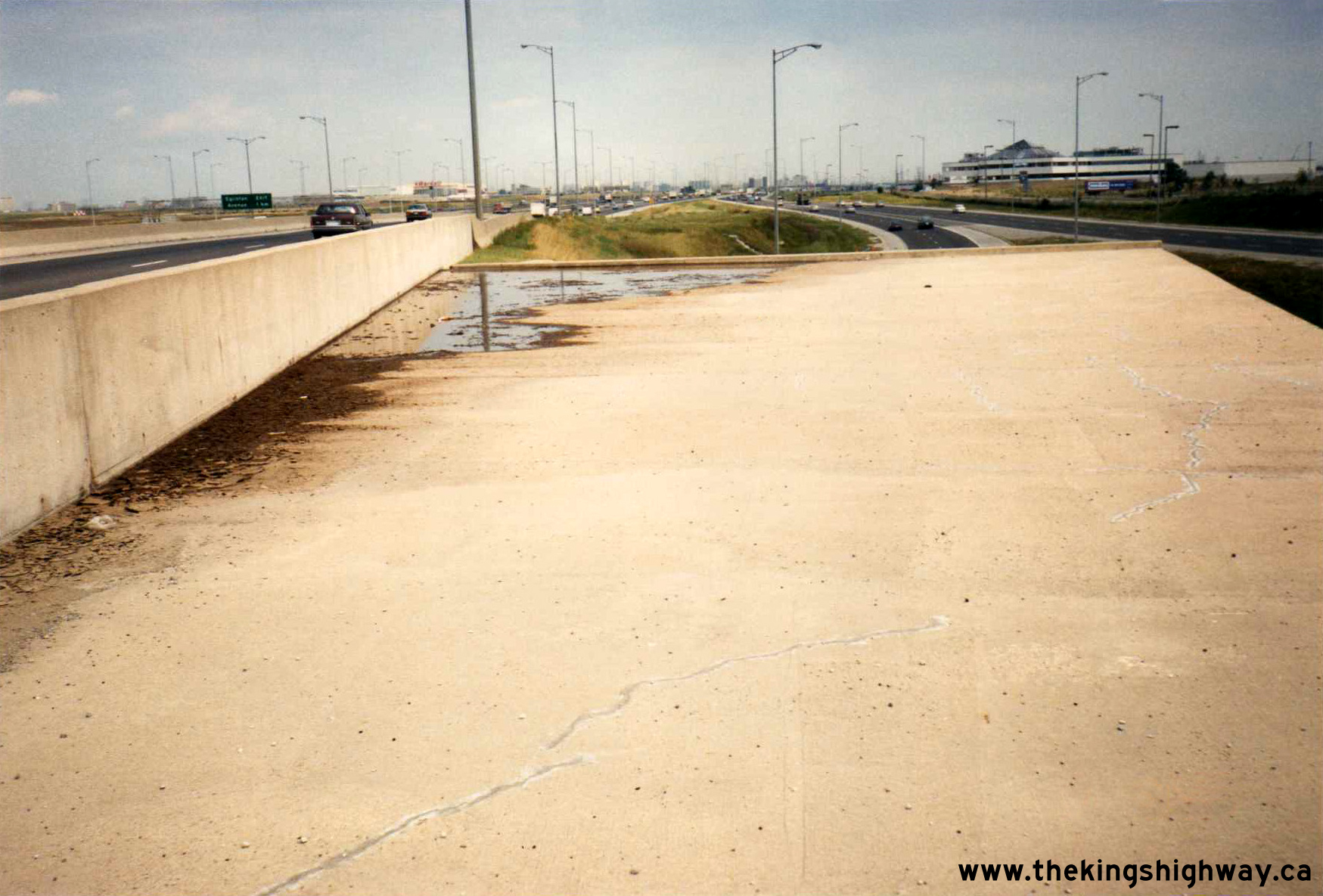
Left - Facing east across the top level of the new Airport Basketweave structure on eastbound Hwy 401 in 1985. While the top level photos of this structure are
unfortunately out-of-focus, they show preparation for a traffic stage which was only in place for about two months during the Summer of 1985. Note that this structure
was designed to accommodate three lanes of traffic temporarily during one of the construction stages. All Hwy 401 traffic had to be diverted into the newly-built
Collector Lanes east of Dixie Road for a brief period in order to construct the tie-ins with the Hwy 401 Express Lanes at Dixie Road. The existing Hwy 401 Express
Lanes were then temporarily closed, with all Hwy 401 traffic detoured over the top level of the Airport Basketweave. Once construction of the tie-ins for the Hwy 401
Express Lanes were completed, the overpass was re-striped to allow two lanes of traffic only on the top level. See an
Enlarged Photo Here. Photo taken on June 13, 1985. (Photo courtesy of Ontario Ministry of Transportation - © King's Printer for Ontario, 2011) Right - Facing west across the new Airport Basketweave structure on eastbound Hwy 401 in Mississauga, just prior to opening. See an Enlarged Photo Here. Photo taken on June 13, 1985. (Photo courtesy of Ontario Ministry of Transportation - © King's Printer for Ontario, 2011) 
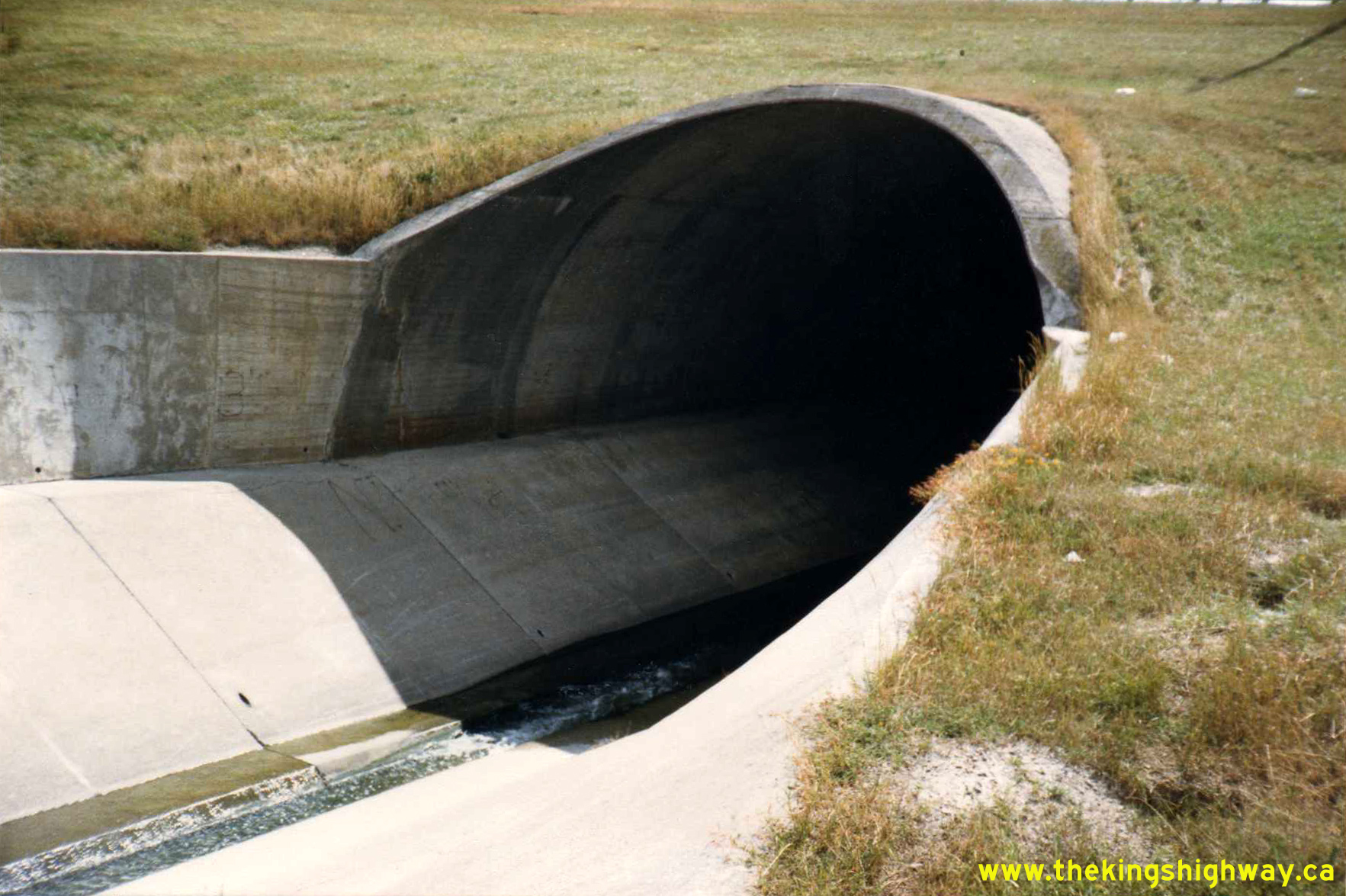
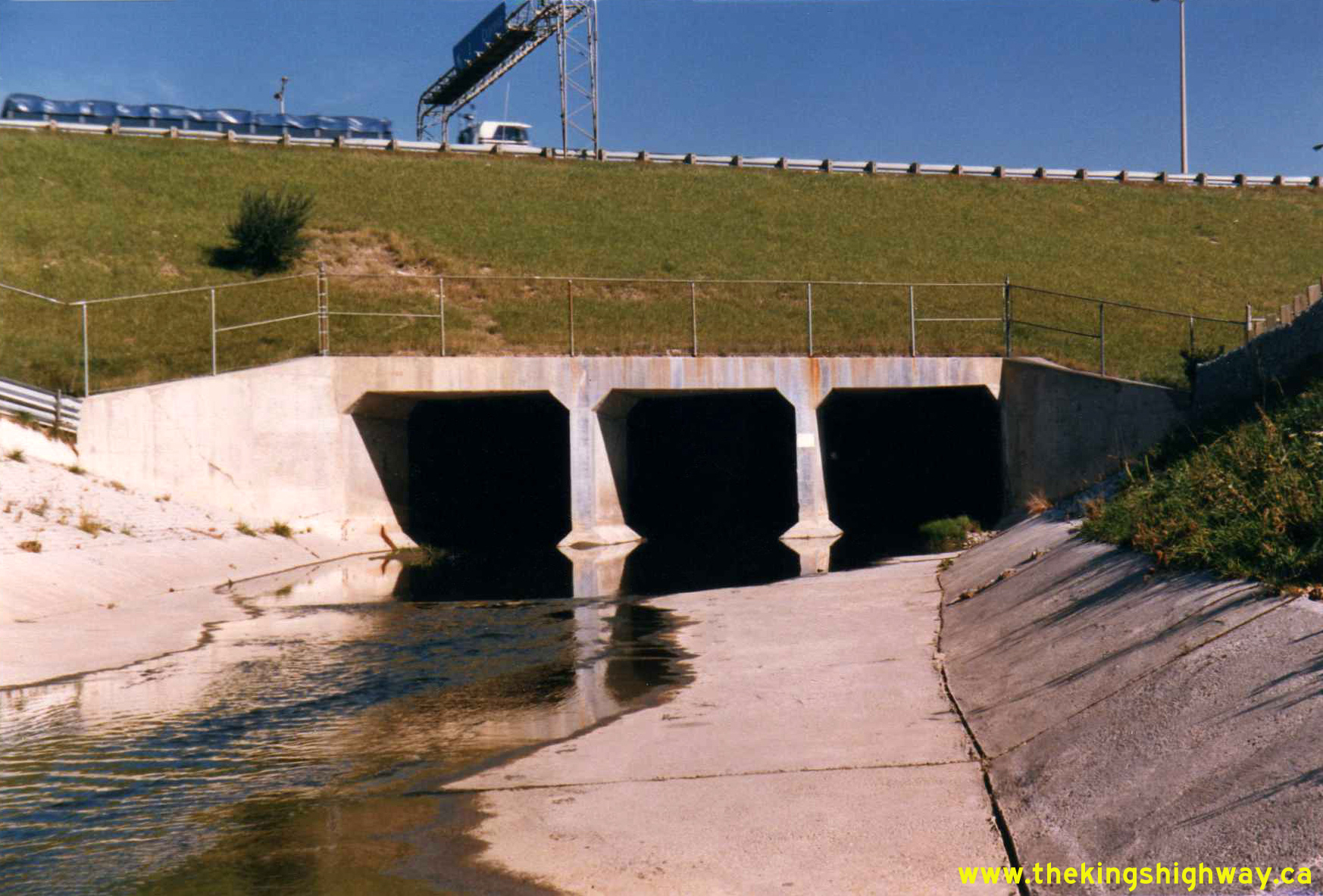
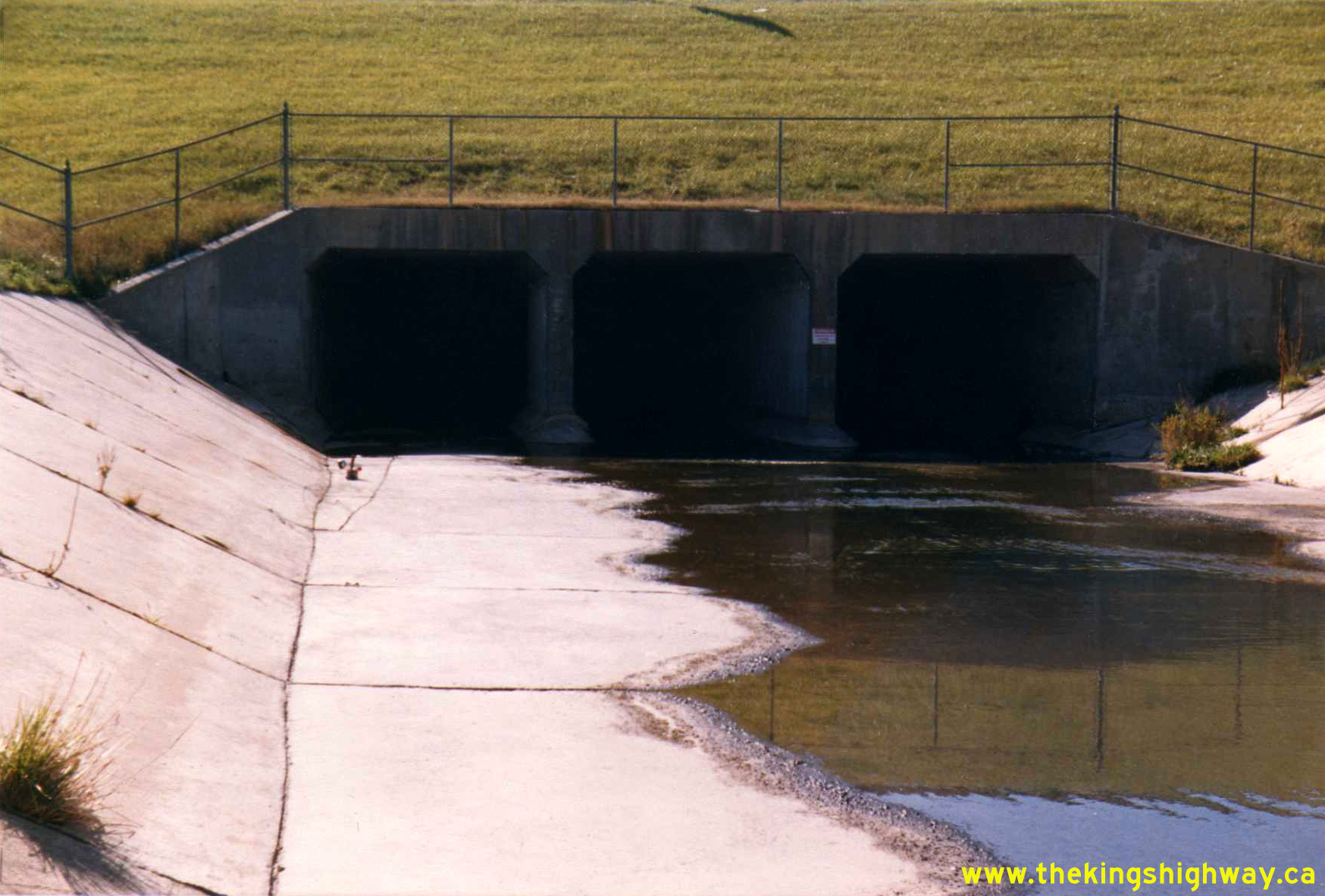
  Left - View of the northern end of the Mimico Creek Culvert (Site #37-824/C) below Hwy 401 just east of the Hwy 427 Interchange. See an
Enlarged Photo Here. Photo taken on August 21, 1985. Left - View of the northern end of the Mimico Creek Culvert (Site #37-824/C) below Hwy 401 just east of the Hwy 427 Interchange. See an
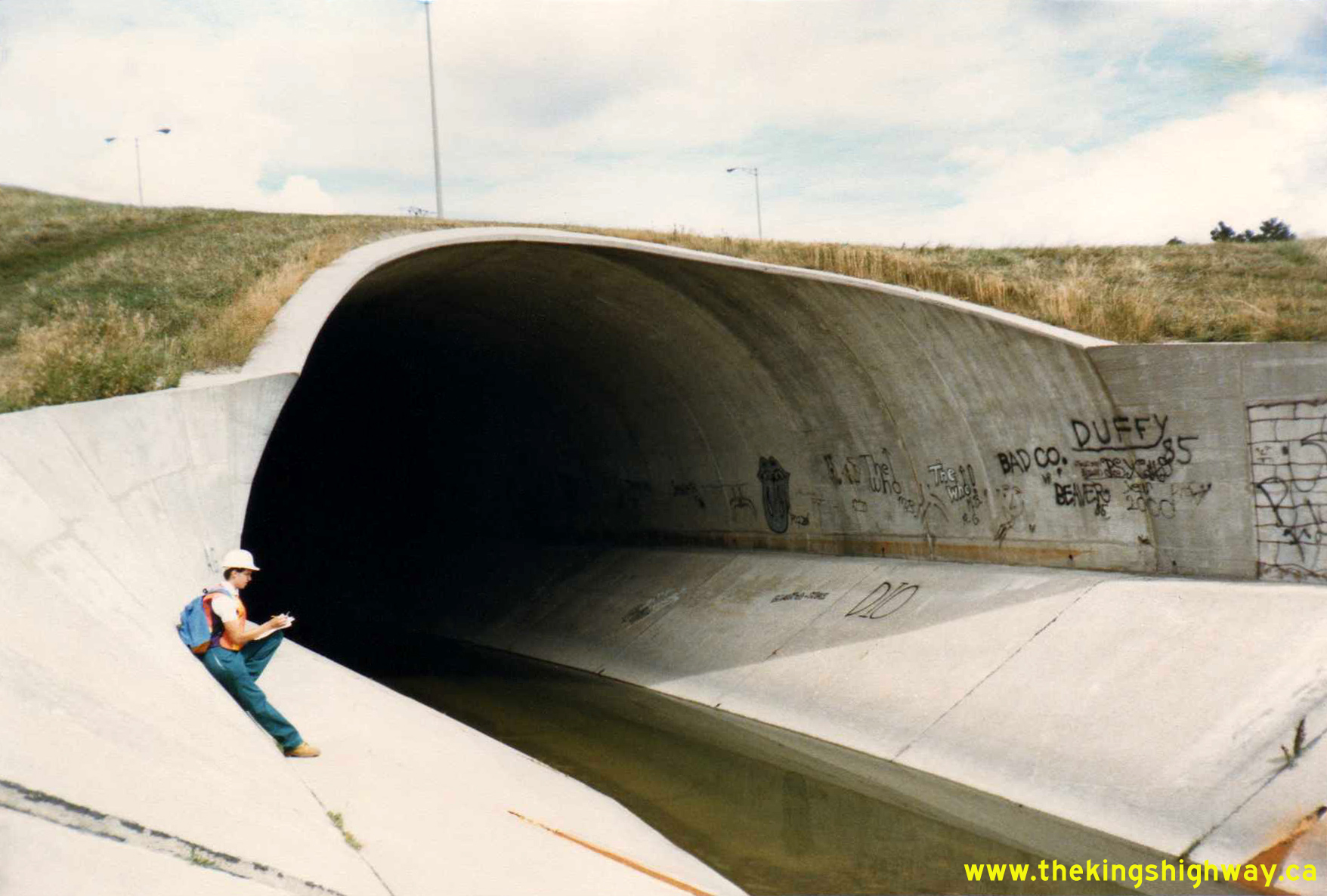
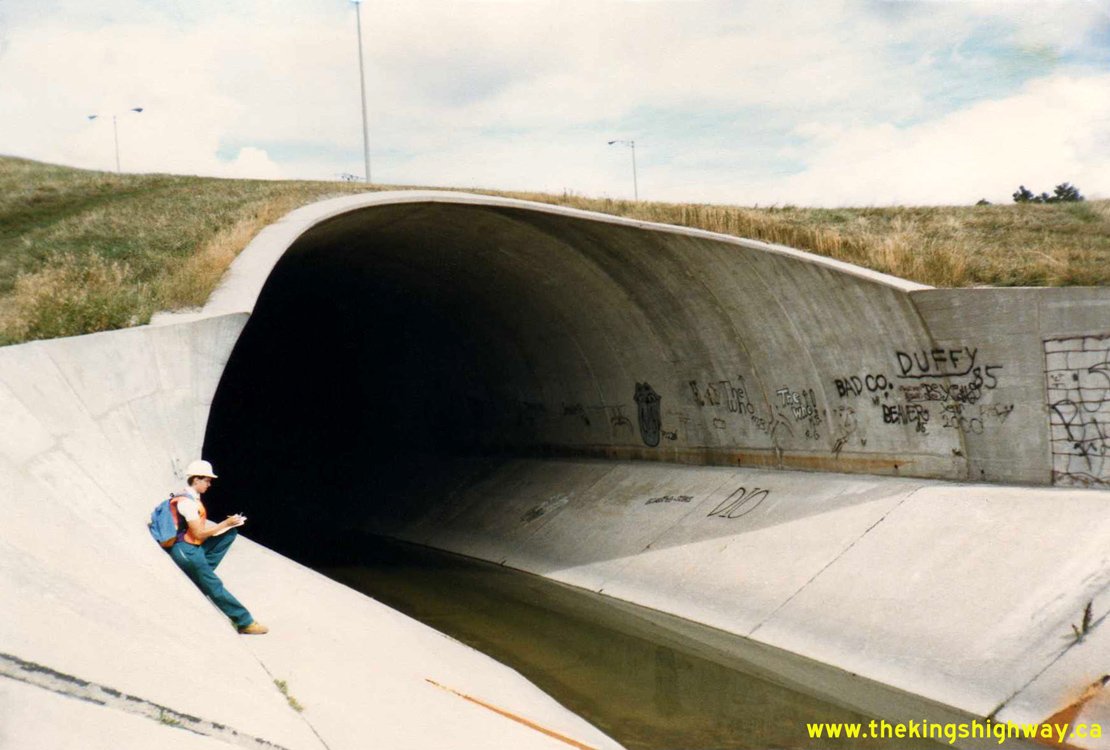
Enlarged Photo Here. Photo taken on August 21, 1985.(Photo courtesy of Ontario Ministry of Transportation - © King's Printer for Ontario, 2025) Right - An engineer with the Ministry of Transportation and Communications inspects the Mimico Creek Arch Culvert below Hwy 401. This view of the southern end
of the arch culvert gives some sense of scale as to the culvert's size. Even the 1980s-era graffiti on the drainage channel walls seems nostalgic now! See an
Enlarged Photo Here. Photo taken on August 21, 1985.(Photo courtesy of Ontario Ministry of Transportation - © King's Printer for Ontario, 2025) 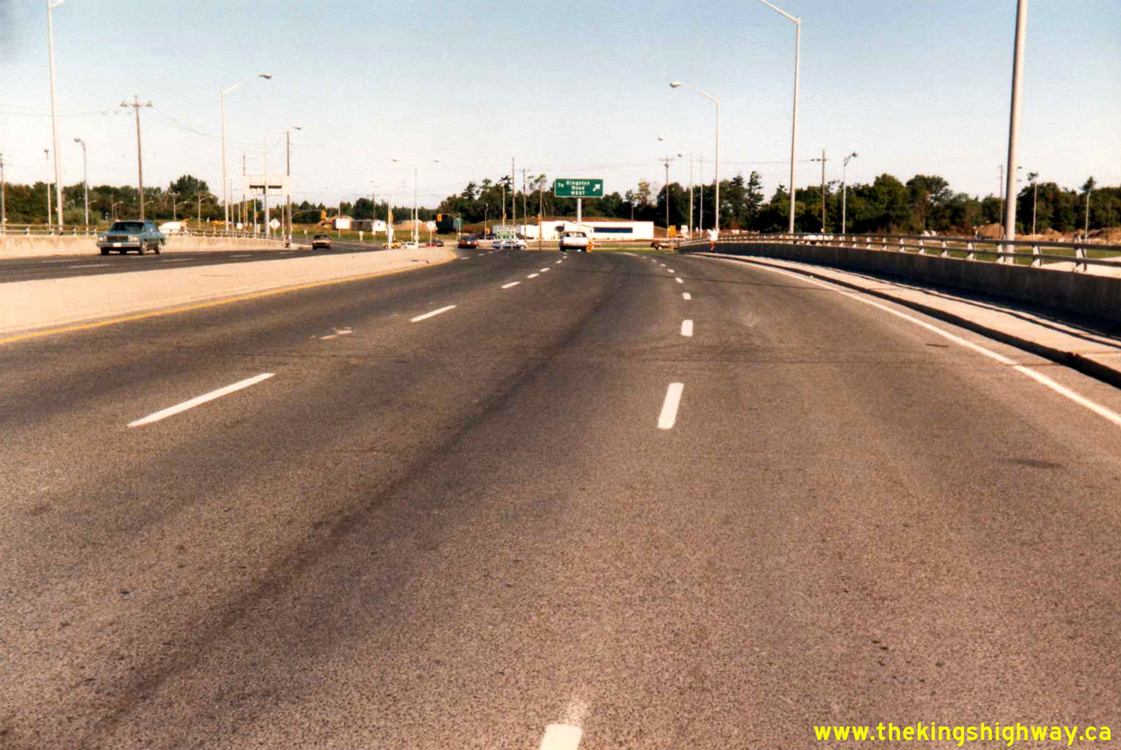
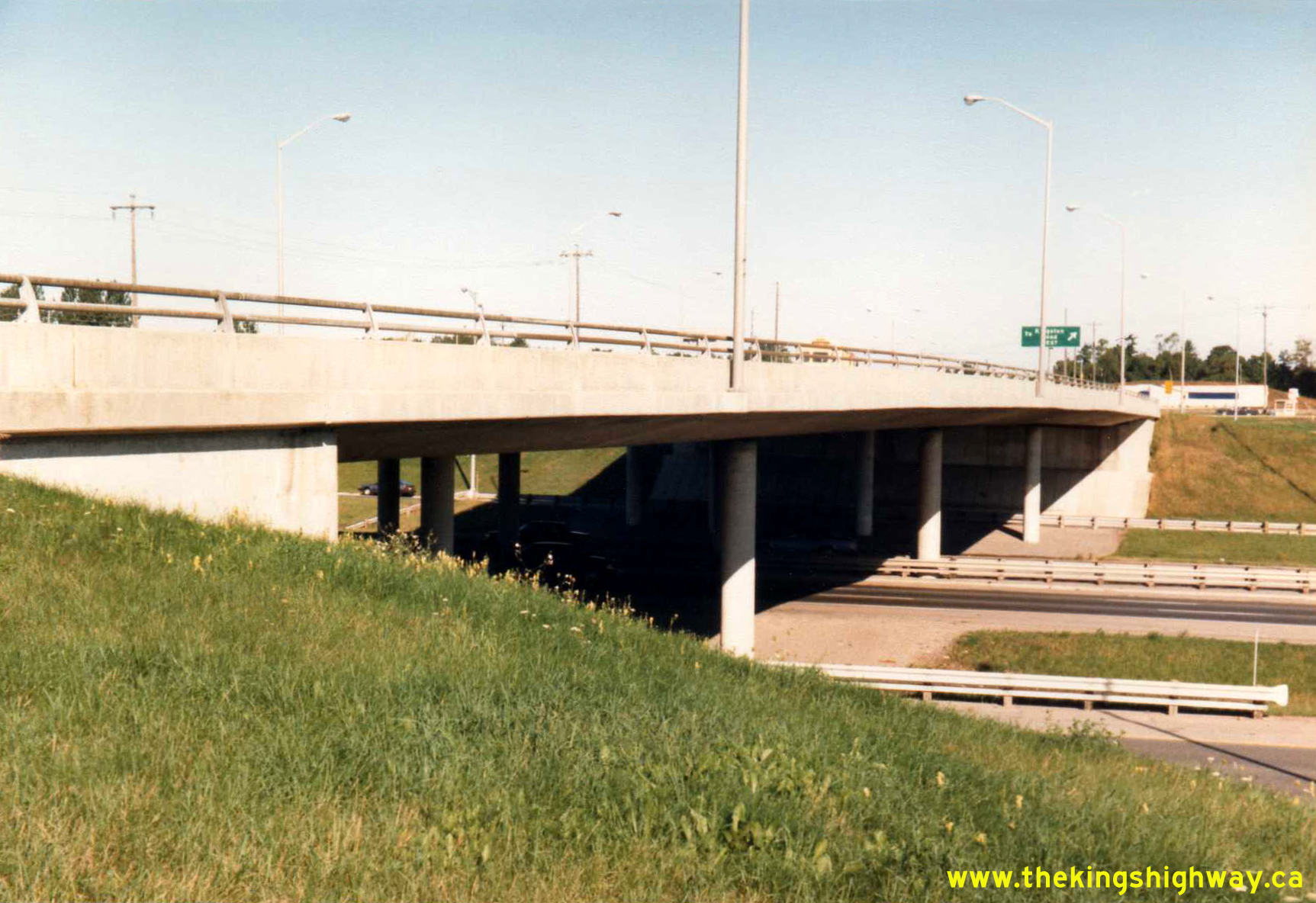
 Left - Facing north across the Port Union Road Overpass on Hwy 401 & Hwy 2A towards Hwy 2 (Kingston Road) in Toronto. Note that the entrance ramp in the
background was merely signed as "To Kingston Road West" rather than an indication that motorists were actually entering onto Hwy 2A. The short route of Hwy 2A only
extended westerly to the next interchange, where the highway tied back into Kingston Road (Hwy 2). Once the westbound Hwy 401 Collector Lanes were built in the 1990s,
a new on-ramp was provided to allow Port Union Road traffic to also access westbound Hwy 401 directly. See an
Enlarged Photo Here. Photo taken on September 11, 1985. Left - Facing north across the Port Union Road Overpass on Hwy 401 & Hwy 2A towards Hwy 2 (Kingston Road) in Toronto. Note that the entrance ramp in the
background was merely signed as "To Kingston Road West" rather than an indication that motorists were actually entering onto Hwy 2A. The short route of Hwy 2A only
extended westerly to the next interchange, where the highway tied back into Kingston Road (Hwy 2). Once the westbound Hwy 401 Collector Lanes were built in the 1990s,
a new on-ramp was provided to allow Port Union Road traffic to also access westbound Hwy 401 directly. See an
Enlarged Photo Here. Photo taken on September 11, 1985.(Photo courtesy of Ontario Ministry of Transportation - © King's Printer for Ontario, 2025) Right - Eastern side of the Port Union Road Overpass (Site #37-228) in Toronto. This new six-lane overpass was constructed under Contract #1971-06 and was
designed to accommodate a widened Hwy 401 below. This new bridge and interchange replaced the old Lansing Road Cloverleaf, which was constructed under Contract
#1946-68 along the Toronto-Oshawa Dual Highway (Hwy 401). This 1940s-era cloverleaf was dogged with various operational problems in the years after it was finished in
1947, due partly to the decision to tie in the eastern end of the Toronto Bypass into the Toronto-Oshawa Highway immediately west of the cloverleaf. With the need to
widen the Toronto Bypass by the early 1970s, a decision was made to completely remove the old Lansing Road Cloverleaf and replace it with a modern interchange. See an
Enlarged Photo Here. Photo taken on September 11, 1985.(Photo courtesy of Ontario Ministry of Transportation - © King's Printer for Ontario, 2025) 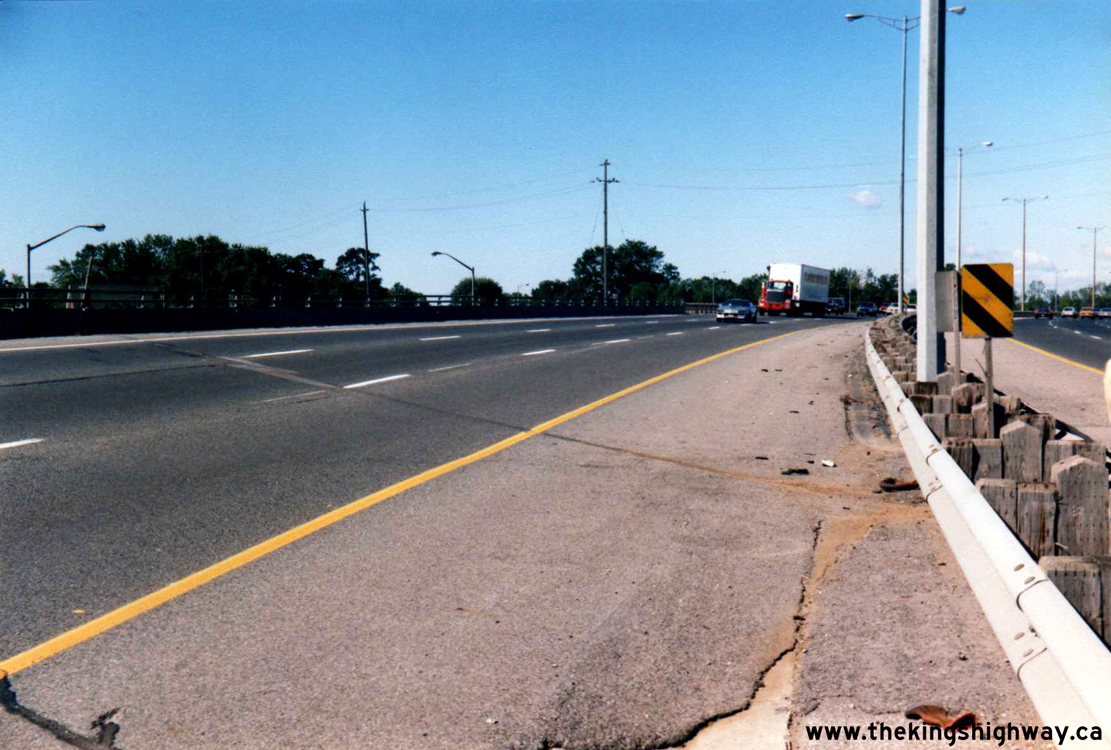
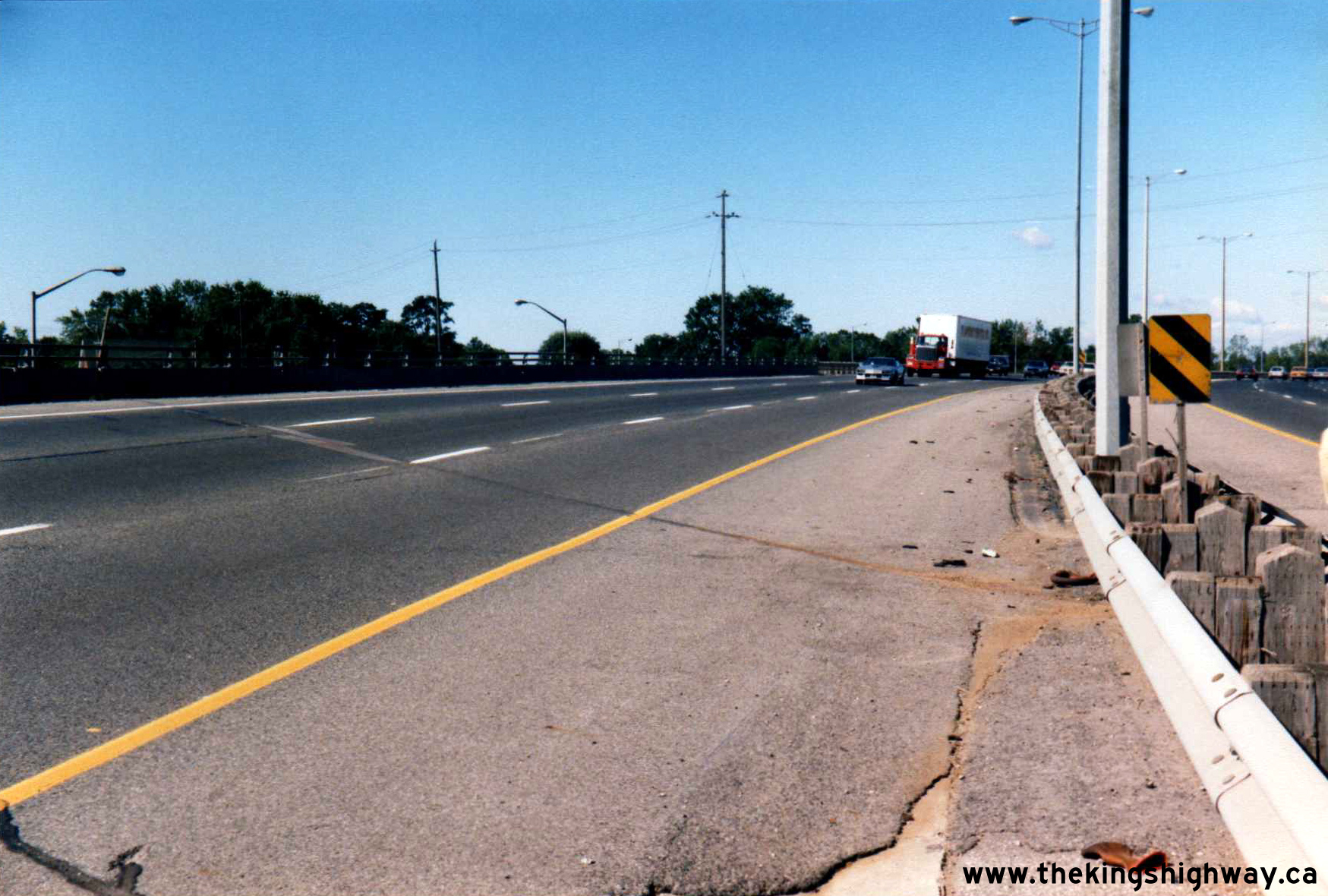
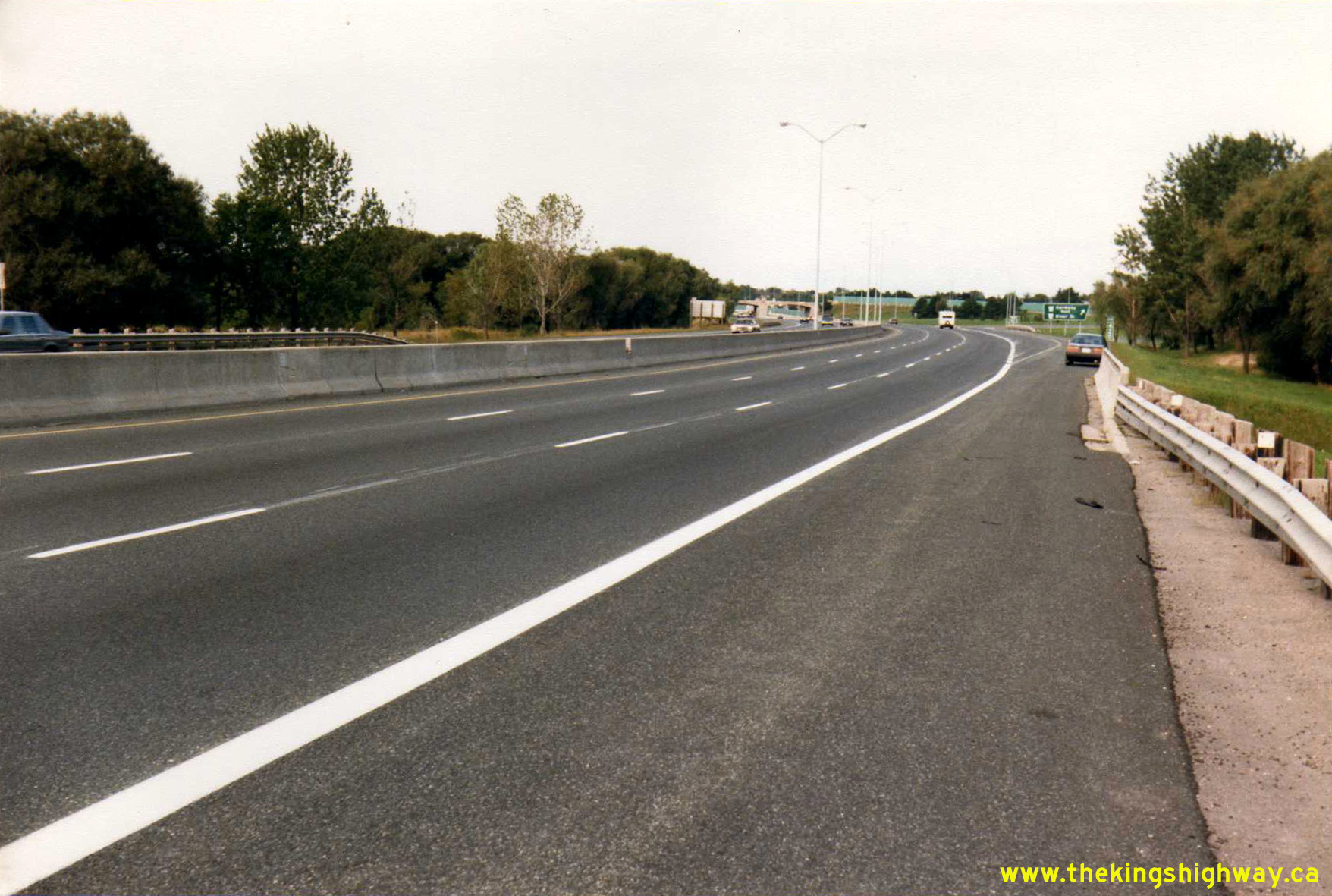
 Left - View of the eastbound lanes of Hwy 401 in Toronto, facing west towards Meadowvale Road from the Hwy 2 (Kingston Road) Underpass. See an
Enlarged Photo Here. Photo taken on September 11, 1985. Left - View of the eastbound lanes of Hwy 401 in Toronto, facing west towards Meadowvale Road from the Hwy 2 (Kingston Road) Underpass. See an
Enlarged Photo Here. Photo taken on September 11, 1985.(Photo courtesy of Ontario Ministry of Transportation - © King's Printer for Ontario, 2025) Right - Southern side of the Hwy 2 (Kingston Road) Underpass (Site #37-902) in Toronto. A new four-lane underpass was constructed for Hwy 2 below Hwy 401 in
the early 1970s, under Contract #1971-06. This new structure replaced an older two-lane underpass for Hwy 2 built underneath the original Toronto Bypass (Hwy 401) in
1954, under Contract #1954-40. See an Enlarged Photo Here. Photo taken on September 11,
1985.(Photo courtesy of Ontario Ministry of Transportation - © King's Printer for Ontario, 2025) 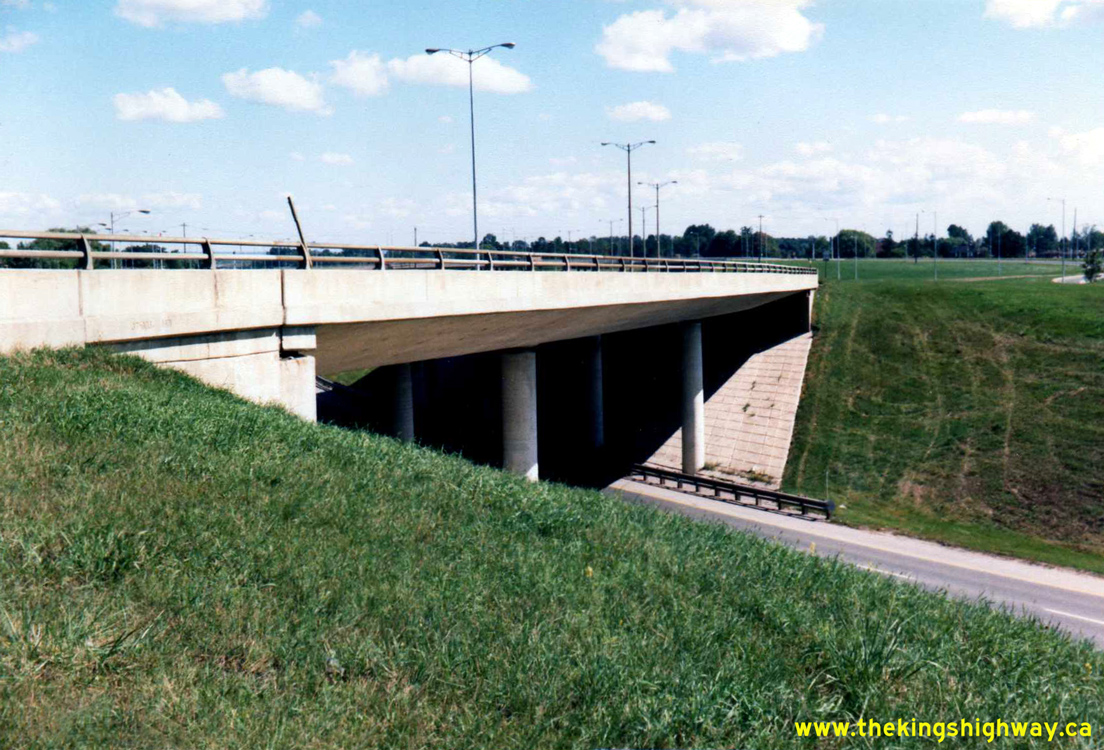
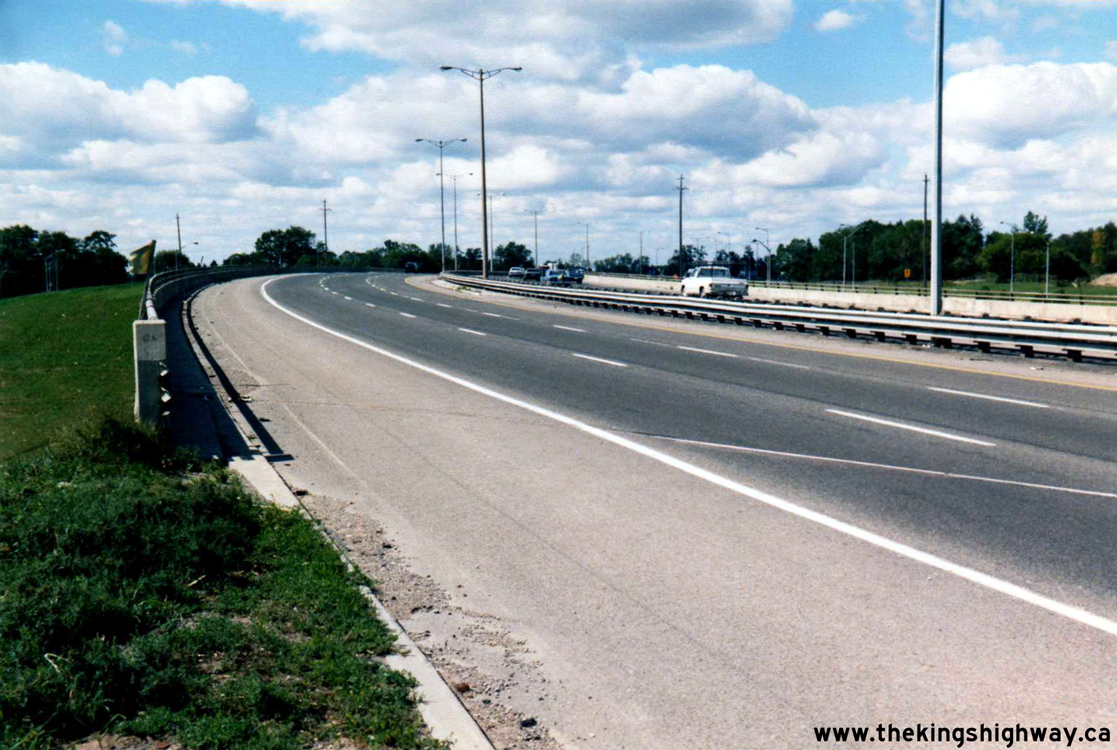 Left - Southern side of the Hwy 2A Underpass (Site #37-903) in Toronto. This structure accommodated the westbound Hwy 401 exit ramp to westbound Hwy 2A. Like
the adjacent Hwy 2 Underpass located a short distance to the north, this was a newer structure built in the early 1970s as part of the reconstruction and widening of
Hwy 401 through the Hwy 2, Hwy 2A and Port Union Road Interchanges under Contract #1971-06. See an
Enlarged Photo Here. Photo taken on September 11, 1985. Left - Southern side of the Hwy 2A Underpass (Site #37-903) in Toronto. This structure accommodated the westbound Hwy 401 exit ramp to westbound Hwy 2A. Like
the adjacent Hwy 2 Underpass located a short distance to the north, this was a newer structure built in the early 1970s as part of the reconstruction and widening of
Hwy 401 through the Hwy 2, Hwy 2A and Port Union Road Interchanges under Contract #1971-06. See an
Enlarged Photo Here. Photo taken on September 11, 1985.(Photo courtesy of Ontario Ministry of Transportation - © King's Printer for Ontario, 2025) Right - Facing west along the eastbound lanes of Hwy 401 from the Hwy 2A Interchange in Toronto. This great photo shows a lightly-travelled six-lane Hwy 401,
before the Hwy 401 Collector Lanes were built through this area in the 1990s. Interestingly, this section of Hwy 401 was built with a steel beam guide rail median
barrier system when the highway was widened in the early 1970s. The highway widening contracts on either side of this one employed the steel box-beam median barrier
system. See an Enlarged Photo Here. Photo taken on September 11, 1985.(Photo courtesy of Ontario Ministry of Transportation - © King's Printer for Ontario, 2025) 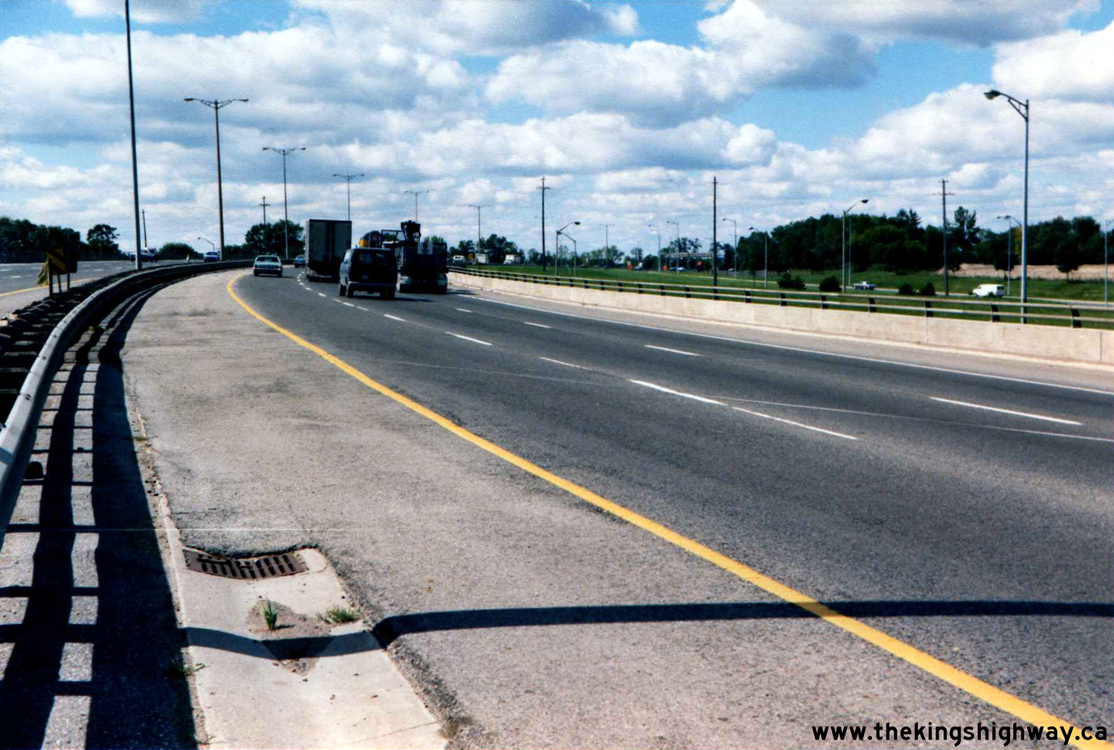
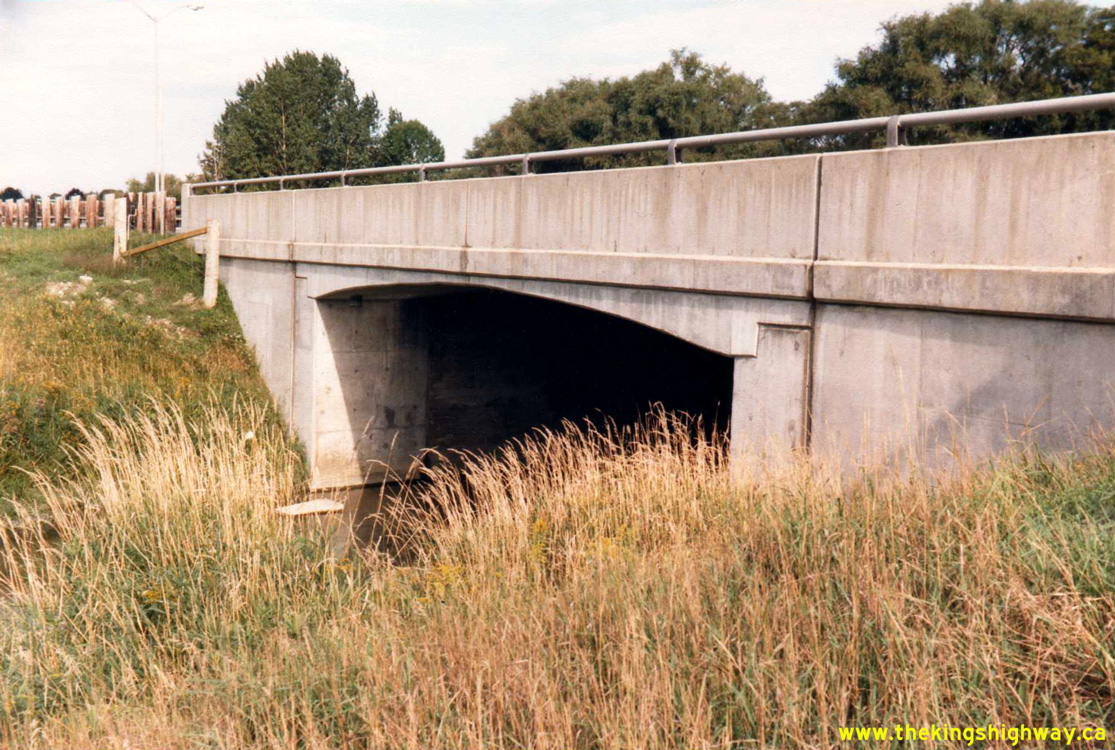 Left - View of the westbound lanes of Hwy 401 at the Hwy 2A Interchange in Toronto, facing west towards Hwy 2 and Meadowvale Road. When this section of Hwy 401
was widened from four to six lanes in 1971-1972, the median and inner portions of the highway were built out to its ultimate cross section. Enough space was left on
the external sides of the highway for the future construction of a Collector Lane System, which was eventually built in the 1990s. See an
Enlarged Photo Here. Photo taken on September 11, 1985. Left - View of the westbound lanes of Hwy 401 at the Hwy 2A Interchange in Toronto, facing west towards Hwy 2 and Meadowvale Road. When this section of Hwy 401
was widened from four to six lanes in 1971-1972, the median and inner portions of the highway were built out to its ultimate cross section. Enough space was left on
the external sides of the highway for the future construction of a Collector Lane System, which was eventually built in the 1990s. See an
Enlarged Photo Here. Photo taken on September 11, 1985.(Photo courtesy of Ontario Ministry of Transportation - © King's Printer for Ontario, 2025) Right - Southern side of the Farewell Creek Bridge (Site #22-183) on Hwy 401, located just east of the Bloor Street Interchange in Oshawa. This single-span
concrete rigid frame structure was originally constructed in 1951 as part of the extension of Hwy 401 easterly from Oshawa to a point just west of Newcastle. The
original structure was widened as part of a project to expand Hwy 401 from four to six lanes in the late 1970s, under Contract #1977-133. See an
Enlarged Photo Here. Photo taken on September 12, 1985.(Photo courtesy of Ontario Ministry of Transportation - © King's Printer for Ontario, 2025) 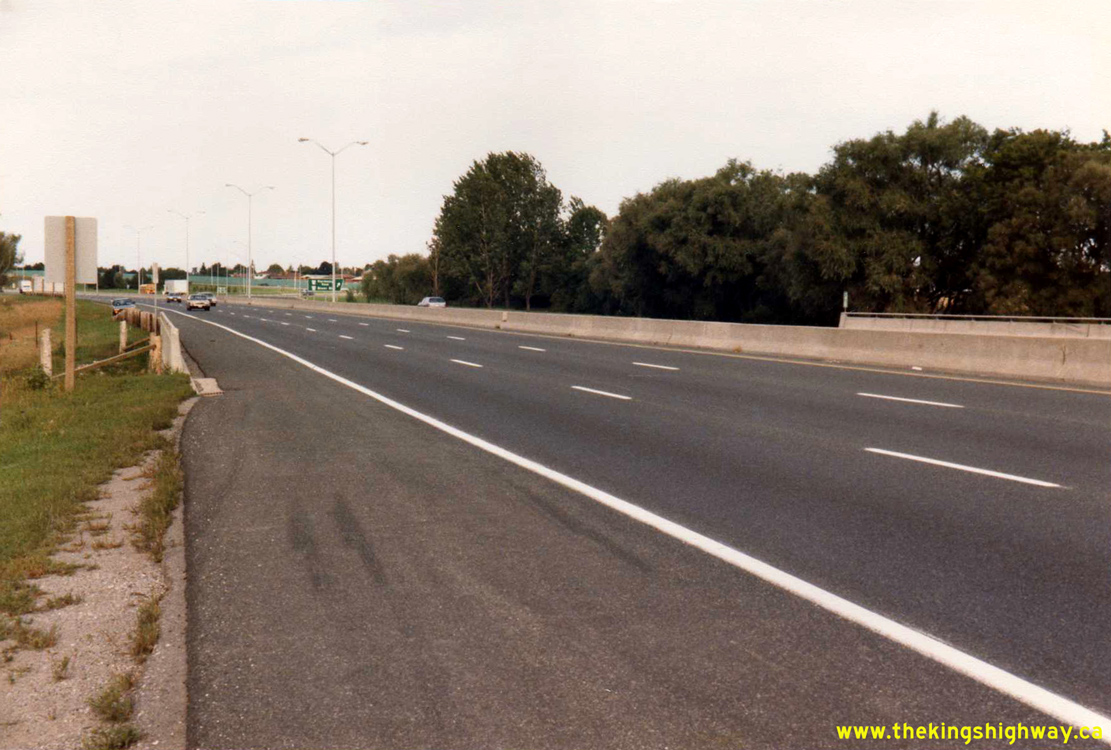
 Left - Facing west across the Farewell Creek Bridge on Hwy 401 in Oshawa towards the Bloor Street Interchange. See an
Enlarged Photo Here. Photo taken on September 12, 1985. Left - Facing west across the Farewell Creek Bridge on Hwy 401 in Oshawa towards the Bloor Street Interchange. See an
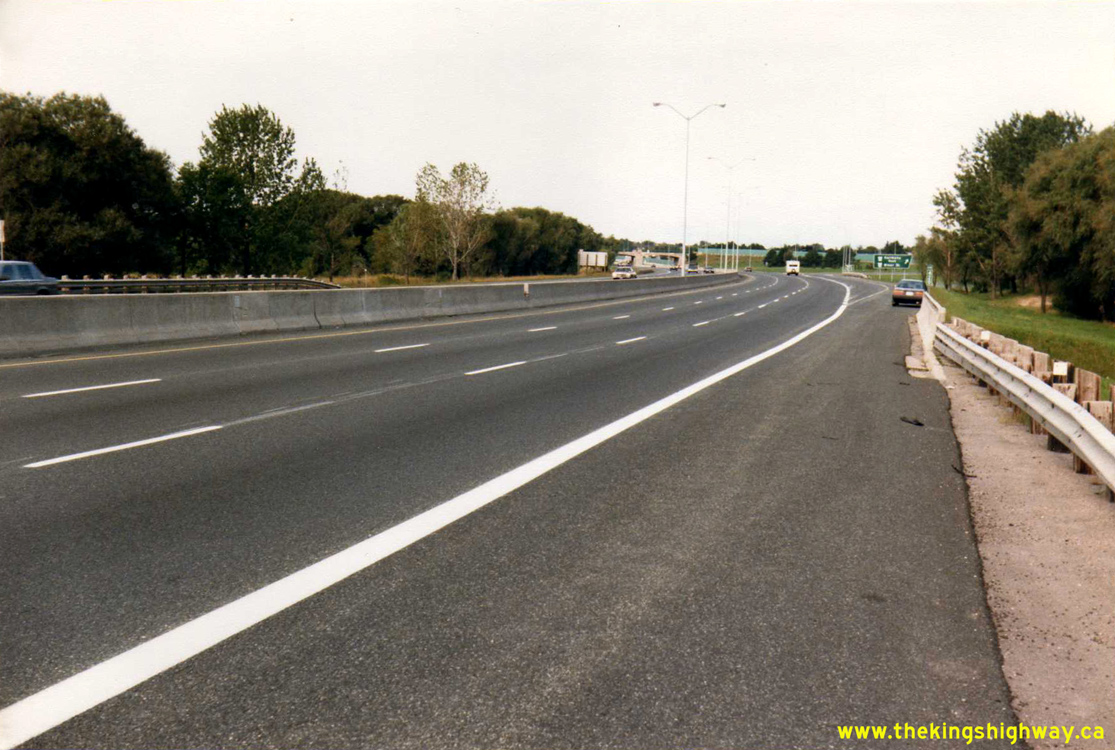
Enlarged Photo Here. Photo taken on September 12, 1985.(Photo courtesy of Ontario Ministry of Transportation - © King's Printer for Ontario, 2025) Right - View of the westbound lanes of Hwy 401 at the Farewell Creek Bridge, facing west towards the Bloor Street Interchange in Oshawa. Note the old "angled"
turn-off freeway exit guide sign for Bloor Street and Harmony Road in the background. These signs were used to mark turn-offs for freeway exit ramps up until the
early 1980s, when they were changed to a standard rectangular shape. See an
Enlarged Photo Here. Photo taken on September 12, 1985.(Photo courtesy of Ontario Ministry of Transportation - © King's Printer for Ontario, 2025) 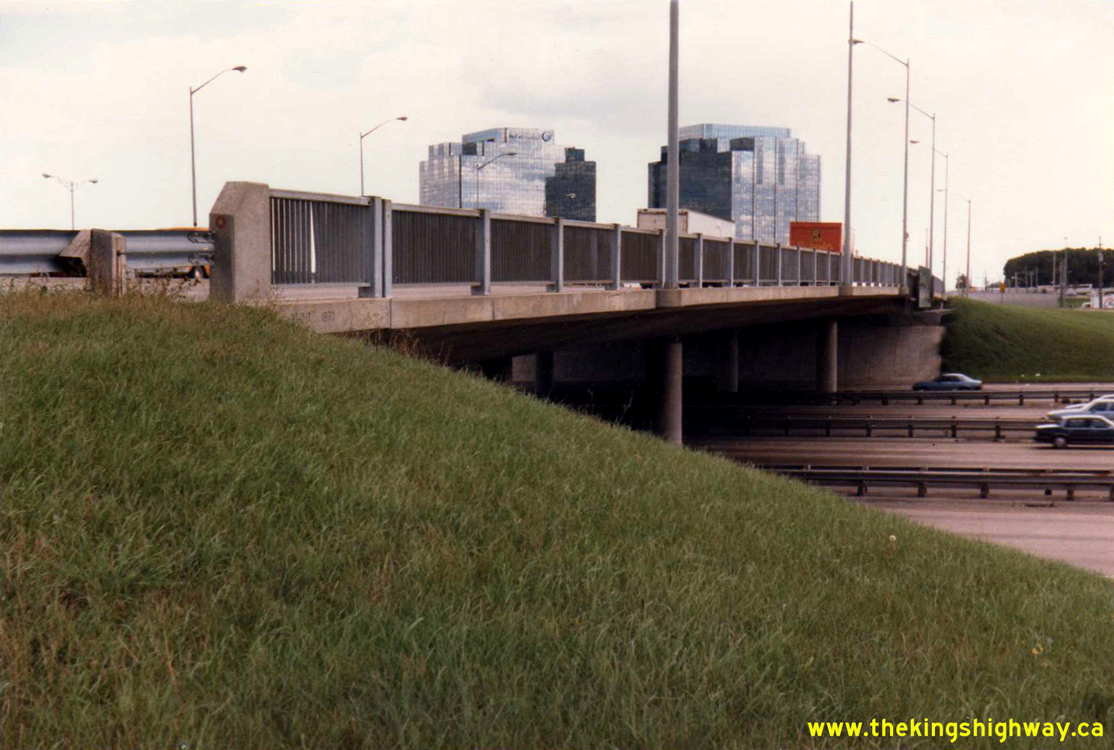
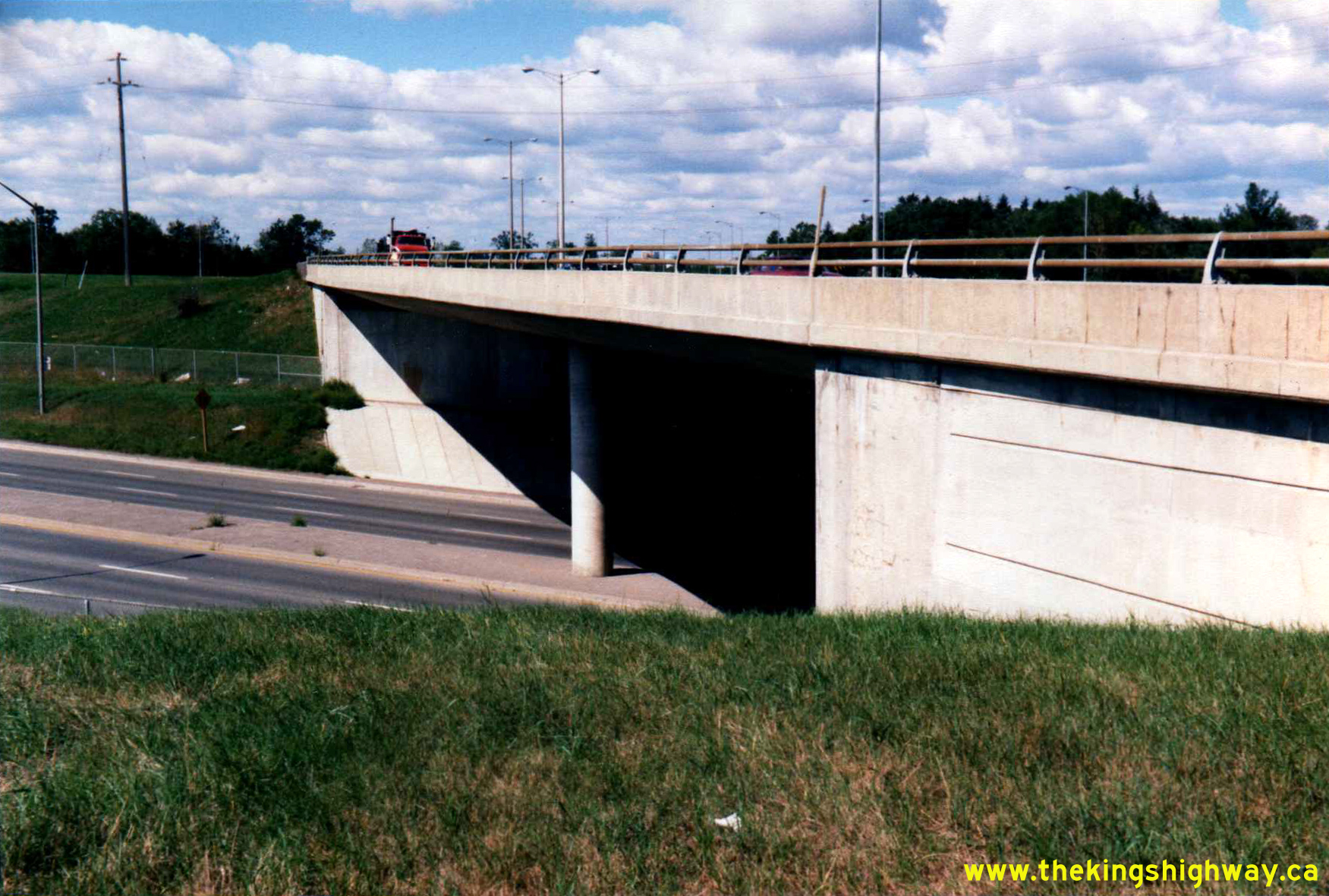
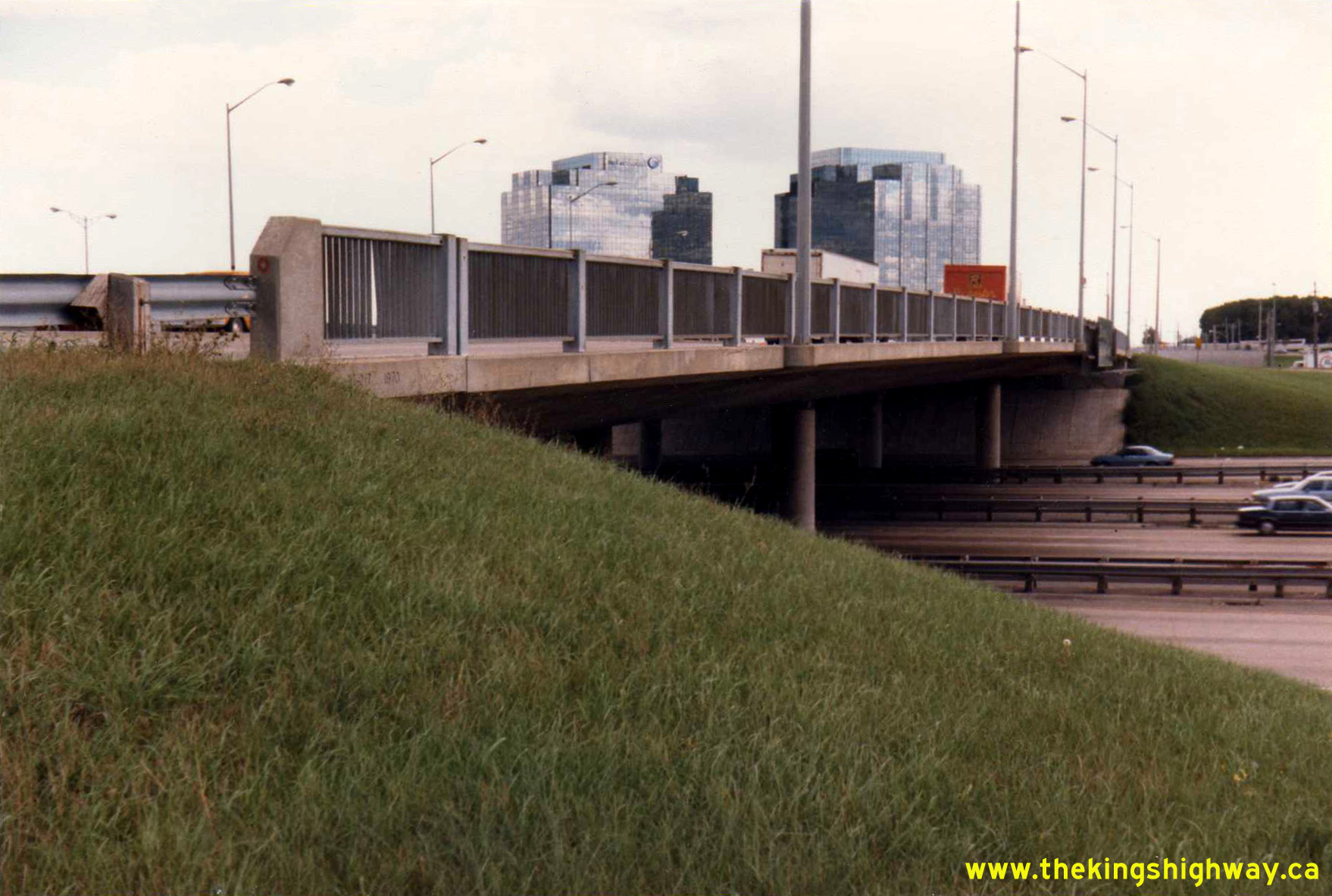
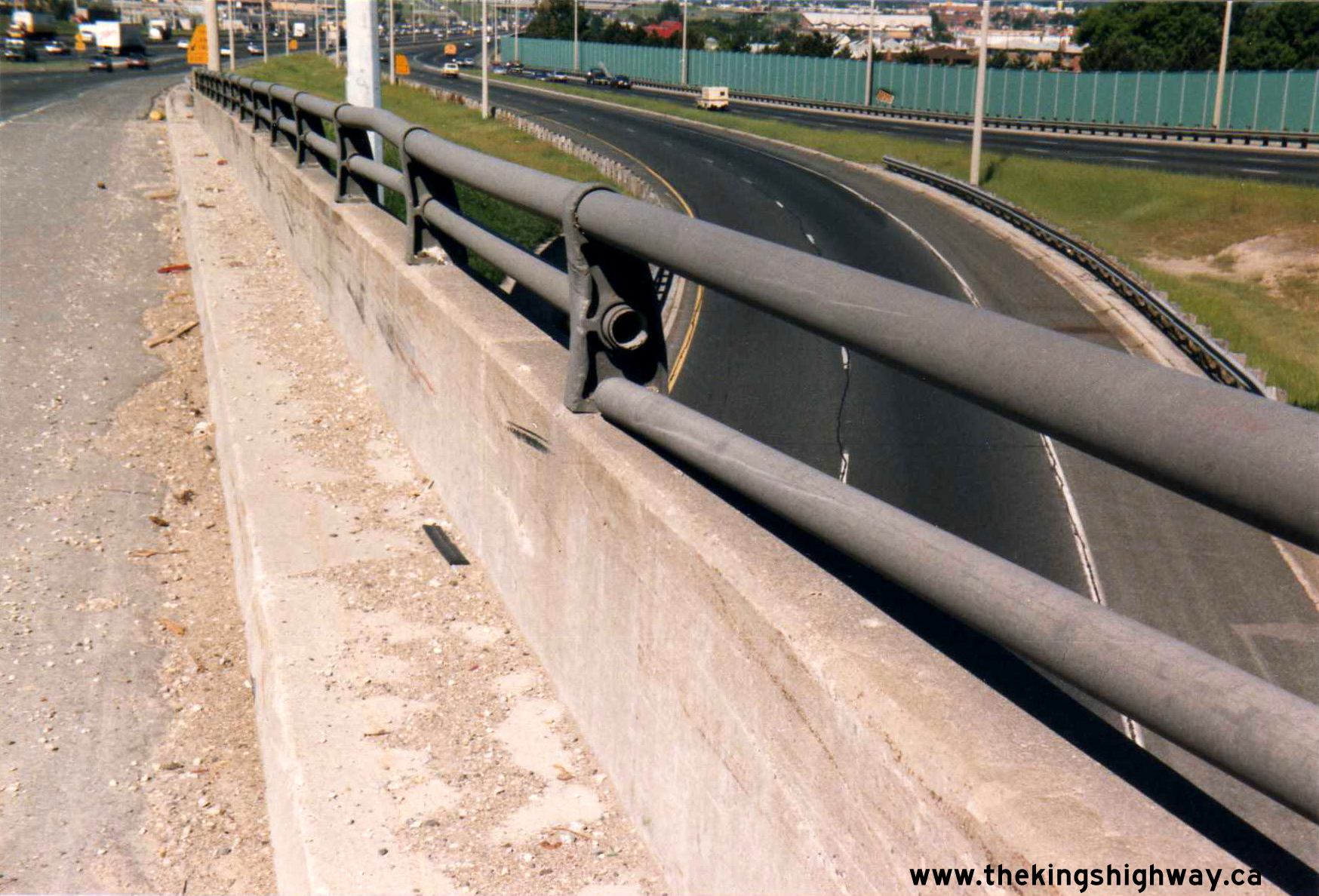
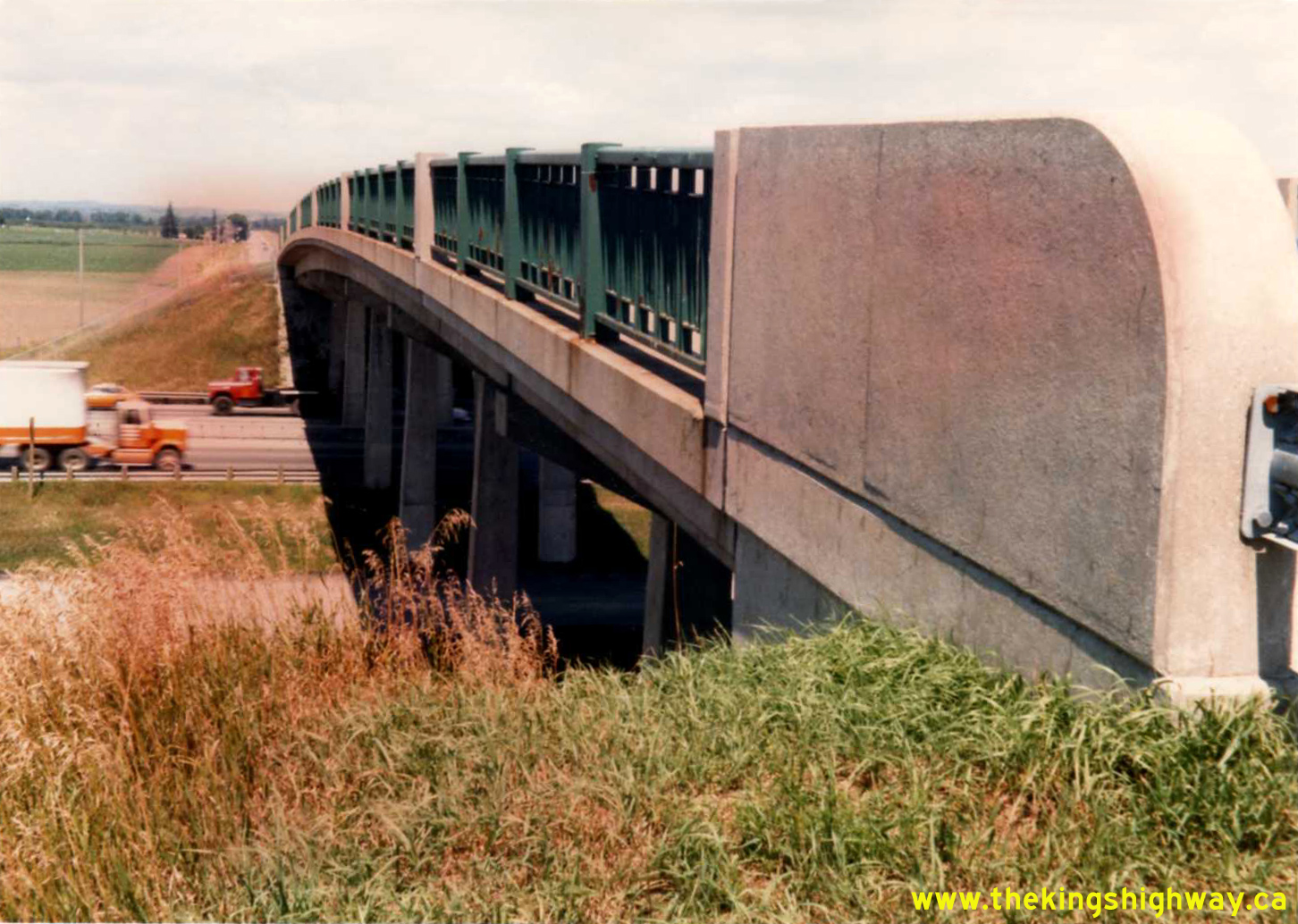
 Left - Western side of the McCowan Road Overpass (Site #37-217) on Hwy 401 in Toronto, facing south. Constructed under Contract #1970-15, the McCowan Road
Overpass was likely among the last provincial highway structures in Ontario to be constructed with this type of handrail. These galvanized steel handrail panels were
introduced in the mid-1960s and were a slightly different design than the standard Department of Highways of Ontario (DHO) steel handrail panels used previously.
These panels were only used for a few years in the late 1960s, before they were discontinued around 1970. See an
Enlarged Photo Here. Photo taken on September 13, 1985. Left - Western side of the McCowan Road Overpass (Site #37-217) on Hwy 401 in Toronto, facing south. Constructed under Contract #1970-15, the McCowan Road
Overpass was likely among the last provincial highway structures in Ontario to be constructed with this type of handrail. These galvanized steel handrail panels were
introduced in the mid-1960s and were a slightly different design than the standard Department of Highways of Ontario (DHO) steel handrail panels used previously.
These panels were only used for a few years in the late 1960s, before they were discontinued around 1970. See an
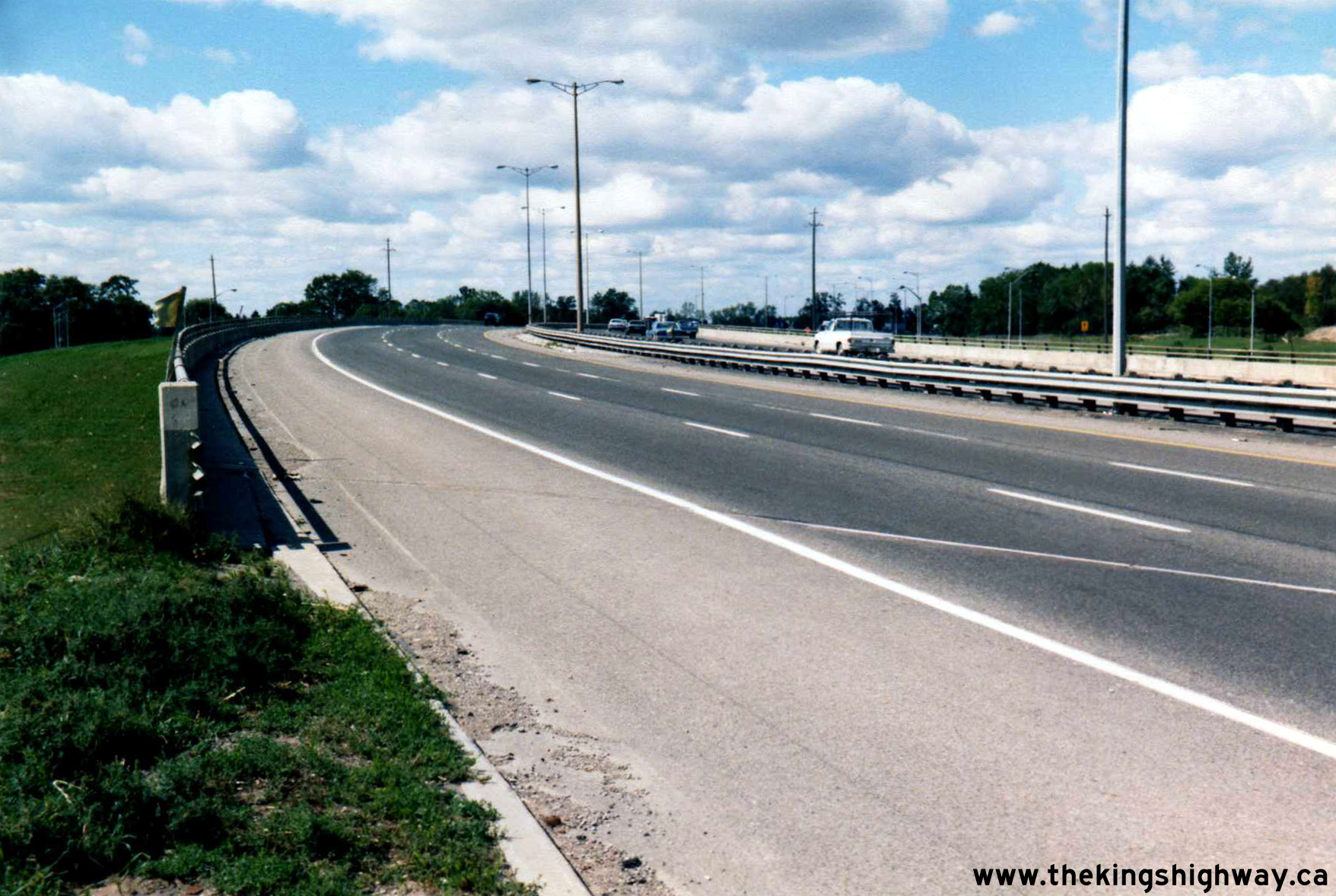
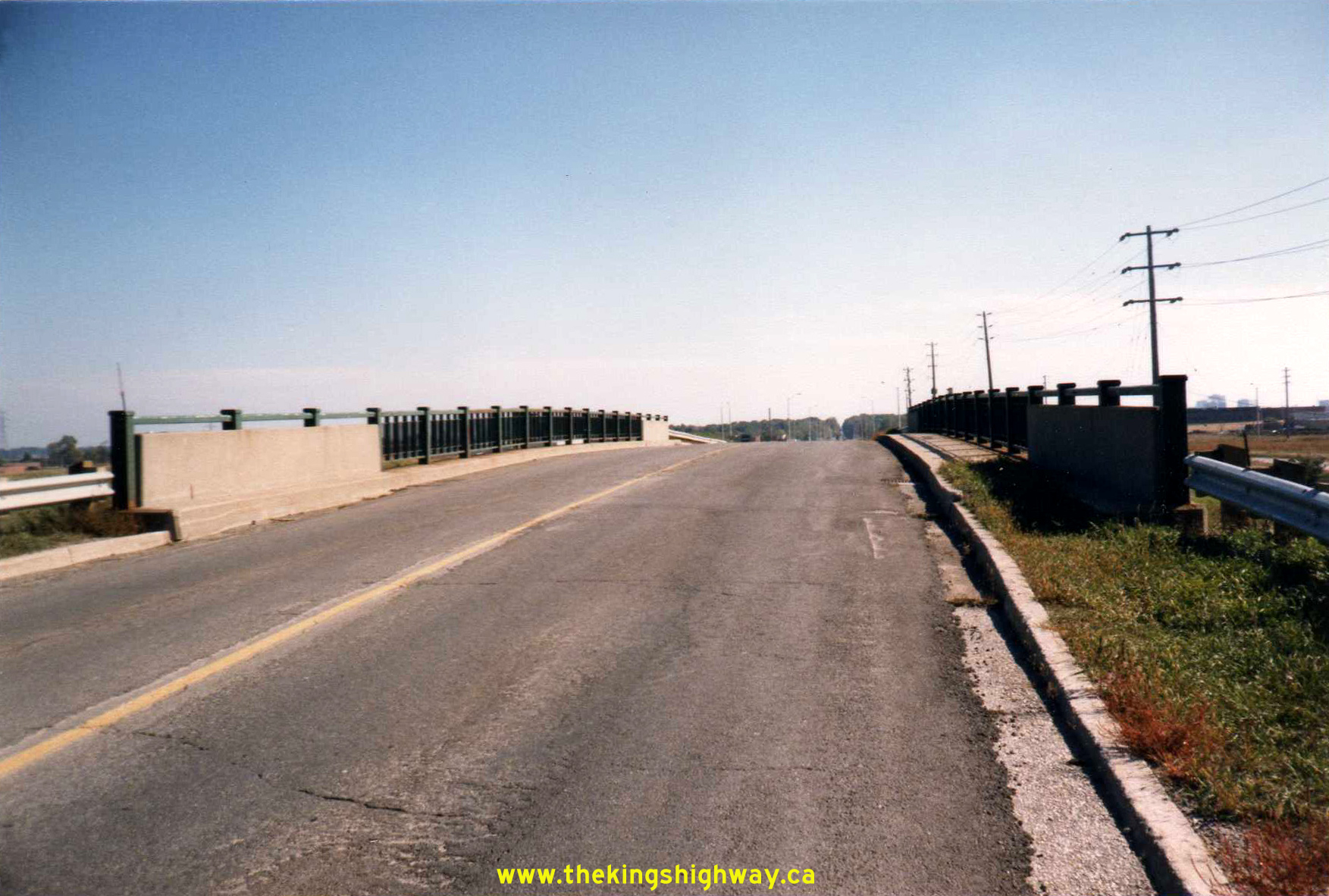
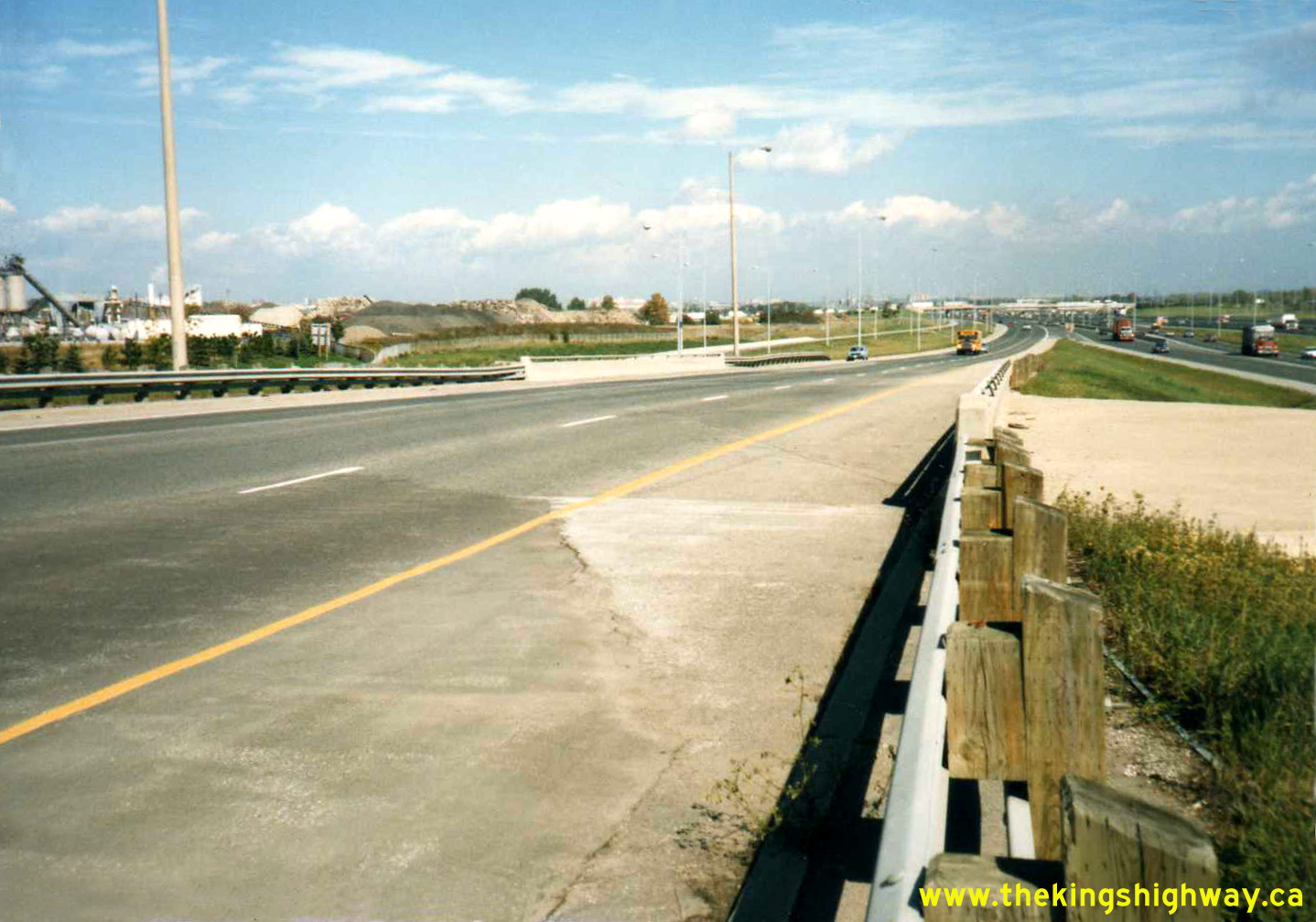
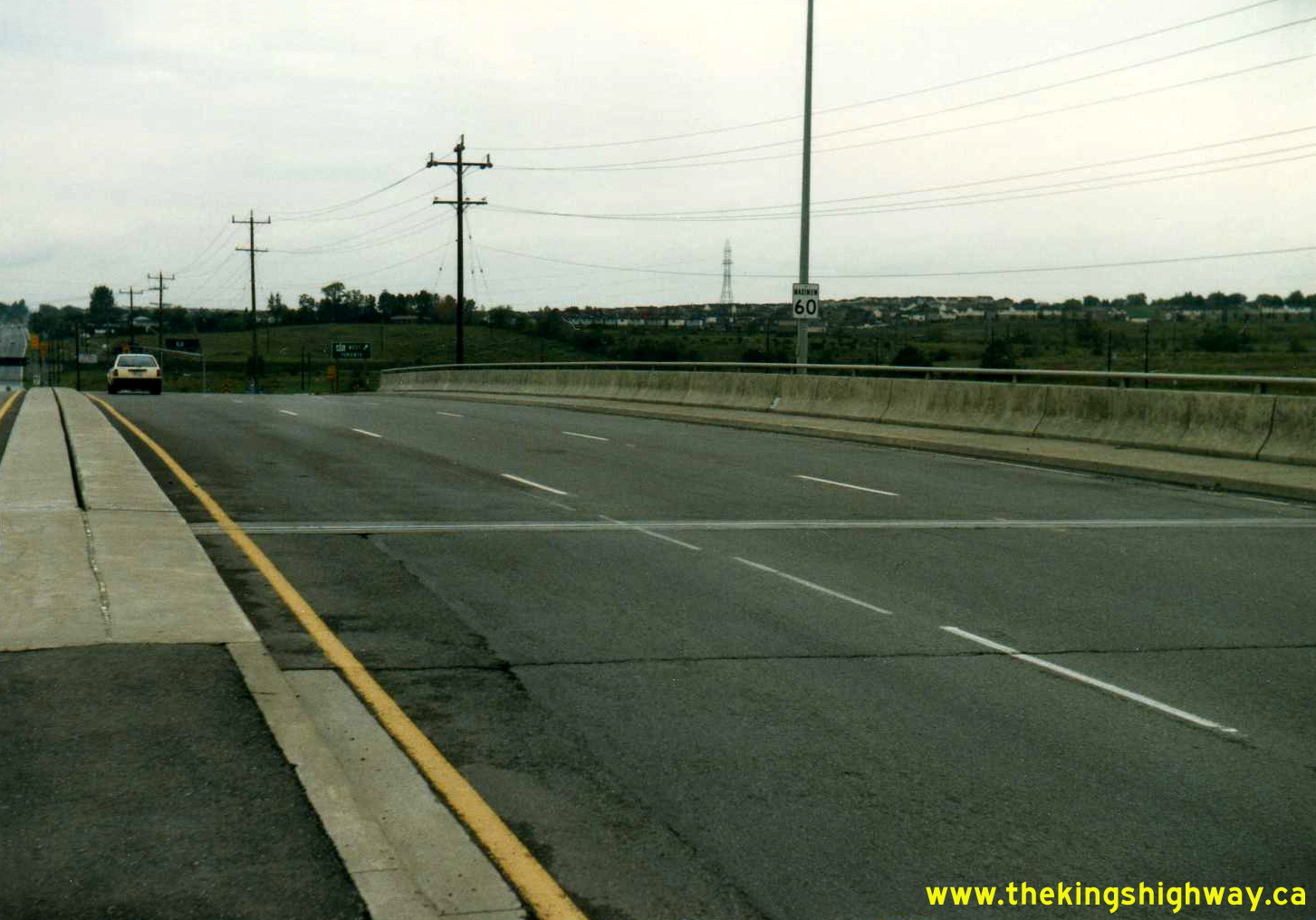
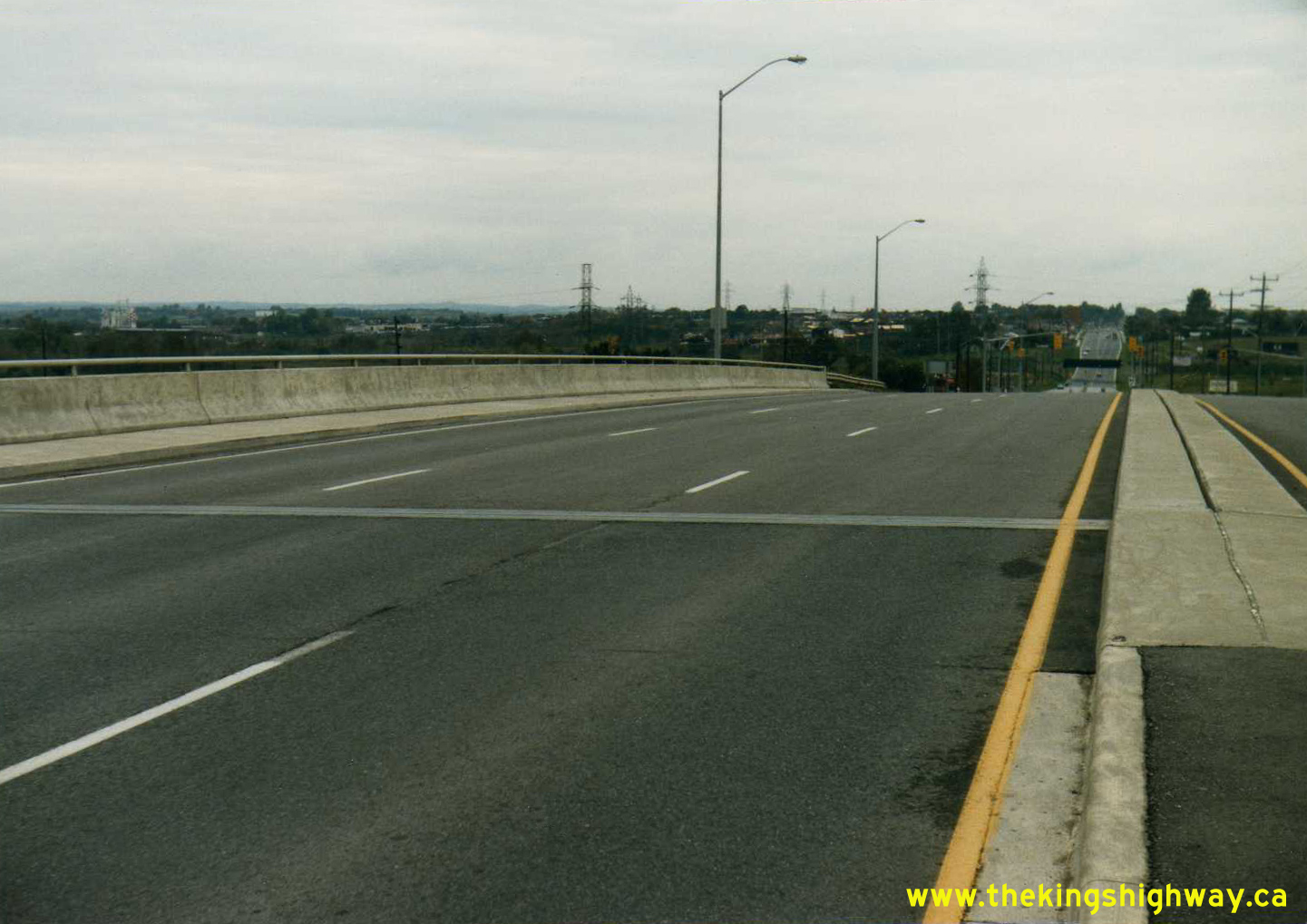
Enlarged Photo Here. Photo taken on September 13, 1985.(Photo courtesy of Ontario Ministry of Transportation - © King's Printer for Ontario, 2025) Right - Facing south across the McCowan Road Overpass on Hwy 401 in Toronto. Note the exposed concrete deck on this bridge. Although once fairly common on
Ontario's Highways, it is unusual to see exposed concrete bridge decks anymore. Typically, an asphalt wearing surface is placed upon the concrete deck, with a
waterproofing membrane below it to protect the concrete from the elements. A large number of Ontario's bridges were originally built with exposed concrete decks, but later
had asphalt wearing surfaces applied to them as a retrofit. See an Enlarged Photo Here.
Photo taken on September 13, 1985.(Photo courtesy of Ontario Ministry of Transportation - © King's Printer for Ontario, 2025) 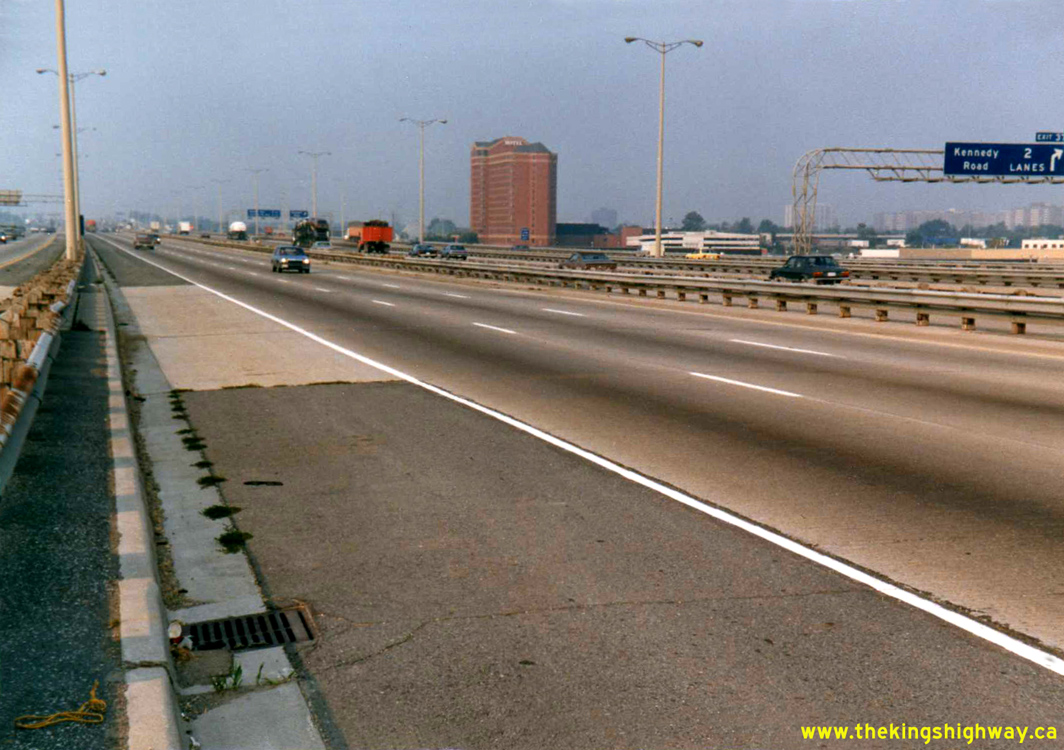
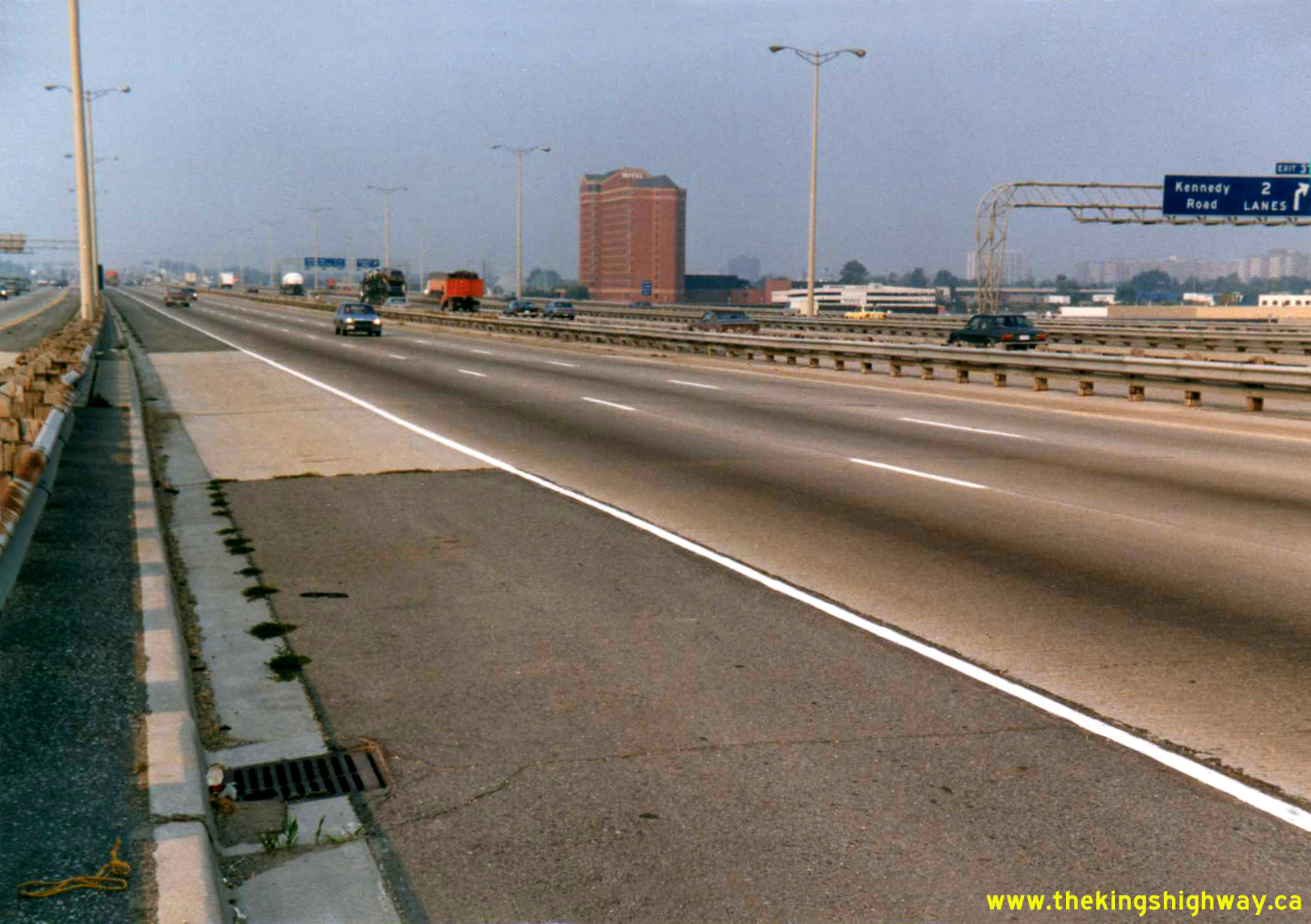
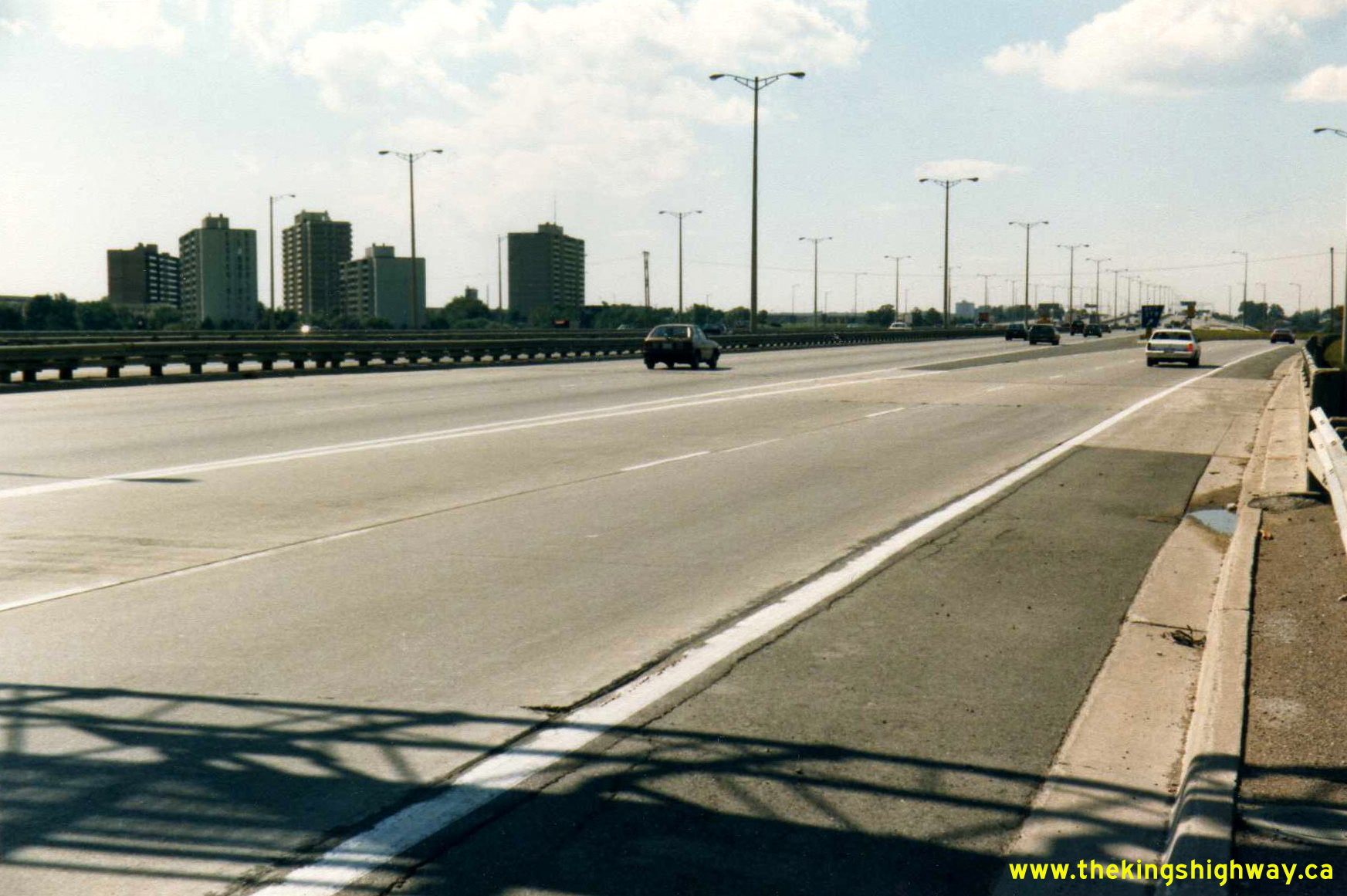
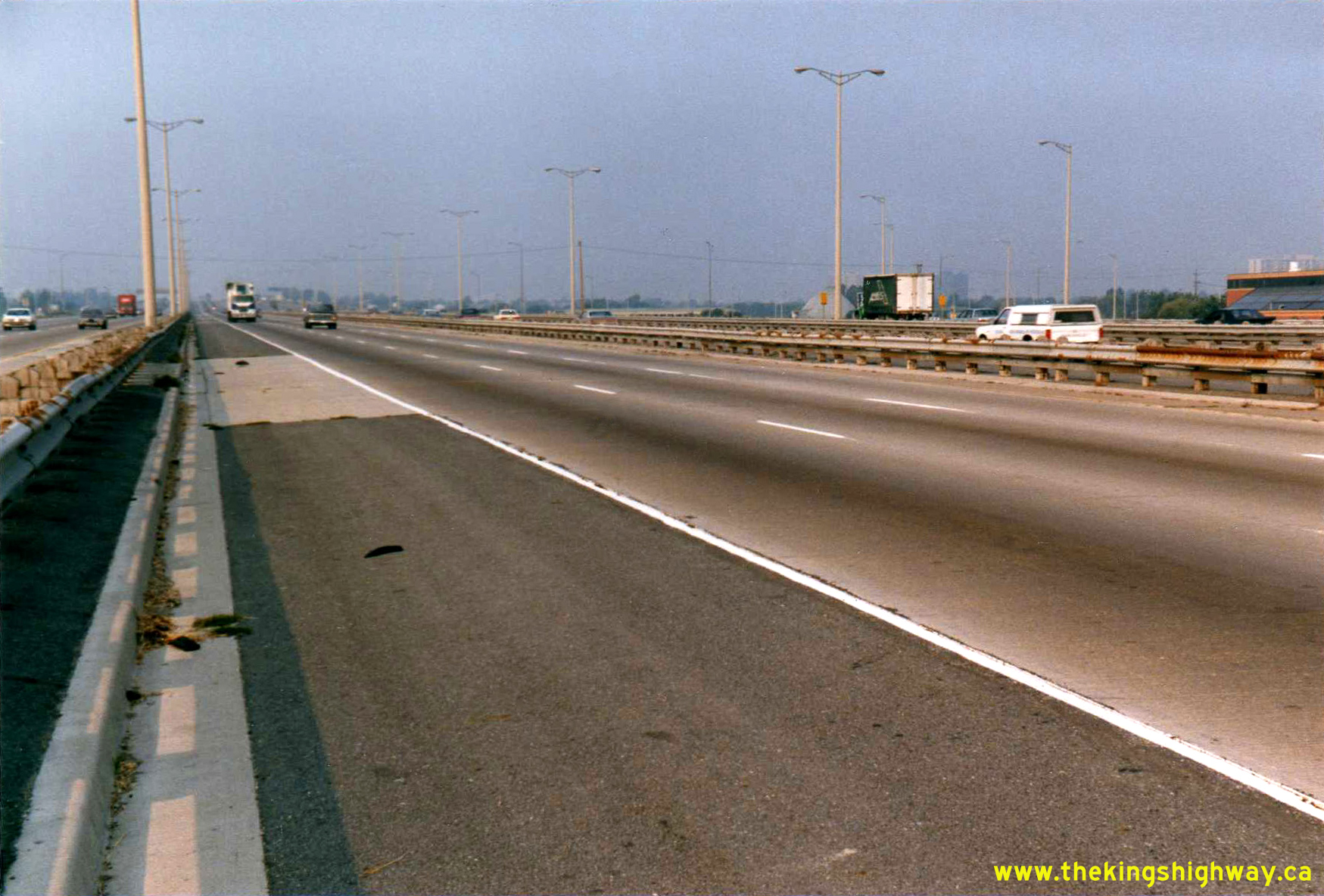
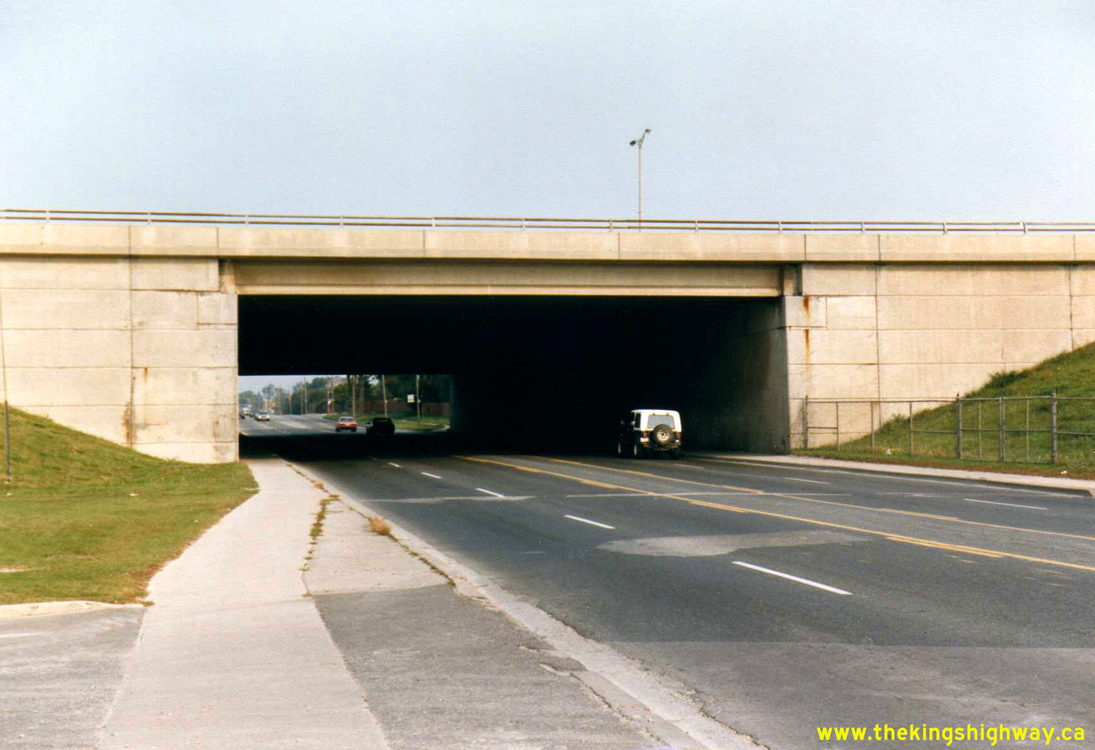 Left - View of the eastbound Hwy 401 Express Lanes in Toronto, facing west towards the Kennedy Road Interchange from Midland Avenue. Although the highway may
appear in this photo to be quite lightly-travelled, it is a bit deceiving. Even during the first half of the 1980s, this section of Hwy 401 carried about 175,000
vehicles per day. Traffic volumes on the highway have only gone up since then - roughly doubling to almost 360,000 vehicles per day by 2021. See an
Enlarged Photo Here. Photo taken on September 23, 1985. Left - View of the eastbound Hwy 401 Express Lanes in Toronto, facing west towards the Kennedy Road Interchange from Midland Avenue. Although the highway may
appear in this photo to be quite lightly-travelled, it is a bit deceiving. Even during the first half of the 1980s, this section of Hwy 401 carried about 175,000
vehicles per day. Traffic volumes on the highway have only gone up since then - roughly doubling to almost 360,000 vehicles per day by 2021. See an
Enlarged Photo Here. Photo taken on September 23, 1985.(Photo courtesy of Ontario Ministry of Transportation - © King's Printer for Ontario, 2025) Right - Southern side of the Midland Avenue Underpass (Site #37-216) on Hwy 401 in Toronto in 1985. This was one of several new structures built along the
expanded section of Hwy 401 through the eastern end of Toronto (Scarborough) in the early 1970s. This new structure was built under Contract #1969-09 and replaced a
narrow underpass built for a two-lane Midland Avenue in 1953 as part of the initial construction of the Toronto Bypass. When the Toronto Bypass was initially built,
this part of Scarborough was predominantly rural, but rapid postwar expansion of Toronto led to the reconstruction and widening of arterial streets crossing Hwy 401
as the area quickly urbanized. See an Enlarged Photo Here. Photo taken on September 23, 1985.(Photo courtesy of Ontario Ministry of Transportation - © King's Printer for Ontario, 2025) 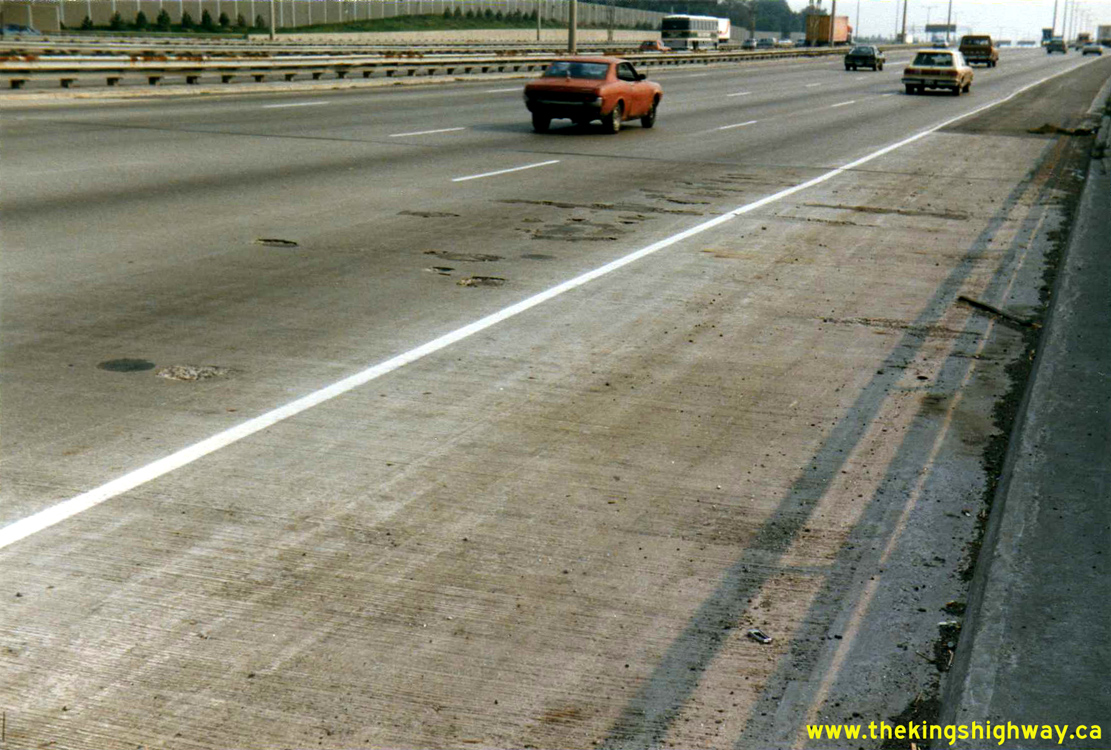
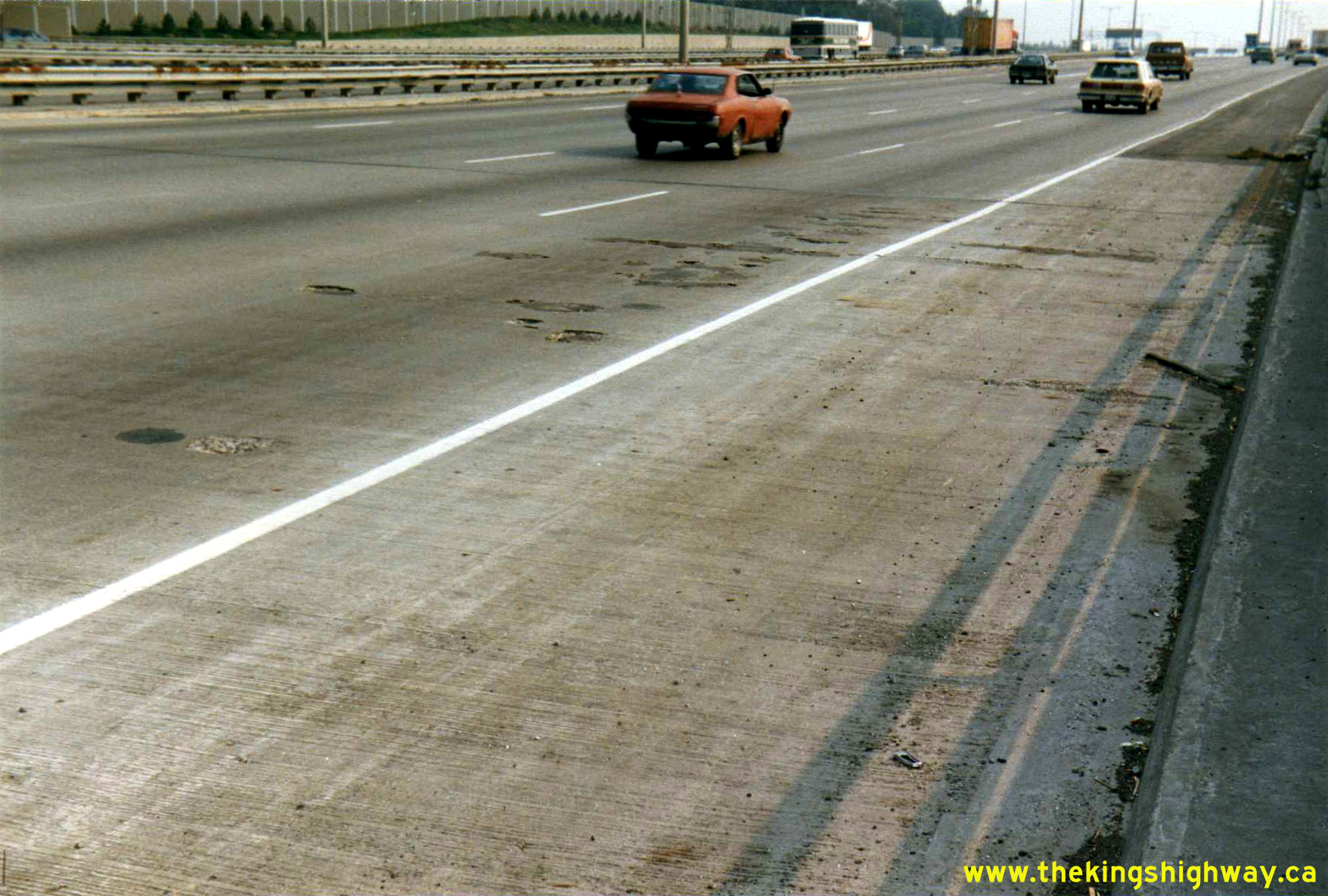
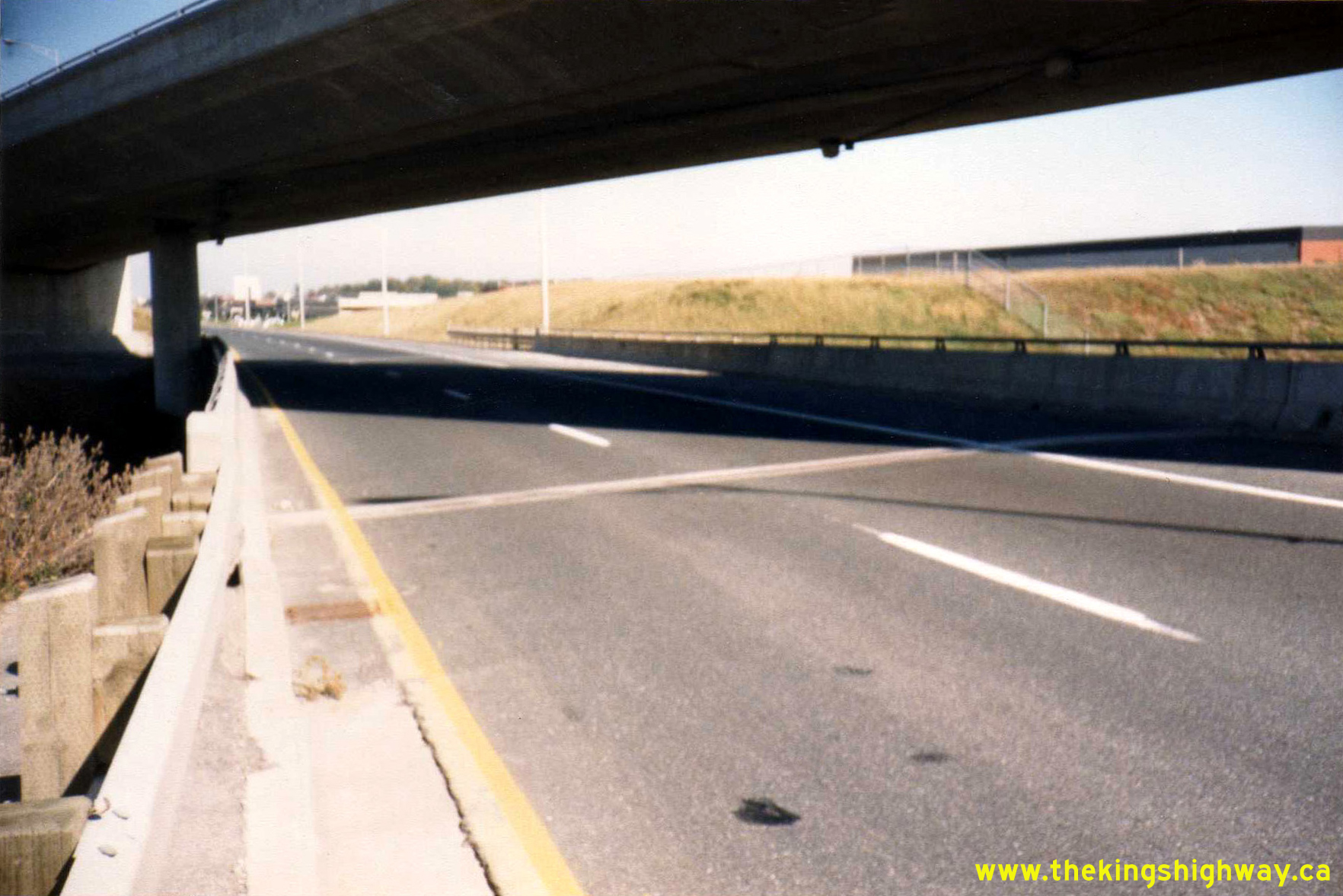
 Left - Deteriorated section of concrete deck on the Midland Avenue Underpass on the eastbound Hwy 401 Collector Lanes in Toronto in 1985. When the
Express-Collector System was built along this section of Hwy 401 in the early 1970s, it was originally built with a concrete surface with exposed concrete bridge
decks. This section of the Hwy 401 Collector Lanes was rehabilitated in 1994 under Contract #1993-107 and a composite pavement (asphalt over concrete base) was
introduced. An asphalt wearing surface was laid across all exposed concrete bridge decks, including this one. See an
Enlarged Photo Here. Photo taken on September 23, 1985. Left - Deteriorated section of concrete deck on the Midland Avenue Underpass on the eastbound Hwy 401 Collector Lanes in Toronto in 1985. When the
Express-Collector System was built along this section of Hwy 401 in the early 1970s, it was originally built with a concrete surface with exposed concrete bridge
decks. This section of the Hwy 401 Collector Lanes was rehabilitated in 1994 under Contract #1993-107 and a composite pavement (asphalt over concrete base) was
introduced. An asphalt wearing surface was laid across all exposed concrete bridge decks, including this one. See an
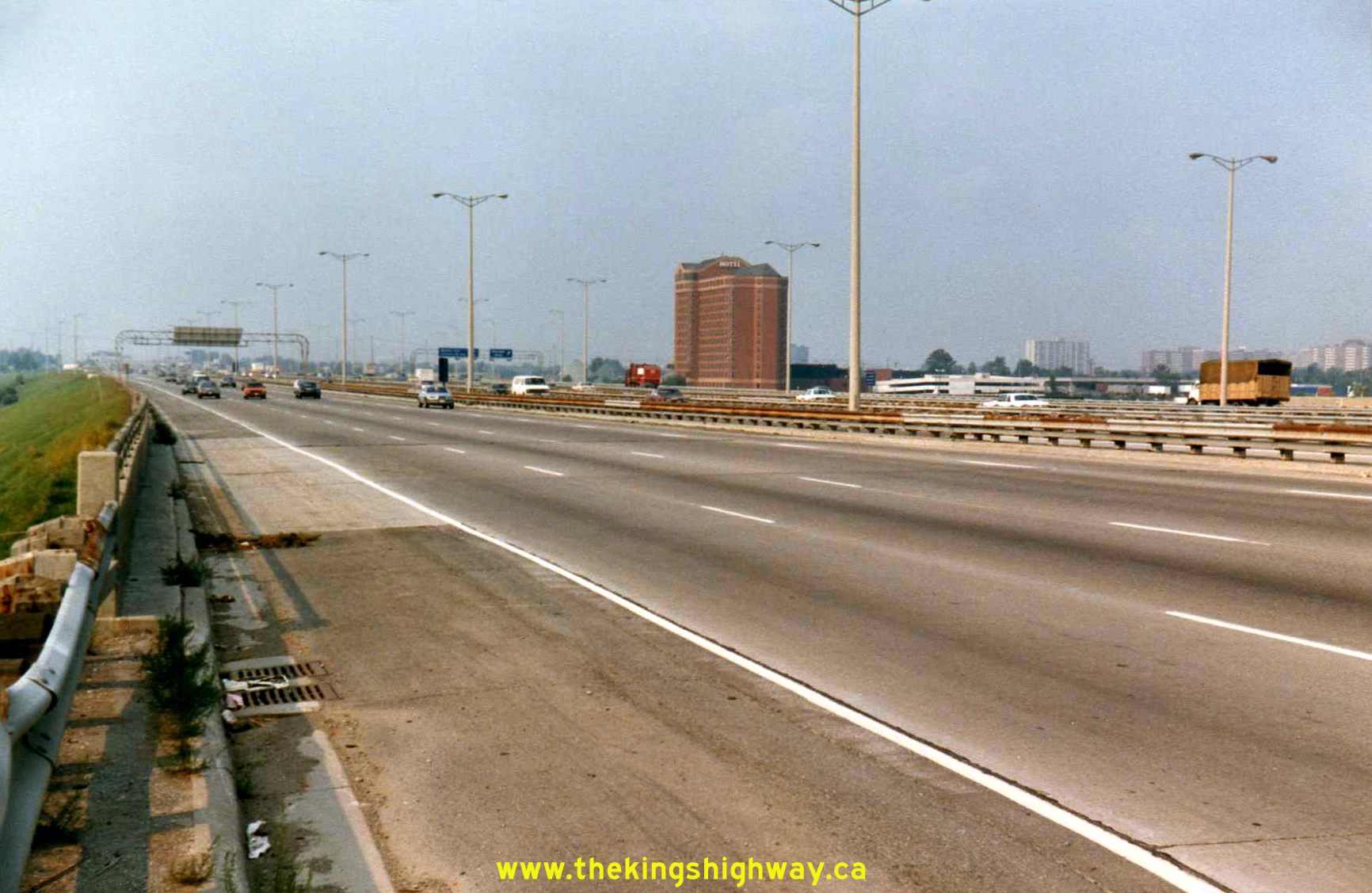
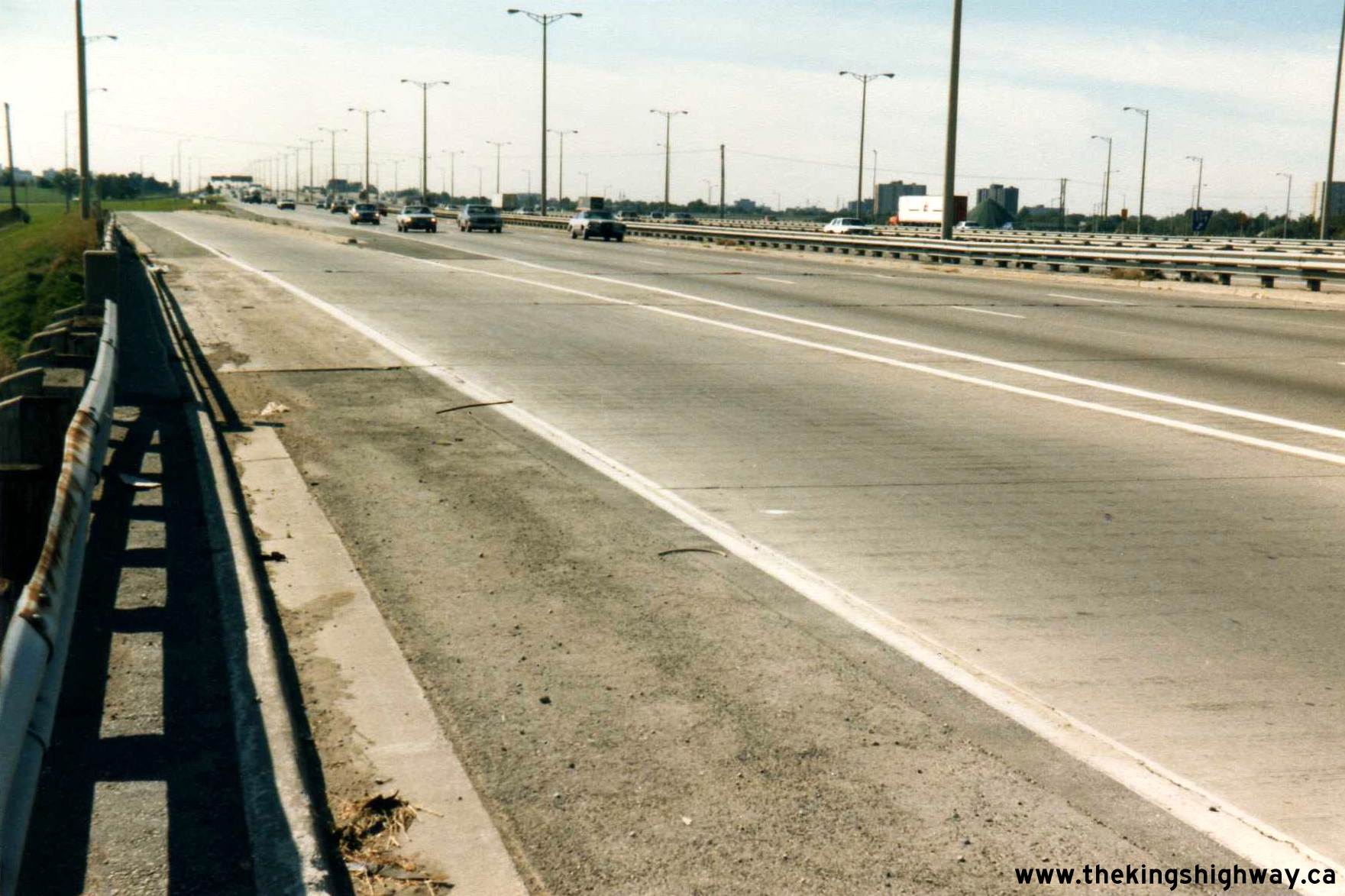
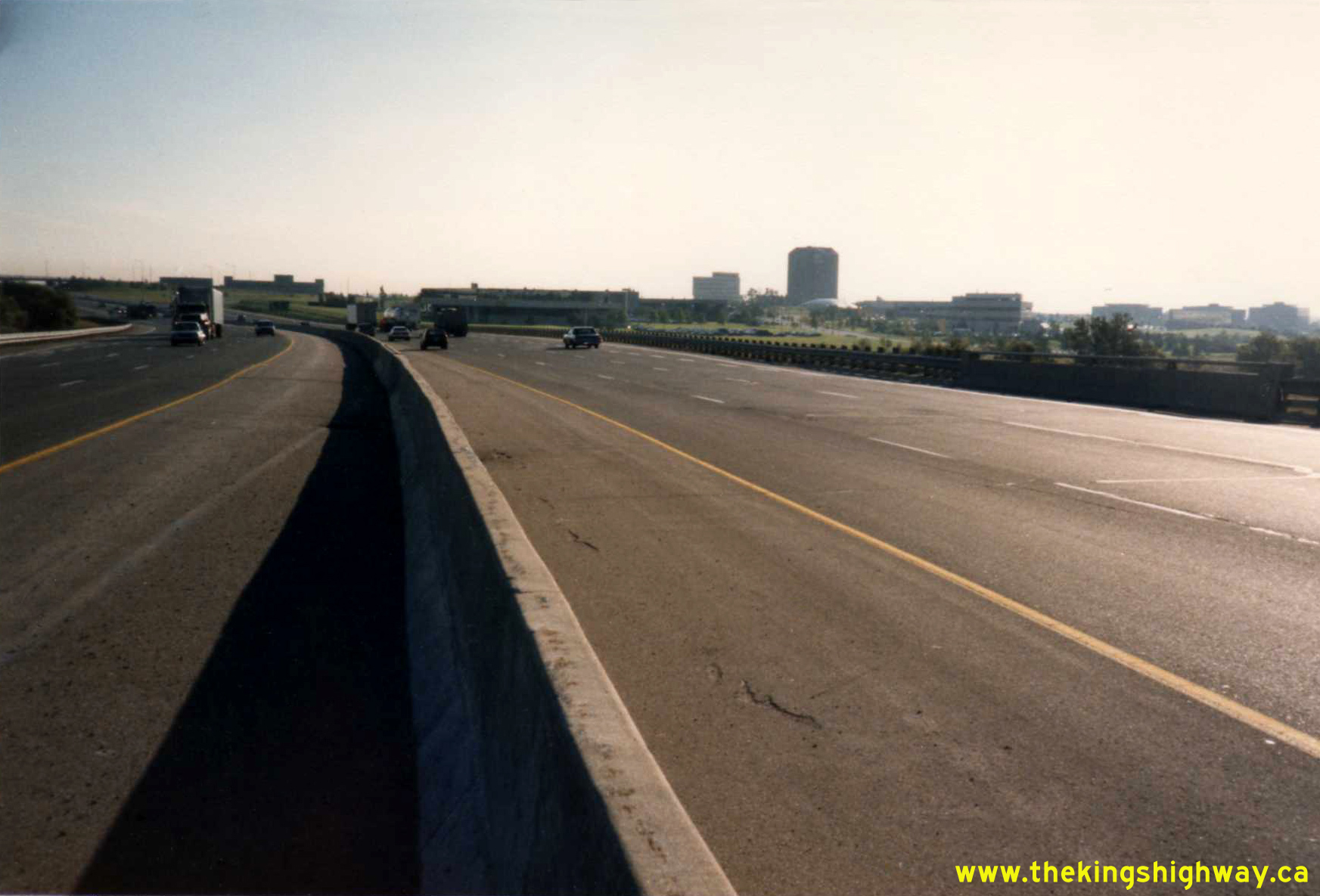
Enlarged Photo Here. Photo taken on September 23, 1985.(Photo courtesy of Ontario Ministry of Transportation - © King's Printer for Ontario, 2025) Right - Facing west along the eastbound Hwy 401 Collector Lanes in Toronto towards the Kennedy Road Interchange from the Midland Avenue Underpass in 1985. This
photo provides a good general view of the Express-Collector Lane System through the eastern part of Toronto. Constructed in the late 1960s and early 1970s under
Contract #1969-09, the original four-lane Toronto Bypass was expanded to 12 lanes through this area. The four individual roadways comprising the Express-Collector
Lane System were separated by steel beam guide rail barriers. The Express-Collector Lane System separated shorter-distance traffic which was more local in nature from
longer-distance through traffic using Hwy 401. See an Enlarged Photo Here. Photo taken on
September 23, 1985.(Photo courtesy of Ontario Ministry of Transportation - © King's Printer for Ontario, 2025) 
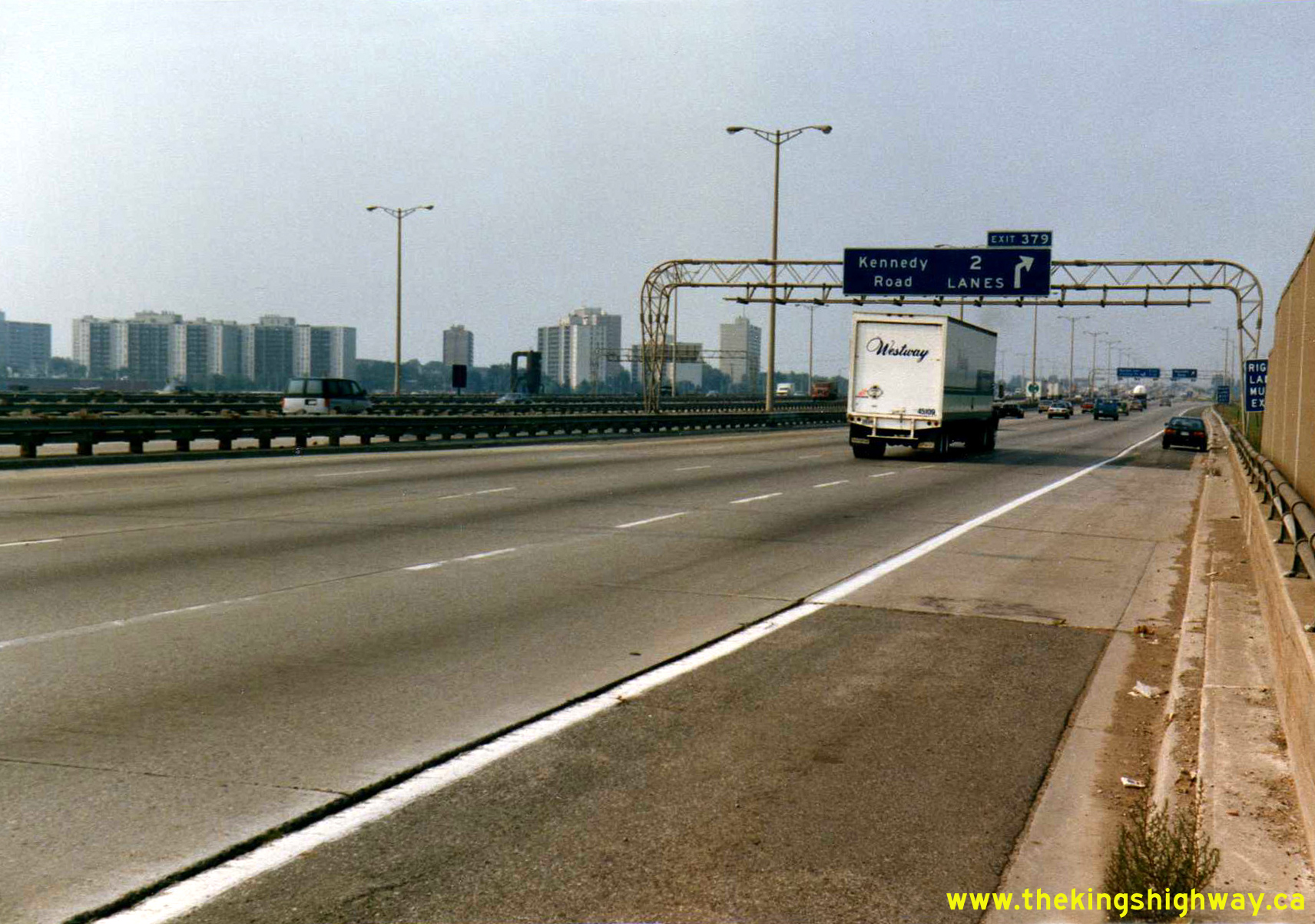
 Left - Advance freeway exit guide sign for the Kennedy Road Interchange on the westbound Hwy 401 Collector Lanes in Toronto in 1985. This sign shows a good
example of Ontario's intermediate version of the two-lane freeway exit overhead sign. Ever since two-lane freeway exit ramps were introduced in Ontario, traffic
engineers have struggled to properly convey the message of a freeway exit with an "either-or" lane configuration - that is, an exit where the right-most lane is
forced off the freeway, but the adjacent lane splits into two lanes giving motorists a choice of which lane to take. The earliest versions of these overhead freeway
signs read "Keep Right 2 Lanes", but it was soon found that these signs were misinterpreted by many motorists as meaning that both right lanes were forced to exit
from the freeway. The intermediate version of these signs was introduced in the 1970s and abbreviated the lengthy message to "2 Lanes", but it was still found that
some motorists interpreted these signs incorrectly. This was despite the use of the "Right Lane Must Exit" guide signs placed upstream of the exit, which were
intended to complement the overhead signs and assure motorists that it was in fact only the right-most lane which had to exit from the freeway. Ultimately, these
intermediate versions of the advance overhead signs were replaced altogether in the early 1990s by a new graphical version of the sign with upward-pointing arrows,
which represented the either-or lane configuration at the exit with minimal text required. These graphical exit signs are still in use on Ontario's Highways today.
See an Enlarged Photo Here. Photo taken on September 23, 1985. Left - Advance freeway exit guide sign for the Kennedy Road Interchange on the westbound Hwy 401 Collector Lanes in Toronto in 1985. This sign shows a good
example of Ontario's intermediate version of the two-lane freeway exit overhead sign. Ever since two-lane freeway exit ramps were introduced in Ontario, traffic
engineers have struggled to properly convey the message of a freeway exit with an "either-or" lane configuration - that is, an exit where the right-most lane is
forced off the freeway, but the adjacent lane splits into two lanes giving motorists a choice of which lane to take. The earliest versions of these overhead freeway
signs read "Keep Right 2 Lanes", but it was soon found that these signs were misinterpreted by many motorists as meaning that both right lanes were forced to exit
from the freeway. The intermediate version of these signs was introduced in the 1970s and abbreviated the lengthy message to "2 Lanes", but it was still found that
some motorists interpreted these signs incorrectly. This was despite the use of the "Right Lane Must Exit" guide signs placed upstream of the exit, which were
intended to complement the overhead signs and assure motorists that it was in fact only the right-most lane which had to exit from the freeway. Ultimately, these
intermediate versions of the advance overhead signs were replaced altogether in the early 1990s by a new graphical version of the sign with upward-pointing arrows,
which represented the either-or lane configuration at the exit with minimal text required. These graphical exit signs are still in use on Ontario's Highways today.
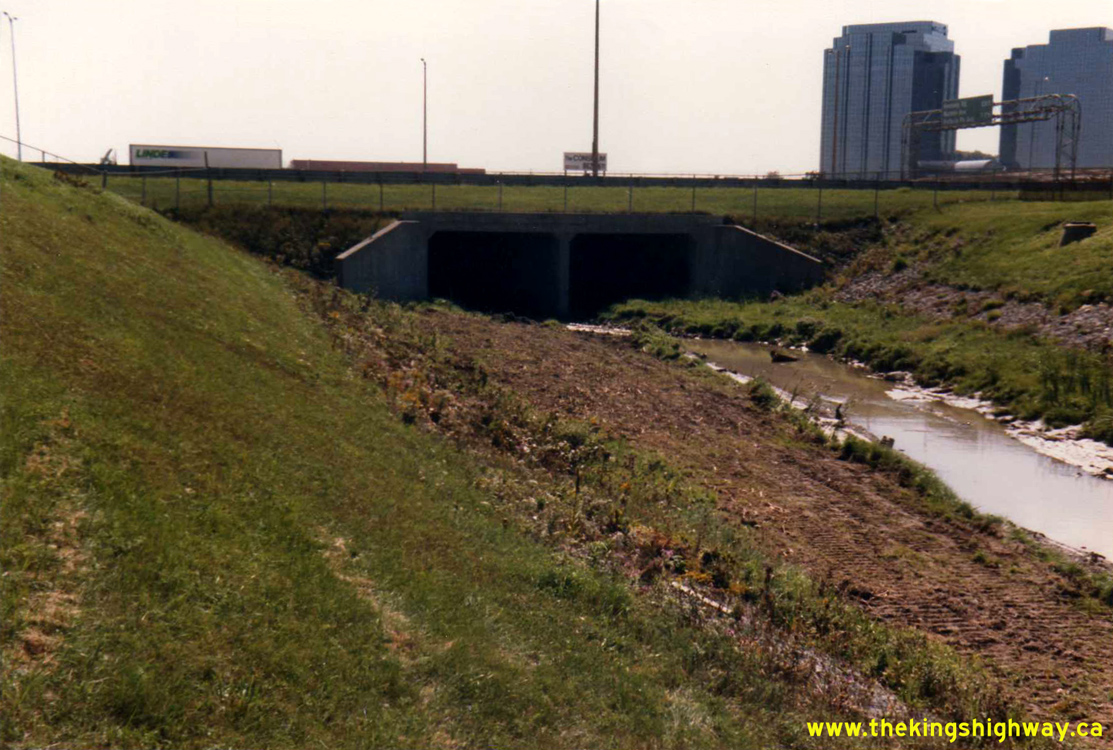
See an Enlarged Photo Here. Photo taken on September 23, 1985.(Photo courtesy of Ontario Ministry of Transportation - © King's Printer for Ontario, 2025) Right - Northern side of the East Highland Creek Tributary Twin Cell Box Culvert (Site #37-710/C), located west of the Markham Road (Hwy 48) Interchange in
Toronto. This culvert was built in 1965 under Contract #1965-130 as part of a municipal stream diversion project. See an
Enlarged Photo Here. Photo taken on September 25, 1985.(Photo courtesy of Ontario Ministry of Transportation - © King's Printer for Ontario, 2025) 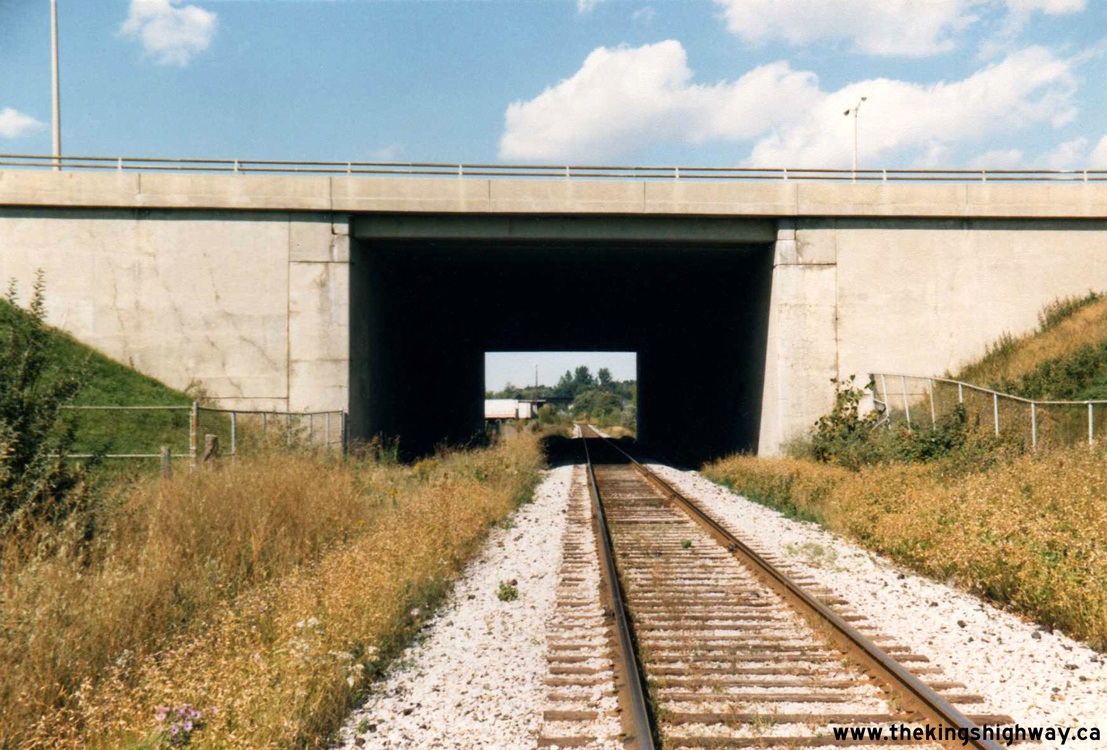
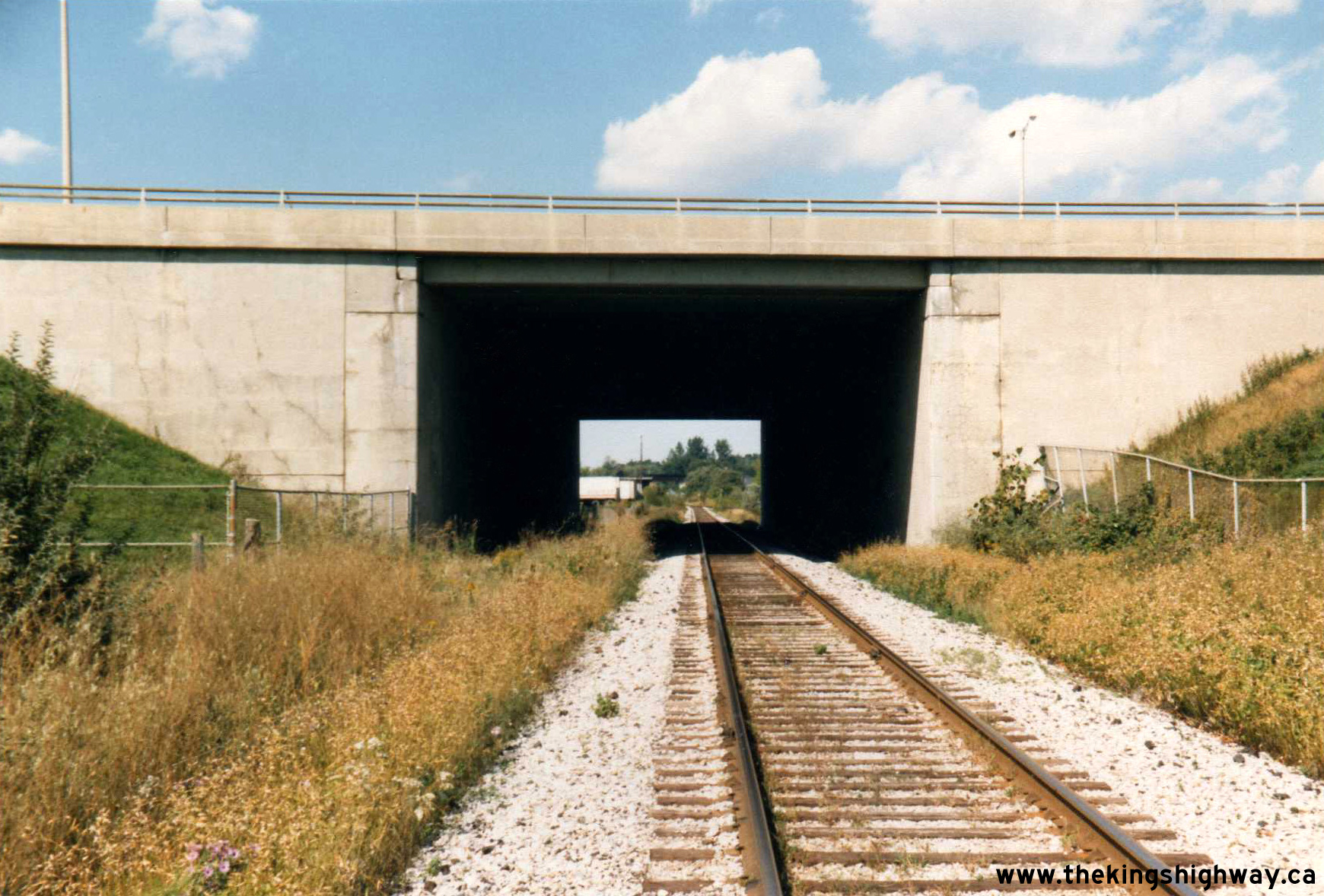
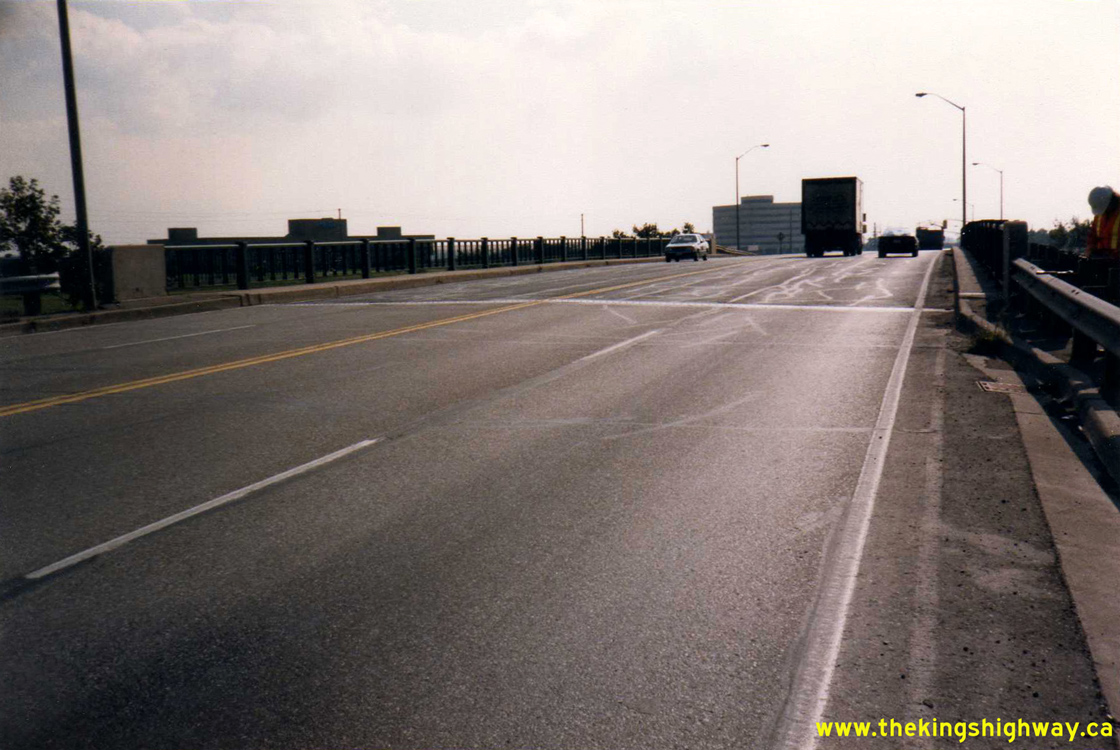
 Left - Southern side of the Agincourt Canadian National Railway (CNR) Overhead (Site #37-215) on Hwy 401 in Toronto. This single-span bridge was originally
constructed along the Toronto Bypass just east of the Kennedy Road Interchange under Contract #1954-30. This railway overhead was widened on both sides under Contract
#1969-09 during the expansion of Hwy 401 from 4 to 12 lanes. Like many railway overheads of this vintage, space was provided below the structure for a future twin
railway track. See an Enlarged Photo Here. Photo taken on September 25, 1985. Left - Southern side of the Agincourt Canadian National Railway (CNR) Overhead (Site #37-215) on Hwy 401 in Toronto. This single-span bridge was originally
constructed along the Toronto Bypass just east of the Kennedy Road Interchange under Contract #1954-30. This railway overhead was widened on both sides under Contract
#1969-09 during the expansion of Hwy 401 from 4 to 12 lanes. Like many railway overheads of this vintage, space was provided below the structure for a future twin
railway track. See an Enlarged Photo Here. Photo taken on September 25, 1985.(Photo courtesy of Ontario Ministry of Transportation - © King's Printer for Ontario, 2025) Right - Facing west along the eastbound Hwy 401 Collector Lanes towards the Kennedy Road Interchange from the Agincourt CNR Overhead in Toronto. See an
Enlarged Photo Here. Photo taken on September 25, 1985.(Photo courtesy of Ontario Ministry of Transportation - © King's Printer for Ontario, 2025) 
 Left - View of the Kennedy Road Interchange from the Agincourt CNR Overhead in Toronto in 1985, facing west along the westbound Hwy 401 Collector Lanes. Kennedy
Road now passes below Hwy 401, but when the Toronto Bypass was originally constructed in the 1950s, Kennedy Road was an overpass. During the reconstruction and
widening of Hwy 401 through Scarborough, Kennedy Road was fully closed to traffic during the Fall of 1969 to allow for the replacement of the old Kennedy Road
Overpass. All Hwy 401 traffic was shifted onto a temporary diversion around the north side of the structure. The old Kennedy Road Overpass was then demolished, which
made space for the construction of the new Kennedy Road Underpass. Construction work progressed on this structure from south to north, which enabled all Hwy 401
traffic to be temporarily shifted into the eastbound Hwy 401 Express and Collector Lanes while the westbound lanes were constructed. The replacement of the old
1950s-era Kennedy Road Cloverleaf was among the most complicated portions of the Hwy 401 Express-Collector Lane System to construct through Scarborough. See an
Enlarged Photo Here. Photo taken on September 25, 1985. Left - View of the Kennedy Road Interchange from the Agincourt CNR Overhead in Toronto in 1985, facing west along the westbound Hwy 401 Collector Lanes. Kennedy
Road now passes below Hwy 401, but when the Toronto Bypass was originally constructed in the 1950s, Kennedy Road was an overpass. During the reconstruction and
widening of Hwy 401 through Scarborough, Kennedy Road was fully closed to traffic during the Fall of 1969 to allow for the replacement of the old Kennedy Road
Overpass. All Hwy 401 traffic was shifted onto a temporary diversion around the north side of the structure. The old Kennedy Road Overpass was then demolished, which
made space for the construction of the new Kennedy Road Underpass. Construction work progressed on this structure from south to north, which enabled all Hwy 401
traffic to be temporarily shifted into the eastbound Hwy 401 Express and Collector Lanes while the westbound lanes were constructed. The replacement of the old
1950s-era Kennedy Road Cloverleaf was among the most complicated portions of the Hwy 401 Express-Collector Lane System to construct through Scarborough. See an
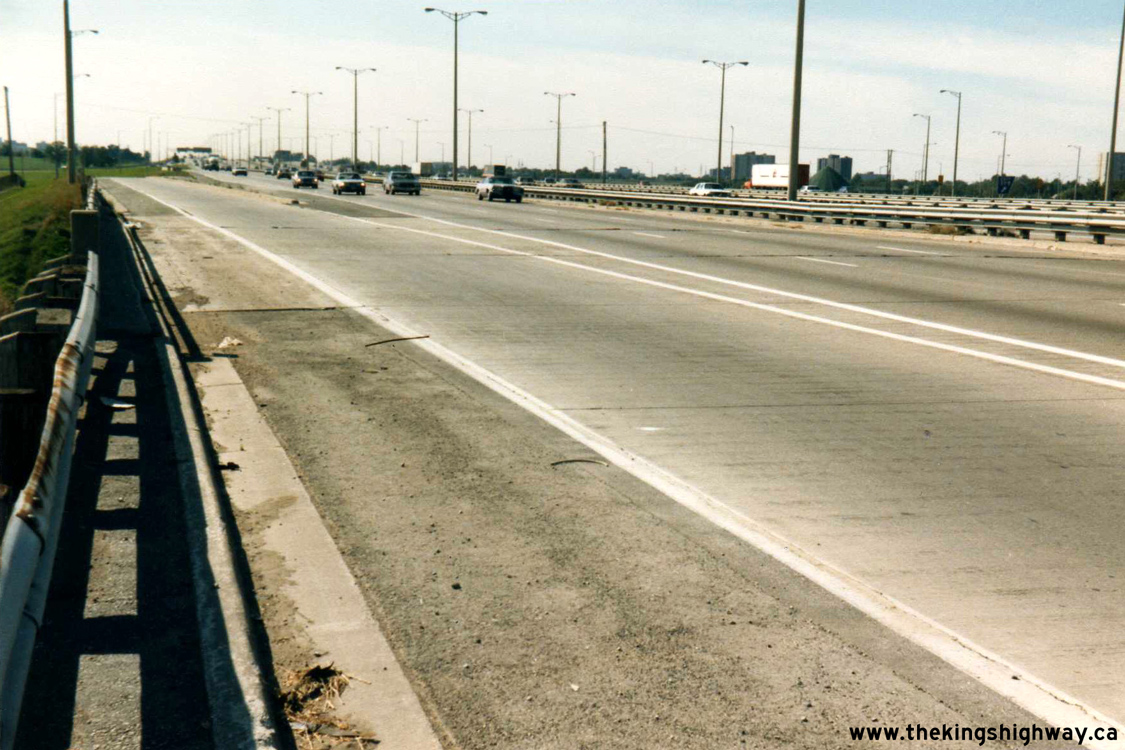
Enlarged Photo Here. Photo taken on September 25, 1985.(Photo courtesy of Ontario Ministry of Transportation - © King's Printer for Ontario, 2025) Right - Facing west along the eastbound Hwy 401 Express Lanes towards the Kennedy Road Interchange from the Agincourt CNR Overhead. This photo shows a close-up
of the physical separator that was used to divide the Hwy 401 Express and Collector Lane System. Raised barrier curbs and a steel beam guide rail barrier were used to
prevent traffic from crossing between the roadways other than at designated transfer points. The separators between the Collector and Express Lanes were built
slightly wider than the highway median, in order to accommodate provisions for the highway luminaires. The standard centreline median width used for Hwy 401 in this
area was 8 feet, 4 inches while the outer separator widths were 10 feet, inclusive of the curbs. See an
Enlarged Photo Here. Photo taken on September 25, 1985.(Photo courtesy of Ontario Ministry of Transportation - © King's Printer for Ontario, 2025) 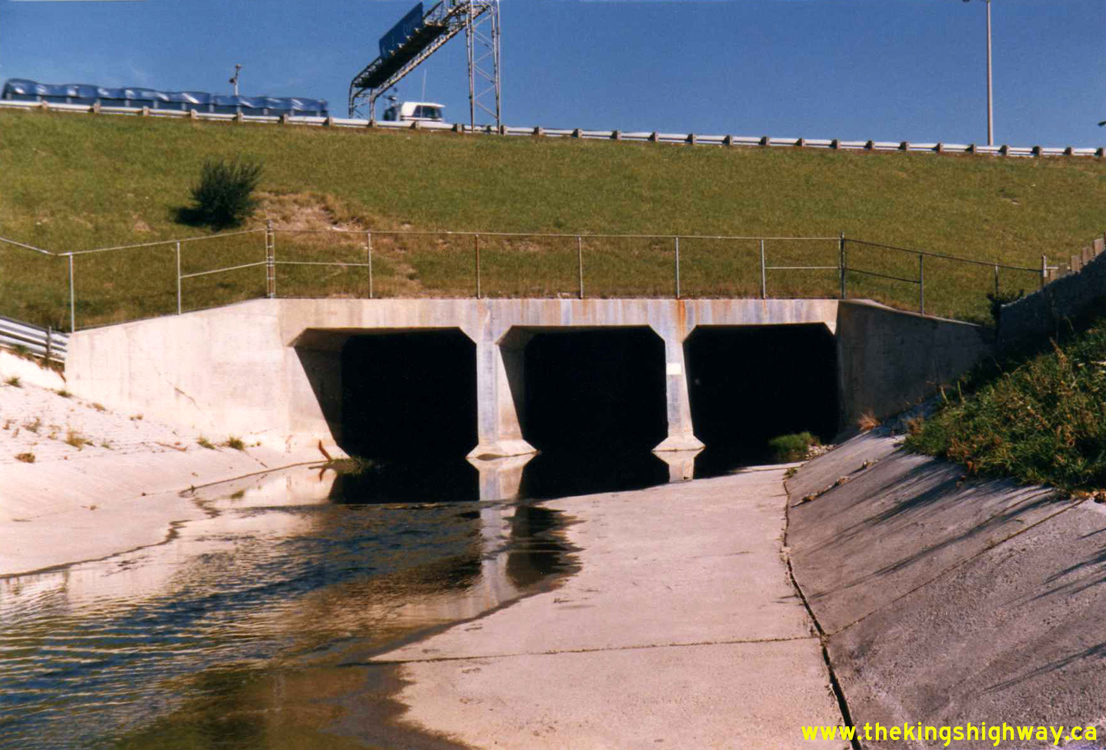
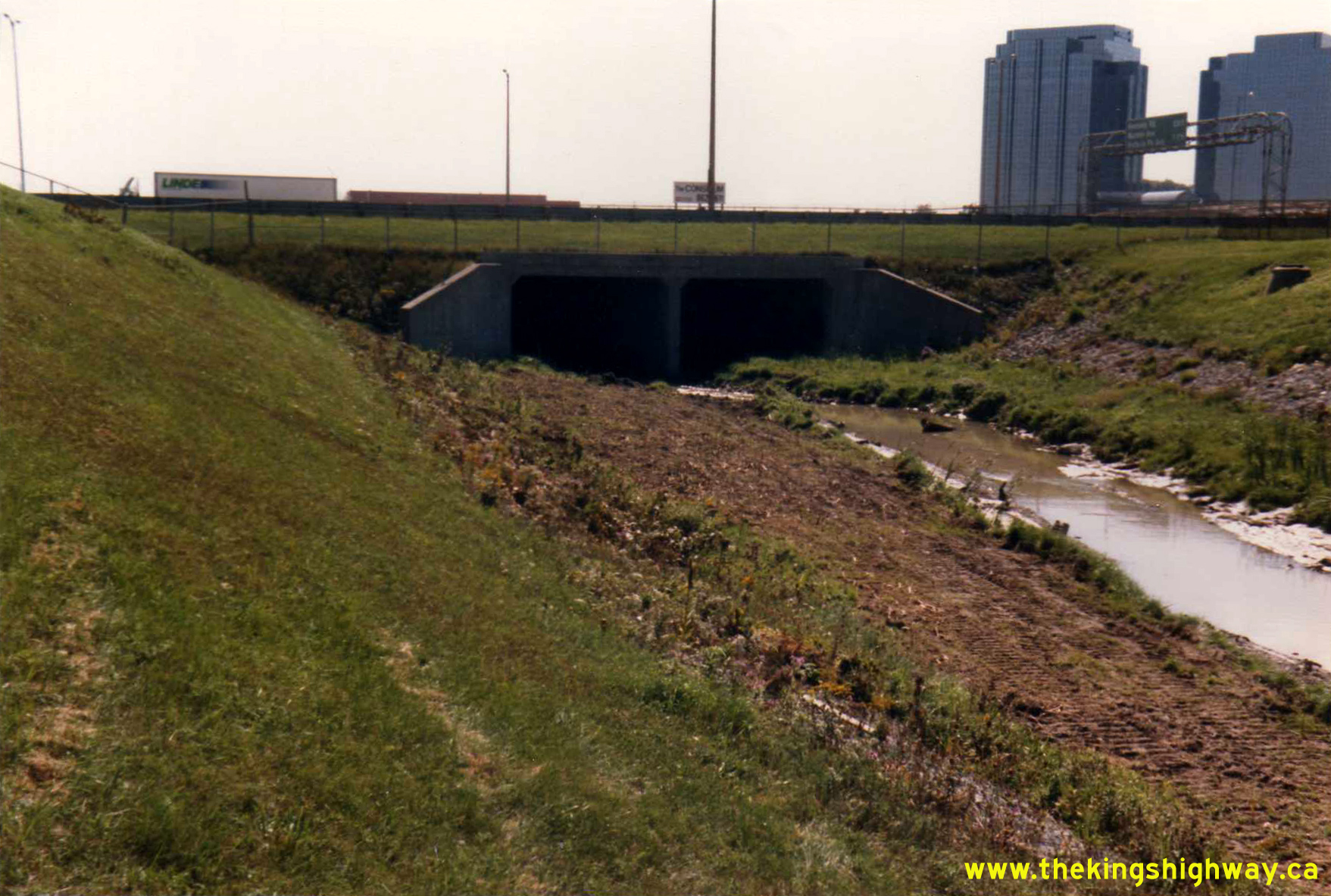
 Left - Southern side of the Highland Creek West Branch Culvert (Site #37-755/C) on Hwy 401 in Toronto. Also known as Bendale Creek, this large culvert is
located between Midland Avenue and Kennedy Road. This three-cell culvert was constructed under Contract #1969-09. It replaced an older single concrete box culvert
which used to carry Bendale Creek below the Toronto Bypass. See an Enlarged Photo Here.
Photo taken on September 25, 1985. Left - Southern side of the Highland Creek West Branch Culvert (Site #37-755/C) on Hwy 401 in Toronto. Also known as Bendale Creek, this large culvert is
located between Midland Avenue and Kennedy Road. This three-cell culvert was constructed under Contract #1969-09. It replaced an older single concrete box culvert
which used to carry Bendale Creek below the Toronto Bypass. See an Enlarged Photo Here.
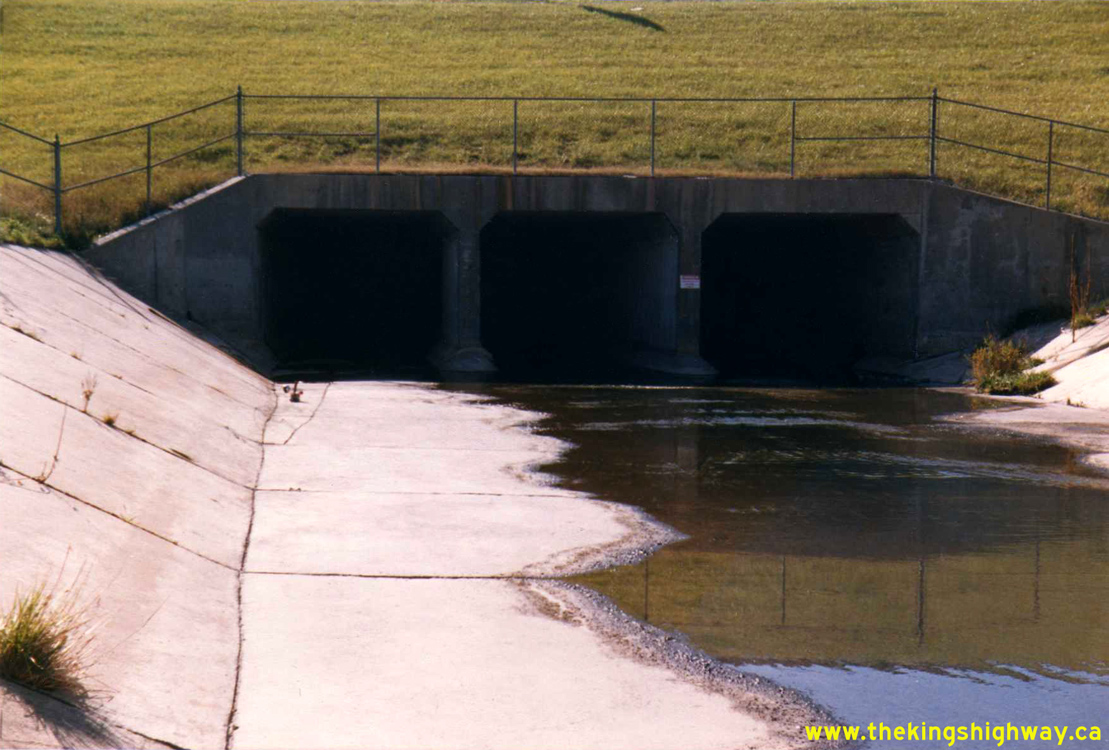
Photo taken on September 25, 1985.(Photo courtesy of Ontario Ministry of Transportation - © King's Printer for Ontario, 2025) Right - Northern side of the Highland Creek West Branch (Bendale Creek) Culvert on Hwy 401. See an
Enlarged Photo Here. Photo taken on September 25, 1985.(Photo courtesy of Ontario Ministry of Transportation - © King's Printer for Ontario, 2025) 

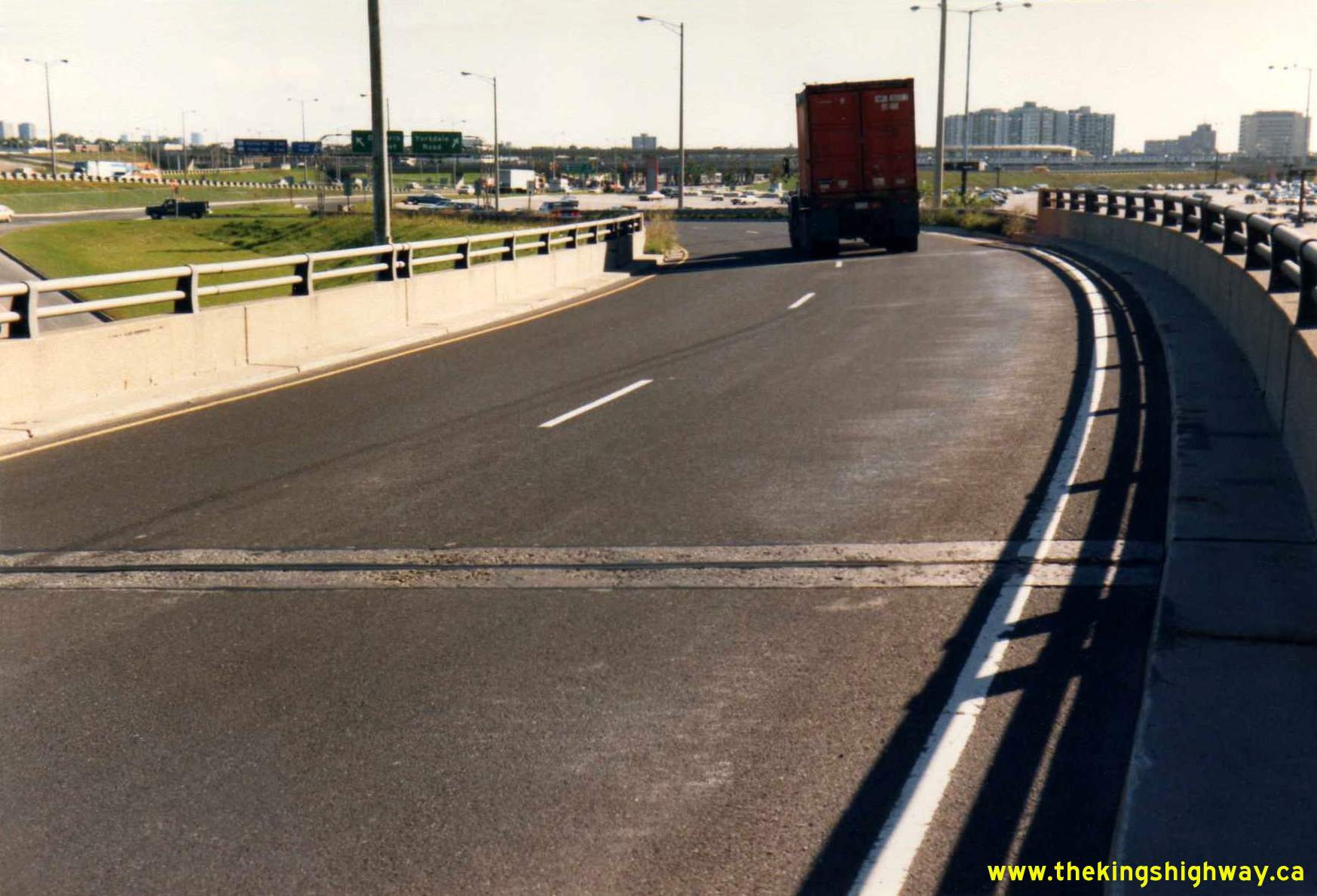
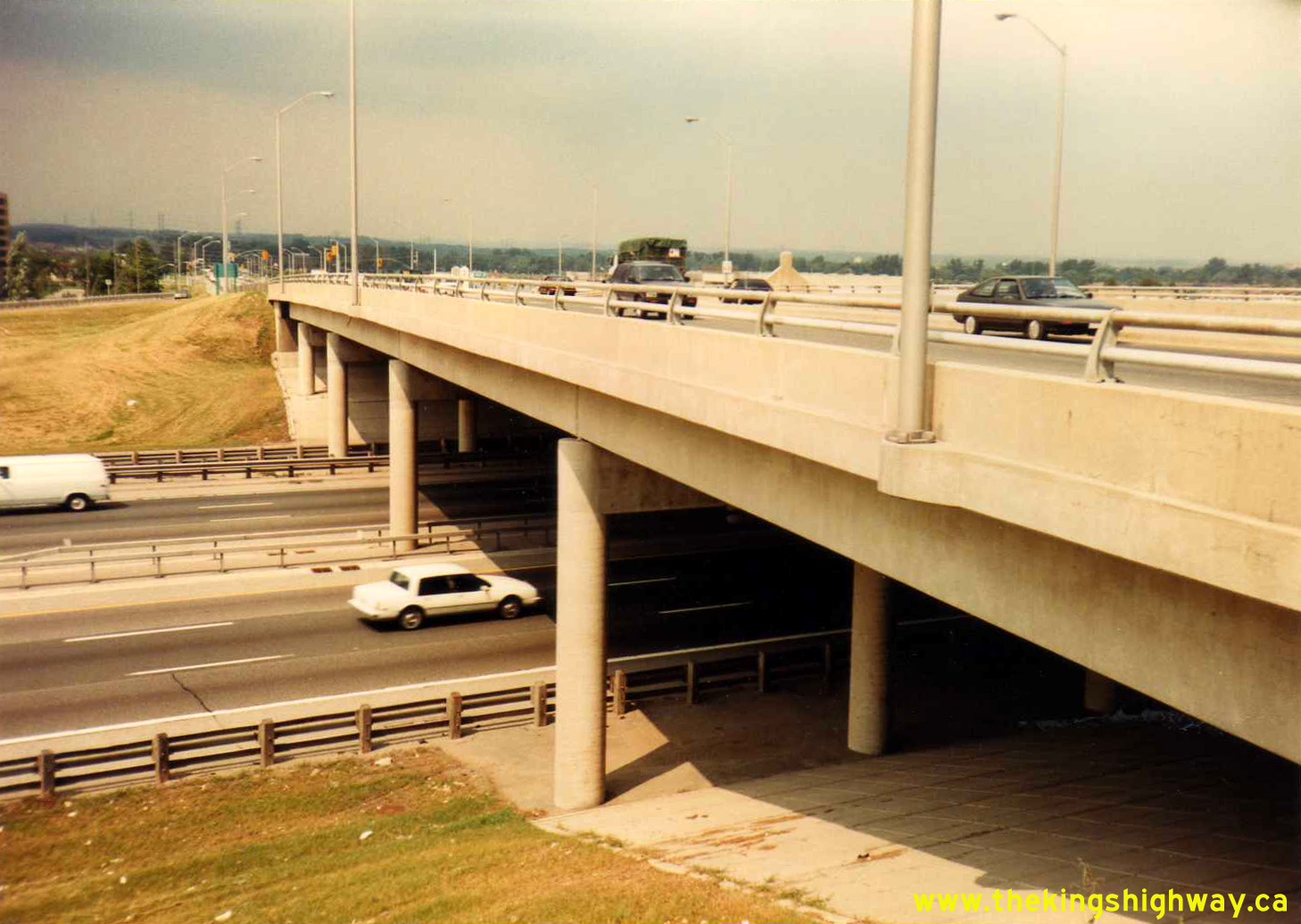
Left - View of the Hwy 401 eastbound exit ramp flyover to Yorkdale Road in Toronto across Dufferin Street (Site #37-284). See an
Enlarged Photo Here. Photo taken in September 1985. (Photo courtesy of Ontario Ministry of Transportation - © King's Printer for Ontario, 2011) Right - View of the First Line East Overpass (Site #24-181) on Hwy 401 in Mississauga in 1985, shortly before demolition. First Line East is known today as
Kennedy Road. This single-span concrete rigid frame structure had to be demolished in order to make way for the new west-oriented ramps to Hwy 410. When the
interchange at Hwy 401 & Hwy 410 was first constructed in the late 1970s, the interchange featured two east-oriented ramps only. It was not possible to construct
the west-oriented ramps initially, as there was not enough room below the old First Line East Overpass to fit any additional lanes. The First Line East (Kennedy
Road) Overpass seen here was replaced under Contract #1986-67. See an Enlarged Photo Here.
Photo taken on October 3, 1985.(Photo courtesy of Ontario Ministry of Transportation - © King's Printer for Ontario, 2025) 
 Left - Facing east along the eastbound Hwy 401 exit ramp to Dixie Road at the bridge over Tomken Road (Site #24-331). The top-level structure above
(Site #24-317) carries the ramp from the eastbound Hwy 403 Collector Lanes to the eastbound Hwy 401 Collector Lanes across Tomken Road and the eastbound Hwy 401 exit ramp
to Dixie Road. See an Enlarged Photo Here. Photo taken on October 3, 1985. Left - Facing east along the eastbound Hwy 401 exit ramp to Dixie Road at the bridge over Tomken Road (Site #24-331). The top-level structure above
(Site #24-317) carries the ramp from the eastbound Hwy 403 Collector Lanes to the eastbound Hwy 401 Collector Lanes across Tomken Road and the eastbound Hwy 401 exit ramp
to Dixie Road. See an Enlarged Photo Here. Photo taken on October 3, 1985.(Photo courtesy of Ontario Ministry of Transportation - © King's Printer for Ontario, 2025) Right - View of the Mississauga Road Overpass (Site #24-125) on Hwy 401 in Mississauga, facing south. See an
Enlarged Photo Here. Photo taken in October 3, 1985.(Photo courtesy of Ontario Ministry of Transportation - © King's Printer for Ontario, 2025) 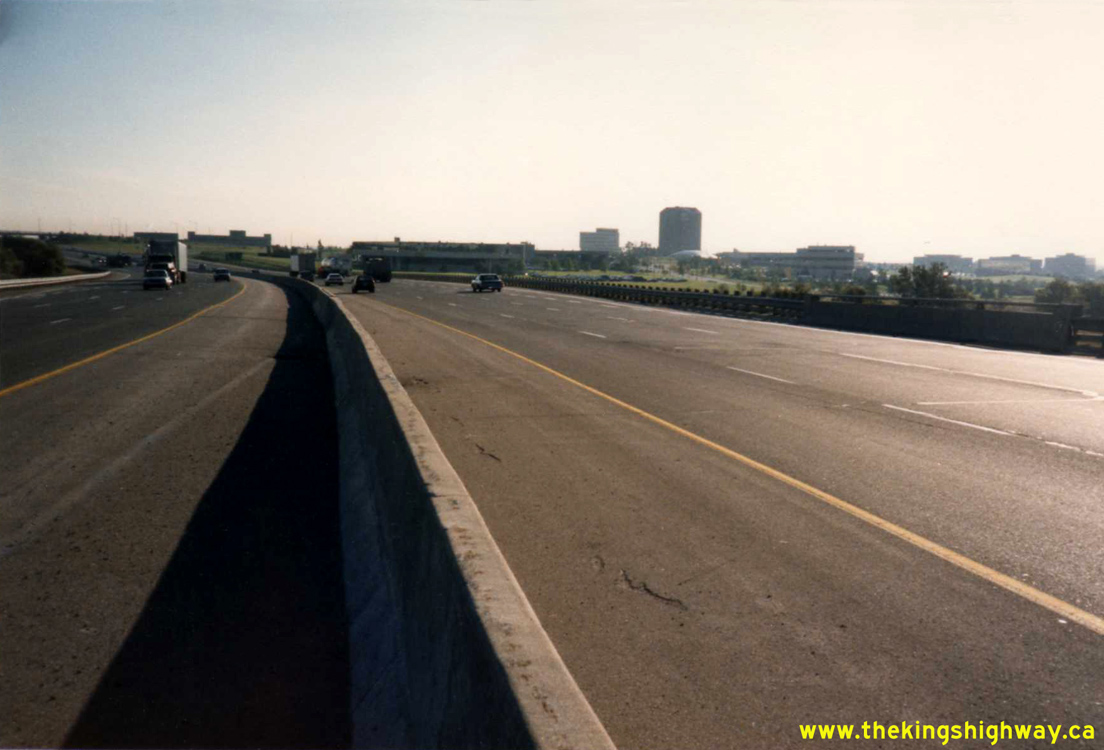
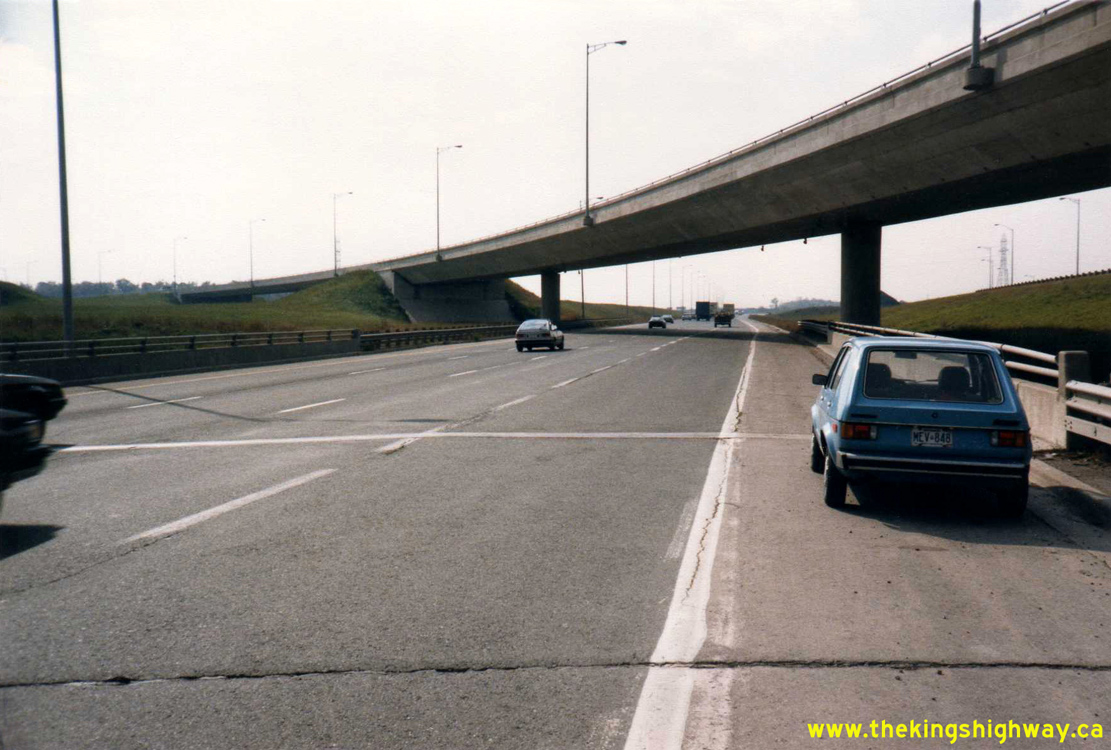 Left - Facing east along Hwy 401 towards Toronto from the Derry Road Underpass in Mississauga (Site #24-124). See an
Enlarged Photo Here. Photo taken in October 3, 1985. Left - Facing east along Hwy 401 towards Toronto from the Derry Road Underpass in Mississauga (Site #24-124). See an
Enlarged Photo Here. Photo taken in October 3, 1985.(Photo courtesy of Ontario Ministry of Transportation - © King's Printer for Ontario, 2025) Right - View of the westbound Hwy 401 Collector Lanes at the Tomken Road Underpass (Site #24-314) in Mississauga, facing west. At the time this photo was taken
in 1985, all westbound Hwy 401 traffic followed this roadway as the adjacent Hwy 401 Express Lanes has not been constructed yet. The top level flyover seen above
(Site #24-315) carries the westbound Hwy 403 Collector Lanes westerly towards the Mississauga City Centre. Construction got underway in 1977 on two of the ramp
connections between Hwy 401 and Hwy 403. Under Contract #1976-120, the flyovers carrying the westbound Hwy 403 Collector Lanes over both the eastbound and westbound
lanes of Hwy 401 were constructed, along with the eastbound flyover for the Hwy 403 Collector Lanes across Tomken Road and the eastbound Hwy 401 exit ramp to Dixie
Road. The flyover carrying the westbound Hwy 403 Collector Lanes over the proposed Hwy 401 Express Lanes was built under a subsequent construction project. See an
Enlarged Photo Here. Photo taken in October 9, 1985.(Photo courtesy of Ontario Ministry of Transportation - © King's Printer for Ontario, 2025) 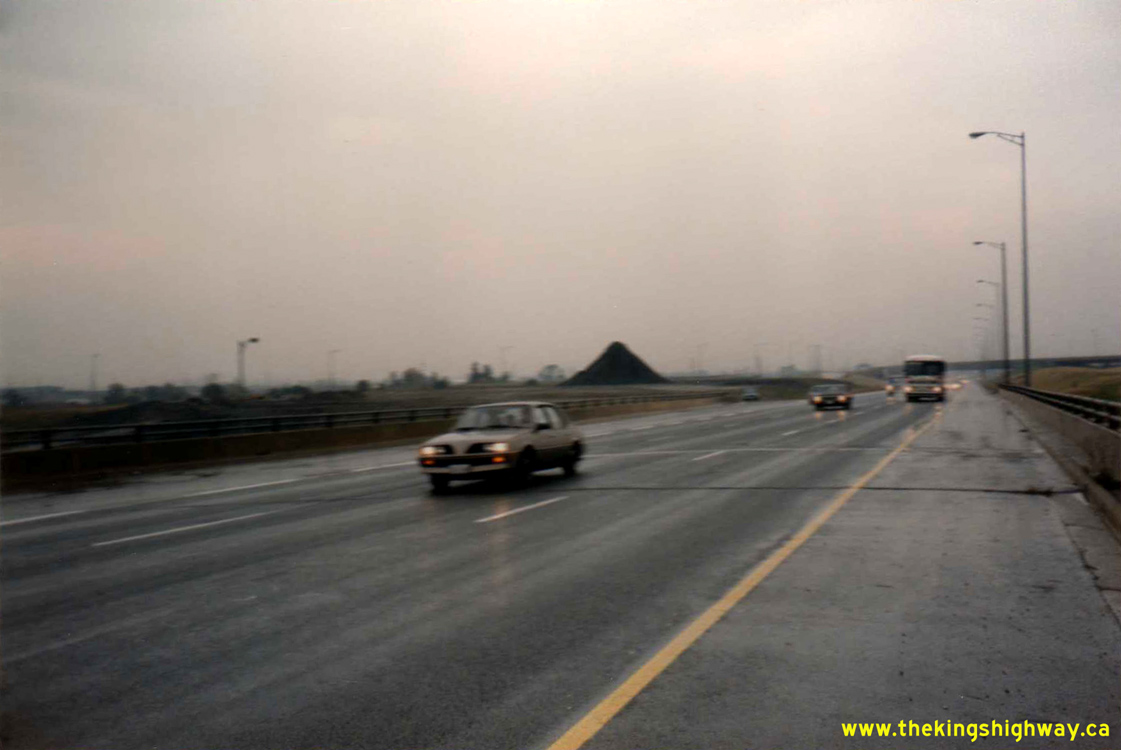

Left - View of the westbound lanes of Hwy 401 at the Hwy 410 Underpass (Site #24-323) in Mississauga, facing east towards the Dixie Road Interchange. See an
Enlarged Photo Here. Photo taken on October 9, 1985. (Photo courtesy of Ontario Ministry of Transportation - © King's Printer for Ontario, 2011) Right - Facing west along the westbound Hwy 401 Express Lanes at the Etobicoke Creek Bridge (Site #24-184) in Mississauga in 1985. Compare this 1985 photo to this 1981 Photo, taken from the eastbound lanes before the highway was widened. The section of Hwy 401 seen here in the vicinity of Pearson Airport is Ontario's widest highway, with a total of 18 through lanes (9 lanes per direction). See an Enlarged Photo Here. Photo taken on October 17, 1985. (Photo courtesy of Ontario Ministry of Transportation - © King's Printer for Ontario, 2011) 

Left - Newly-completed westbound Hwy 401 Collector Lanes, facing west from Etobicoke Creek in Mississauga. The new Hwy 401 Collector Lanes from the Hwy 403
Interchange to a point just west of the Hwy 427 Interchange were constructed under Contract #1983-71 and were completed in the Fall of 1985. See an
Enlarged Photo Here. Photo taken on October 17, 1985. (Photo courtesy of Ontario Ministry of Transportation - © King's Printer for Ontario, 2011) Right - Facing west across the newly-opened flyover on the westbound Hwy 403 Express Lanes over the eastbound Hwy 401 Collector Lanes (Site #24-466). This new
flyover was built as part of the construction of the Hwy 403 Express Lanes from the Hwy 401 Interchange westerly to the vicinity of the Eglinton Avenue Interchange in
Mississauga. The structure itself was built under Contract #1982-108, but it wasn't opened to traffic until 1984 due to the complicated construction sequencing at
this interchange. It was not possible to open the bridge to traffic until the westbound Hwy 403 Express Lanes were completed to Matheson Boulevard under Contract
#1983-68. See an Enlarged Photo Here. Photo taken on November 20, 1985.(Photo courtesy of Ontario Ministry of Transportation - © King's Printer for Ontario, 2025) 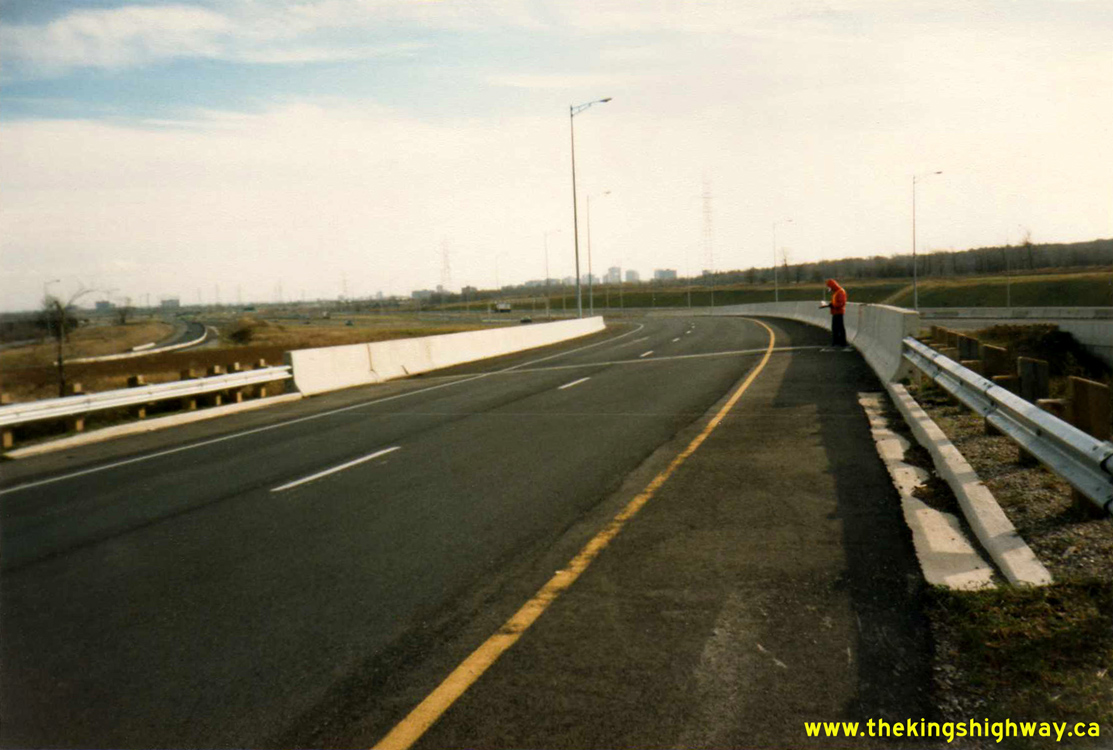
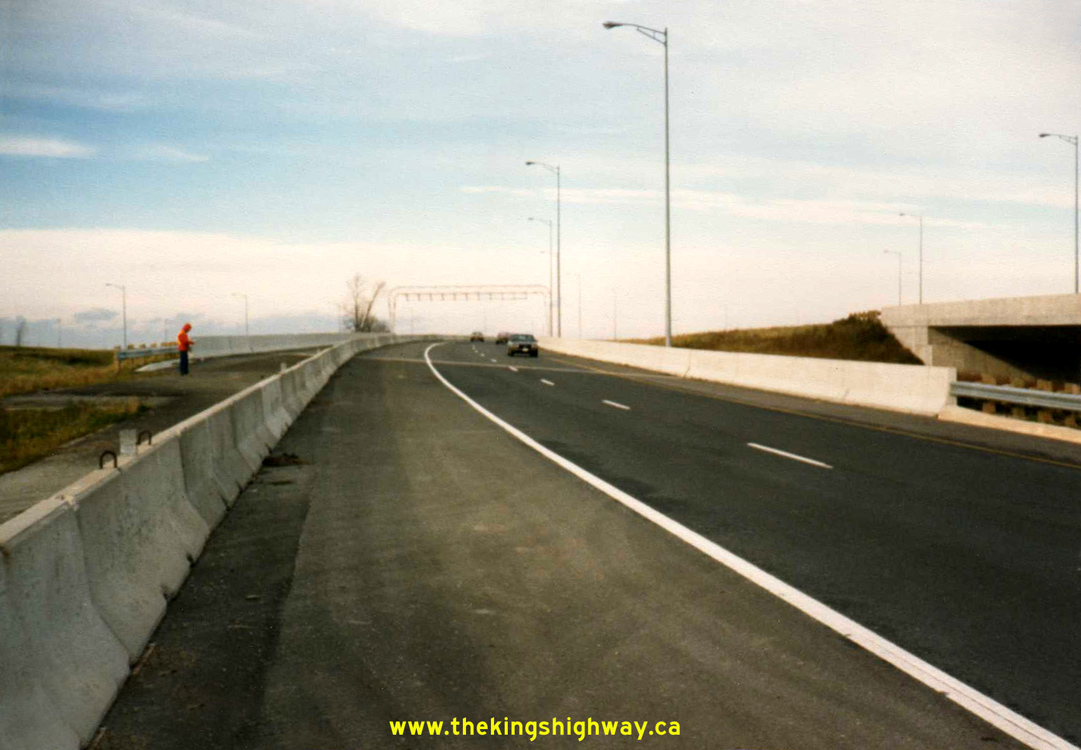 Left - View of the new flyover on the eastbound Hwy 403 Express Lanes crossing the future northbound lanes of Hwy 410 (Site #24-463) in 1985. This structure
was constructed under Contract #1982-107, but wasn't opened to traffic until 1985. Interestingly, this structure did not initially span any road and in fact was not
even fully excavated underneath until the ramp connections between Hwy 403 and Hwy 410 were constructed underneath Hwy 401 in the early 1990s. See an
Enlarged Photo Here. Photo taken in November 20, 1985. Left - View of the new flyover on the eastbound Hwy 403 Express Lanes crossing the future northbound lanes of Hwy 410 (Site #24-463) in 1985. This structure
was constructed under Contract #1982-107, but wasn't opened to traffic until 1985. Interestingly, this structure did not initially span any road and in fact was not
even fully excavated underneath until the ramp connections between Hwy 403 and Hwy 410 were constructed underneath Hwy 401 in the early 1990s. See an
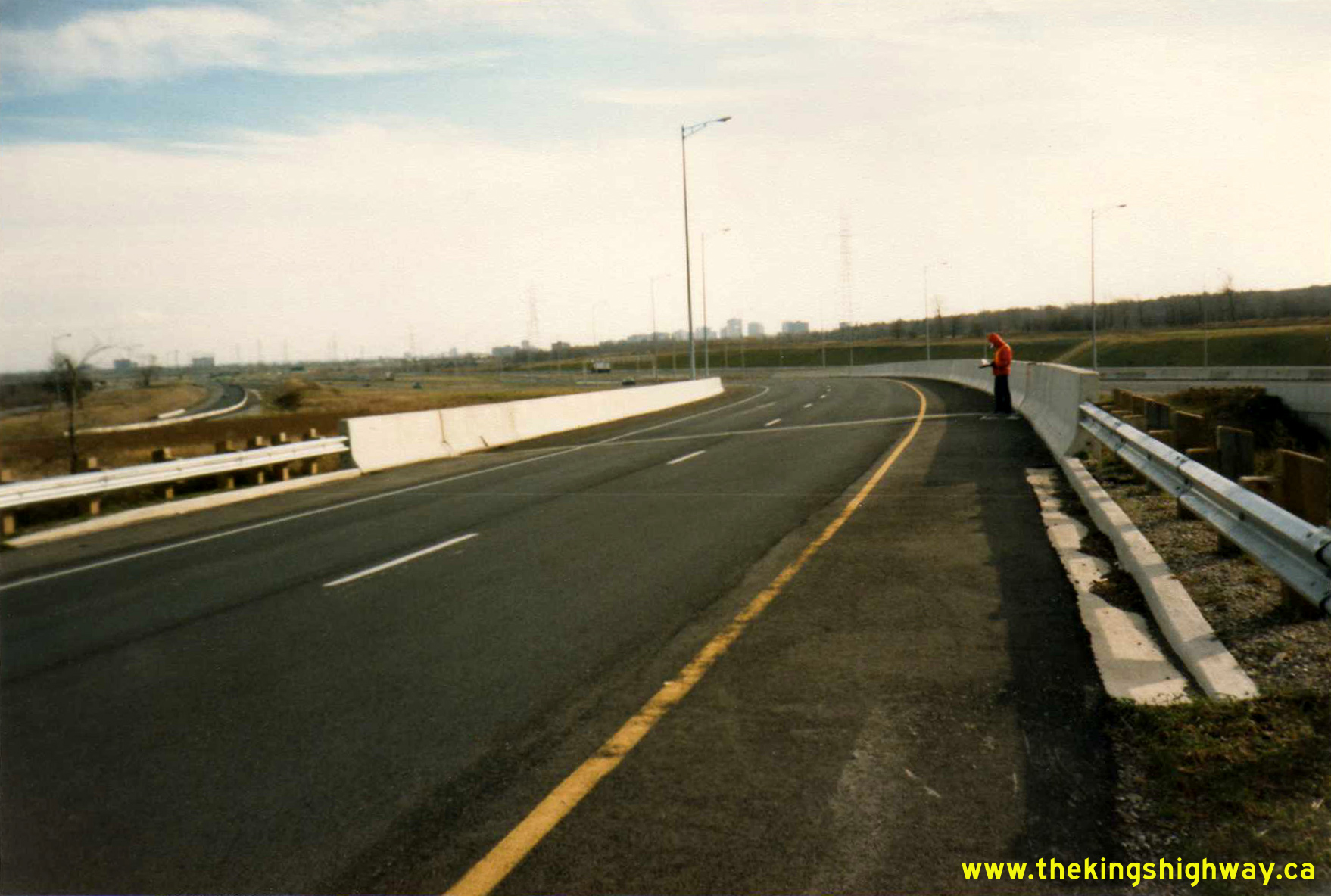
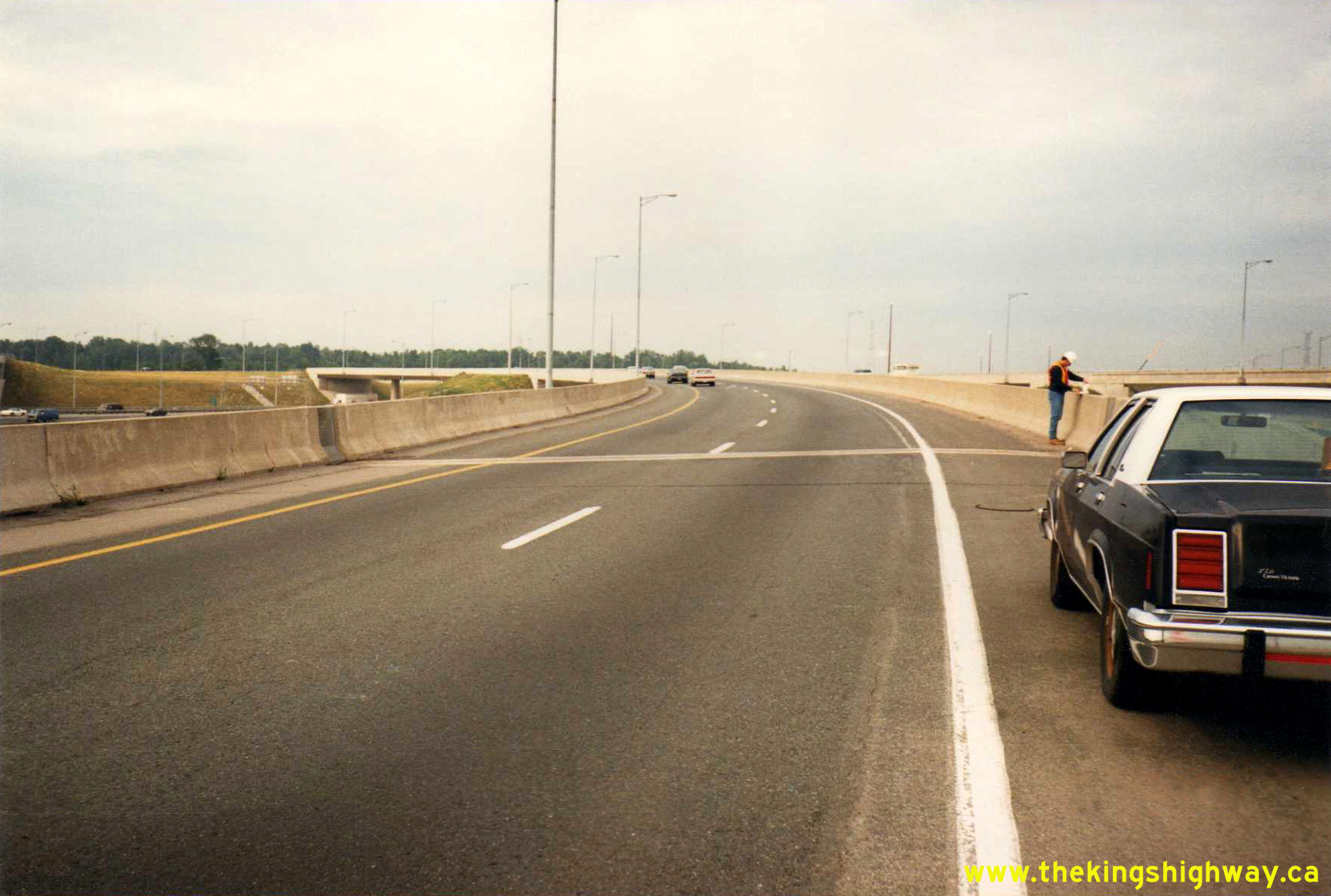
Enlarged Photo Here. Photo taken in November 20, 1985.(Photo courtesy of Ontario Ministry of Transportation - © King's Printer for Ontario, 2025) Right - View of the new flyover on the westbound Hwy 403 Express Lanes crossing the future northbound lanes of Hwy 410 (Site #24-464) in 1985. Similar to other
bridges at this interchange, this structure was constructed under Contract #1982-107 but sat unopened until 1984. During design of this interchange, provisions were
made for a future Hwy 403 Express-to-Collector Basketweave Transfer. This proposed transfer was roughed in, but was never actually built. Note the engineer in the
background, standing behind the concrete barrier at the point where the future basketweave transfer would have departed from the westbound Hwy 403 Express Lanes.
Under a subsequent construction contract, a simple Express-to-Collector Transfer Lane was built downstream of this location without a basketweave structure provided.
See an Enlarged Photo Here. Photo taken in November 20, 1985.(Photo courtesy of Ontario Ministry of Transportation - © King's Printer for Ontario, 2025) 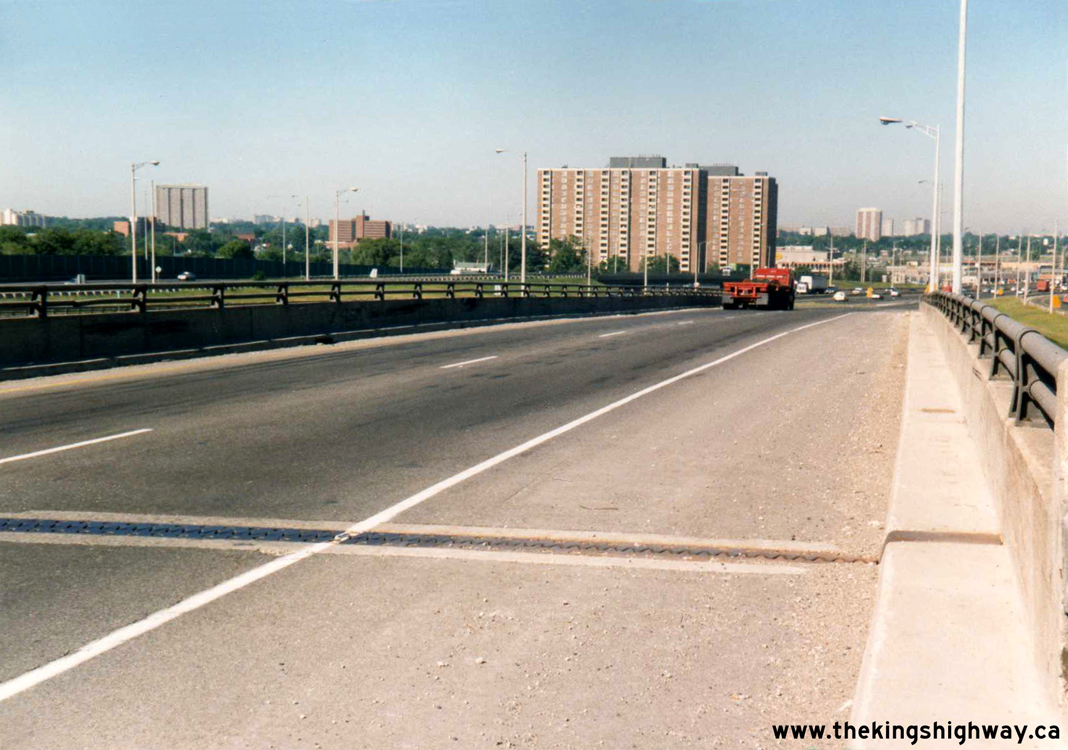

Left - Facing west along Hwy 401 at "The Basketweave" in Toronto. This interesting roadway feature was constructed in 1964-1965 near Jane Street under Contract
#1964-108, and was a first of its kind in Ontario. These simultaneous transfer ramps were built to minimize traffic weaving conflicts between the Keele Street and
Hwy 400 Interchanges. The top-level ramp carries traffic from the westbound Hwy 401 Collector Lanes to the westbound Hwy 401 Express Lanes. The lower level of this
structure carries the westbound Hwy 401 Express-to-Collector Transfer Ramp. See an
Enlarged Photo Here. Photo taken in May 1986. (Photo courtesy of Ontario Ministry of Transportation - © King's Printer for Ontario, 2011) Right - View of the northern side of The Basketweave Overpass on Hwy 401 in Toronto, facing west towards the Hwy 400 Interchange. The lower-level westbound Hwy 401 Express-to Collector Ramp can be seen emerging from below the structure. See an Enlarged Photo Here. Photo taken in May 1986. (Photo courtesy of Ontario Ministry of Transportation - © King's Printer for Ontario, 2011) 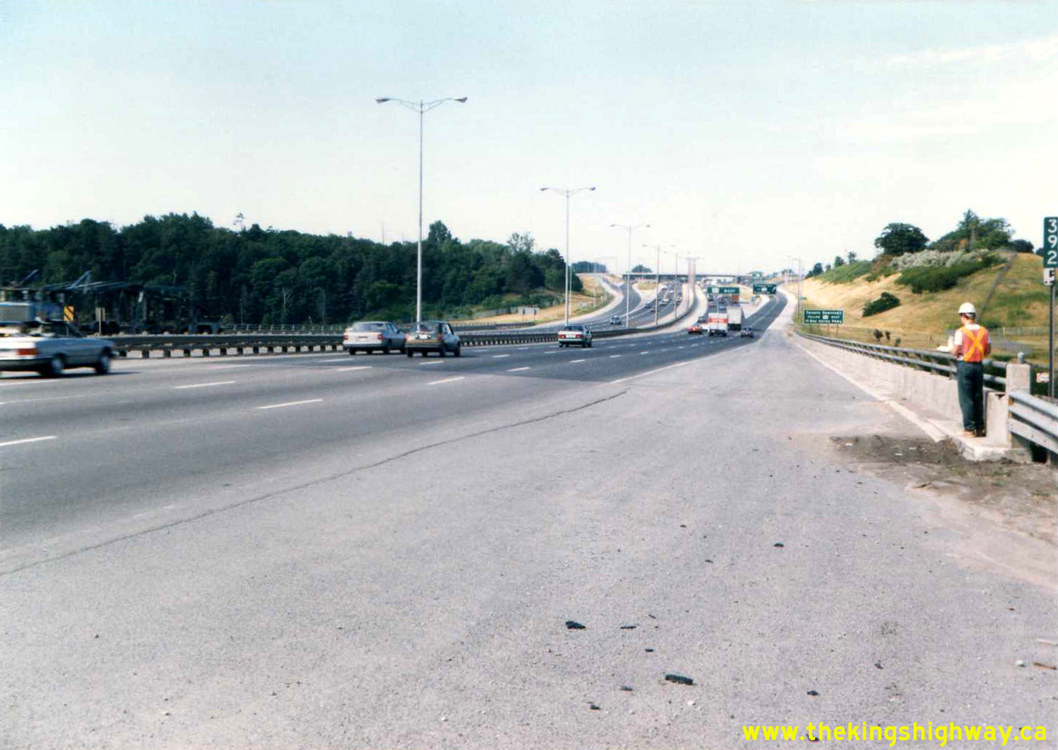
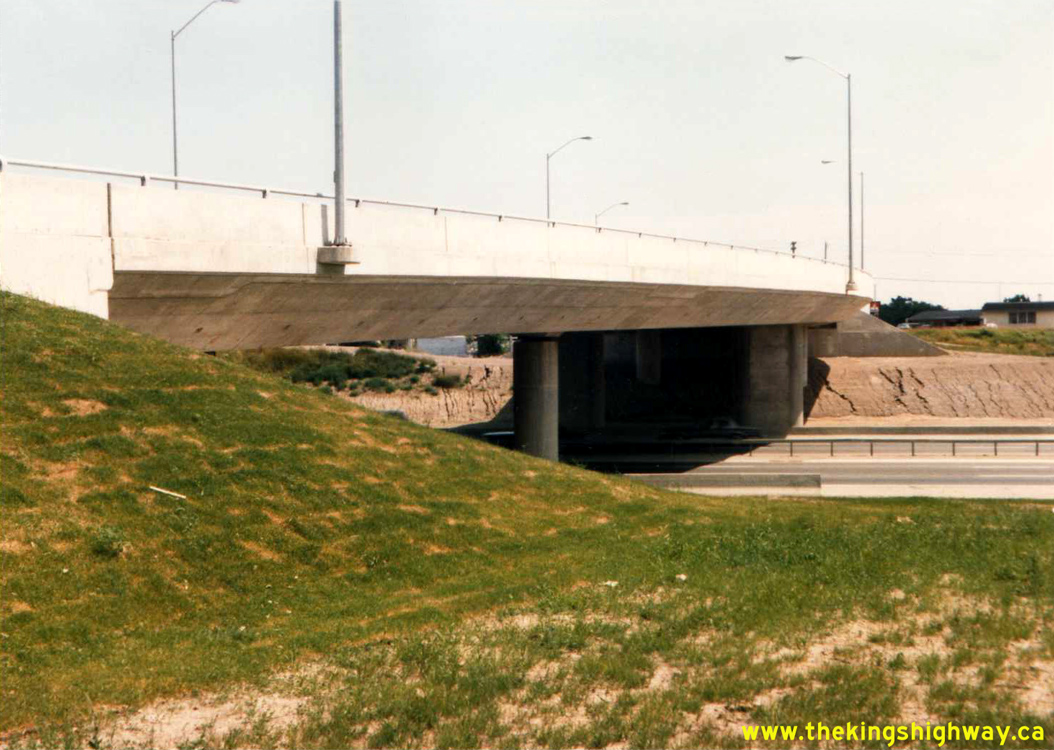
Left - Facing west along the westbound lanes of Hwy 401 towards the Port Union Road and Hwy 2A Interchange from the Rouge River Bridge (Site #22-161) in
Toronto. When the original 1940s-era Rouge River Bridges were replaced with wider structures in the early 1970s, additional space was provided across the bridge decks
to allow for a future expansion of Hwy 401. See an Enlarged Photo Here. Photo taken on July
15, 1986. (Photo courtesy of Ontario Ministry of Transportation - © King's Printer for Ontario, 2011) Right - Western side of the new Liverpool Road Overpass on Hwy 401 in Pickering. The new Liverpool Road Interchange was actually constructed by GO Transit as part of the extension of commuter rail service into Durham Region. The old 1940s-era Liverpool Road Overpass which previously stood at this location was built on the Toronto-Oshawa Dual Highway under Contract #1946-69 and was completed in 1947. As part of the Liverpool Road Interchange's reconstruction in 1984 under GO Transit's Contract #GGE-312, the old Liverpool Road Overpass was replaced along with an interim structure built during the 1970s over the westbound on-ramp on the northern side of Hwy 401. The old Liverpool Road Railway Overhead located a short distance to the south of Hwy 401 was also replaced. The eastbound Hwy 401 exit ramp to Liverpool Road was closed permanently as a result of this interchange reconstruction, since the new Liverpool Road structure spanned both Hwy 401 and the proposed GO Transit railway line. See an Enlarged Photo Here. Photo taken on July 15, 1986. (Photo courtesy of Ontario Ministry of Transportation - © King's Printer for Ontario, 2011) 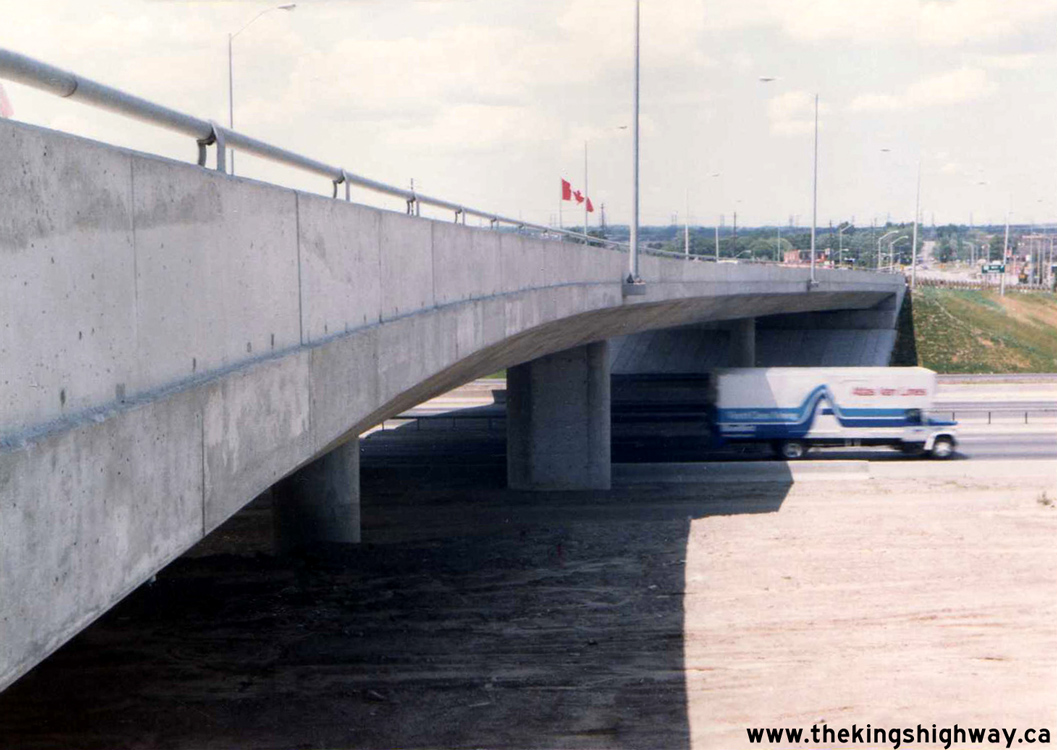
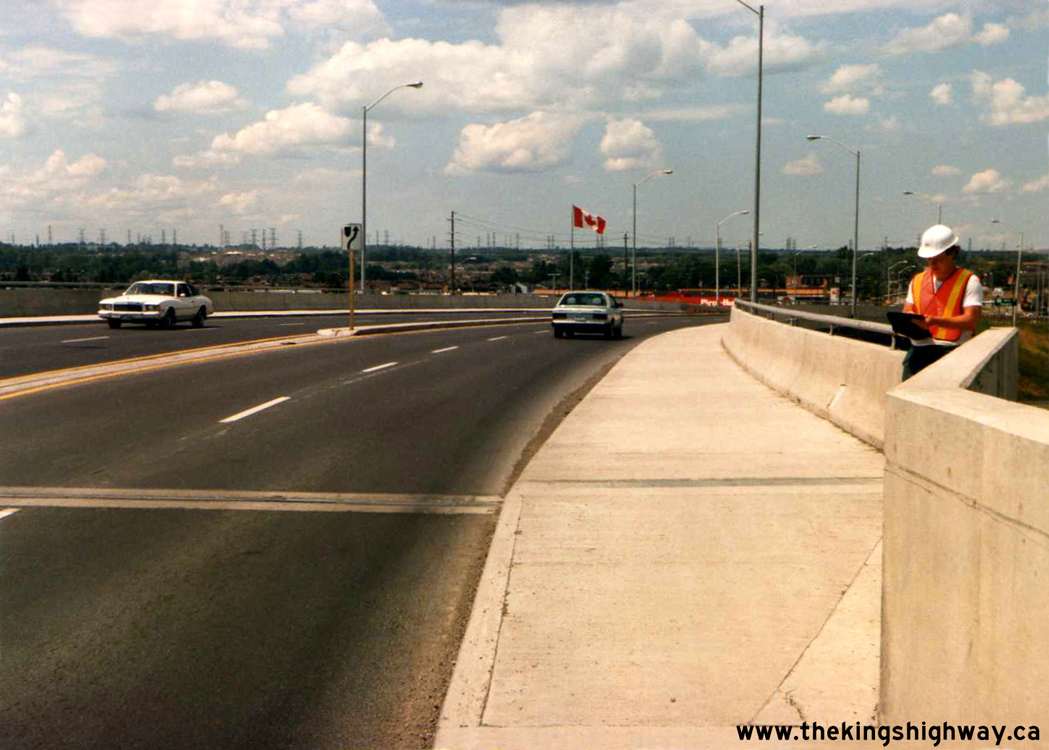
Left - Eastern side of the new Liverpool Road Overpass (Site #22-219) on Hwy 401 in Pickering. During replacement of the old Liverpool Road Overpass, the new
northbound Liverpool Road (east) structure was built first. Once it was completed and opened to traffic, the old Liverpool Road Overpass was closed and demolished.
The new southbound Liverpool Road (west) structure was then built in its place. See an
Enlarged Photo Here. Photo taken on July 15, 1986. (Photo courtesy of Ontario Ministry of Transportation - © King's Printer for Ontario, 2011) Right - Facing north across the new Liverpool Road Overpass on Hwy 401 in Pickering. This structure spans both Hwy 401 as well as the adjacent GO Transit
railway corridor, which had not yet been built in these 1986 photos. The replacement of the old Liverpool Road Bridge and interchange was necessary in order to extend
GO Transit commuter rail service easterly into Whitby. See an Enlarged Photo Here. Photo
taken on July 15, 1986.(Photo courtesy of Ontario Ministry of Transportation - © King's Printer for Ontario, 2025) 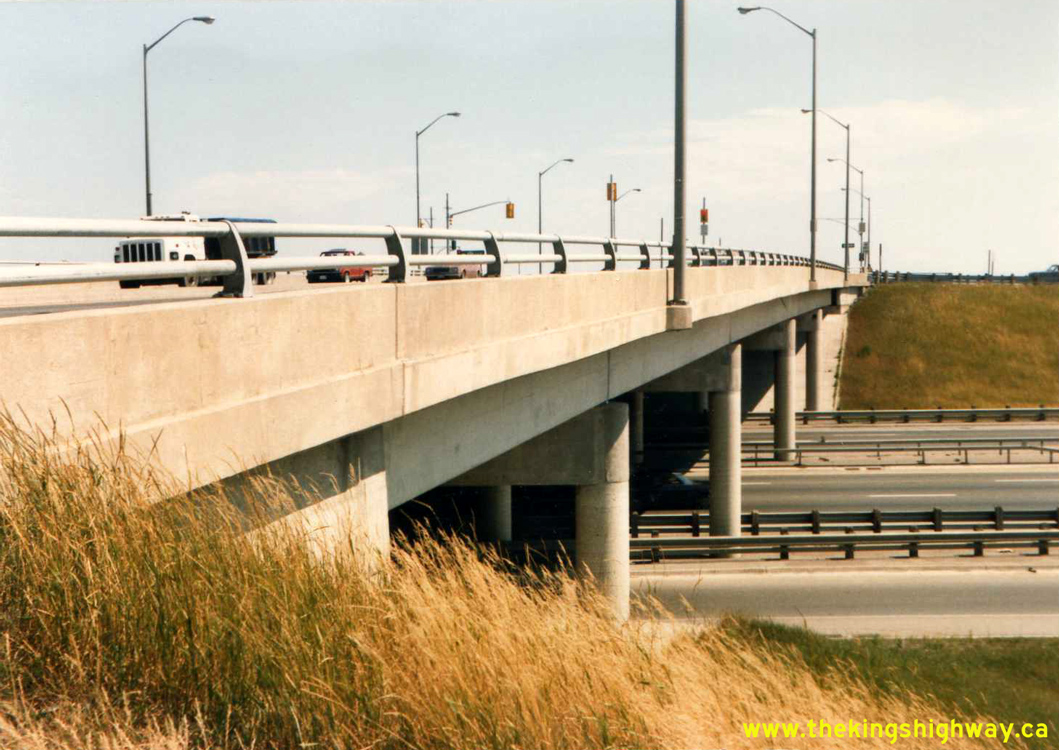
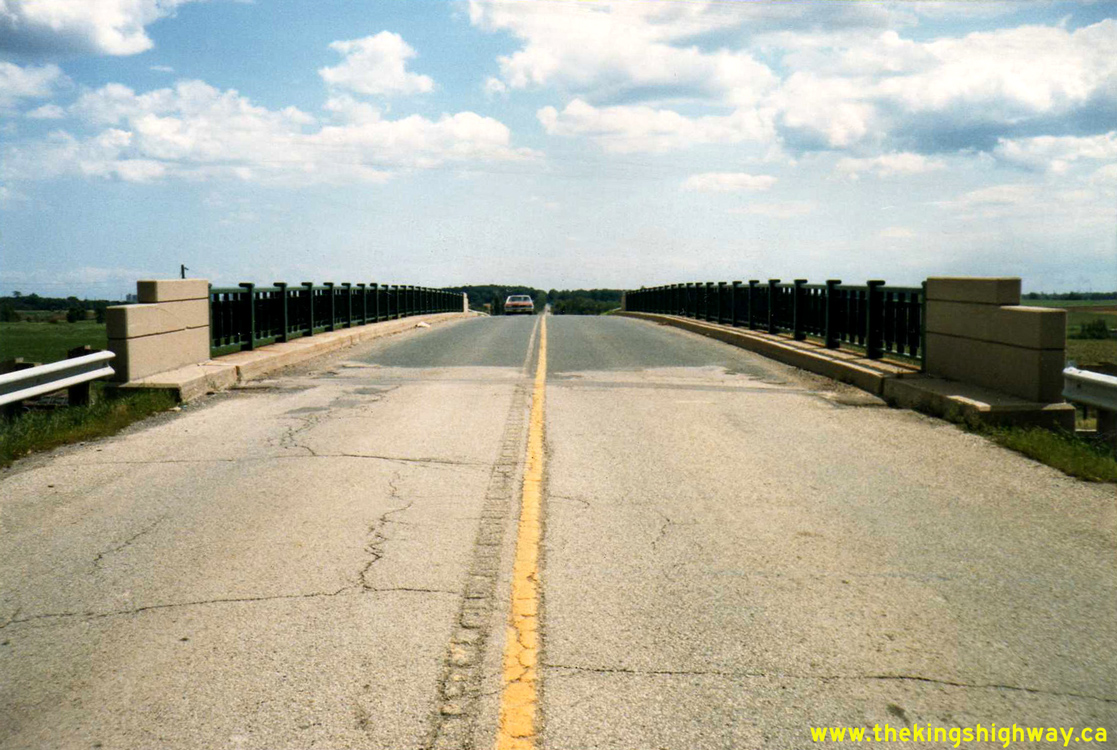 Left - Brock Road Overpass (Site #22-275) on Hwy 401 in Pickering. This was an entirely new interchange built along Hwy 401 during the 1970s under Contract
#1973-41. Previously, Brock Road did not cross Hwy 401 at all and came to a dead-end just to the north of the freeway. See an
Enlarged Photo Here. Photo taken on July 15, 1986. Left - Brock Road Overpass (Site #22-275) on Hwy 401 in Pickering. This was an entirely new interchange built along Hwy 401 during the 1970s under Contract
#1973-41. Previously, Brock Road did not cross Hwy 401 at all and came to a dead-end just to the north of the freeway. See an
Enlarged Photo Here. Photo taken on July 15, 1986.(Photo courtesy of Ontario Ministry of Transportation - © King's Printer for Ontario, 2025) Right - Facing south across the McLaughlin Road Overpass (Site #24-131) on Hwy 401 in Mississauga in 1986. This rural scene has changed quite dramatically over
the past few decades. McLaughlin Road is now a busy four-lane arterial street and all lands around this overpass have become urbanized since this photo was taken. See
an Enlarged Photo Here. Photo taken on August 12, 1986.(Photo courtesy of Ontario Ministry of Transportation - © King's Printer for Ontario, 2025) 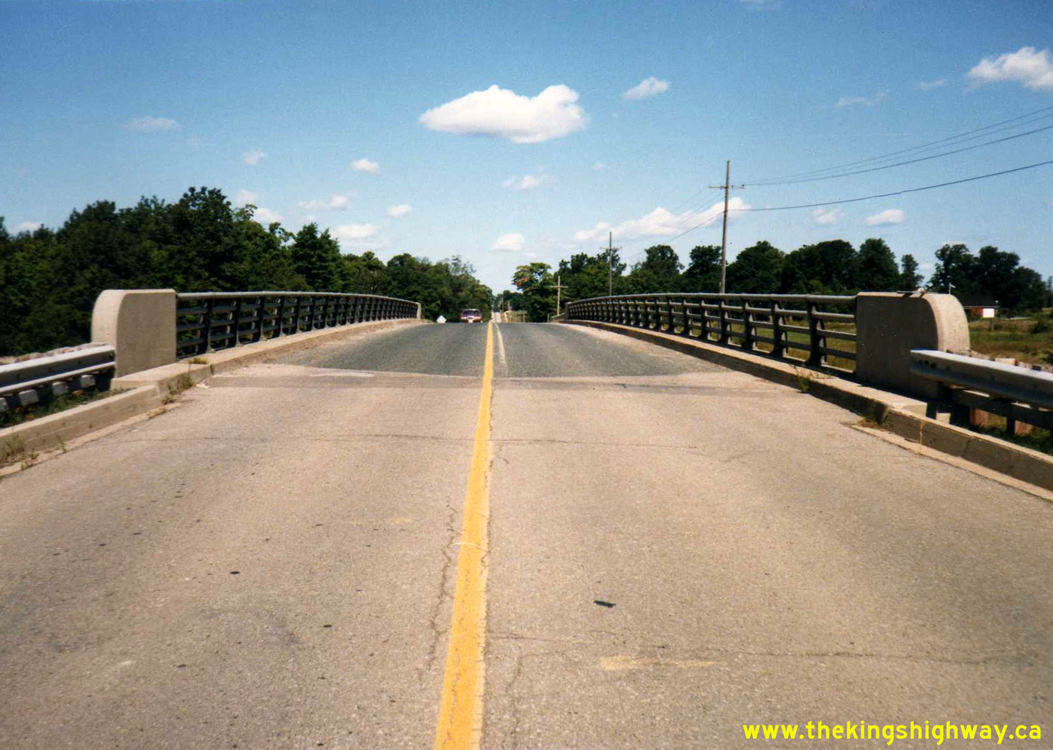
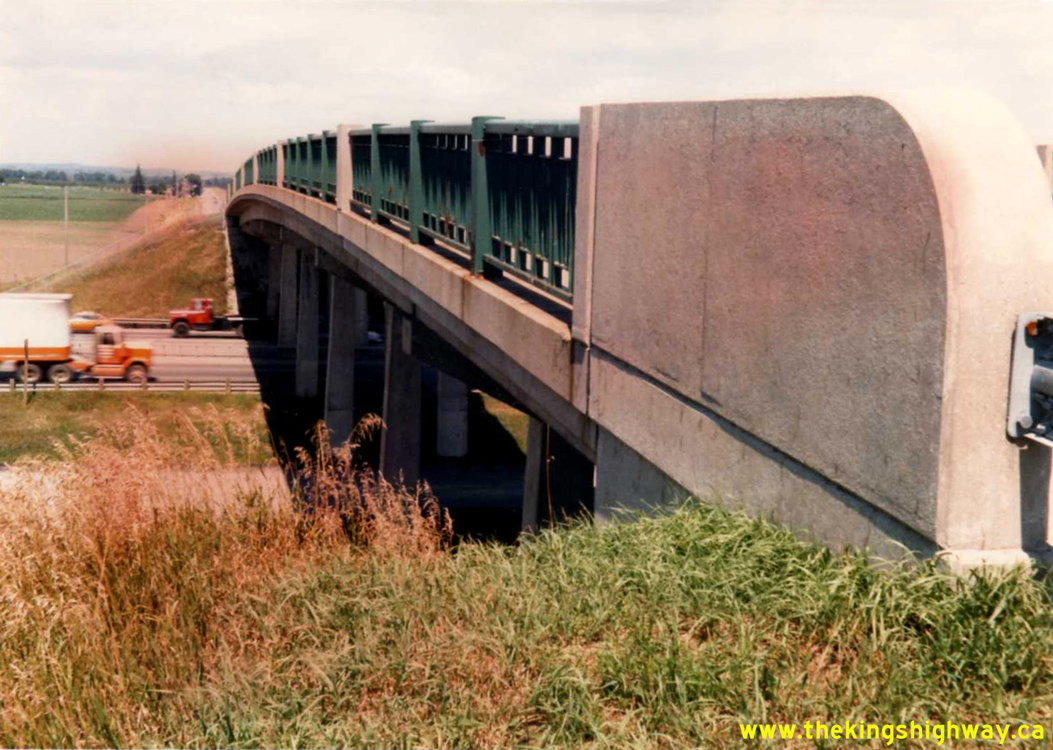 Left - Facing north across the 2nd Line West Overpass (Site #24-130) on Hwy 401 in Mississauga. Before the construction of the Mavis Road Interchange on
Hwy 401 in the late 1990s, this was the main road leading into the small community of Meadowvale from the south. This bridge was removed in 2017 as part of the
expansion of Hwy 401 from 6 to 12 lanes. See an Enlarged Photo Here. Photo taken on August
12, 1986. Left - Facing north across the 2nd Line West Overpass (Site #24-130) on Hwy 401 in Mississauga. Before the construction of the Mavis Road Interchange on
Hwy 401 in the late 1990s, this was the main road leading into the small community of Meadowvale from the south. This bridge was removed in 2017 as part of the
expansion of Hwy 401 from 6 to 12 lanes. See an Enlarged Photo Here. Photo taken on August
12, 1986.(Photo courtesy of Ontario Ministry of Transportation - © King's Printer for Ontario, 2025) Right - Western side of the Lakeridge Road Overpass (Site #22-122) on Hwy 401 in Whitby. This lengthy overpass was constructed under Contract #1960-59. It spans
both Hwy 401 and the adjacent railway line. Prior to the completion of this structure, Lakeridge Road crossed Hwy 401 via an at-grade intersection. The Toronto-Oshawa
Dual Highway was originally designed with full access control in mind, with all major roads grade-separated and connected to the new highway via interchanges. However,
World War II broke out soon after construction has started on the new highway. Due to the difficulty in obtaining sufficient structural steel and other materials for
bridges during and after World War II, it meant that some low-volume roads had to be left with at-grade intersections operating when this section of Hwy 401 was first
opened to traffic in December 1947. See an Enlarged Photo Here. Photo taken on August 13,
1986.(Photo courtesy of Ontario Ministry of Transportation - © King's Printer for Ontario, 2025) 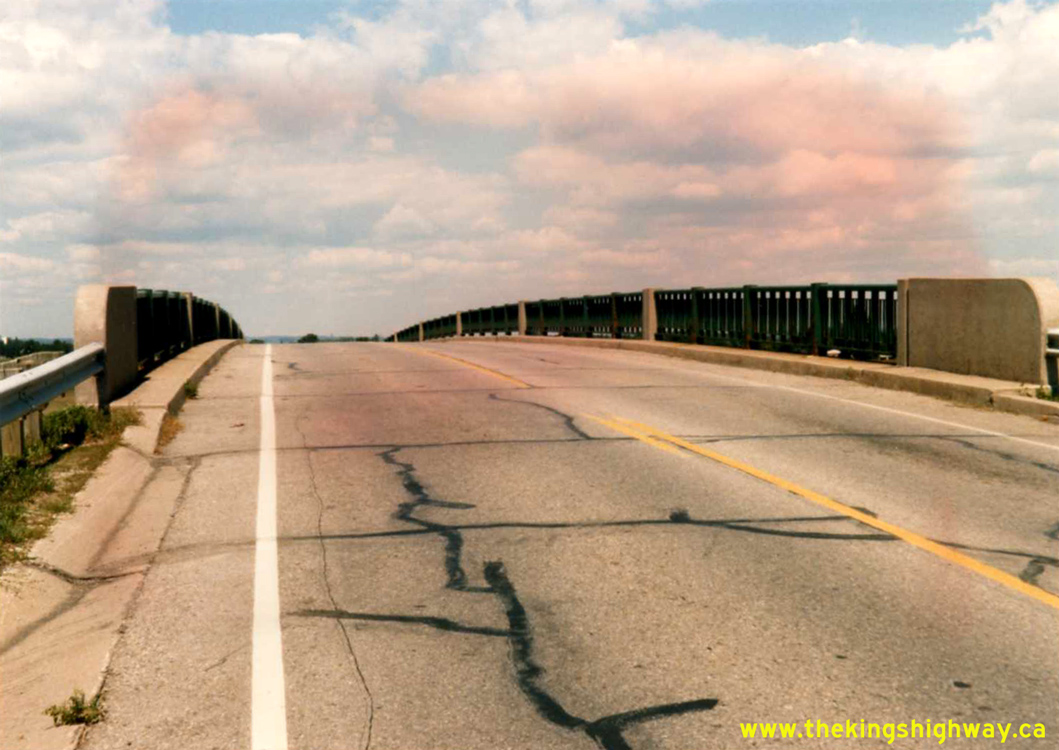
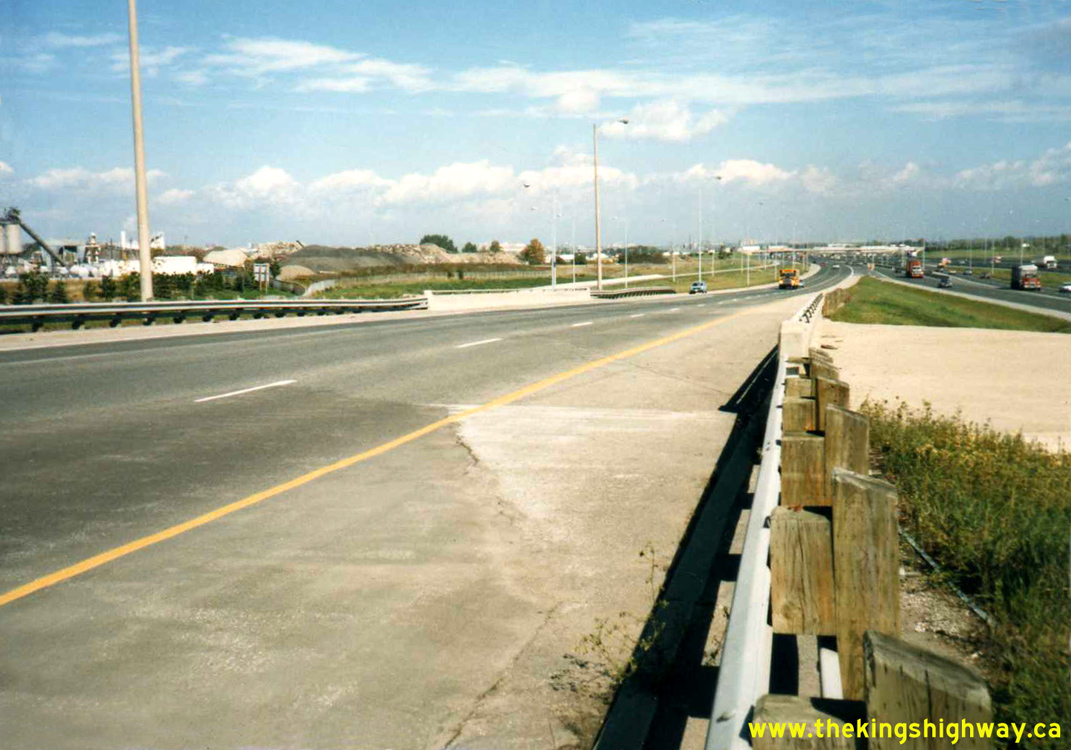 Left - Facing north across the Lakeridge Road Overpass on Hwy 401 in Whitby. This bridge has a very pronounced vertical crest curve. See an
Enlarged Photo Here. Photo taken on August 13, 1986. Left - Facing north across the Lakeridge Road Overpass on Hwy 401 in Whitby. This bridge has a very pronounced vertical crest curve. See an
Enlarged Photo Here. Photo taken on August 13, 1986.(Photo courtesy of Ontario Ministry of Transportation - © King's Printer for Ontario, 2025) Right - View of the westbound Hwy 401 exit ramp to Hwy 403 & Hwy 410 over the Dixie Road Ramp Basketweave structure (Site #24-330) in 1986. Here, the sub-collector lanes from Dixie Road to the westbound Hwy 401 pass below the exit ramps to Hwy 403 & Hwy 410. Also, note that at the time this photo was taken in 1986, the westbound Hwy 401 Express-Collector Lane System collapsed into a single westbound roadway at right. It wasn't until the early 1990s that the Hwy 401 Express Lanes were completed to a point west of the Hwy 410 Interchange. See an Enlarged Photo Here. Photo taken on September 24, 1986. (Photo courtesy of Ontario Ministry of Transportation - © King's Printer for Ontario, 2011) 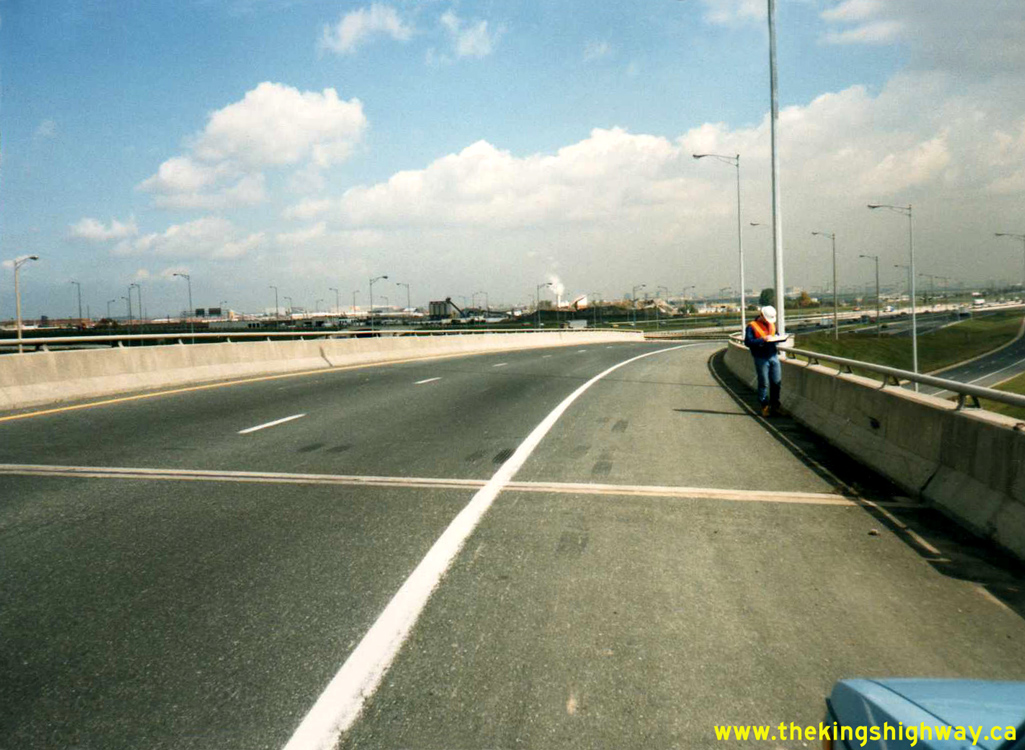
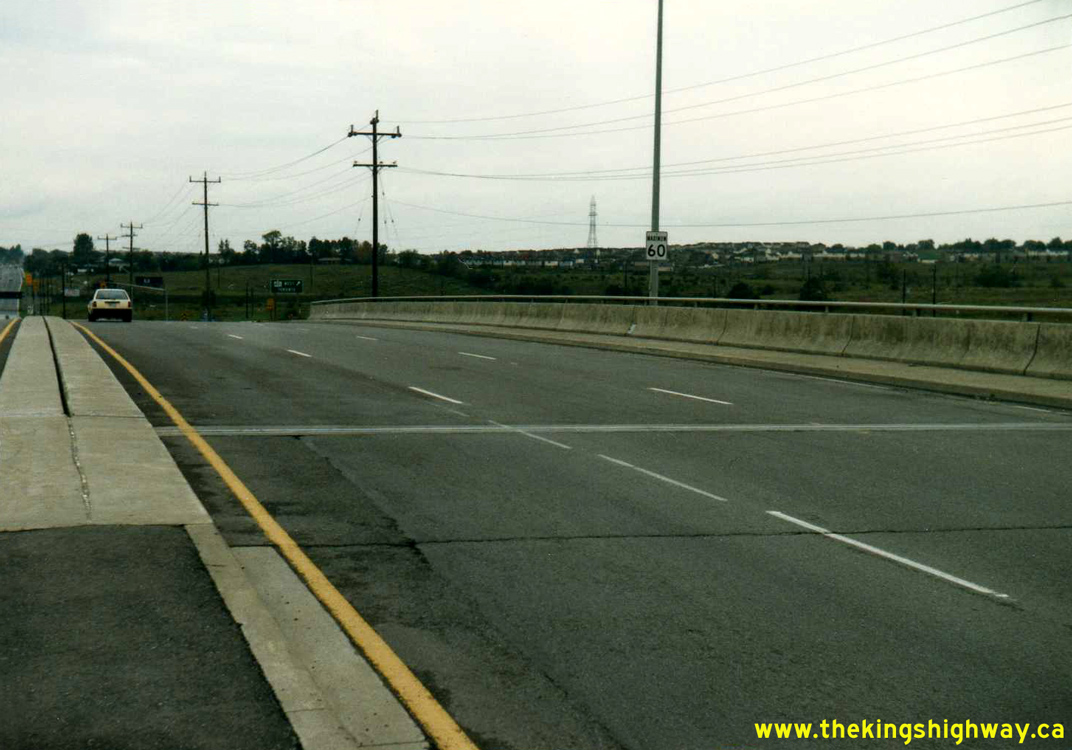 Left - Facing east across the flyover carrying the eastbound Hwy 403 Collector Lanes over Tomken Road and Dixie Road exit ramp (Site #24-317). This was one of
several bridges built under Contract #1976-120 as part of the connections between Hwy 403 and Hwy 401. See an
Enlarged Photo Here. Photo taken on September 24, 1986. Left - Facing east across the flyover carrying the eastbound Hwy 403 Collector Lanes over Tomken Road and Dixie Road exit ramp (Site #24-317). This was one of
several bridges built under Contract #1976-120 as part of the connections between Hwy 403 and Hwy 401. See an
Enlarged Photo Here. Photo taken on September 24, 1986.(Photo courtesy of Ontario Ministry of Transportation - © King's Printer for Ontario, 2025) Right - Facing north along the northbound lanes of the Thickson Road Overpass (Site #22-171) on Hwy 401 in Whitby. See an
Enlarged Photo Here. Photo taken on September 30, 1986.(Photo courtesy of Ontario Ministry of Transportation - © King's Printer for Ontario, 2025) 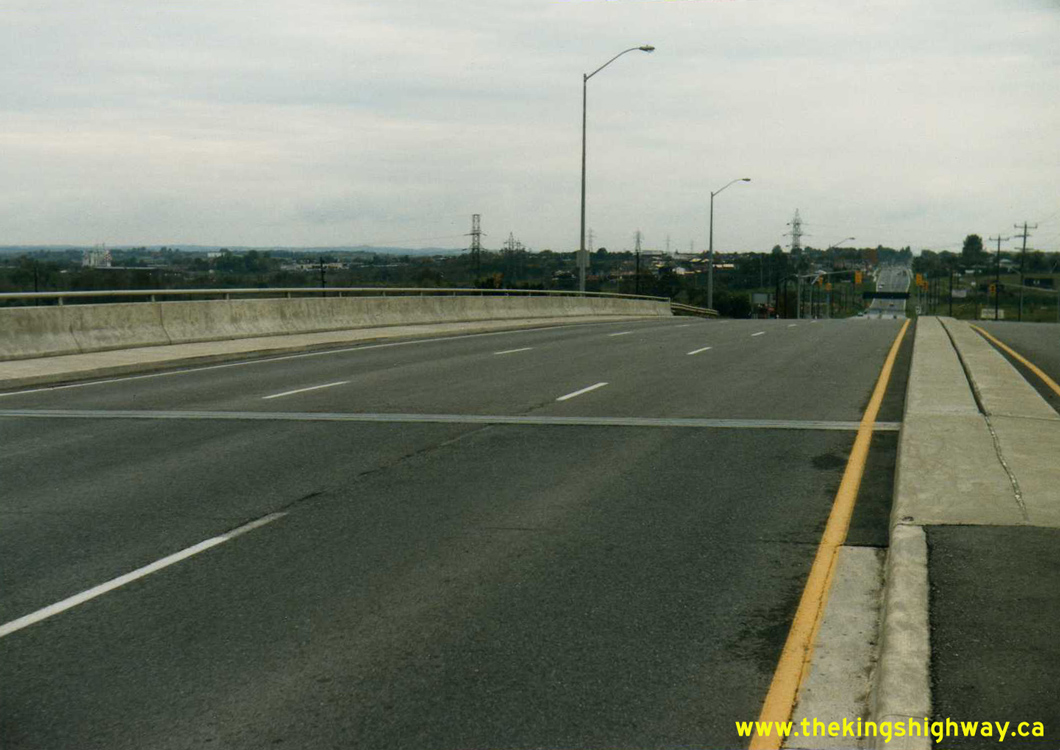
 Left - View of the southbound lanes of the Thickson Road Overpass on Hwy 401 in Whitby, facing north. This new overpass was constructed under Contract
#1982-72 as part of a project to replace the original Thickson Road Overpass, which was built on the Toronto-Oshawa Highway back in 1947. The replacement southbound
structure was built first, so that it could carry Thickson Road traffic temporarily while the old Thickson Road Overpass was being demolished. The new northbound
structure was built in its place, and once completed, it began to carry northbound traffic only. See an
Enlarged Photo Here. Photo taken on September 30, 1986. Left - View of the southbound lanes of the Thickson Road Overpass on Hwy 401 in Whitby, facing north. This new overpass was constructed under Contract
#1982-72 as part of a project to replace the original Thickson Road Overpass, which was built on the Toronto-Oshawa Highway back in 1947. The replacement southbound
structure was built first, so that it could carry Thickson Road traffic temporarily while the old Thickson Road Overpass was being demolished. The new northbound
structure was built in its place, and once completed, it began to carry northbound traffic only. See an
Enlarged Photo Here. Photo taken on September 30, 1986.(Photo courtesy of Ontario Ministry of Transportation - © King's Printer for Ontario, 2025) Right - Western side of the Thickson Road Overpass on Hwy 401 in Whitby. The replacement structure was completed in 1983. See an
Enlarged Photo Here. Photo taken on September 30, 1986.(Photo courtesy of Ontario Ministry of Transportation - © King's Printer for Ontario, 2025) 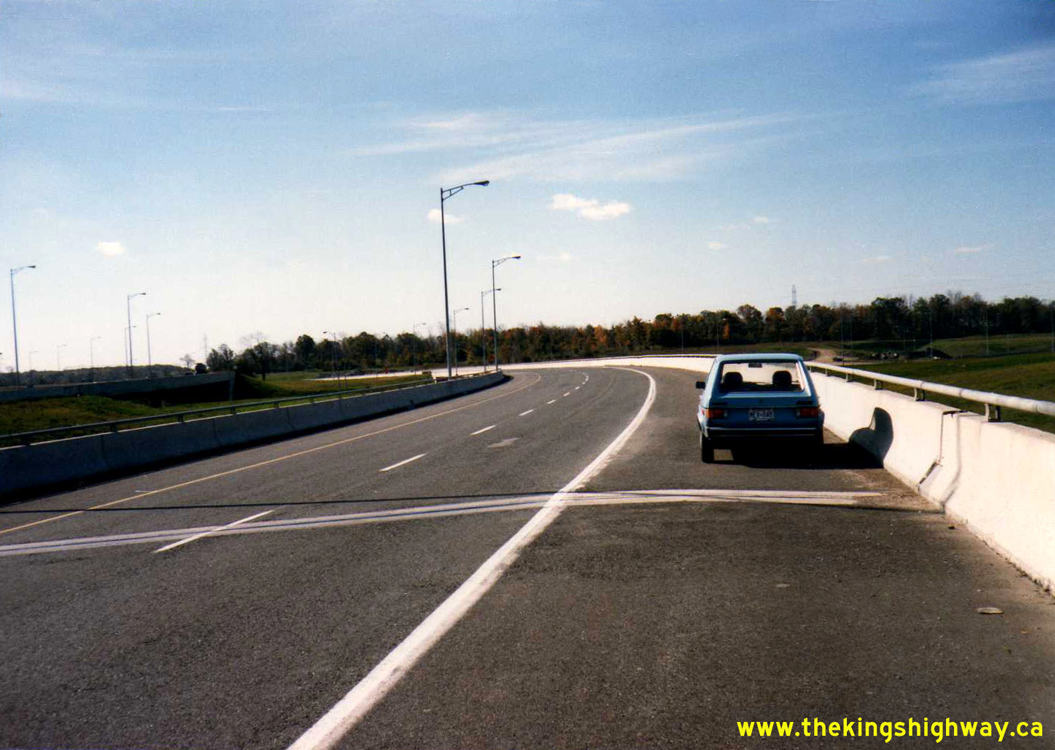
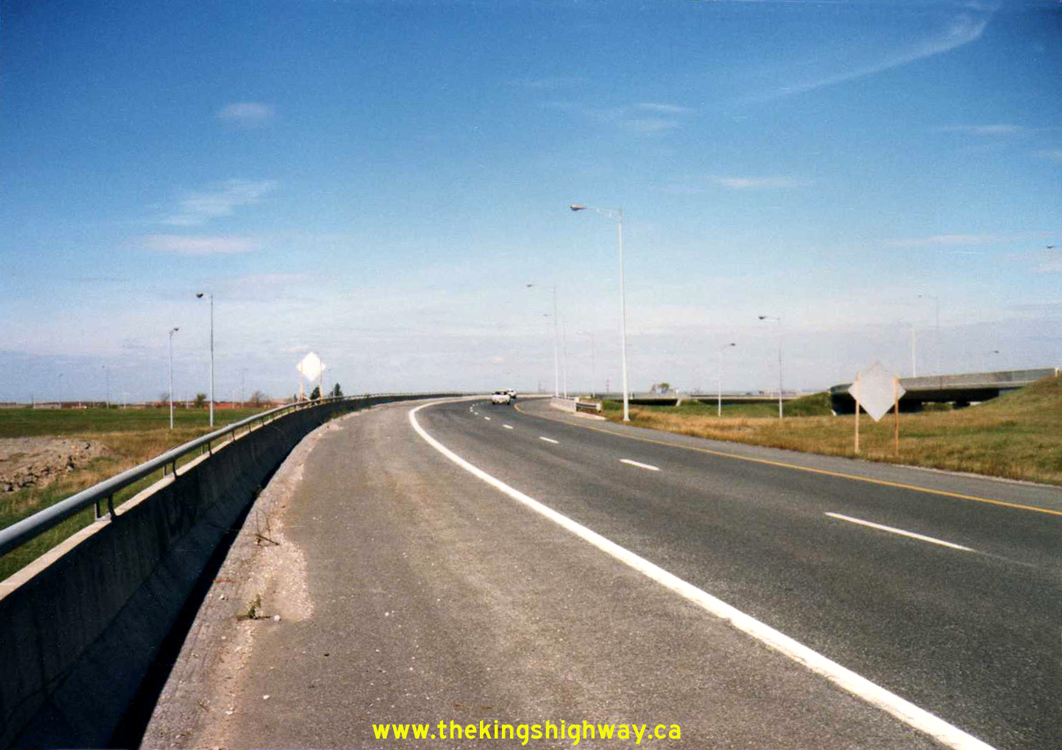 Left - View of the new flyover carrying the westbound Hwy 403 Collector Lanes over the proposed Hwy 401 Express Lanes (Site #24-329) in Mississauga in 1986.
When this ramp to Hwy 403 was initially built in the 1970s, only the flyovers crossing the existing lanes of Hwy 401 were built. Although planned for future
construction, a decision was made at that time not to construct the flyover for the westbound Hwy 403 Collector Lanes over the proposed Hwy 401 Express Lanes until a
later date. This decision ultimately created a construction sequencing problem, as it was not possible to build the structure over the Hwy 401 Express Lanes while
this ramp to Hwy 403 was open to traffic. Accordingly, construction had to be accelerated on the westbound Hwy 403 Express Lanes in order for that roadway to serve
as a detour for all westbound Hwy 403 traffic. The westbound Hwy 403 Collector Lanes were temporarily closed for a period in 1984-1985 in order to allow construction
of this flyover, which was carried out under Contract #1983-68. See an Enlarged Photo Here.
Photo taken on October 7, 1986. Left - View of the new flyover carrying the westbound Hwy 403 Collector Lanes over the proposed Hwy 401 Express Lanes (Site #24-329) in Mississauga in 1986.
When this ramp to Hwy 403 was initially built in the 1970s, only the flyovers crossing the existing lanes of Hwy 401 were built. Although planned for future
construction, a decision was made at that time not to construct the flyover for the westbound Hwy 403 Collector Lanes over the proposed Hwy 401 Express Lanes until a
later date. This decision ultimately created a construction sequencing problem, as it was not possible to build the structure over the Hwy 401 Express Lanes while
this ramp to Hwy 403 was open to traffic. Accordingly, construction had to be accelerated on the westbound Hwy 403 Express Lanes in order for that roadway to serve
as a detour for all westbound Hwy 403 traffic. The westbound Hwy 403 Collector Lanes were temporarily closed for a period in 1984-1985 in order to allow construction
of this flyover, which was carried out under Contract #1983-68. See an Enlarged Photo Here.
Photo taken on October 7, 1986.(Photo courtesy of Ontario Ministry of Transportation - © King's Printer for Ontario, 2025) Right - Facing east across the flyover carrying the westbound Hwy 403 Collector Lanes over the eastbound Hwy 401 Collector Lanes (Site #24-318) in 1986. This
was one of two flyover structures constructed across Hwy 401 under Contract #1976-120 on the westbound ramp to Hwy 403. Both structures were completed in 1977, with
the centre bridge over the Hwy 401 Express Lanes completed in 1984. See an
Enlarged Photo Here. Photo taken on October 7, 1986.(Photo courtesy of Ontario Ministry of Transportation - © King's Printer for Ontario, 2025) 
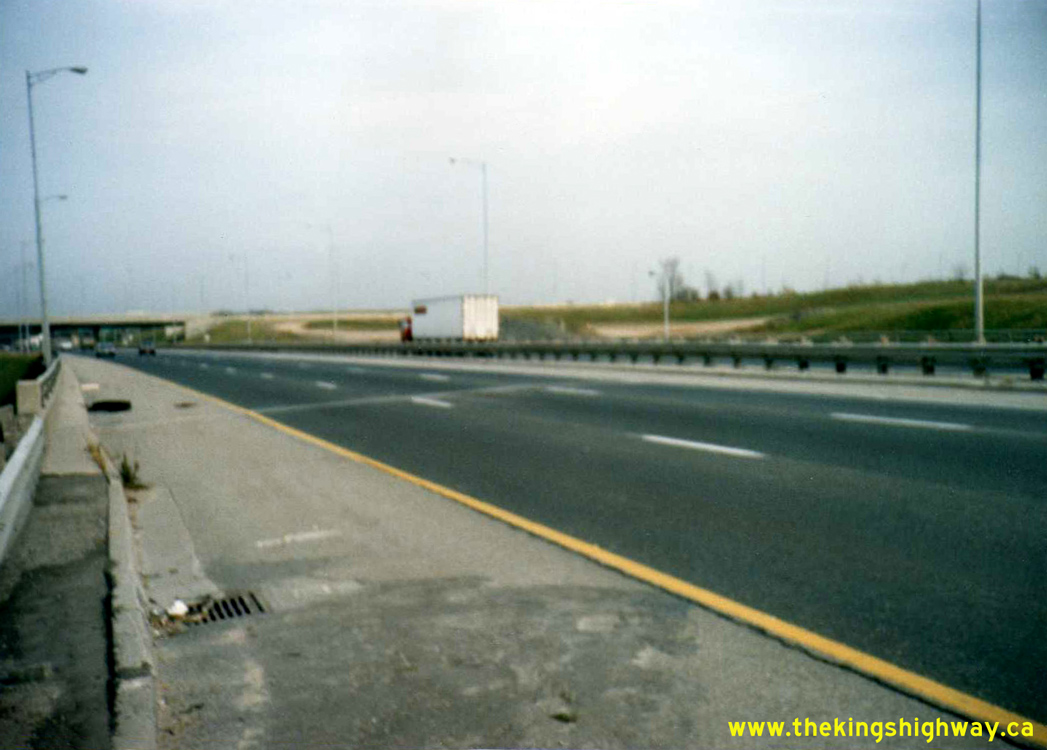 Left - View of the flyover on the westbound Hwy 403 Collector Lanes over the future northbound lanes of Hwy 410 (Site #24-326). This structure was built
under Contract #1978-60, and interestingly, did not span any roadway until the connections between Hwy 403 and Hwy 410 were constructed in the early 1990s. See an
Enlarged Photo Here. Photo taken on October 7, 1986. Left - View of the flyover on the westbound Hwy 403 Collector Lanes over the future northbound lanes of Hwy 410 (Site #24-326). This structure was built
under Contract #1978-60, and interestingly, did not span any roadway until the connections between Hwy 403 and Hwy 410 were constructed in the early 1990s. See an
Enlarged Photo Here. Photo taken on October 7, 1986.(Photo courtesy of Ontario Ministry of Transportation - © King's Printer for Ontario, 2025) Right - Facing east along the eastbound lanes of Hwy 401 from the Hwy 410 Underpass (Site #24-324) in Mississauga. At right, a sub-collector lane system manages eastbound Hwy 401 traffic exiting to Dixie Road and southbound Hwy 410 traffic merging into eastbound Hwy 401. See an Enlarged Photo Here. Photo taken on October 21, 1986. (Photo courtesy of Ontario Ministry of Transportation - © King's Printer for Ontario, 2011) 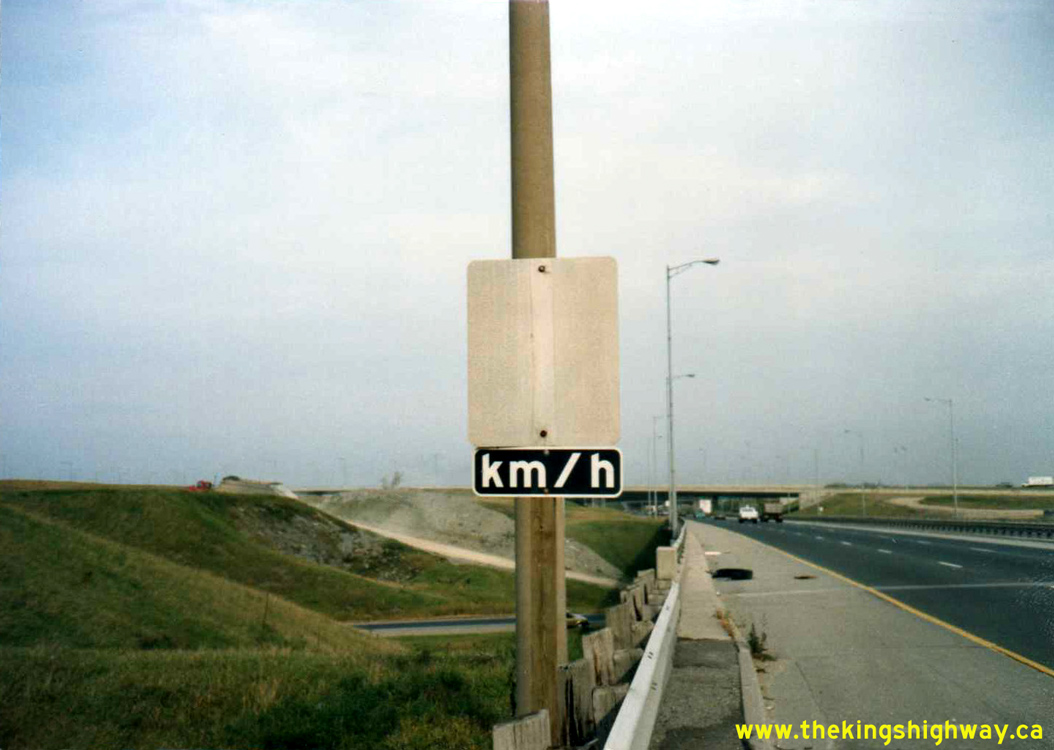
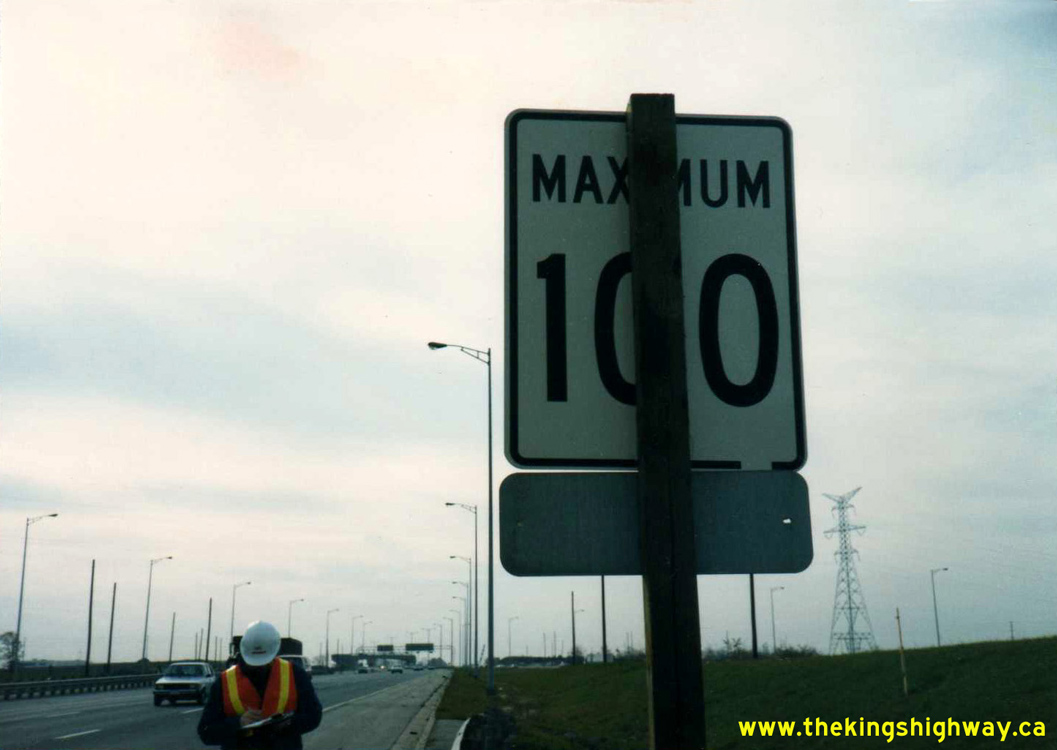
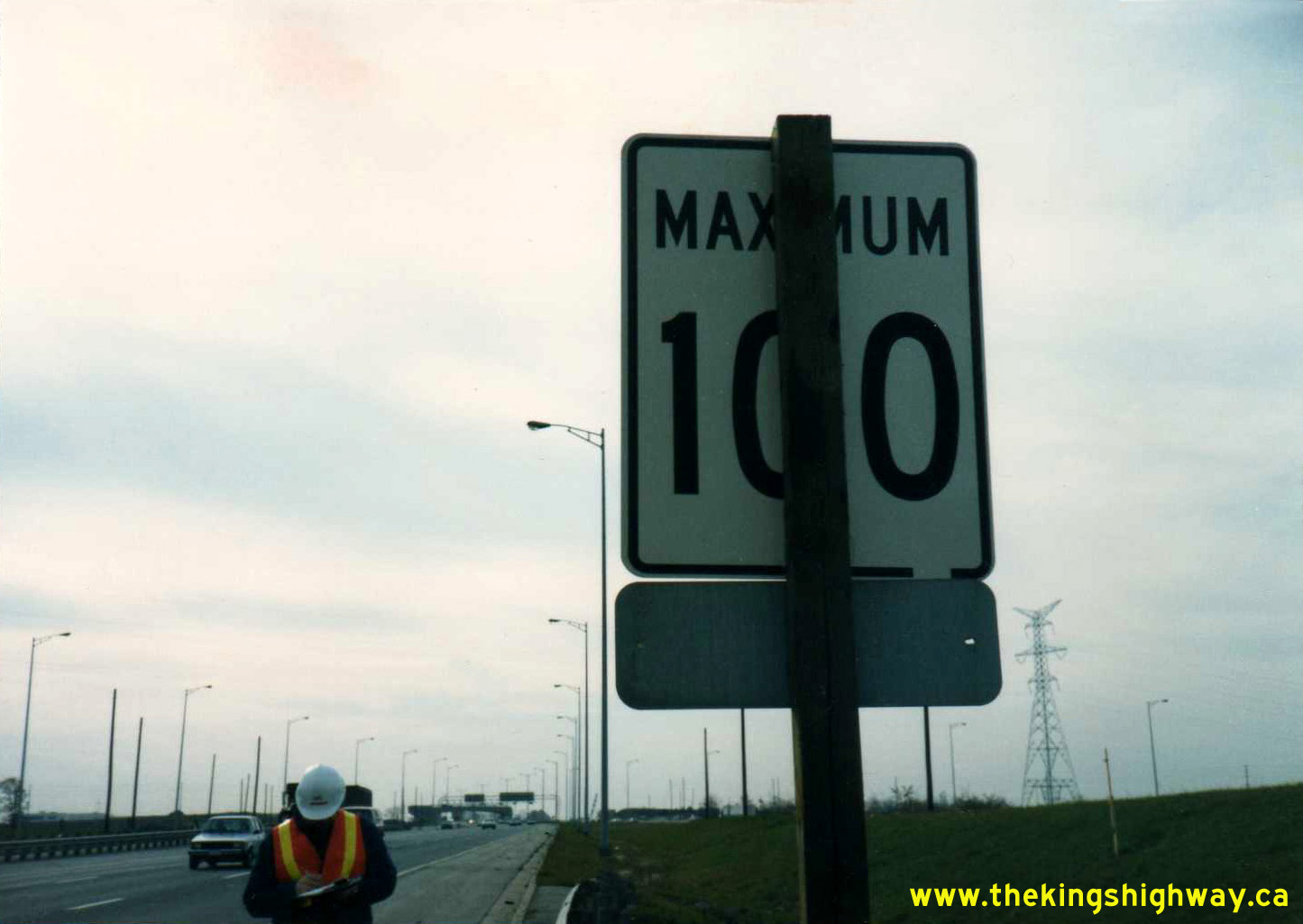
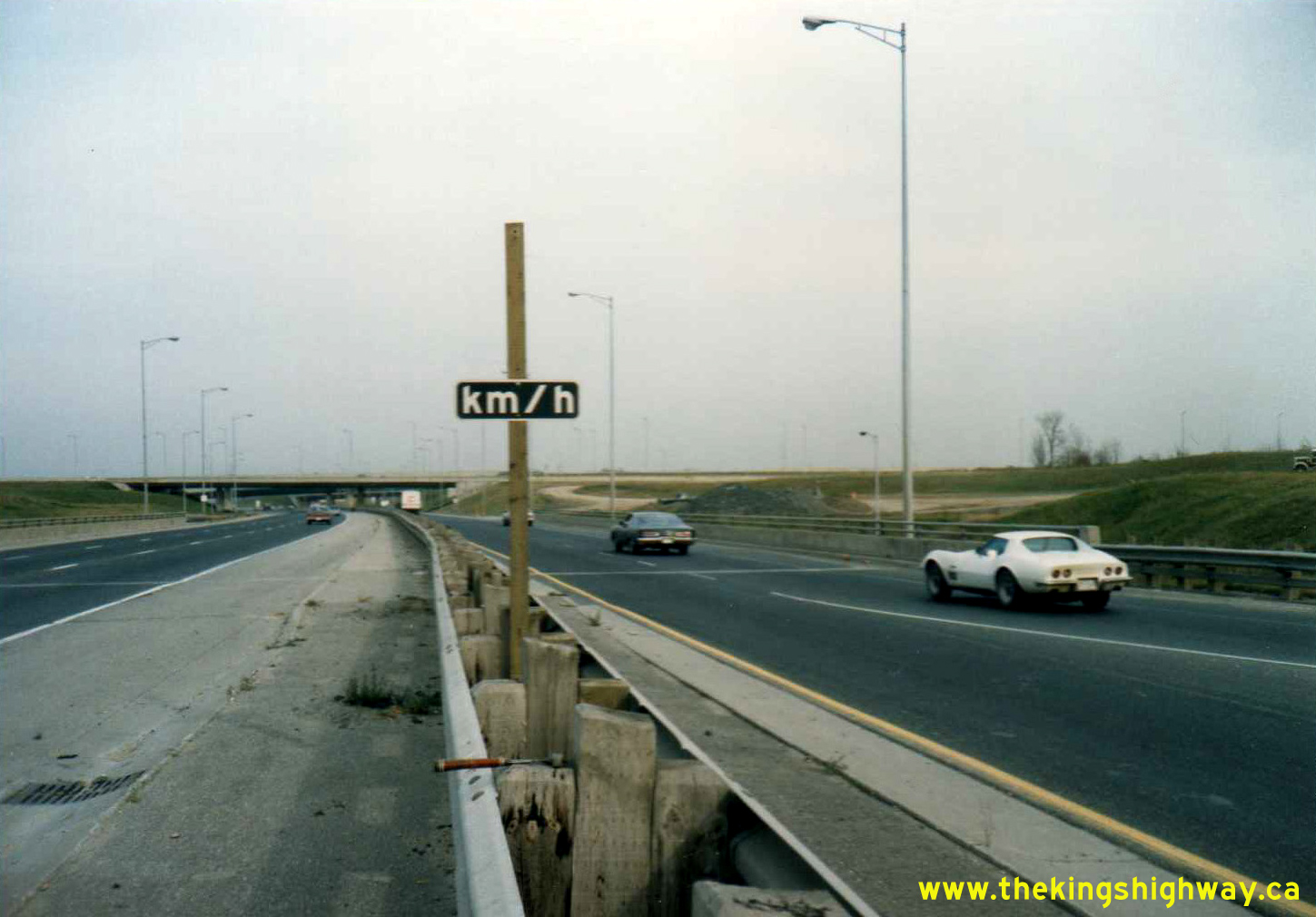
Left - Reversed speed limit sign on the eastbound lanes of Hwy 401 at Hwy 410. It was common practice up until the 1980s to remove or reverse regulatory speed
limit signs in construction zones where advisory speed signs were in use, so that the regulatory speed limit was not visible to traffic. However, in many cases, the
regulatory signs were not restored after construction ended, as was the case here. Also note the absence of the Hwy 401 Express Lanes at left, which were not built
until the early 1990s. The old single-lane southbound Hwy 410 ramp can be seen on the lower level of the interchange. This ramp was replaced with the current two-lane
flyover ramp in 1990. See an Enlarged Photo Here. Photo taken on October 21, 1986. (Photo courtesy of Ontario Ministry of Transportation - © King's Printer for Ontario, 2011) Right - Reversed speed limit sign on Hwy 401 at the Hwy 410 Interchange in Mississauga in 1986. In the background of this photo, the approaches to the old 1950s-era First Line East (Kennedy Road) Overpass have been removed, in preparation for the structure's demolition. The removal of the Kennedy Road Overpass was required in order to construct the western half of the Hwy 401 & Hwy 410 Interchange. See an Enlarged Photo Here. Photo taken on October 21, 1986. (Photo courtesy of Ontario Ministry of Transportation - © King's Printer for Ontario, 2011) 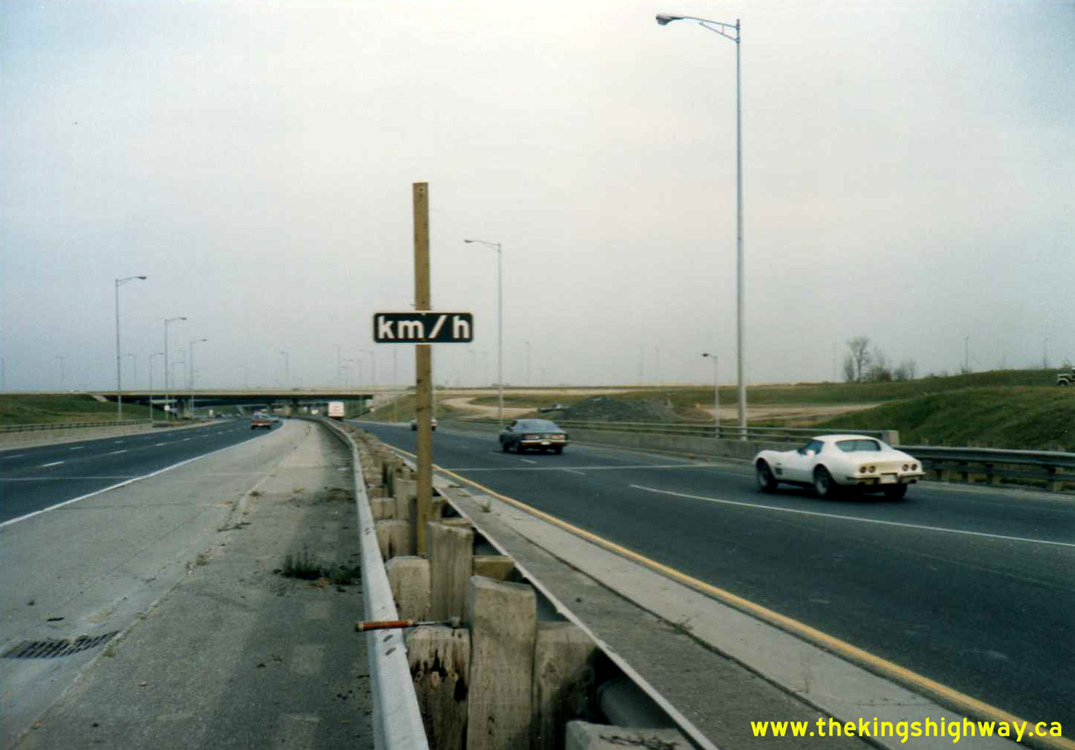
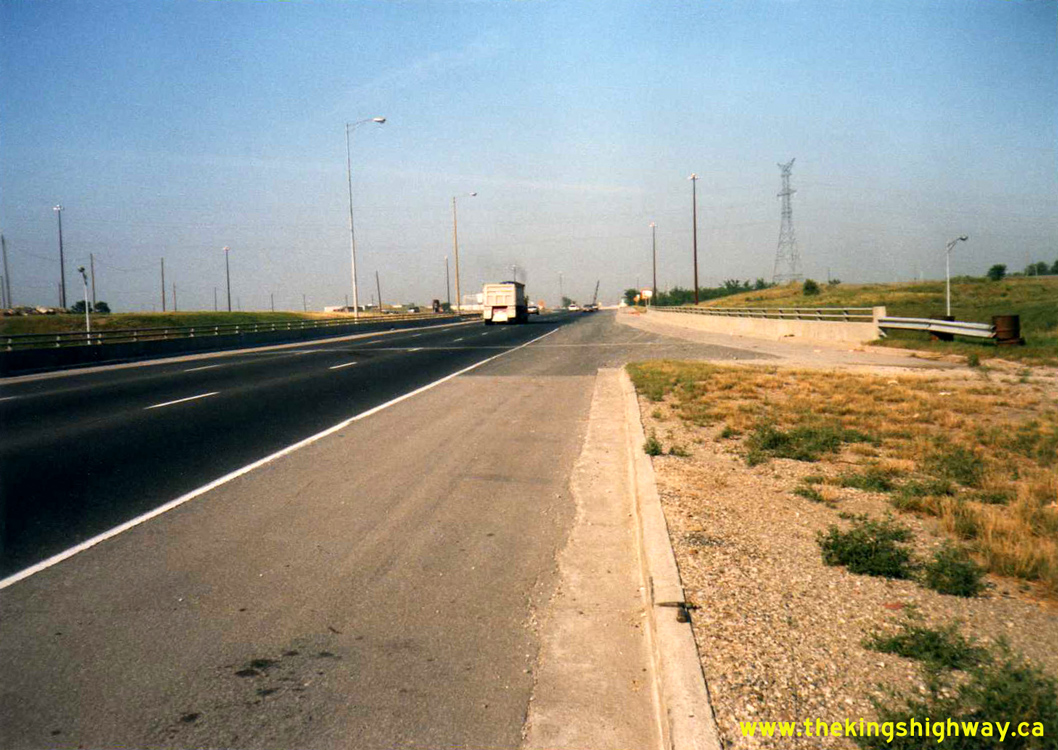
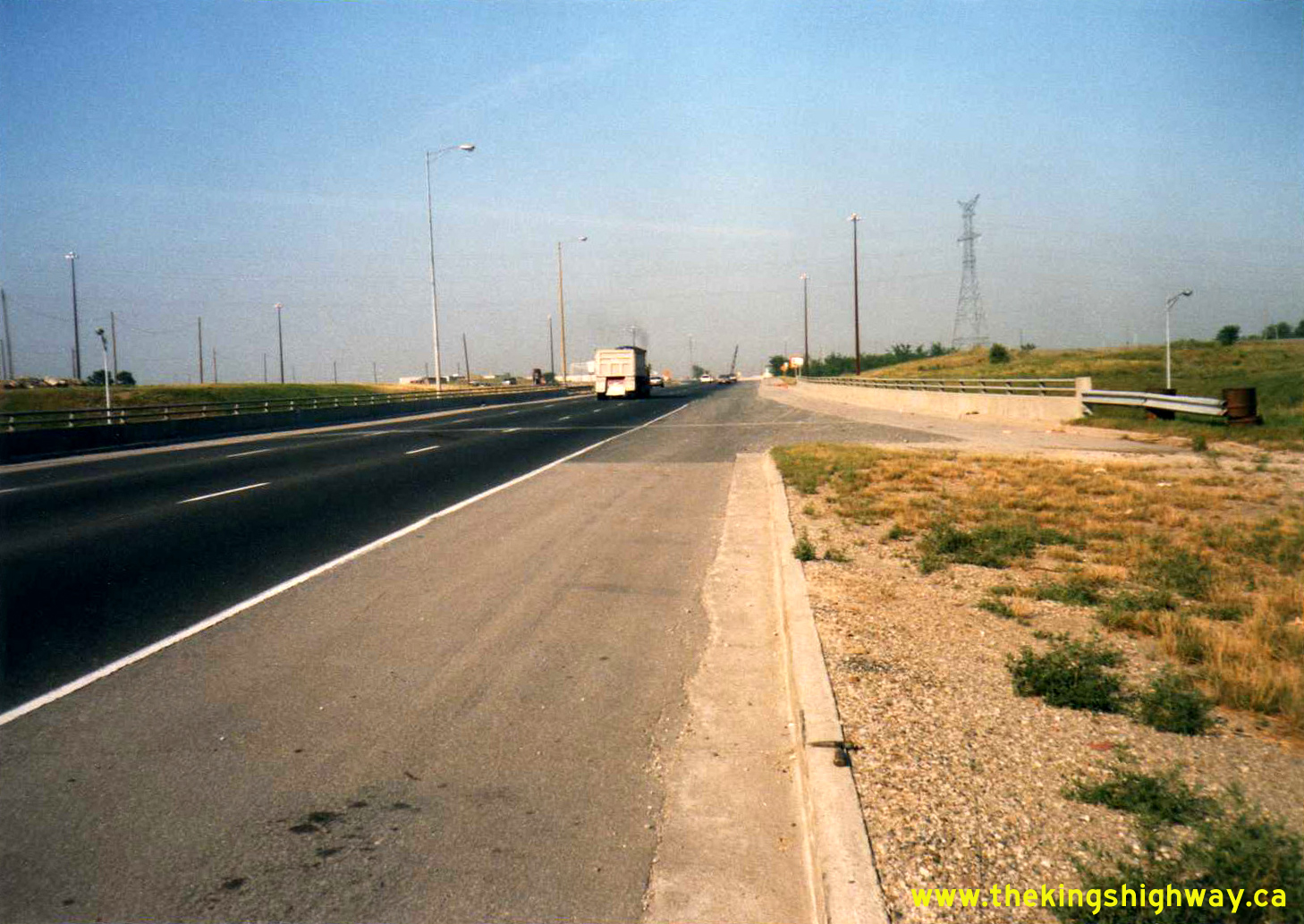
Left - Facing east along Hwy 401 from the Hwy 410 Interchange in 1986. The sub-collector lanes at right were used to separate traffic exiting from eastbound
Hwy 401 to Dixie Road and traffic entering eastbound Hwy 401 from southbound Hwy 410 from the traffic on the Hwy 401 through lanes at left. See an
Enlarged Photo Here. Photo taken on October 21, 1986. (Photo courtesy of Ontario Ministry of Transportation - © King's Printer for Ontario, 2011) Right - Facing west across the Hwy 410 Underpass (Site #24-323) on the westbound lanes of Hwy 401 in Mississauga. Note that at the time this photo was taken in 1987, the construction of the flyovers at Hwy 410 had not yet commenced. Compare this photo to this 1989 Photo, which shows the new Hwy 410 flyovers under construction. See an Enlarged Photo Here. Photo taken on July 17, 1987. (Photo courtesy of Ontario Ministry of Transportation - © King's Printer for Ontario, 2011) 
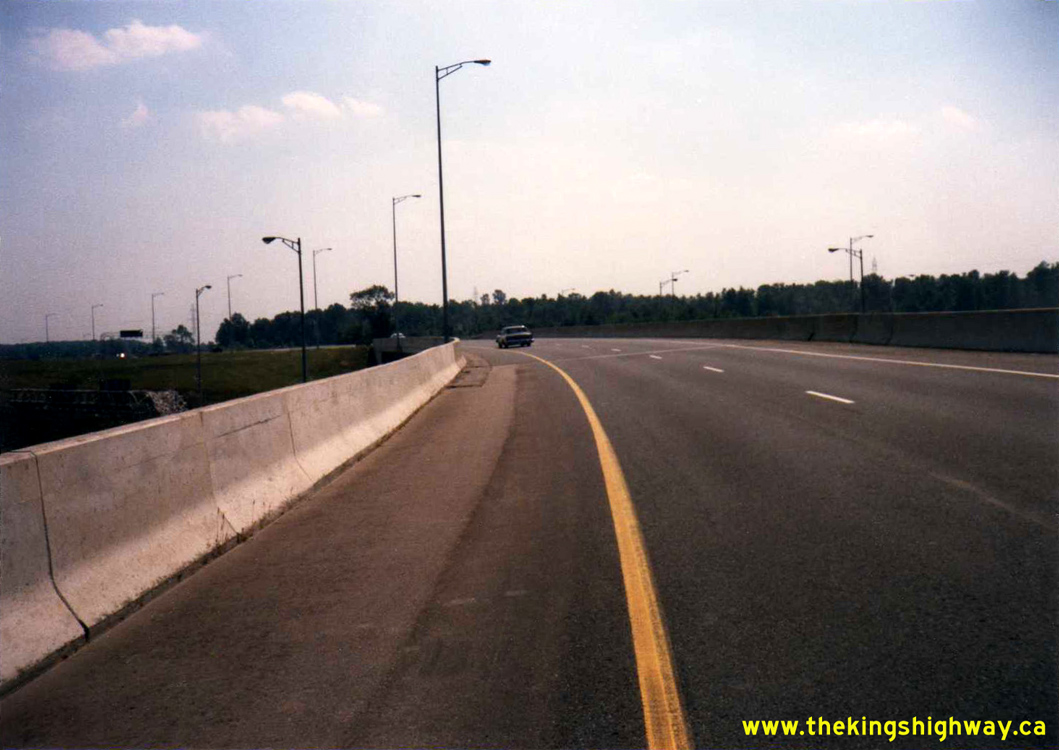 Left - View of the flyover on the westbound Hwy 403 Express Lanes crossing the future northbound lanes of Hwy 410 (Site #24-464). An overhead freeway guide
sign was installed for the upcoming Express-to-Collector Transfer Lane, which initially just listed the Eglinton Avenue Interchange. See an
Enlarged Photo Here. Photo taken on July 17, 1987. Left - View of the flyover on the westbound Hwy 403 Express Lanes crossing the future northbound lanes of Hwy 410 (Site #24-464). An overhead freeway guide
sign was installed for the upcoming Express-to-Collector Transfer Lane, which initially just listed the Eglinton Avenue Interchange. See an
Enlarged Photo Here. Photo taken on July 17, 1987.(Photo courtesy of Ontario Ministry of Transportation - © King's Printer for Ontario, 2025) Right - Facing west across the flyover carrying the westbound Hwy 403 Express Lanes over the eastbound Hwy 401 Collector Lanes (Site #24-466). See an
Enlarged Photo Here. Photo taken on July 17, 1987.(Photo courtesy of Ontario Ministry of Transportation - © King's Printer for Ontario, 2025) 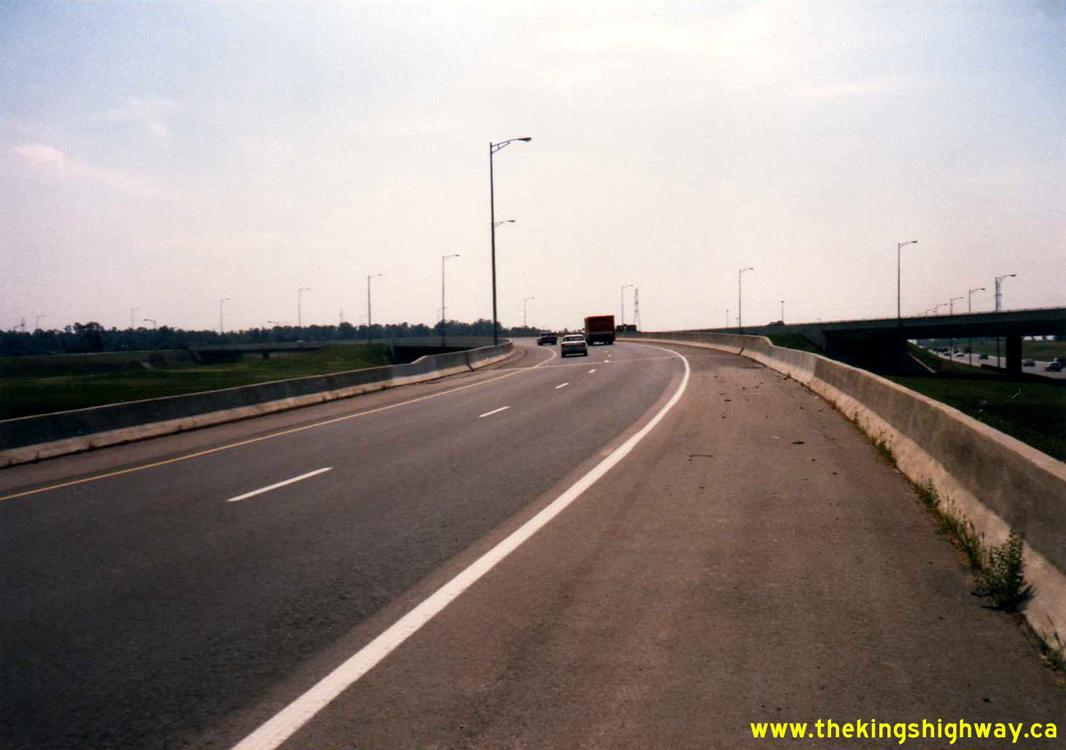
 Left - View of the flyover on the westbound Hwy 403 Express Lanes crossing the future Hwy 401 Express Lanes (Site #24-467). This structure was built across
Tomken Road and the proposed Hwy 401 Express Lanes under Contract #1982-108. This structure was opened to traffic in 1984, along the remainder of the new
westbound Hwy 403 Express Lanes between Hwy 401 and Matheson Boulevard. See an
Enlarged Photo Here. Photo taken on July 17, 1987. Left - View of the flyover on the westbound Hwy 403 Express Lanes crossing the future Hwy 401 Express Lanes (Site #24-467). This structure was built across
Tomken Road and the proposed Hwy 401 Express Lanes under Contract #1982-108. This structure was opened to traffic in 1984, along the remainder of the new
westbound Hwy 403 Express Lanes between Hwy 401 and Matheson Boulevard. See an
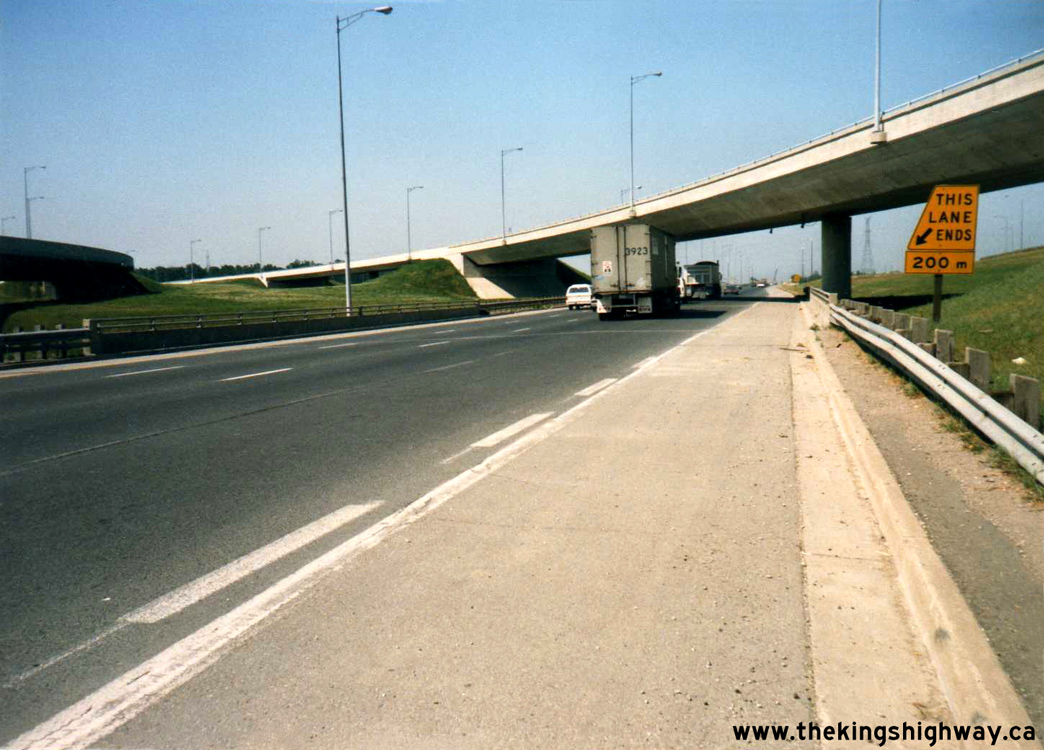
Enlarged Photo Here. Photo taken on July 17, 1987.(Photo courtesy of Ontario Ministry of Transportation - © King's Printer for Ontario, 2025) Right - Facing west along the westbound lanes of Hwy 401 at the Tomken Road Underpass (Site
#24-314) in Mississauga. The top-level structure above (Site #24-315) carries the ramp from the westbound Hwy 401 Collector Lanes to the westbound Hwy 403 Collector
Lanes across Tomken Road and the westbound Hwy 401 Collector Lanes. A vintage yellow-and-black "This Lane Ends 200 m" sign can be seen at right. Although commonly
seen along Ontario's freeways up until the 1980s, these unconventional warning signs were phased out and replaced with the current diamond-shaped warning signs that
we see out on the highways today. Instead of having the "Lane Ends" message conveyed in text, newer signs show this information graphically. Over the decades, traffic
engineers have attempted to minimize the use of text on signs whenever it can be substituted by a commonly-understood graphical representation of the intended
message. See an Enlarged Photo Here. Photo taken on July 17, 1987.(Photo courtesy of Ontario Ministry of Transportation - © King's Printer for Ontario, 2025) 

Left - View of the top level of the Airport Basketweave Structure (Site #24-468) on eastbound Hwy 401 in Mississauga in 1987. Note that the roadway across the
structure has been re-striped with only two through lanes. The 1985 photos above show the structure with three lanes, which were required temporarily during
construction due to the project staging. See an Enlarged Photo Here. Photo taken on July 21,
1987. (Photo courtesy of Ontario Ministry of Transportation - © King's Printer for Ontario, 2011) Right - Facing east along the eastbound Hwy 401 Collector Lanes at the Etobicoke Creek Bridge (Site #24-184) in Mississauga. See an Enlarged Photo Here. Photo taken on July 28, 1987. (Photo courtesy of Ontario Ministry of Transportation - © King's Printer for Ontario, 2011) 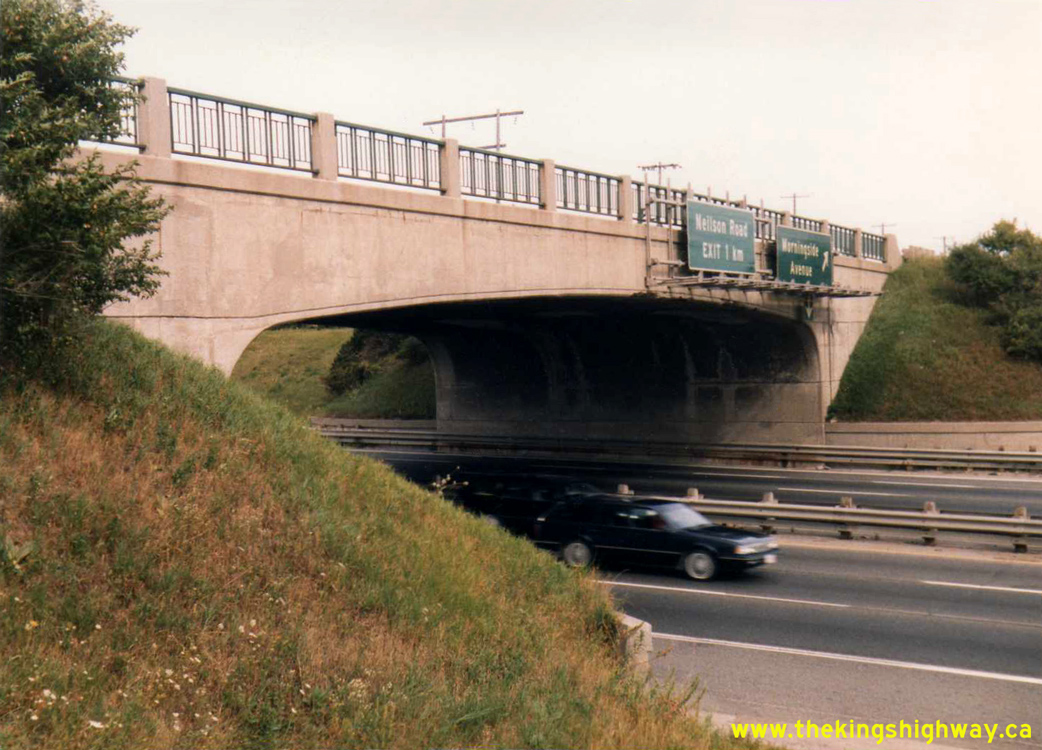
Left - Eastern side of the Morningside Avenue Overpass on Hwy 401 in Toronto in 1987. This handsome 1950s-era structure was built along the Toronto Bypass
under Contract #1954-107. As originally designed, the bridge spanned a four-lane Toronto Bypass along with the two speed change lanes which led to the interchange
ramps. As Hwy 401 was expanded across the eastern part of Toronto during the 1970s, one additional lane was added in each direction to the highway through this
structure. West of this interchange, the highway was widened to 8 lanes. While the additional outside westbound lane simply began from the westbound Morningside
Avenue on-ramp, the outside eastbound lane became a force-off exit lane to Morningside Avenue. This interchange configuration was unexpected to motorists, so it was
reconfigured in 1978 to address various operational issues. A new eastbound exit ramp to Morningside Avenue was built on the upstream side of the structure under
Contract #1978-34, with an either-or lane which continued east for a short distance and then ended below the structure. The Morningside Avenue structure was
demolished in the 1990s in order to make way for the expanded Hwy 401 Express-Collector Lane System through Scarborough and Pickering. See an
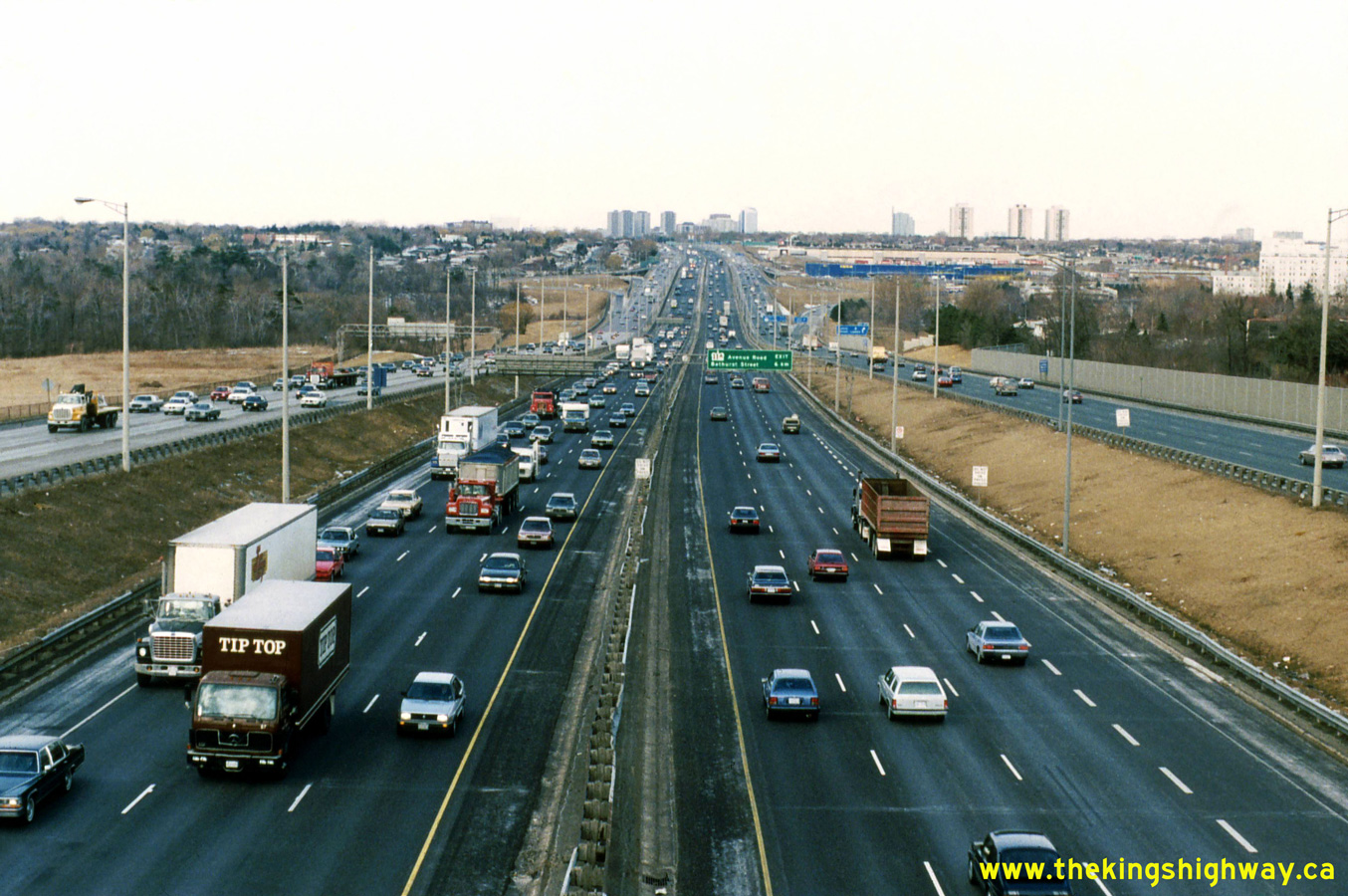
Enlarged Photo Here. Photo taken on August 25, 1987. (Photo courtesy of Ontario Ministry of Transportation - © King's Printer for Ontario, 2011) Right - View of Hwy 401 facing west towards Leslie Street from the Don Mills Road Overpass in Toronto in 1988. This iconic view of Hwy 401's Express-Collector
Lane System is the best vantage point to observe this "freeway within a freeway" in action. As a result of a series of Origin-Destination (O-D) Studies carried out
along Hwy 401 in 1959, it was found that many motorists used the Toronto Bypass for short trips across Toronto - often travelling only one or two exits before leaving
the highway. These travel patterns meant that the right-most lane on the original four-lane Toronto Bypass was very heavily-utilized and created stop-and-go traffic
conditions throughout the day. As part of the widening of the Toronto Bypass in the 1960s and early 1970s, a separate Collector Lane System was built to manage
shorter-distance trips and keep that traffic stream separated from longer-distance through traffic in the Express Lanes. Access between the inner Express Lanes and
outer Collector Lanes was only possible at periodic entry and exit points, or transfers. See an
Enlarged Photo Here. Photo taken in March 1988.(Photo courtesy of Ontario Ministry of Transportation - © King's Printer for Ontario, 2025) 
 Left - View of the eastbound Hwy 401 exit ramp at the new Westney Road Interchange in Ajax in 1988. This new interchange was built in the 1980s to replace the
outdated 1940s-era interchange at Church Street, located a short distance to the west. While it was originally intended to service the rural Village of Pickering, the
old Church Street Interchange had become functionally obsolete by the 1980s, as it was unable to meet the growing traffic demands in this part of Durham Region.
Additionally, the closure of the south interchange ramps at Church Street was required in order to extend Go Transit commuter rail service easterly to Whitby and
Oshawa. See an Enlarged Photo Here. Photo taken on May 9, 1988. Left - View of the eastbound Hwy 401 exit ramp at the new Westney Road Interchange in Ajax in 1988. This new interchange was built in the 1980s to replace the
outdated 1940s-era interchange at Church Street, located a short distance to the west. While it was originally intended to service the rural Village of Pickering, the
old Church Street Interchange had become functionally obsolete by the 1980s, as it was unable to meet the growing traffic demands in this part of Durham Region.
Additionally, the closure of the south interchange ramps at Church Street was required in order to extend Go Transit commuter rail service easterly to Whitby and
Oshawa. See an Enlarged Photo Here. Photo taken on May 9, 1988.(Photo courtesy of Ontario Ministry of Transportation - © King's Printer for Ontario, 2025) Right - Facing west towards Pickering along the eastbound lanes of Hwy 401 at the new Westney Road Interchange in Ajax. See an
Enlarged Photo Here. Photo taken on May 9, 1988.(Photo courtesy of Ontario Ministry of Transportation - © King's Printer for Ontario, 2025) 
 Left - View of the eastbound Hwy 401 exit ramp to Westney Road in Ajax. Flanked on both sides by high retaining walls, this ramp was constructed within the
limited space between Hwy 401 and the adjacent railway line. The Westney Road Interchange was actually constructed by GO Transit as part of the extension of commuter
rail service into Durham Region. This interchange was built over four construction seasons under two different GO Transit contracts. Between 1984 and 1986, Westney
Road was constructed from Bailey Street northerly to the Hwy 401 south ramp terminal under GO Transit's Contract #GGE-312. The southern Hwy 401 interchange ramps were
also built under this contract, but not opened to traffic. Various other railway infrastructure was built under this contract to support this large transit expansion
program. See an Enlarged Photo Here. Photo taken on May 9, 1988. Left - View of the eastbound Hwy 401 exit ramp to Westney Road in Ajax. Flanked on both sides by high retaining walls, this ramp was constructed within the
limited space between Hwy 401 and the adjacent railway line. The Westney Road Interchange was actually constructed by GO Transit as part of the extension of commuter
rail service into Durham Region. This interchange was built over four construction seasons under two different GO Transit contracts. Between 1984 and 1986, Westney
Road was constructed from Bailey Street northerly to the Hwy 401 south ramp terminal under GO Transit's Contract #GGE-312. The southern Hwy 401 interchange ramps were
also built under this contract, but not opened to traffic. Various other railway infrastructure was built under this contract to support this large transit expansion
program. See an Enlarged Photo Here. Photo taken on May 9, 1988.(Photo courtesy of Ontario Ministry of Transportation - © King's Printer for Ontario, 2025) Right - Facing south along Westney Road at the Hwy 401 Interchange in Ajax. During construction of the Westney Road Interchange, the entire route of Hwy 401
had to be diverted to the north around the construction site. The southern half of the interchange was excavated first, in order to construct the new eastbound
Hwy 401 structure over Westney Road. Upon completion of this structure, the eastbound lanes of Hwy 401 were shifted back onto alignment. The northern side of the
interchange was then excavated to enable the construction of the new westbound Hwy 401 structure over Westney Road. Once both structures were open to traffic, the
diversion to the north was excavated out and the new ramps along the northern side of the interchange were graded and completed. The new Westney Road Interchange was
opened to traffic in late 1987, after about 3 years of construction. The adjacent Church Street Interchange was permanently closed to traffic as soon as the new
Westney Road Interchange was opened. See an Enlarged Photo Here. Photo taken on May 9,
1988.(Photo courtesy of Ontario Ministry of Transportation - © King's Printer for Ontario, 2025) 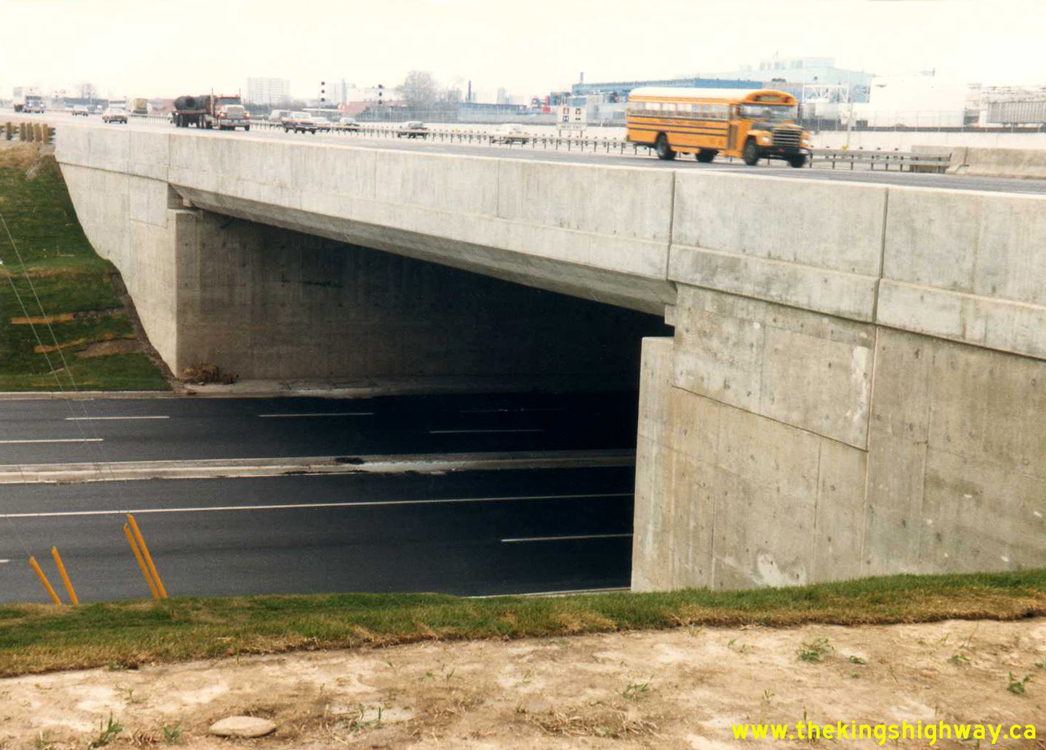
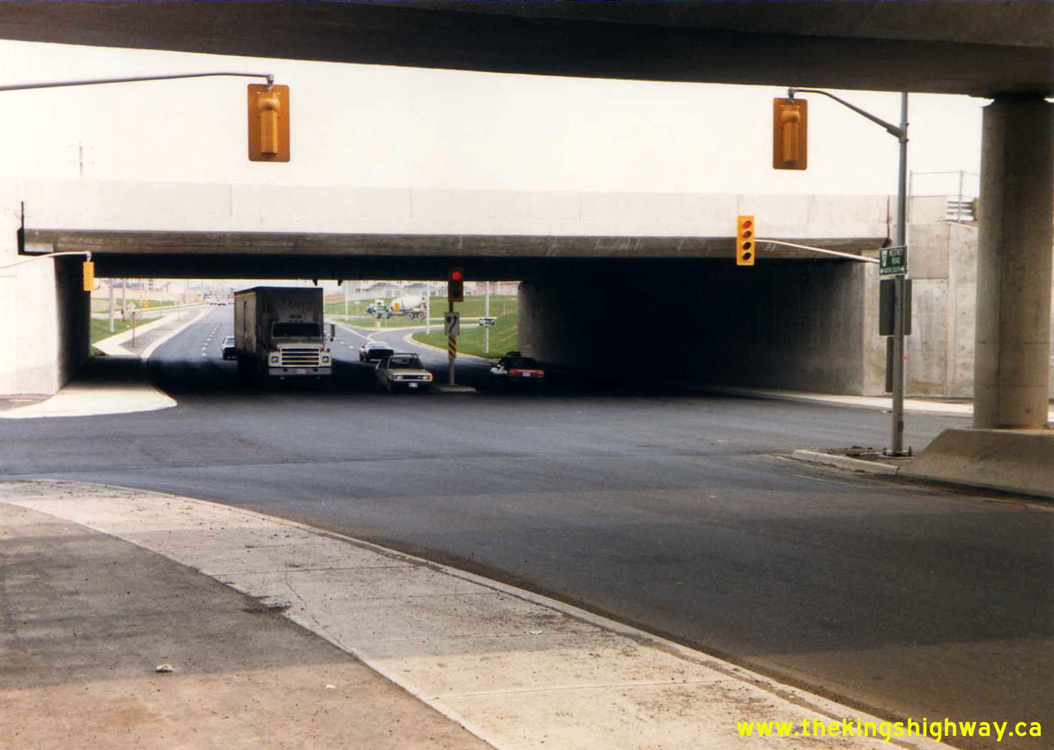 Left - Northern side of the Westney Road Underpass (Site #22-372) on Hwy 401 in Ajax. This prestressed concrete slab structure was constructed in 1986-1987
under GO Transit's Contract #GGE-315. Included in this contract were the Westney Road Underpass structures, construction of the north interchange ramps, construction
of Westney Road from Hwy 401 northerly to Hwy 2 (Kingston Road), and reconstruction of Hwy 401 through the Westney Road Interchange. The new Westney Road Interchange
was opened to traffic in late 1987. See an Enlarged Photo Here. Photo taken on May 9, 1988. Left - Northern side of the Westney Road Underpass (Site #22-372) on Hwy 401 in Ajax. This prestressed concrete slab structure was constructed in 1986-1987
under GO Transit's Contract #GGE-315. Included in this contract were the Westney Road Underpass structures, construction of the north interchange ramps, construction
of Westney Road from Hwy 401 northerly to Hwy 2 (Kingston Road), and reconstruction of Hwy 401 through the Westney Road Interchange. The new Westney Road Interchange
was opened to traffic in late 1987. See an Enlarged Photo Here. Photo taken on May 9, 1988.(Photo courtesy of Ontario Ministry of Transportation - © King's Printer for Ontario, 2025) Right - View of the Westney Road Interchange's south ramp terminal on Hwy 401 in Ajax, facing north. This very compact interchange is in a diamond ramp
configuration on its southern side. The ramp terminal is sandwiched between the adjacent railway line and Hwy 401. When the Toronto-Oshawa Dual Highway was first
being planned out in the late 1930s, engineers laid out the highway's route adjacent to the railway in an effort to minimize property severances. Although it was a
well-intended decision at the time, this decision unfortunately made the construction of future interchanges along this section of Hwy 401 very challenging, due to the
limited space available between the highway and the adjacent railway line. See an
Enlarged Photo Here. Photo taken on May 9, 1988.(Photo courtesy of Ontario Ministry of Transportation - © King's Printer for Ontario, 2025) 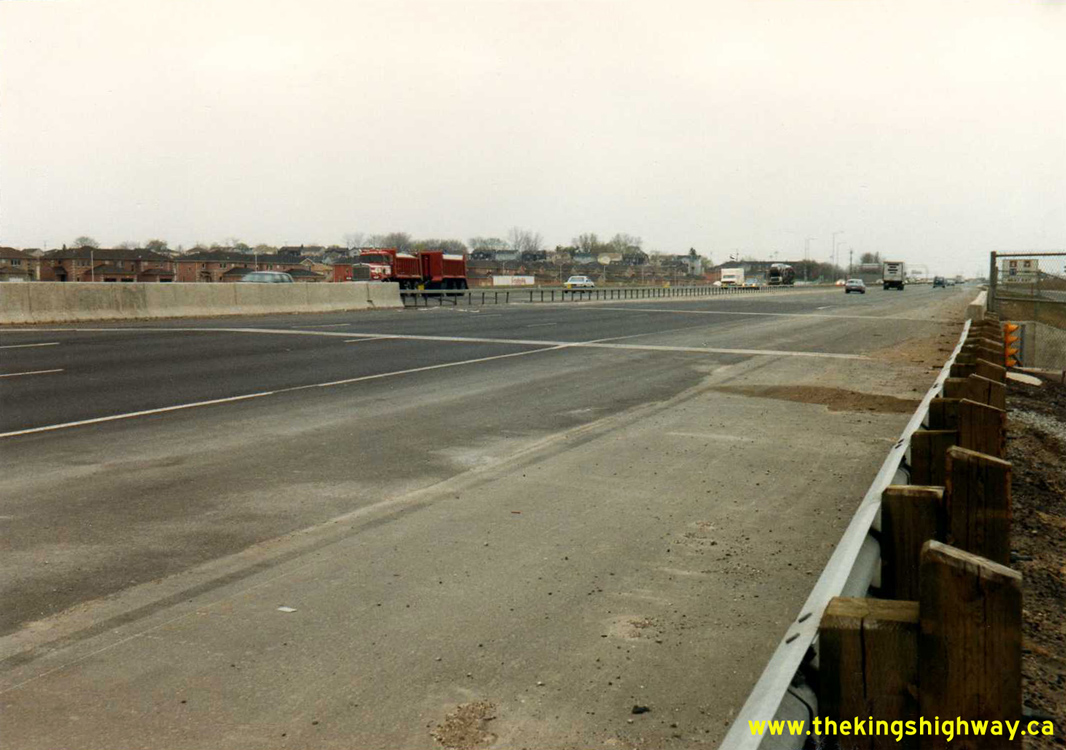
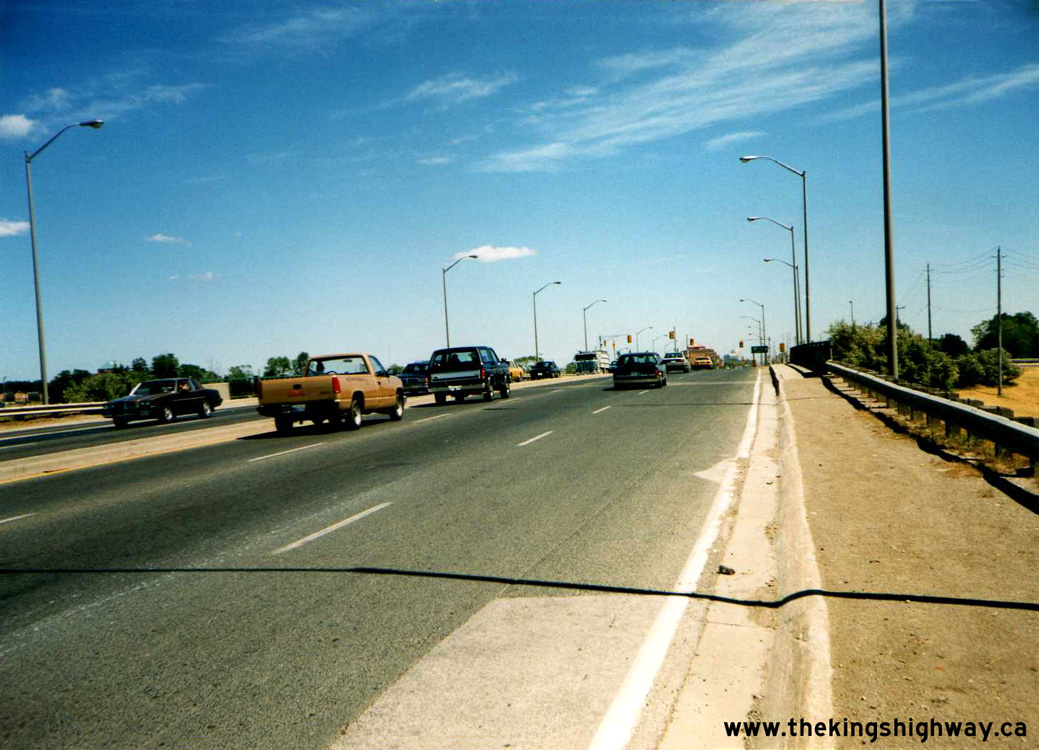 Left - Facing east along the eastbound lanes of Hwy 401 at the Westney Road Interchange in Ajax. Although it only carried three eastbound lanes on opening day,
this structure was designed with additional deck width to accommodate a future widening of the highway. See an
Enlarged Photo Here. Photo taken on May 9, 1988. Left - Facing east along the eastbound lanes of Hwy 401 at the Westney Road Interchange in Ajax. Although it only carried three eastbound lanes on opening day,
this structure was designed with additional deck width to accommodate a future widening of the highway. See an
Enlarged Photo Here. Photo taken on May 9, 1988.(Photo courtesy of Ontario Ministry of Transportation - © King's Printer for Ontario, 2025) Right - Facing south along Hwy 10 (Hurontario Street) at the Hwy 401 Interchange in Mississauga. See an Enlarged Photo Here. Photo taken on June 23, 1988. (Photo courtesy of Ontario Ministry of Transportation - © King's Printer for Ontario, 2011) 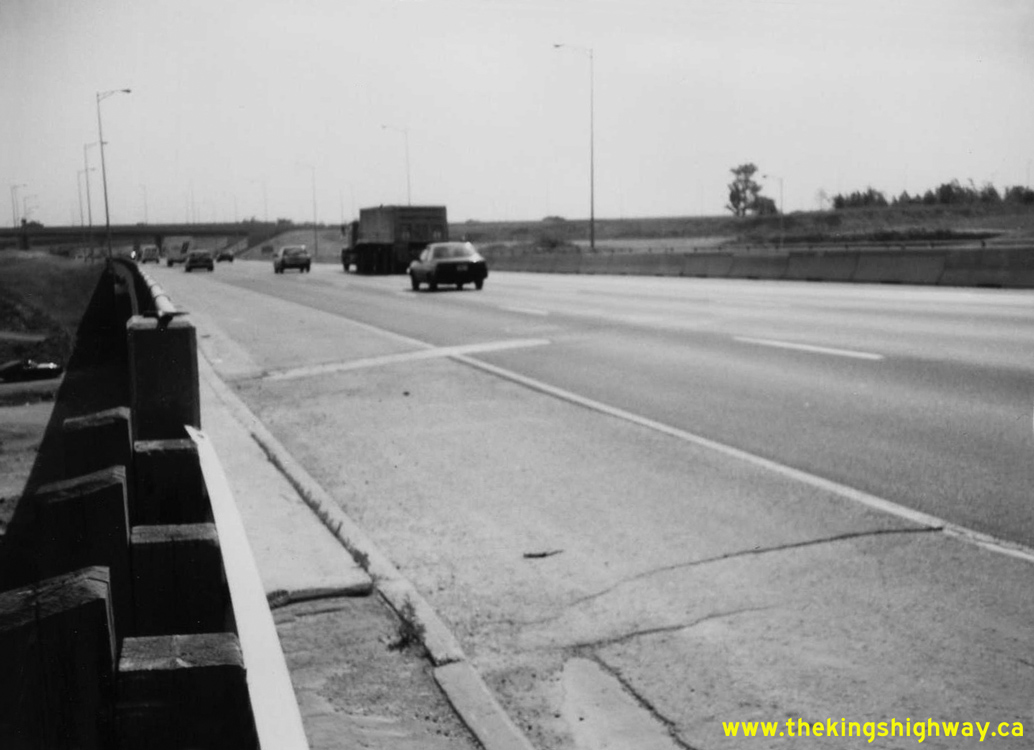

Left - Facing east along Hwy 401 from the Hwy 410 Underpass (Site #24-324) in Mississauga. See an
Enlarged Photo Here. Photo taken on July 6, 1988. (Photo courtesy of Ontario Ministry of Transportation - © King's Printer for Ontario, 2011) Right - Overhead guide signs for Hwy 401 at the northern end of the Don Valley Parkway in Toronto in 1988. Note the use of the phrase "Express Lanes" on the middle sign. When bilingual signs were introduced on Hwy 401 in Toronto in the early 1990s, these signs were changed so that only the word "Express" was indicated. See an Enlarged Photo Here. Photo taken in September 1988. (Photo courtesy of Ontario Ministry of Transportation - © King's Printer for Ontario, 2011) 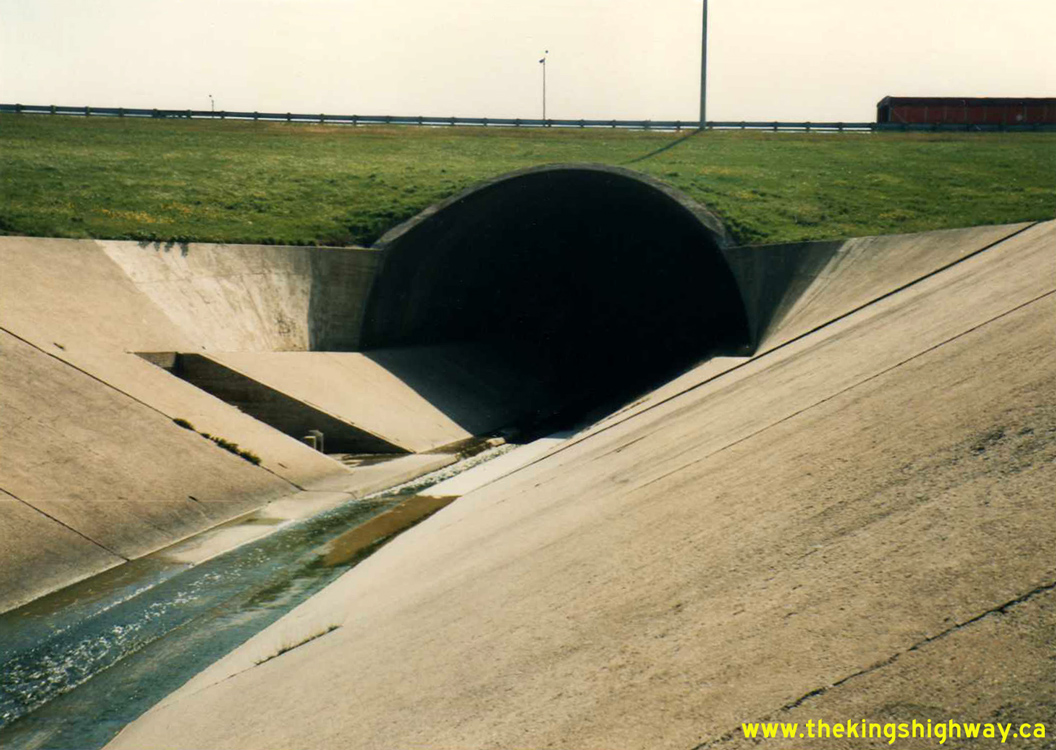
 Left - Mimico Creek Arch Culvert (Site #37-824/C) below Hwy 401 just east of the Hwy 427 Interchange in Toronto. See an
Enlarged Photo Here. Photo taken on September 8, 1988. Left - Mimico Creek Arch Culvert (Site #37-824/C) below Hwy 401 just east of the Hwy 427 Interchange in Toronto. See an
Enlarged Photo Here. Photo taken on September 8, 1988.(Photo courtesy of Ontario Ministry of Transportation - © King's Printer for Ontario, 2025) Right - Southern side of the Rouge River Bridge (Site #22-161) on Hwy 401 in Toronto in 1988. This new steel girder structure was built under Contract #1971-06 as part of the widening of Hwy 401 from four to six lanes. Previously, twin deck truss structures carried the eastbound and westbound lanes of Hwy 401 separately across the Rouge River. Both bridges were built in 1941-1942 along the new Toronto-Oshawa Dual Highway. When these bridges had to be replaced, Hwy 401 was diverted permanently to the north to facilitate construction sequencing. The new structure carrying the westbound lanes of Hwy 401 was constructed first. Once completed, all westbound traffic was shifted onto the new bridge and the old westbound structure was demolished. With the north half of the old structure gone, construction then proceeded on the new Hwy 401 eastbound structure in its place. The final phase of this bridge project involved the demolition of the old eastbound bridge, once the new eastbound bridge was completed and opened to traffic. The old eastbound structure was located immediately south (left) of the new eastbound structure seen here. See an Enlarged Photo Here. Photo taken on September 29, 1988. (Photo courtesy of Ontario Ministry of Transportation - © King's Printer for Ontario, 2011) 

Left - View of the eastbound lanes of Hwy 401, facing east from the Rouge River Bridge in 1988. In the distance, the old Rougemount Drive Overpass can be seen.
This was the only overpass structure built along the Toronto-Oshawa Dual Highway prior to the outbreak of World War II. It was constructed under Contract #1938-55 and
was completed in 1939. See an Enlarged Photo Here. Photo taken on September 29, 1988. (Photo courtesy of Ontario Ministry of Transportation - © King's Printer for Ontario, 2011) Right - Facing east along the westbound lanes of Hwy 401 towards the Rougemount Drive Overpass in Pickering. See an Enlarged Photo Here. Photo taken on September 29, 1988. (Photo courtesy of Ontario Ministry of Transportation - © King's Printer for Ontario, 2011) 

Left - View of the Black Creek Bridge (Site #37-668) on the ramp from southbound Jane Street to northbound Hwy 400 in Toronto in 1988. In the background, an
older angled advance exit sign for Hwy 401 can be seen over the northbound lanes of Hwy 400. These angled signs were designed to "point" towards the direction of the
upcoming exit ramp or transfer. On complex freeways such as Hwy 401, these signs were very helpful in differentiating left-hand exit ramps and transfer points from
those appearing on the right-hand side. At the time Hwy 401 was being widened across Toronto in the 1960s, it was felt that motorists would require extra guidance to
navigate this type of highway, as the complex Express-Collector configuration of Hwy 401 was a novel concept in highway design in Ontario. There was even some
consideration during the early 1960s of installing internally-illuminated overhead signs along urban sections of Hwy 401. However, by the 1990s, motorists had
generally become accustomed to the layout of Hwy 401 across Toronto and so these angled signs were phased out as part of a modernization of freeway signing practices.
See an Enlarged Photo Here. Photo taken on October 26, 1988. (Photo courtesy of Ontario Ministry of Transportation - © King's Printer for Ontario, 2024) Right - Oakville Creek Bridge (Site 10-45) on Hwy 401 west of Milton. This bridge was extended into the median in 1993-1994 when Hwy 401 was widened from four to six lanes west of Milton. See an Enlarged Photo Here. Photo taken on May 24, 1989. (Photo courtesy of Ontario Ministry of Transportation - © King's Printer for Ontario, 2011) 
Left - Facing west along Hwy 401 towards Guelph Line at the Oakville Creek Bridge (Site #10-45/1) in 1989. By the late 1980s, traffic volumes on Hwy 401
between Milton and Cambridge had grown to the point where the original four lane highway was no longer able to accommodate the booming economic and travel demands of
the province. In 1993, the first in a series of construction contracts was awarded to widen Hwy 401 from Milton to Cambridge to six lanes. The widening work was more
or less completed by the end of 1996. See an Enlarged Photo Here. Photo taken on May 24,
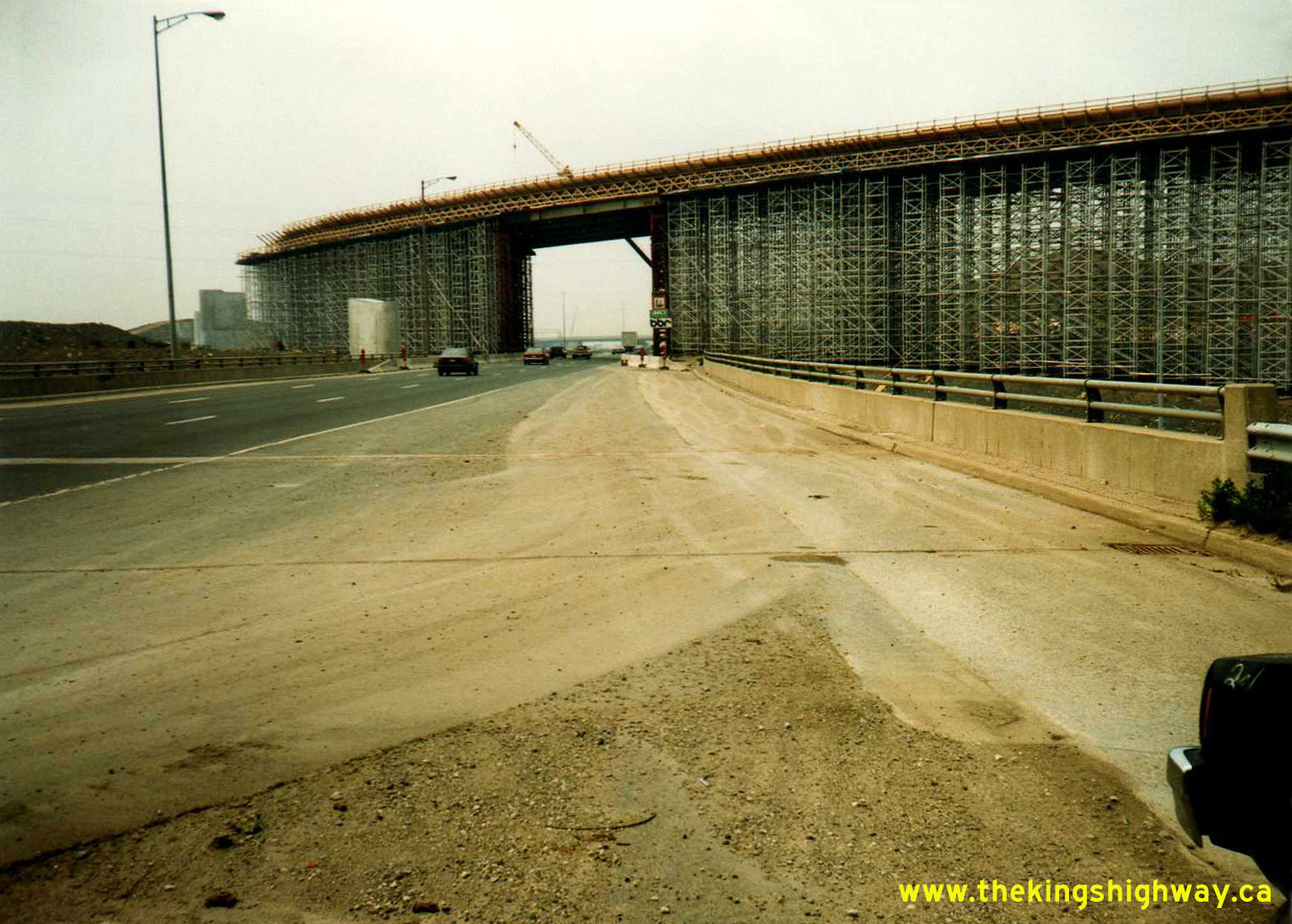
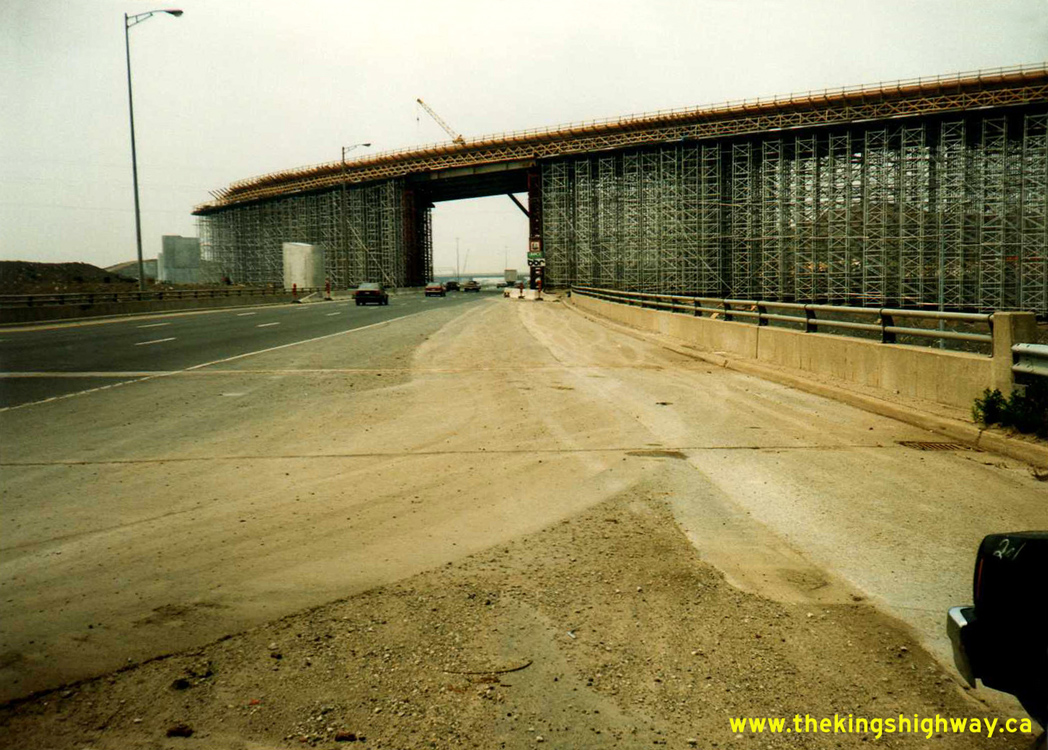
1989. (Photo courtesy of Ontario Ministry of Transportation - © King's Printer for Ontario, 2011) Right - Construction of the new flyover from eastbound Hwy 401 to northbound Hwy 410 (Site #24-492) in Mississauga in 1989. This massive bridge construction project took place between 1988 and 1990 under Contract #1988-48 and resulted in the completion of two new west-oriented ramps between Hwy 401 and Hwy 410. In addition, the original 1970s-era inner loop ramp from southbound Hwy 410 to eastbound Hwy 401 was replaced with a new directional flyover. The amount of falsework required to construct these cast-in-place concrete flyovers at Hwy 401 and Hwy 410 was quite astonishing! See an Enlarged Photo Here. Photo taken on July 4, 1989. (Photo courtesy of Ontario Ministry of Transportation - © King's Printer for Ontario, 2010) 

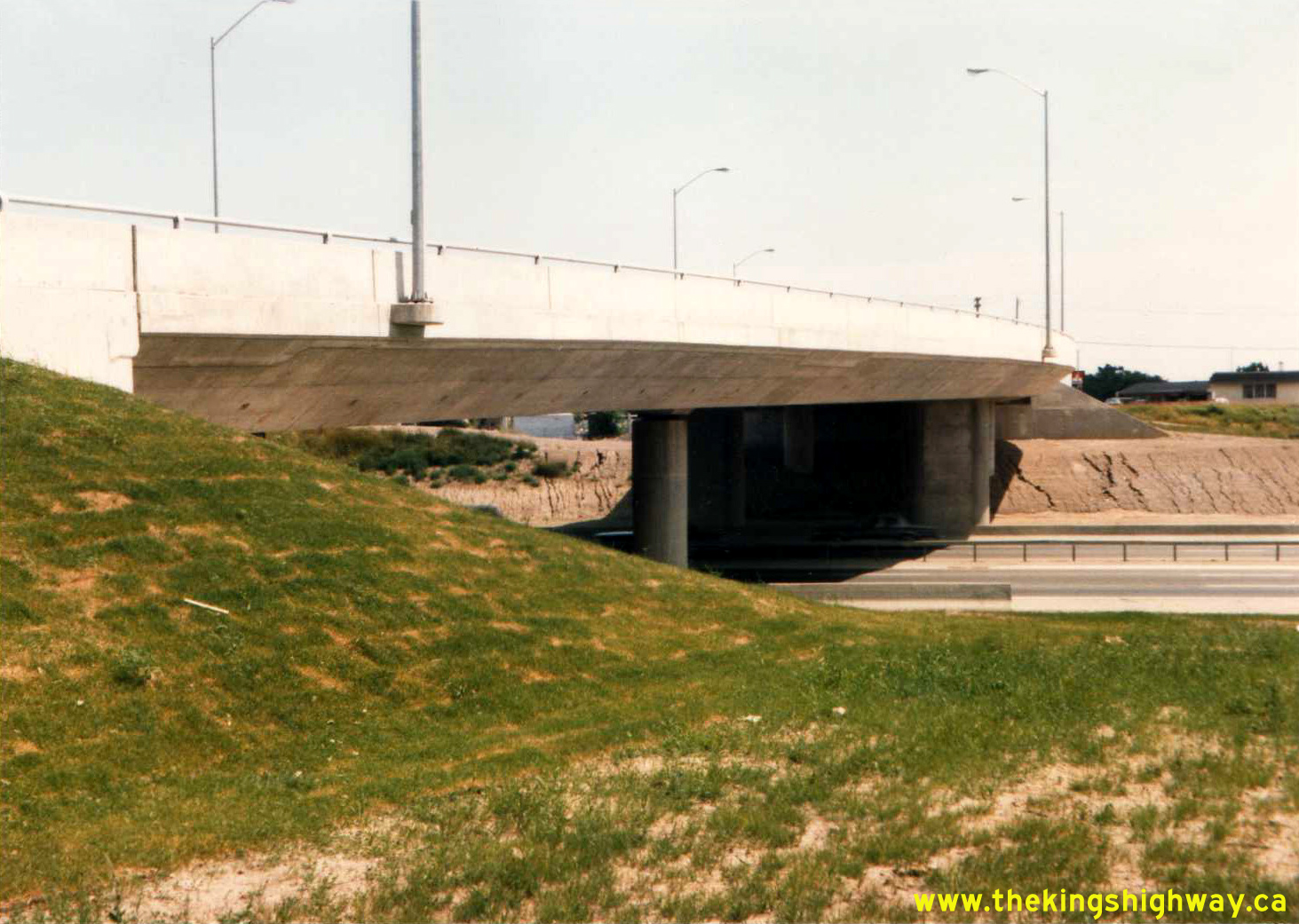
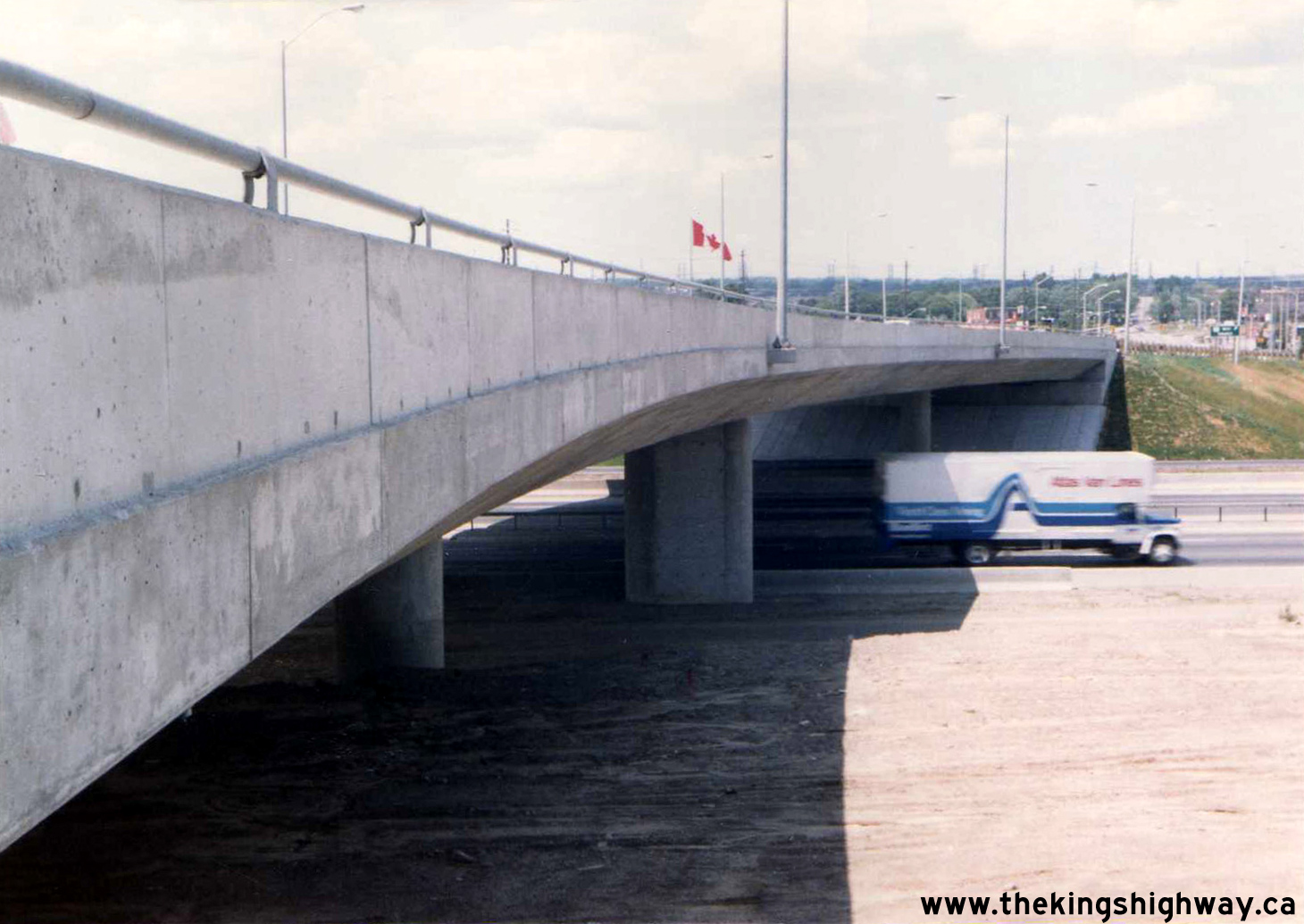
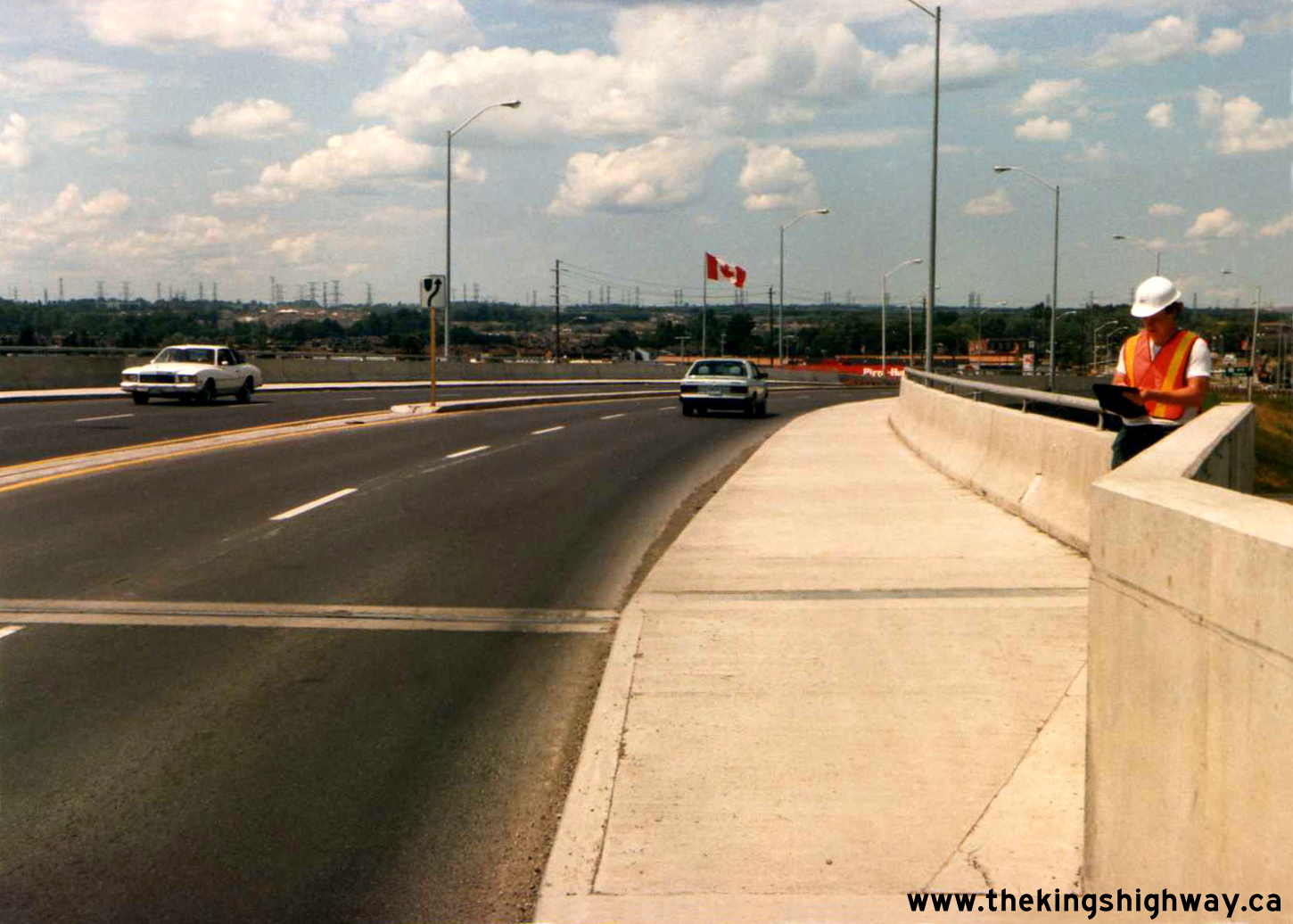
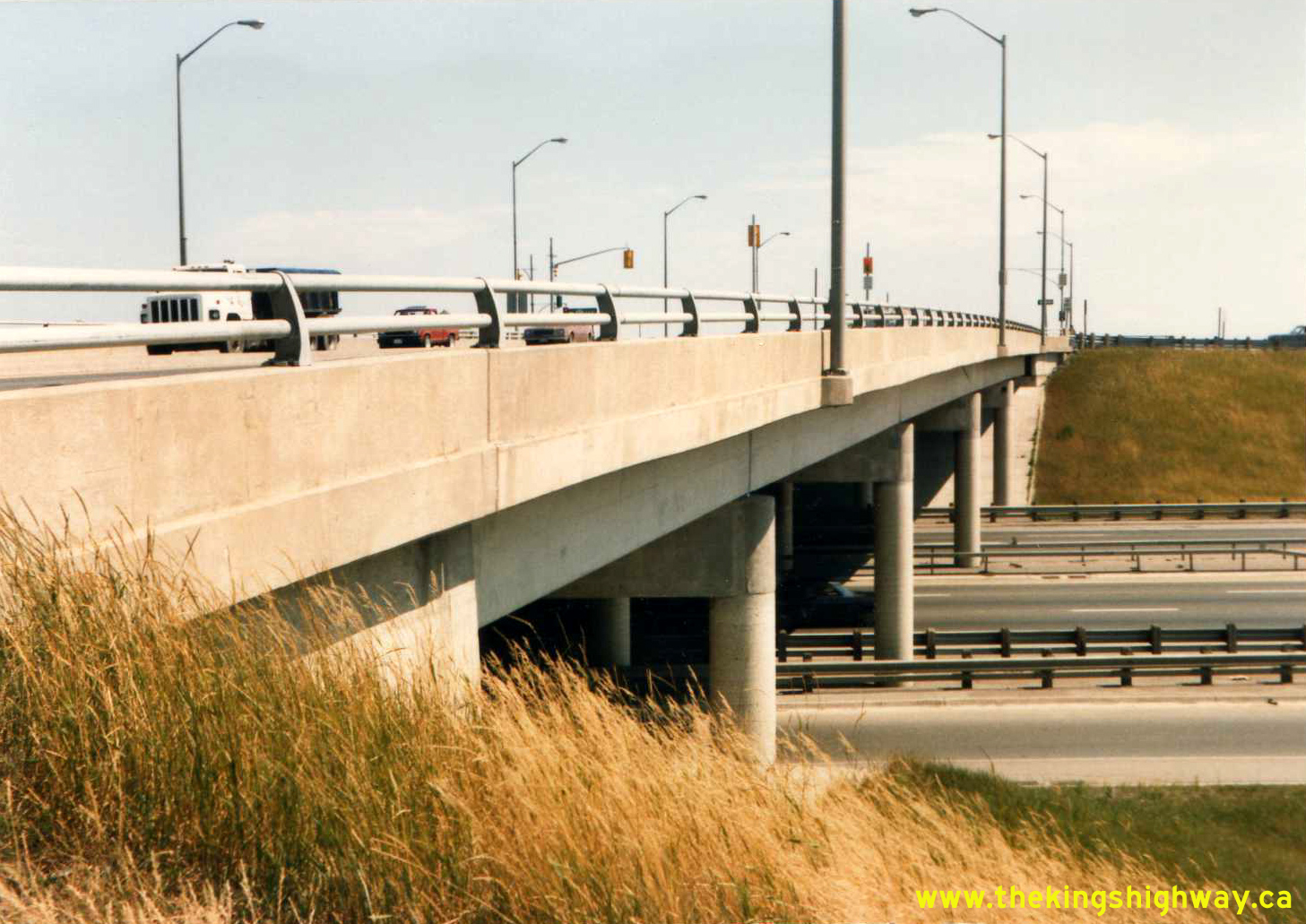
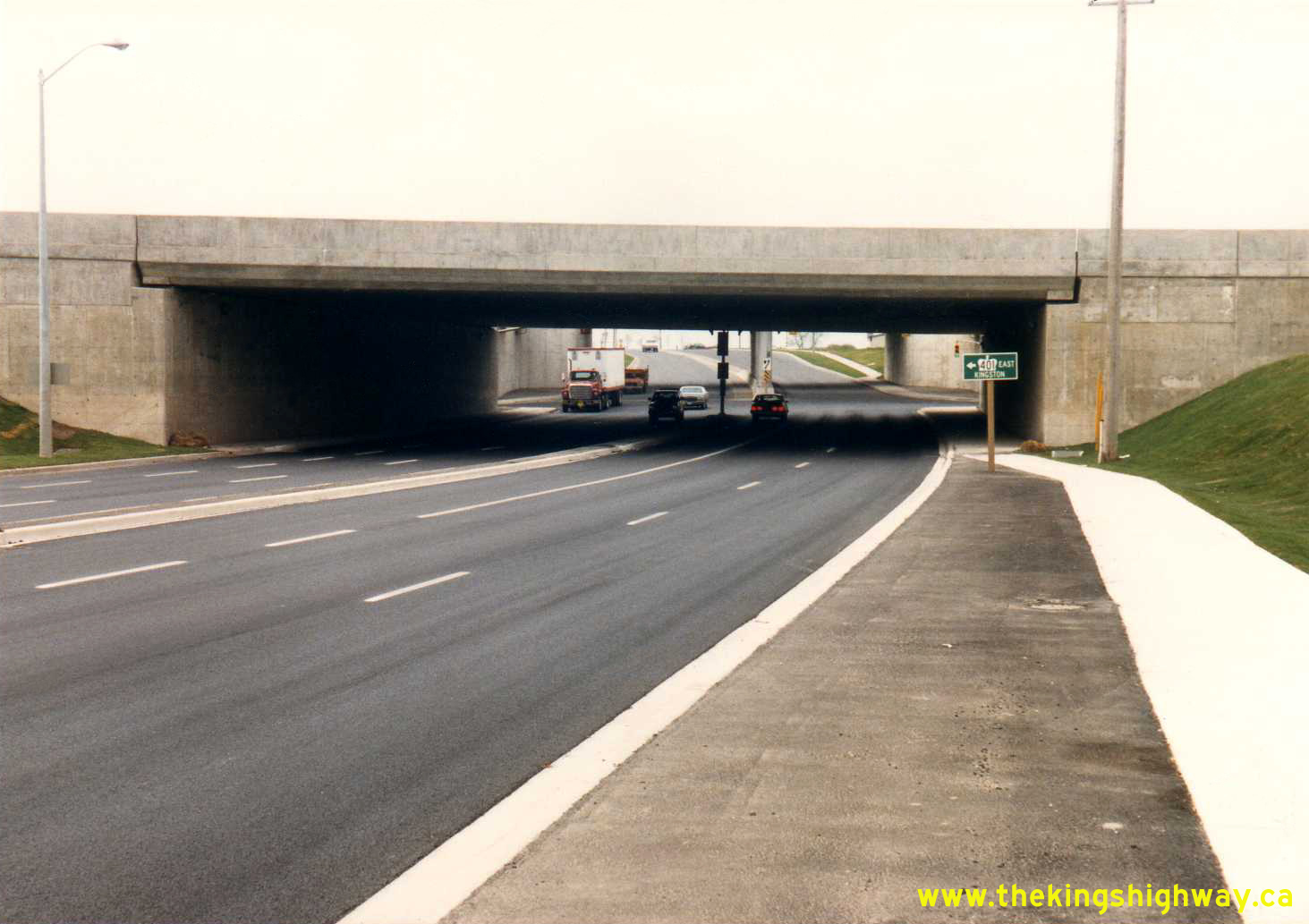
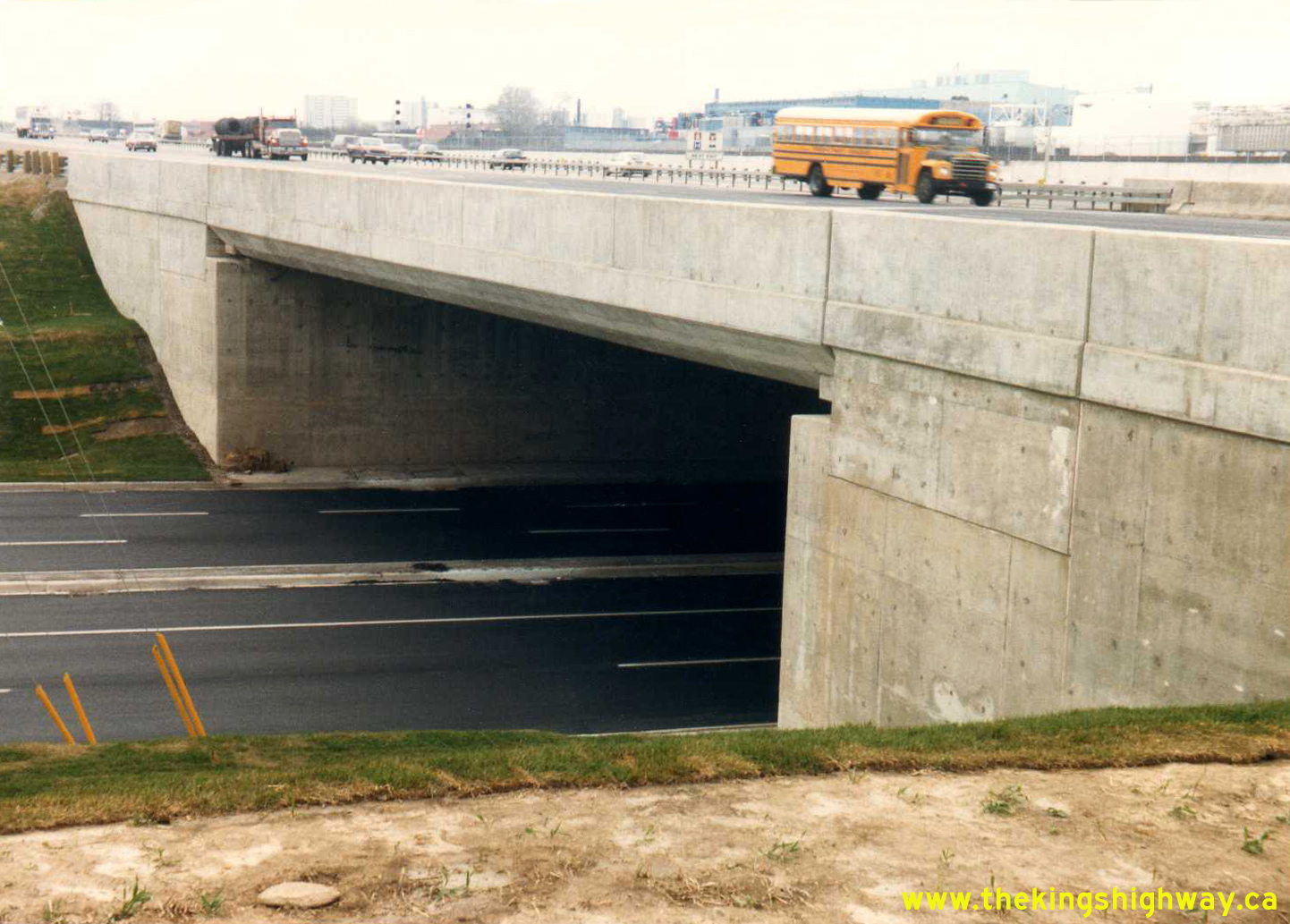
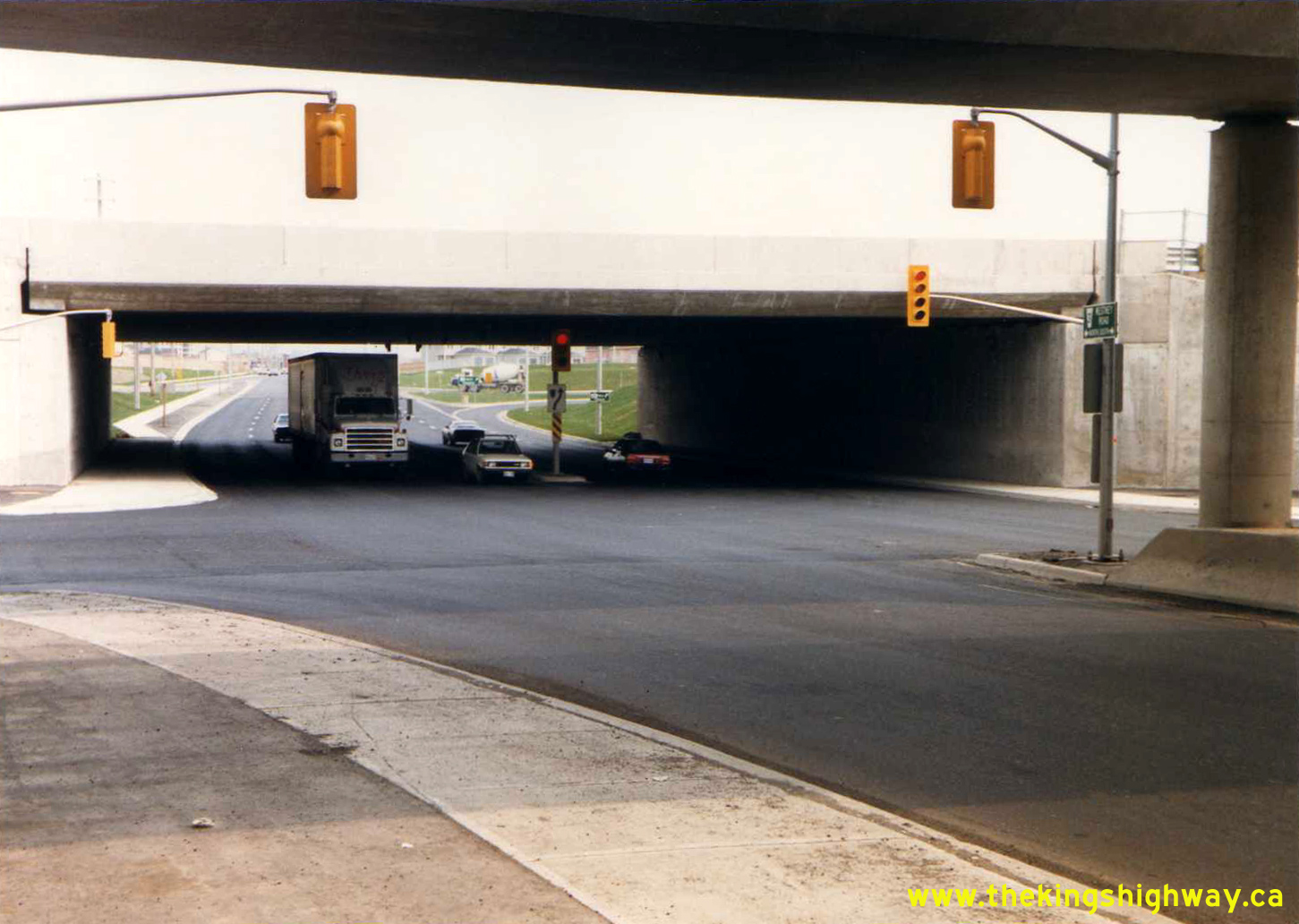
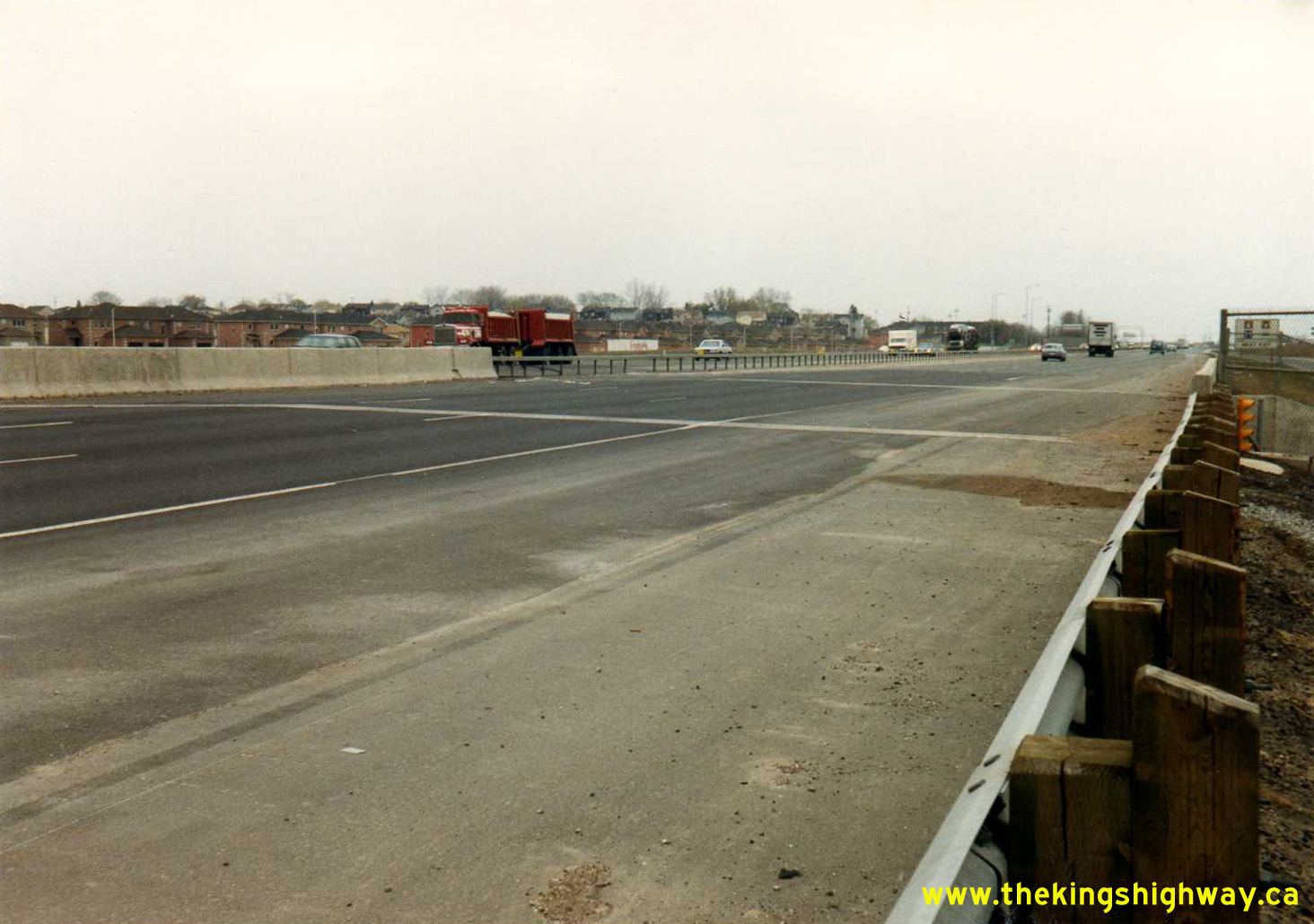
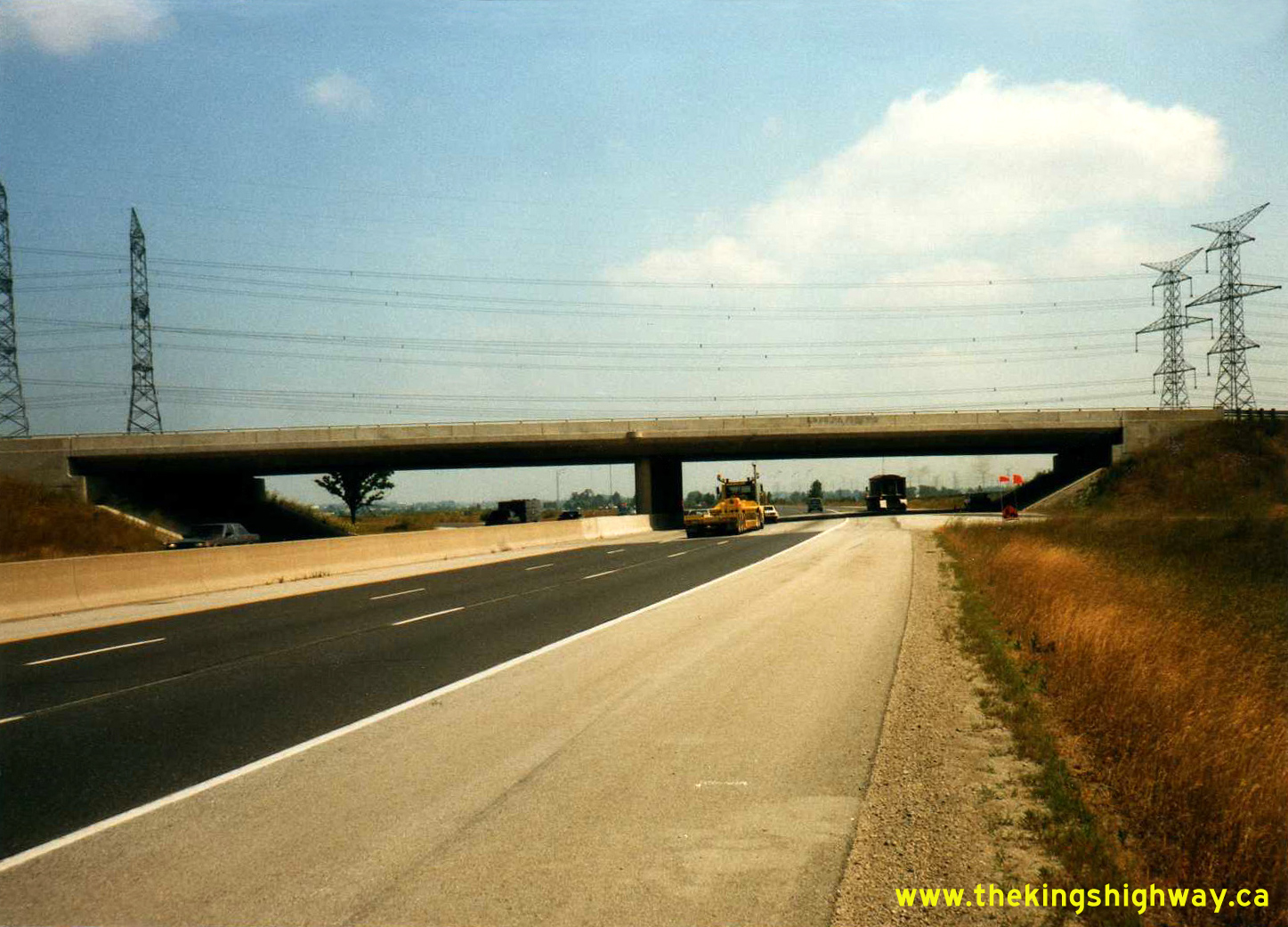
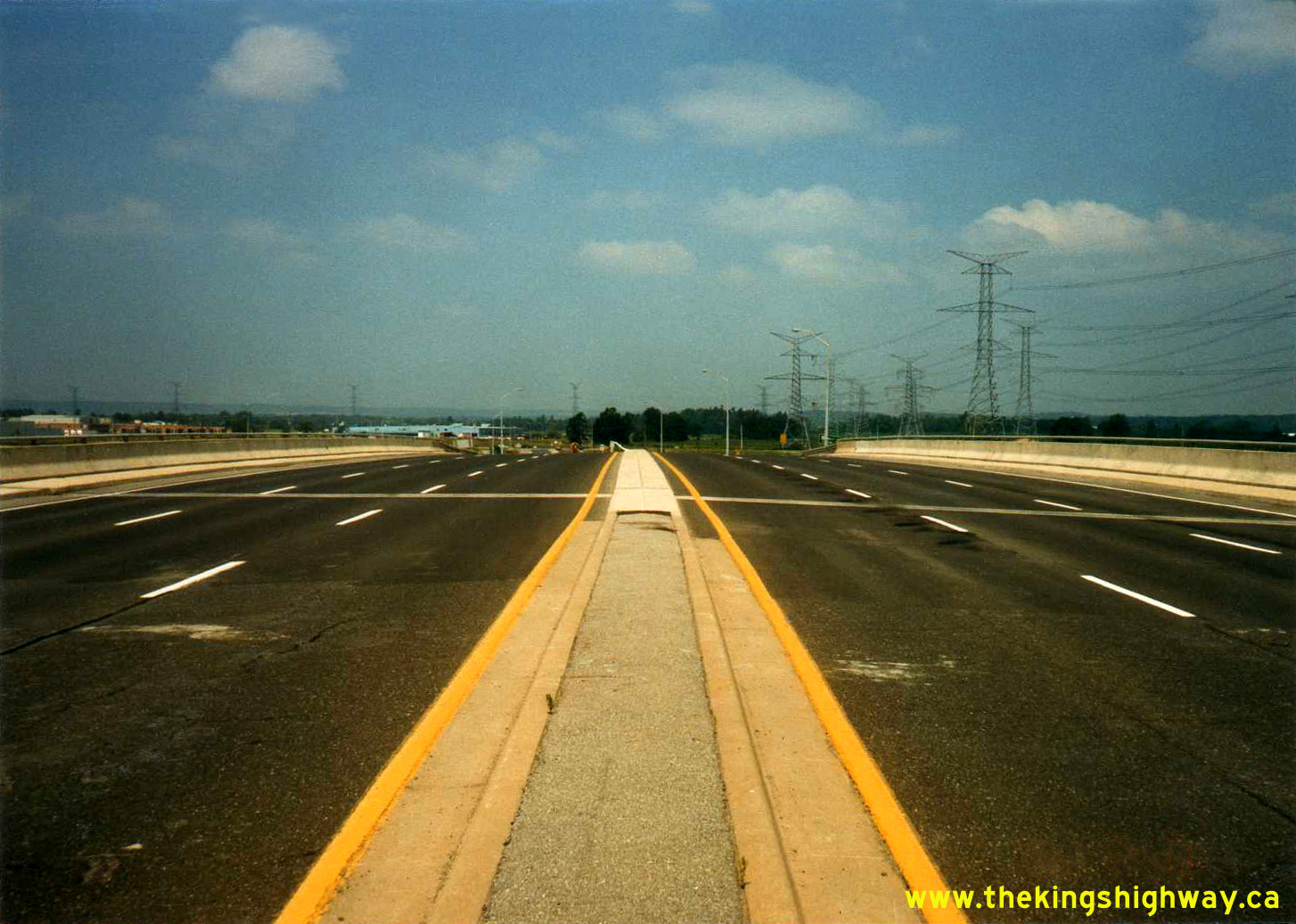
Left - New Winston Churchill Boulevard Overpass (Site #10-98) on Hwy 401 in Mississauga in 1989. The new interchange at Hwy 401 and Winston Churchill Boulevard
was constructed under Contract #1986-72. The interchange was completed and opened to traffic on December 10, 1987. See an
Enlarged Photo Here. Photo taken on July 28, 1989. (Photo courtesy of Ontario Ministry of Transportation - © King's Printer for Ontario, 2011) Right - Facing south across the new Winston Churchill Boulevard Overpass on Hwy 401 in Mississauga. See an Enlarged Photo Here. Photo taken on July 28, 1989. (Photo courtesy of Ontario Ministry of Transportation - © King's Printer for Ontario, 2011) 

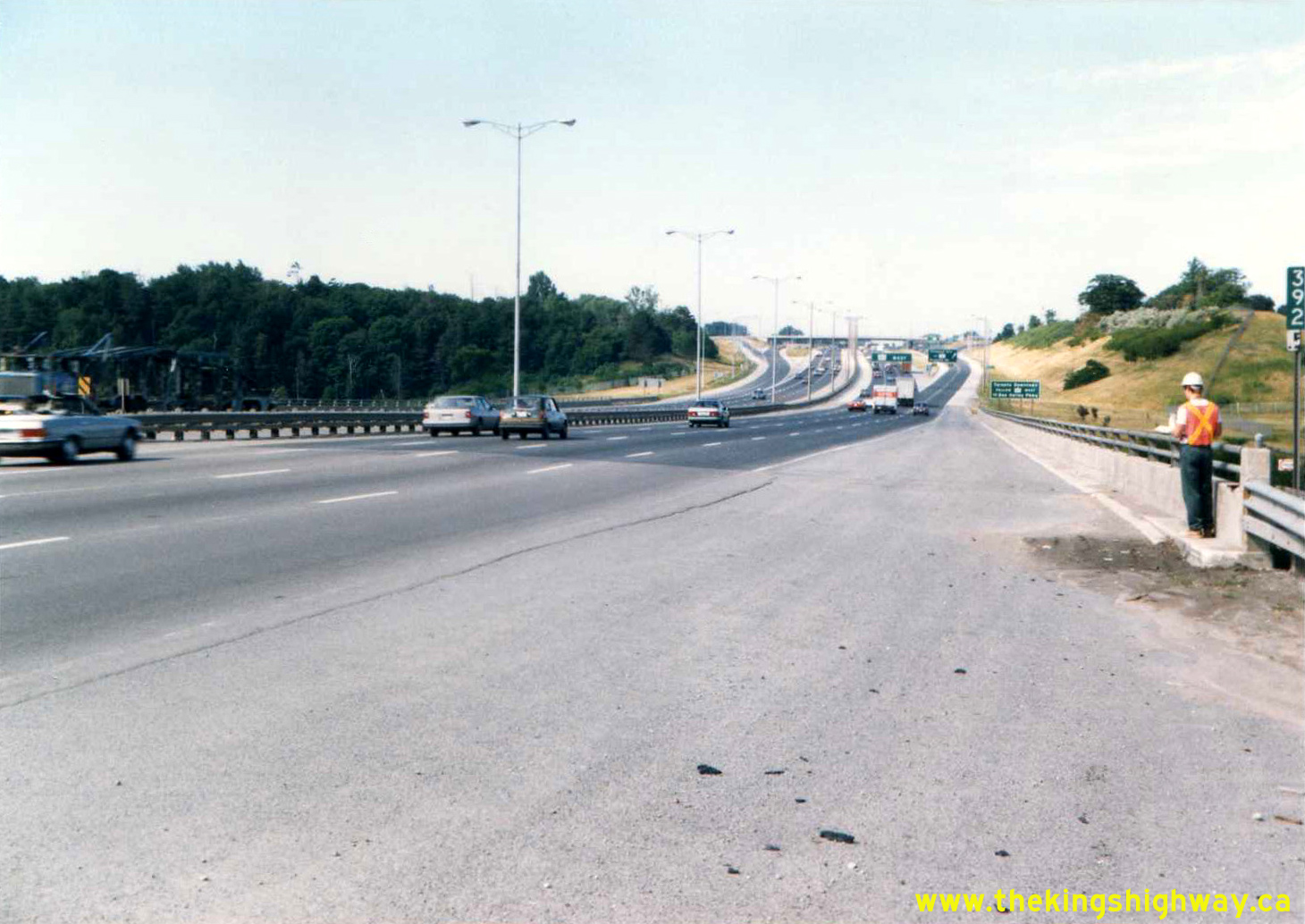
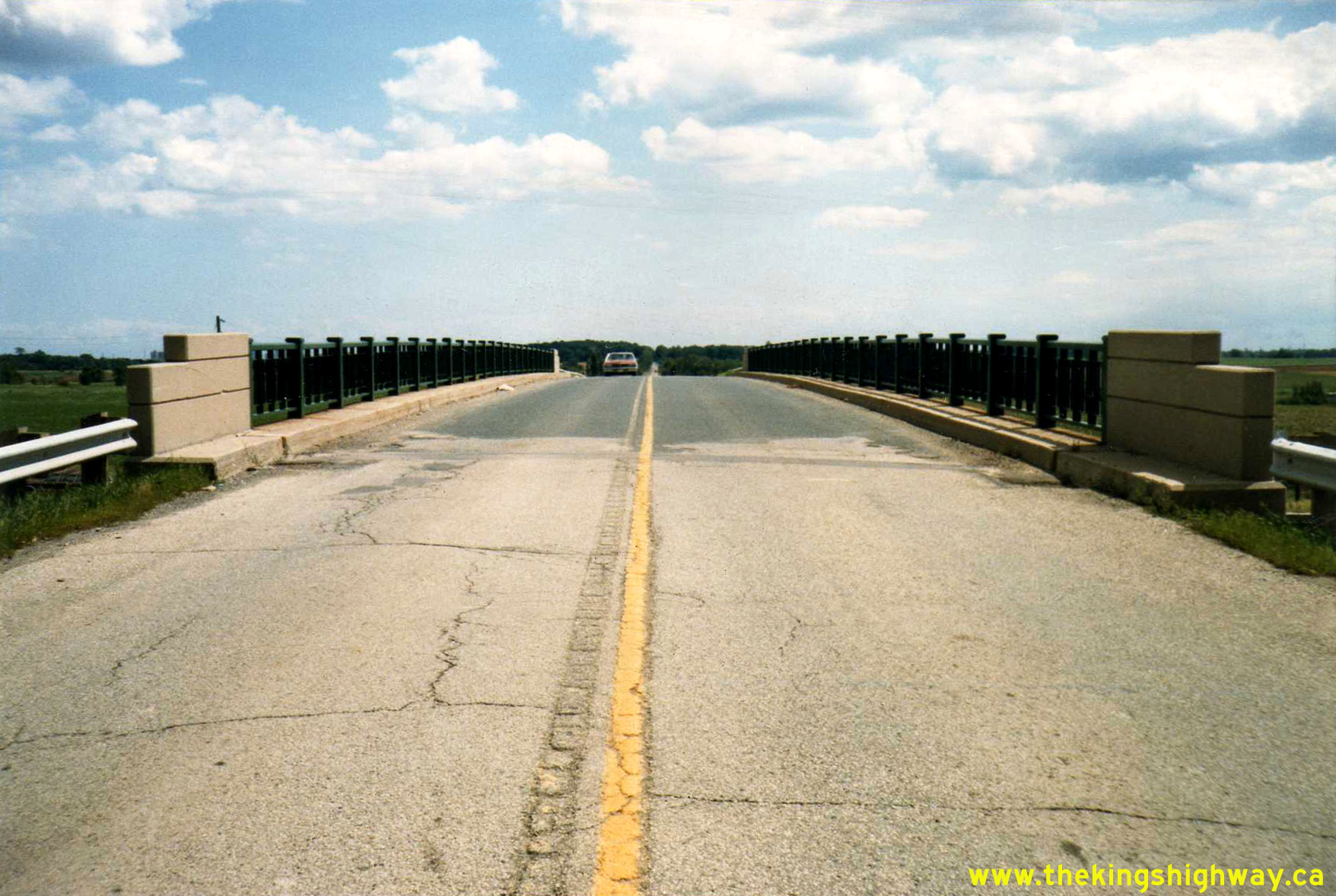
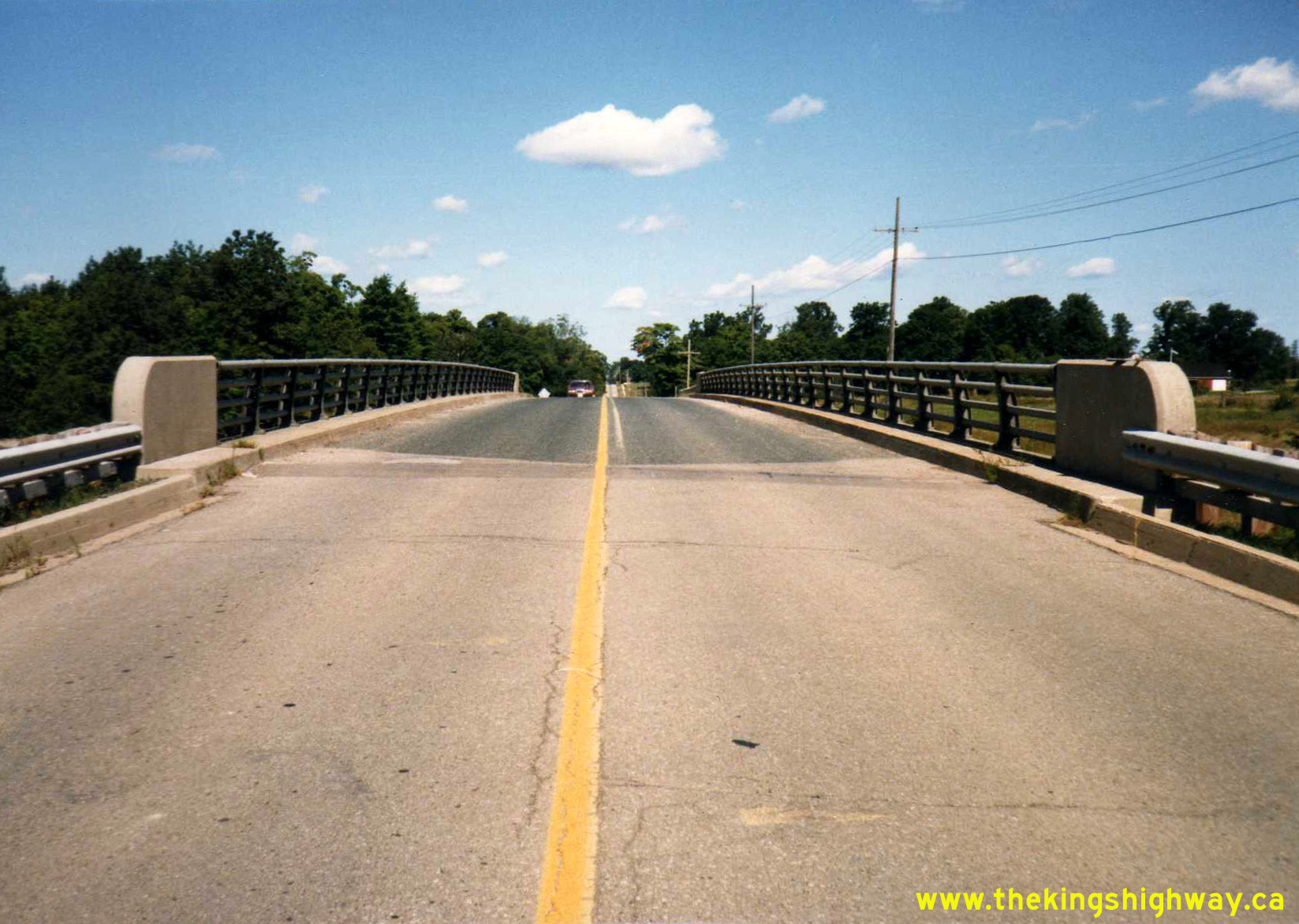
Left - View of Hwy 401 facing east towards Toronto at the James Snow Parkway Interchange on Hwy 401 in Milton. See an
Enlarged Photo Here. Photo taken on July 28, 1989. (Photo courtesy of Ontario Ministry of Transportation - © King's Printer for Ontario, 2011) Right - Facing north across the James Snow Parkway Overpass (Site #10-312) on Hwy 401 in Milton in 1989. The deck of the James Snow Parkway Overpass was badly damaged as a result of a serious collision that took place on Hwy 401 below the structure in March 1986. The entire superstructure of the bridge was subsequently replaced under Contract #1986-533. See an Enlarged Photo Here. Photo taken on July 28, 1989. (Photo courtesy of Ontario Ministry of Transportation - © King's Printer for Ontario, 2011) 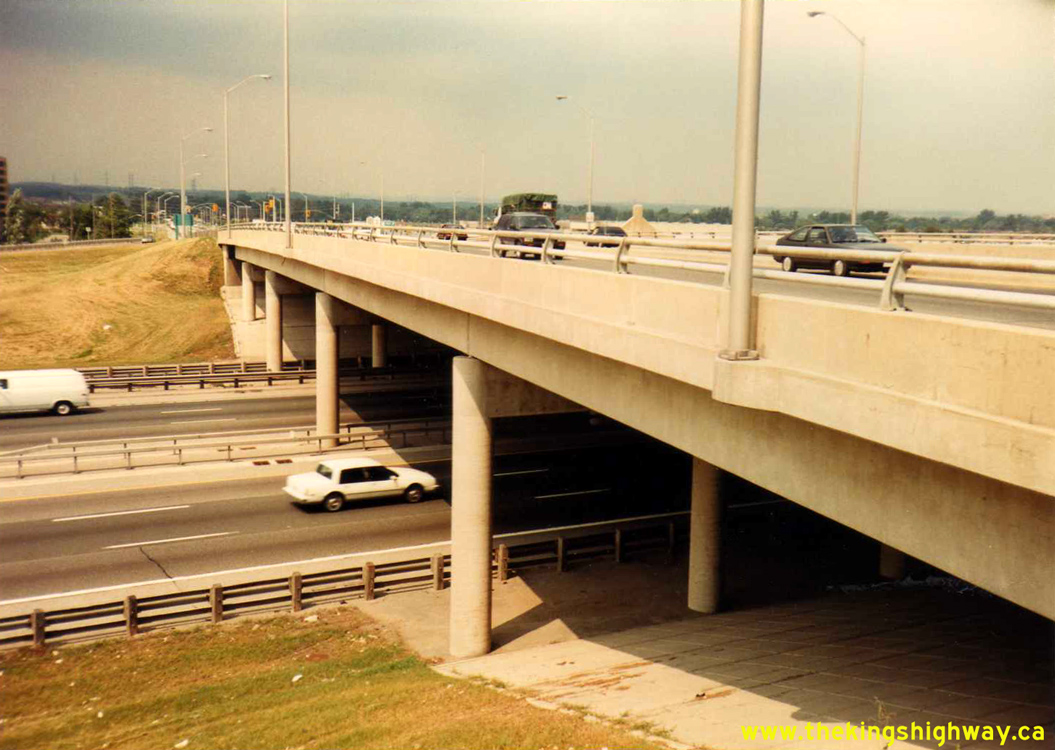
 Left - Western side of the Brock Road Overpass (Site #22-275) on Hwy 401 in Pickering, facing north. See an
Enlarged Photo Here. Photo taken on August 8, 1989. Left - Western side of the Brock Road Overpass (Site #22-275) on Hwy 401 in Pickering, facing north. See an
Enlarged Photo Here. Photo taken on August 8, 1989.(Photo courtesy of Ontario Ministry of Transportation - © King's Printer for Ontario, 2025) Right - Facing west across the flyover carrying the westbound Hwy 403 Collector Lanes over the future Hwy 401 Express Lanes (Site #24-329). See an
Enlarged Photo Here. Photo taken on August 9, 1989.(Photo courtesy of Ontario Ministry of Transportation - © King's Printer for Ontario, 2025) 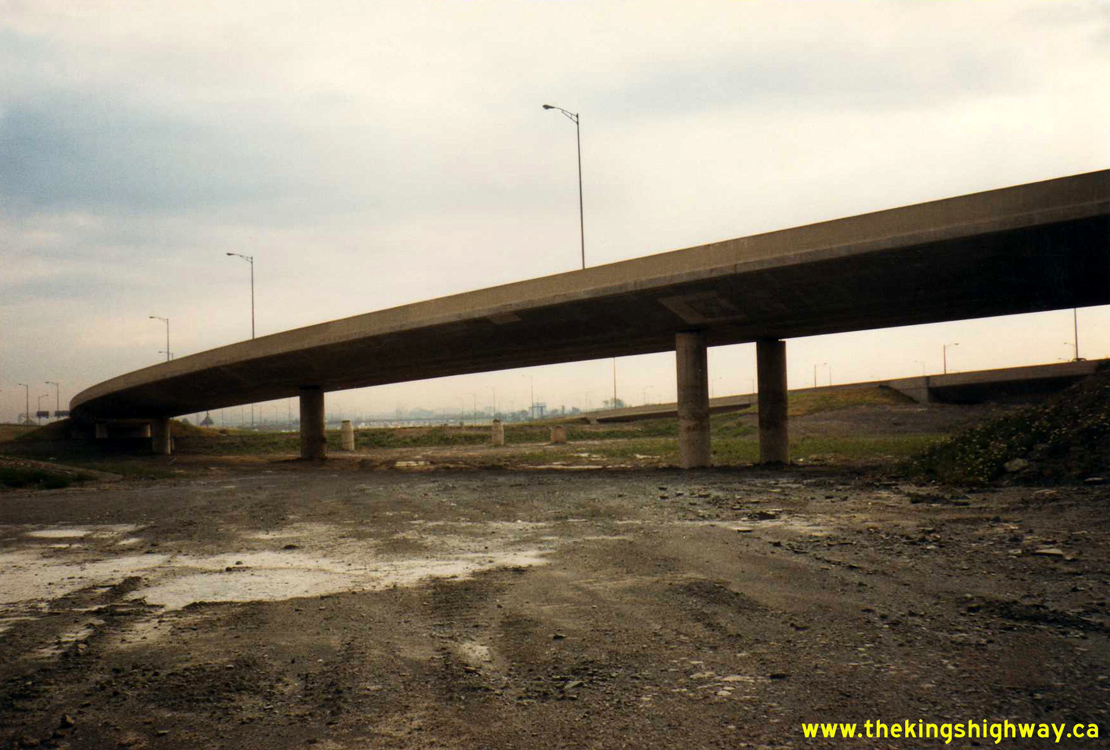
 Left - Future site of the Hwy 401 Express Lanes below the flyover carrying the westbound Hwy 403 Collector Lanes (Site #24-329), facing east towards Dixie
Road. Construction began on the Hwy 401 Express Lanes through the Hwy 403 and Hwy 410 Interchange in the Spring of 1993 under Contract #1993-45. See an
Enlarged Photo Here. Photo taken on August 9, 1989. Left - Future site of the Hwy 401 Express Lanes below the flyover carrying the westbound Hwy 403 Collector Lanes (Site #24-329), facing east towards Dixie
Road. Construction began on the Hwy 401 Express Lanes through the Hwy 403 and Hwy 410 Interchange in the Spring of 1993 under Contract #1993-45. See an
Enlarged Photo Here. Photo taken on August 9, 1989.(Photo courtesy of Ontario Ministry of Transportation - © King's Printer for Ontario, 2025) Right - Facing east towards Toronto from the top level of the Airport Basketweave Structure (Site #24-468) on eastbound Hwy 401 in Mississauga. See an Enlarged Photo Here. Photo taken on August 9, 1989. (Photo courtesy of Ontario Ministry of Transportation - © King's Printer for Ontario, 2011) 
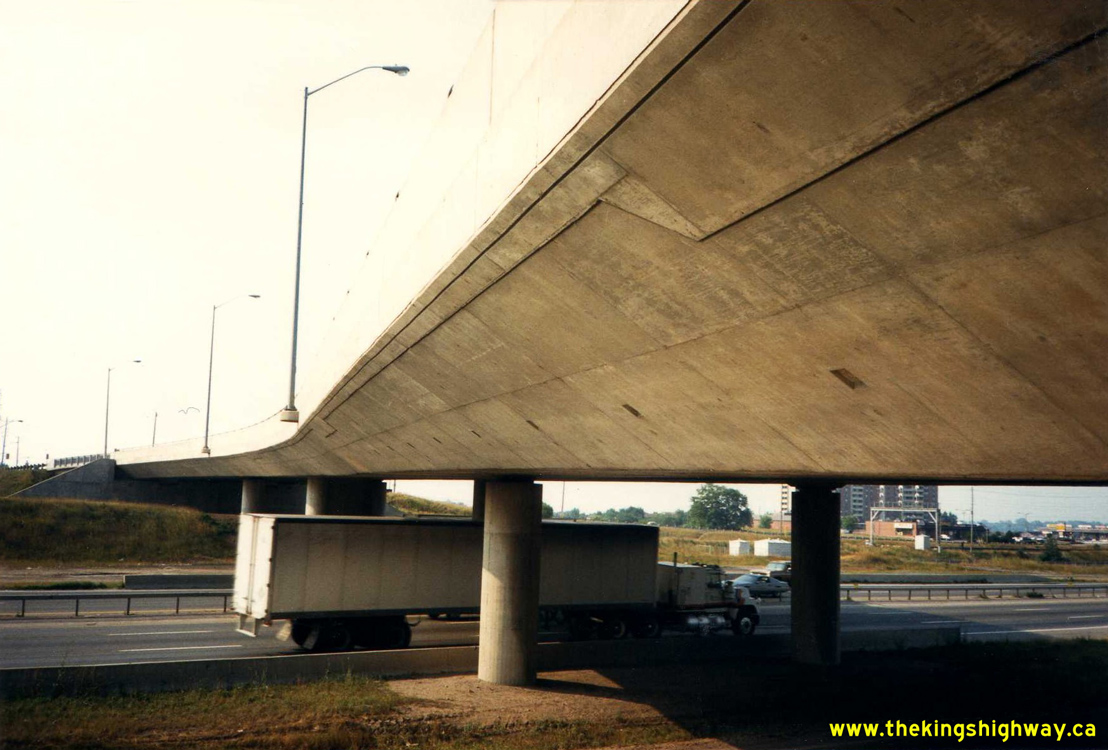
Left - Eastern side of the Liverpool Road Overpass on Hwy 401 in Pickering. See an
Enlarged Photo Here. Photo taken on August 10, 1989. (Photo courtesy of Ontario Ministry of Transportation - © King's Printer for Ontario, 2011) Right - Liverpool Road Overpass on Hwy 401 in Pickering. Note that the Hwy 401 Collector Lanes had not yet been built at the time this photo was taken in 1989. They were constructed as part of a highway widening project in the late 1990s under Contract #1996-02. See an Enlarged Photo Here. Photo taken on August 10, 1989. (Photo courtesy of Ontario Ministry of Transportation - © King's Printer for Ontario, 2011)
Continue on to King's Highway 401 Photos: Historical Photos (1990-1994)
|
|---|
Links to Adjacent King's Highway Photograph Pages:
Back to Hwy 401 - Historical Photos (1980-1984)
Hwy 401 Photo Index
On to Hwy 401 - Historical Photos (1990-1994)
Back to King's Highway 400 Photos /
King's Highway 401 History /
On to King's Highway 402 Photos
Ontario Highway History - Main Menu / Back to List of Highways Website contents, photos & text © 2002-2026, Cameron
Bevers (Webmaster) - All Rights Reserved / Contact Me
|
|---|