| 
| |
|
|
This page contains historical photos of Ontario's Queen Elizabeth Way dating from 1950 to 1959. All photographs displayed on
this page were taken by the Ontario Ministry of Transportation, unless specifically noted otherwise. Historical photographs are arranged in approximate chronological
order. Click on any thumbnail to see a larger image!
Please note that all photographs displayed on this
website are protected by copyright. These photographs must not be reproduced, published,
electronically stored or copied, distributed, or posted onto other websites without
my written permission. If you want to use photos from this website, please
email me first for permission. Thank-you!
|
|---|
|
Page 3: Historical Queen Elizabeth Way Photographs (1950 to 1959)
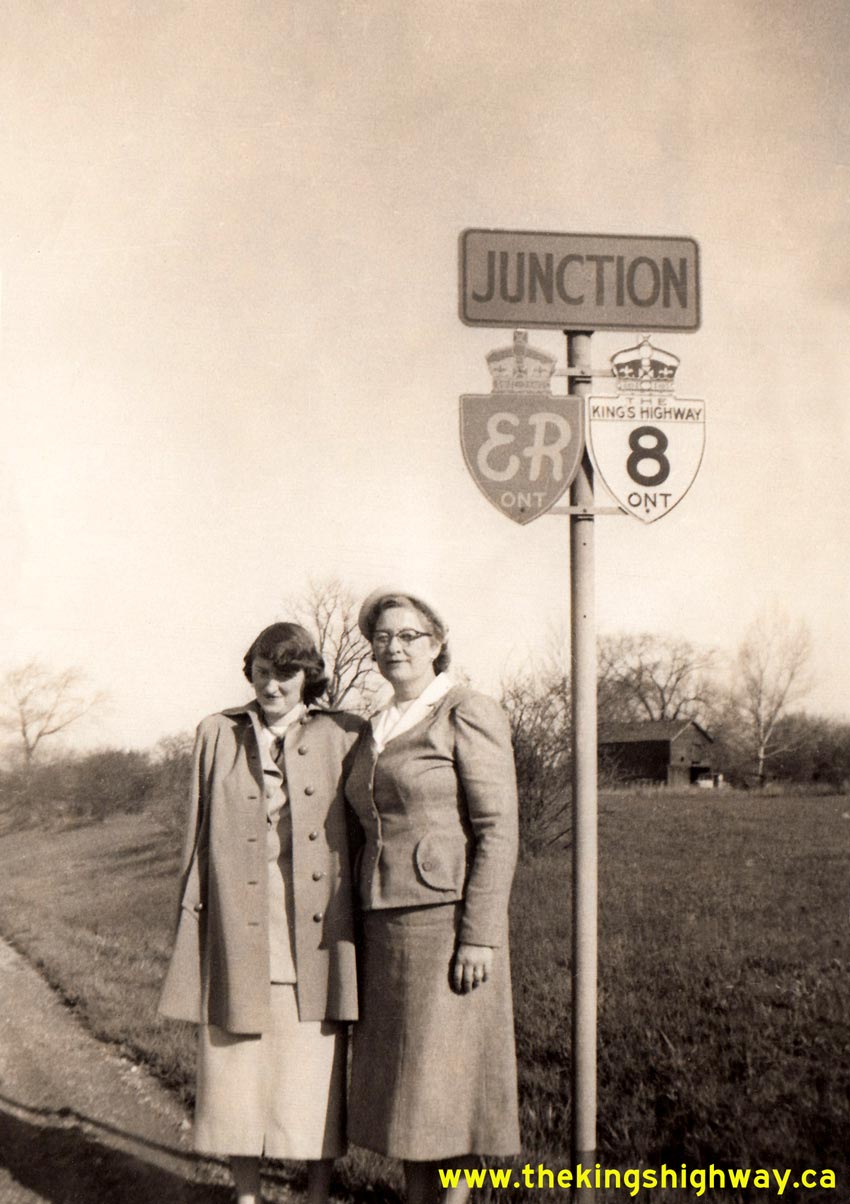
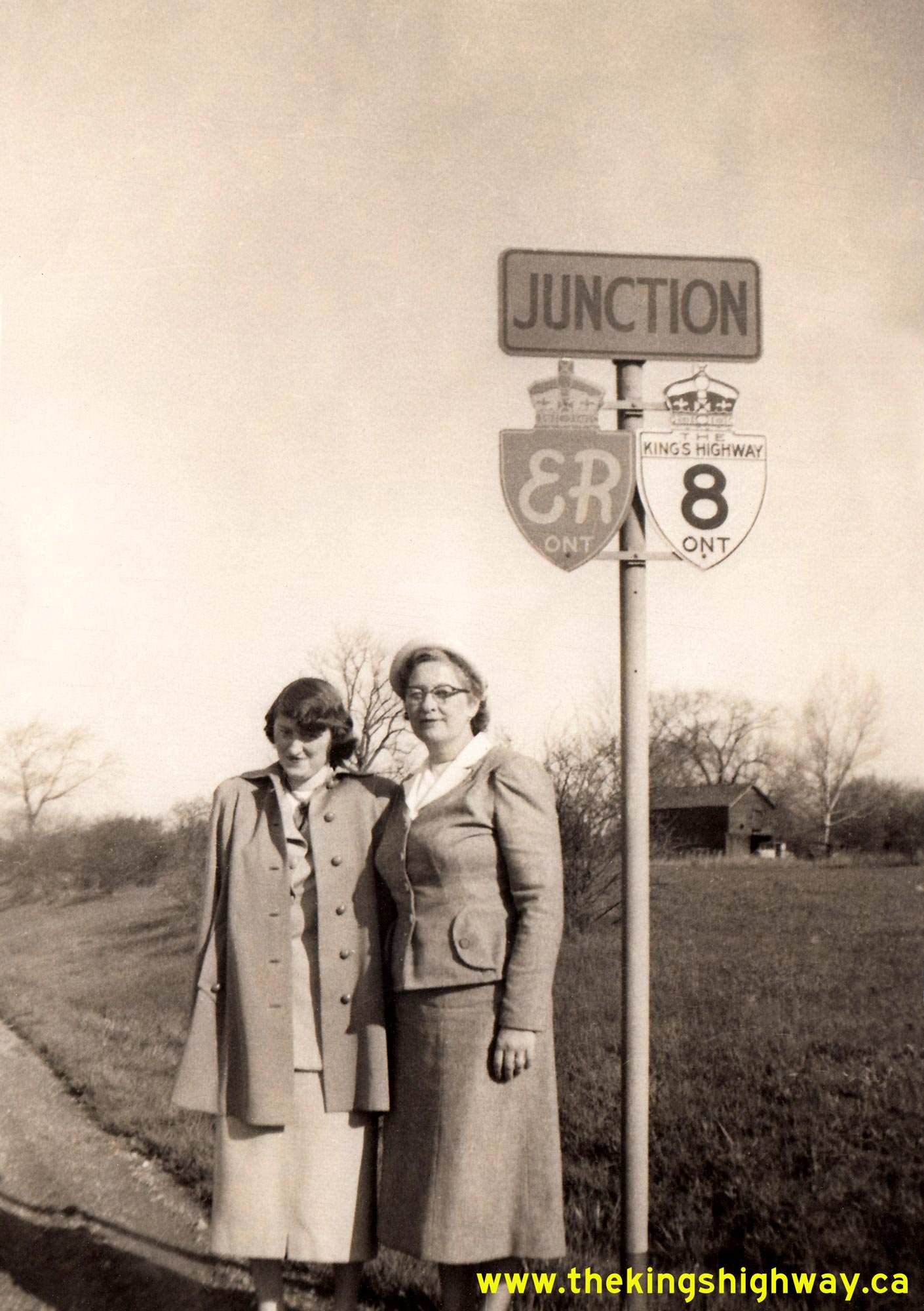
Above - Circa 1950 photo of motorists standing beside an older Elizabeth Regina "ER" and King's Highway 8 route marker junction assembly on the Queen Elizabeth
Way near St. Catharines. These Elizabeth Regina "ER" route markers were originally used to sign the Queen Elizabeth Way, but the meaning of the Latin "ER"
abbreviation for Queen Elizabeth was lost on all but the most educated. The signs were eventually replaced with a new series of route markers in the mid-1950s, which
more logically abbreviated the highway's name as "QEW". See an Enlarged Photo Here. Photo taken
circa 1950. (Photo from Cameron Bevers' historical photograph collection - Original photographer unknown) 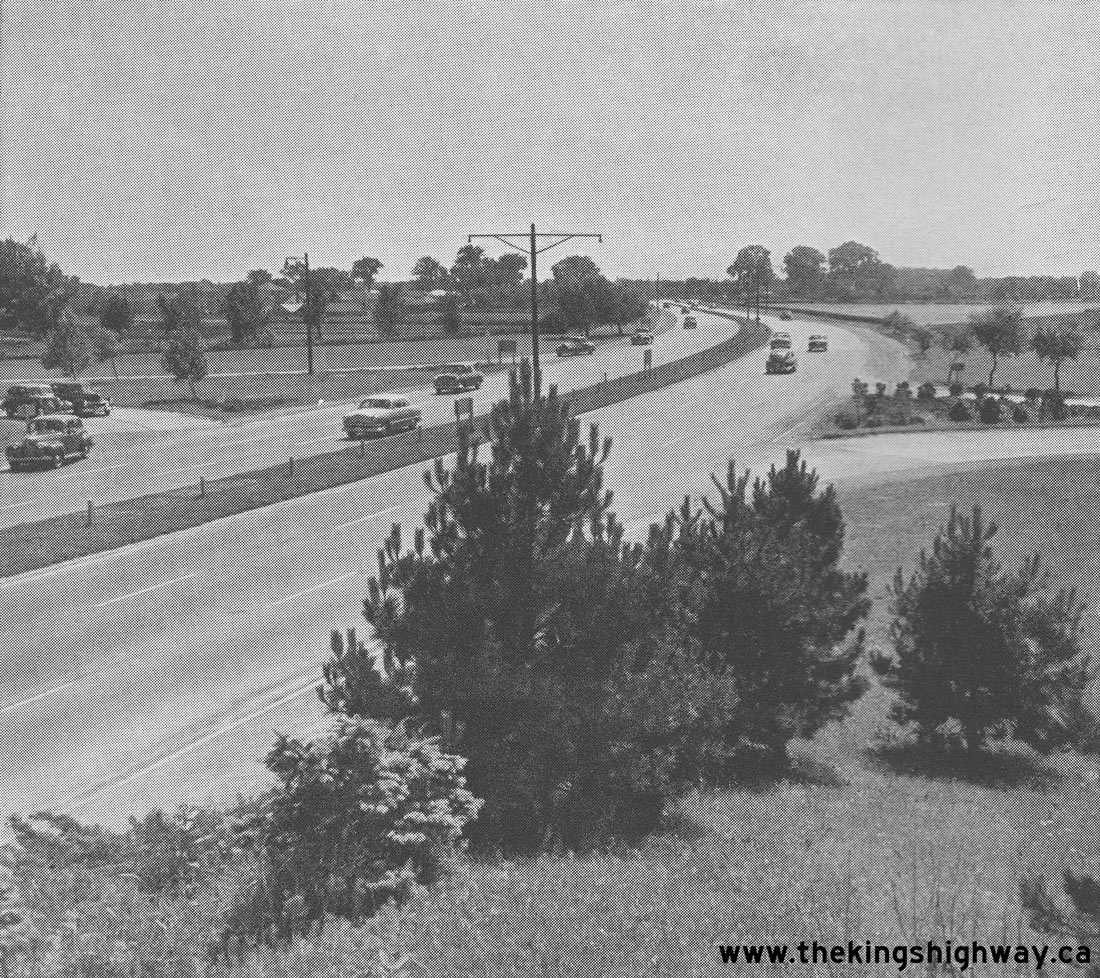
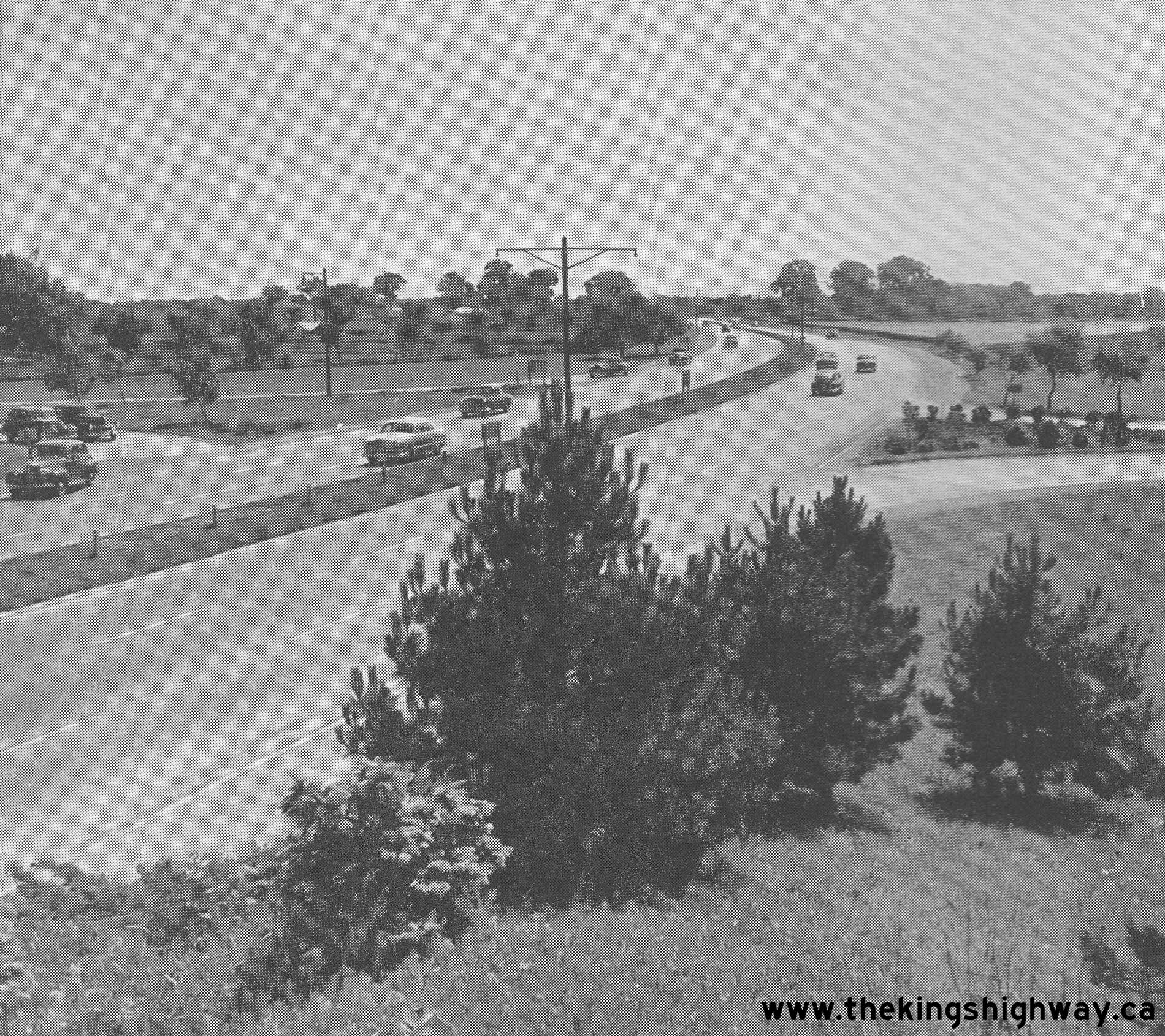
Above - Facing west along the Queen Elizabeth Way towards Hamilton from the Hwy 27 Cloverleaf in Toronto. See an
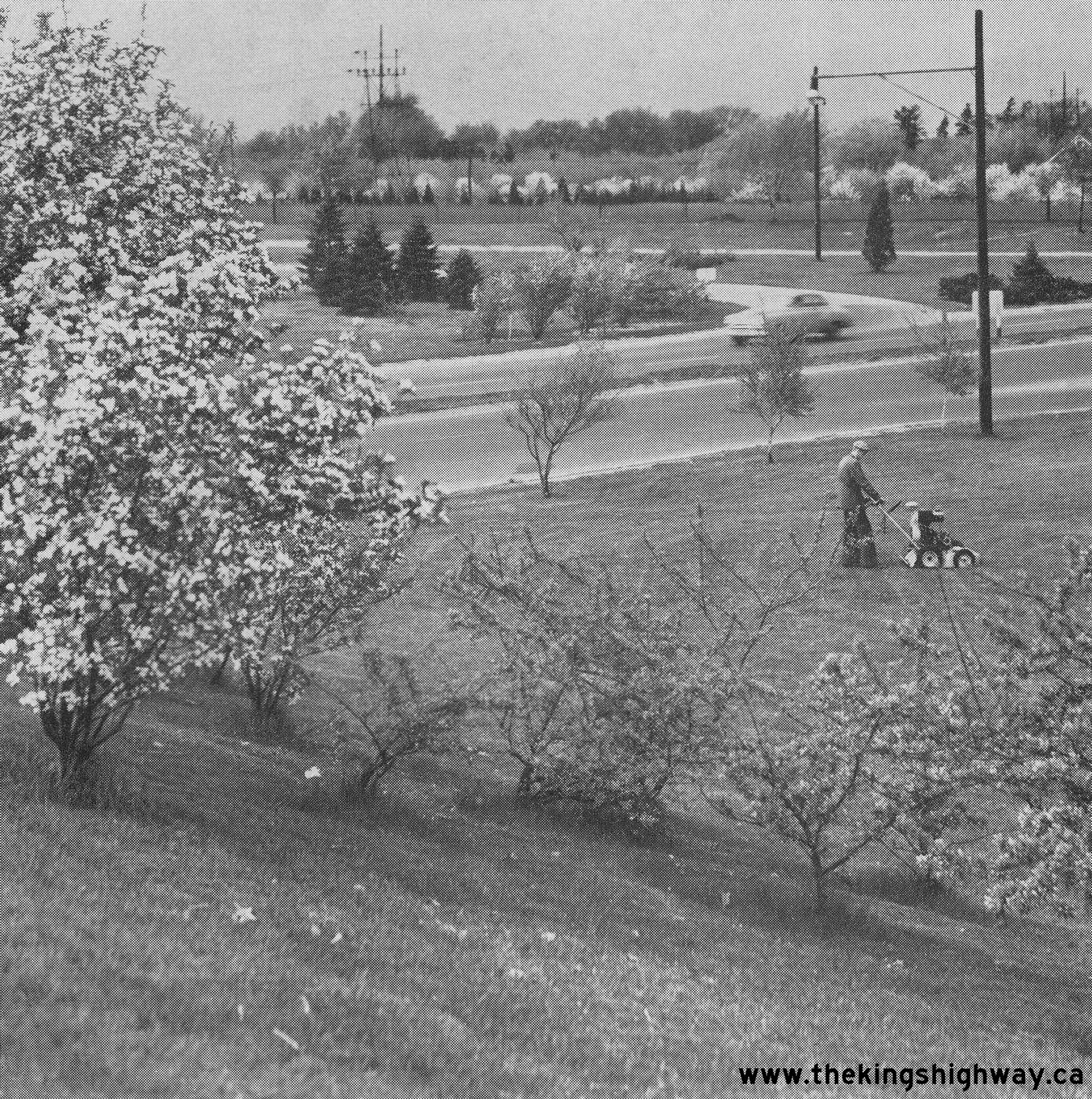
Enlarged Photo Here. Photo taken on July 3, 1951. (Photo courtesy of Ontario Ministry of Transportation - © King's Printer for Ontario, 1951) 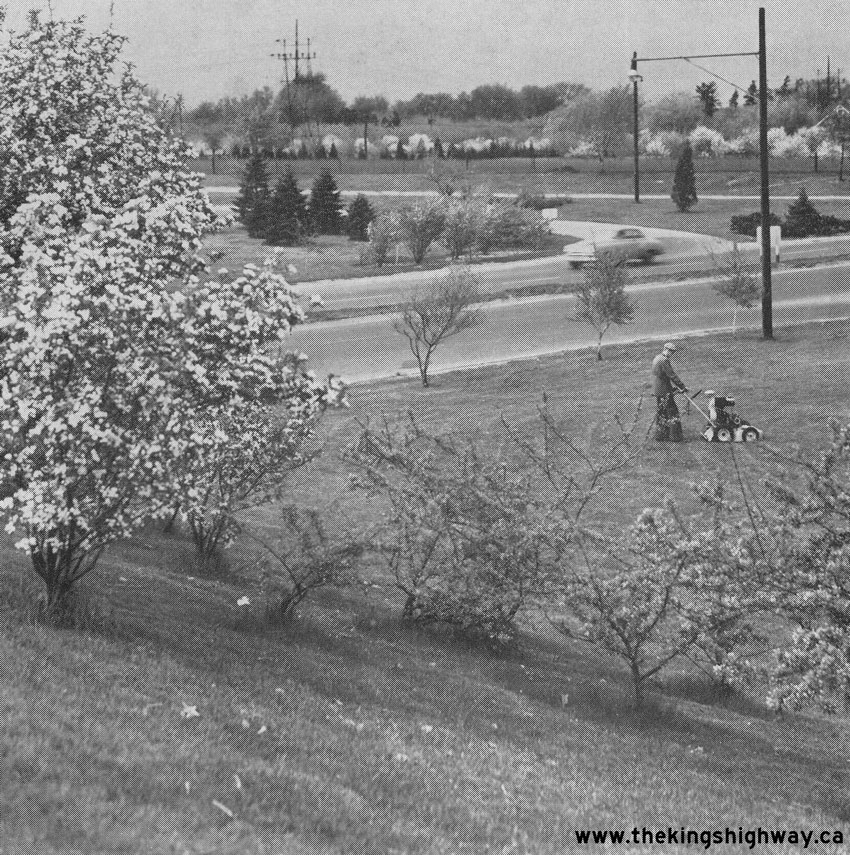  Above - Spring blossoms along the Queen Elizabeth Way at the Hwy 10 Cloverleaf at Port Credit in 1953. See an
Enlarged Photo Here. Photo taken on May 27, 1953. Above - Spring blossoms along the Queen Elizabeth Way at the Hwy 10 Cloverleaf at Port Credit in 1953. See an
Enlarged Photo Here. Photo taken on May 27, 1953.(Photo courtesy of Ontario Ministry of Transportation - © King's Printer for Ontario, 1953) 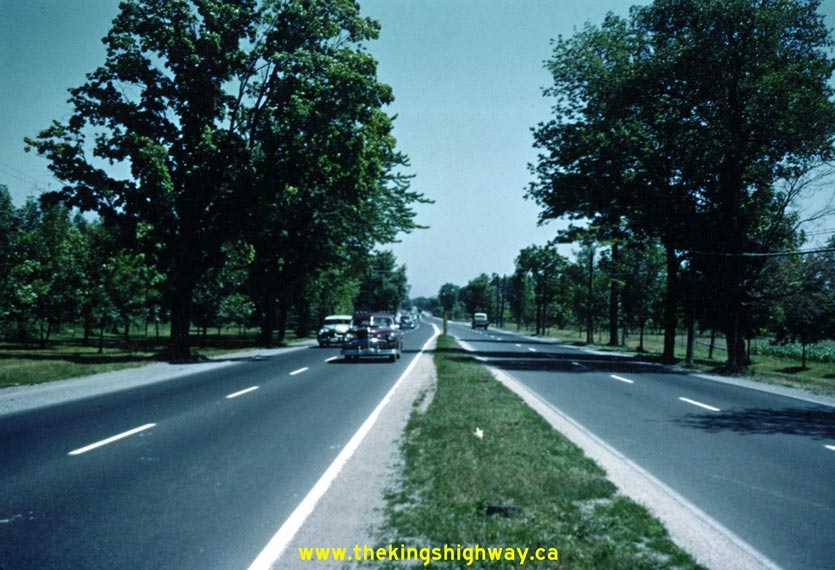
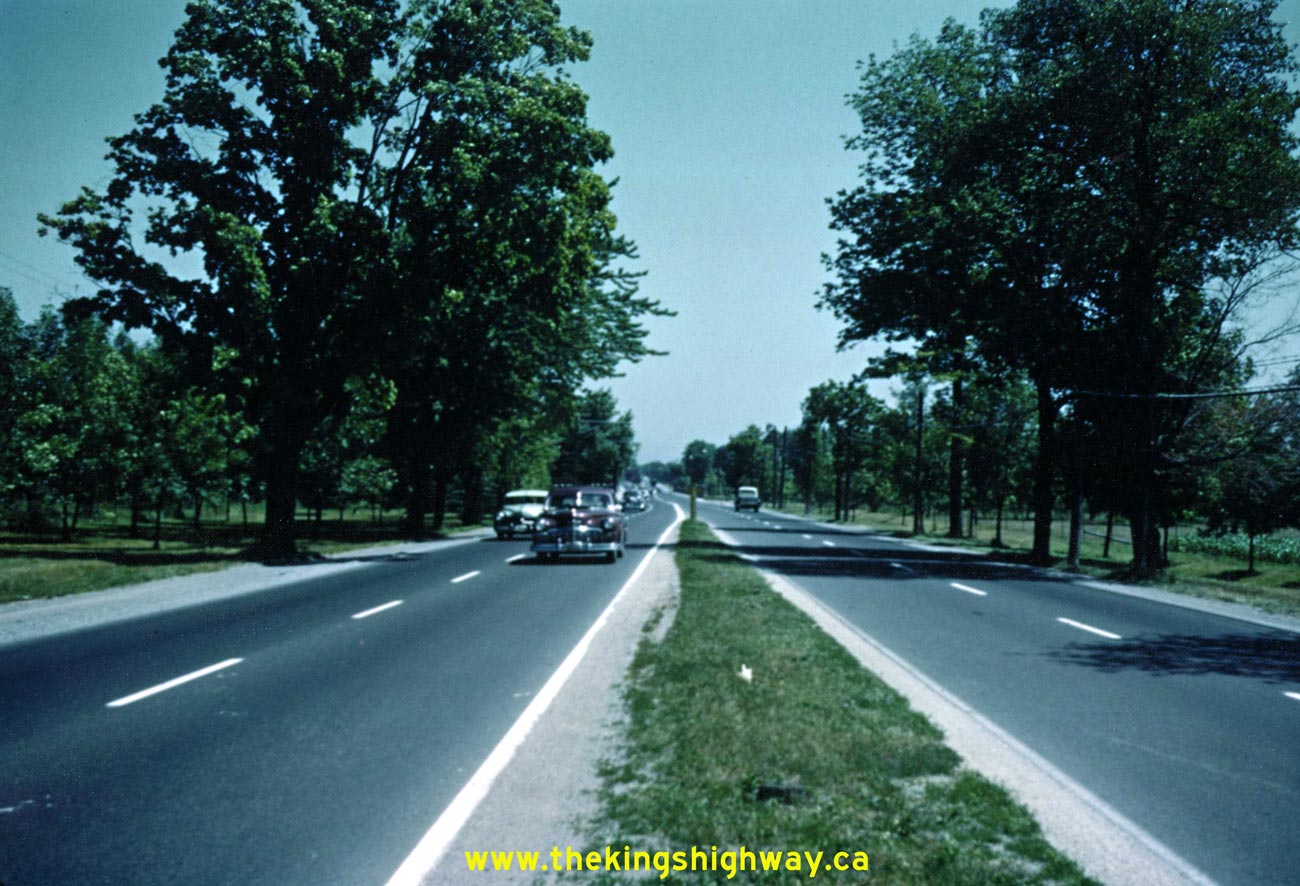
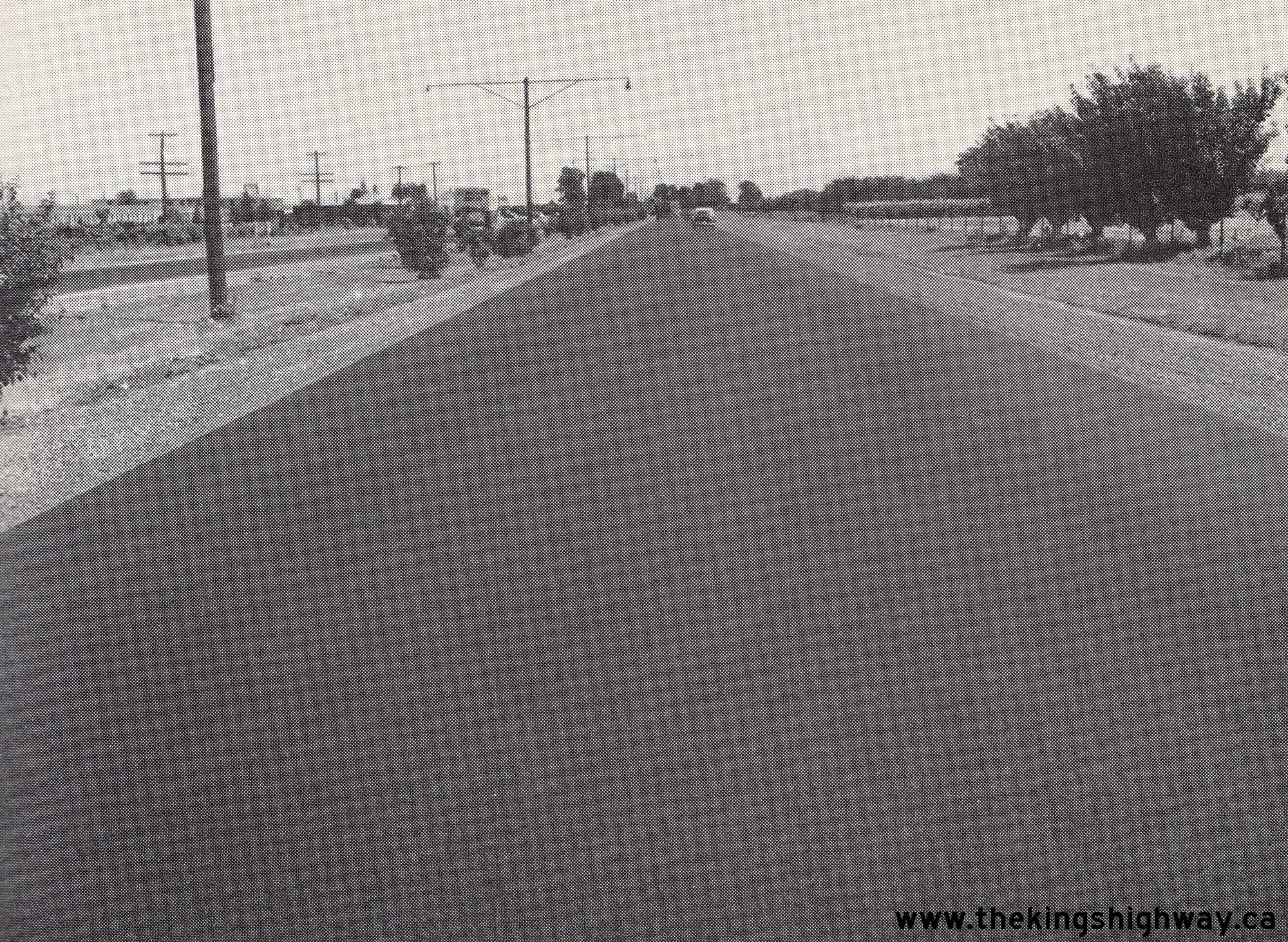
Left - Circa 1953 photo of a resurfaced section of the Queen Elizabeth Way near Port Credit. During the late 1940s and early 1950s, many of the original
concrete sections of the Queen Elizabeth Way were overlaid with a hot-mix asphalt, in order to improve the driving surface of the pavement. See an
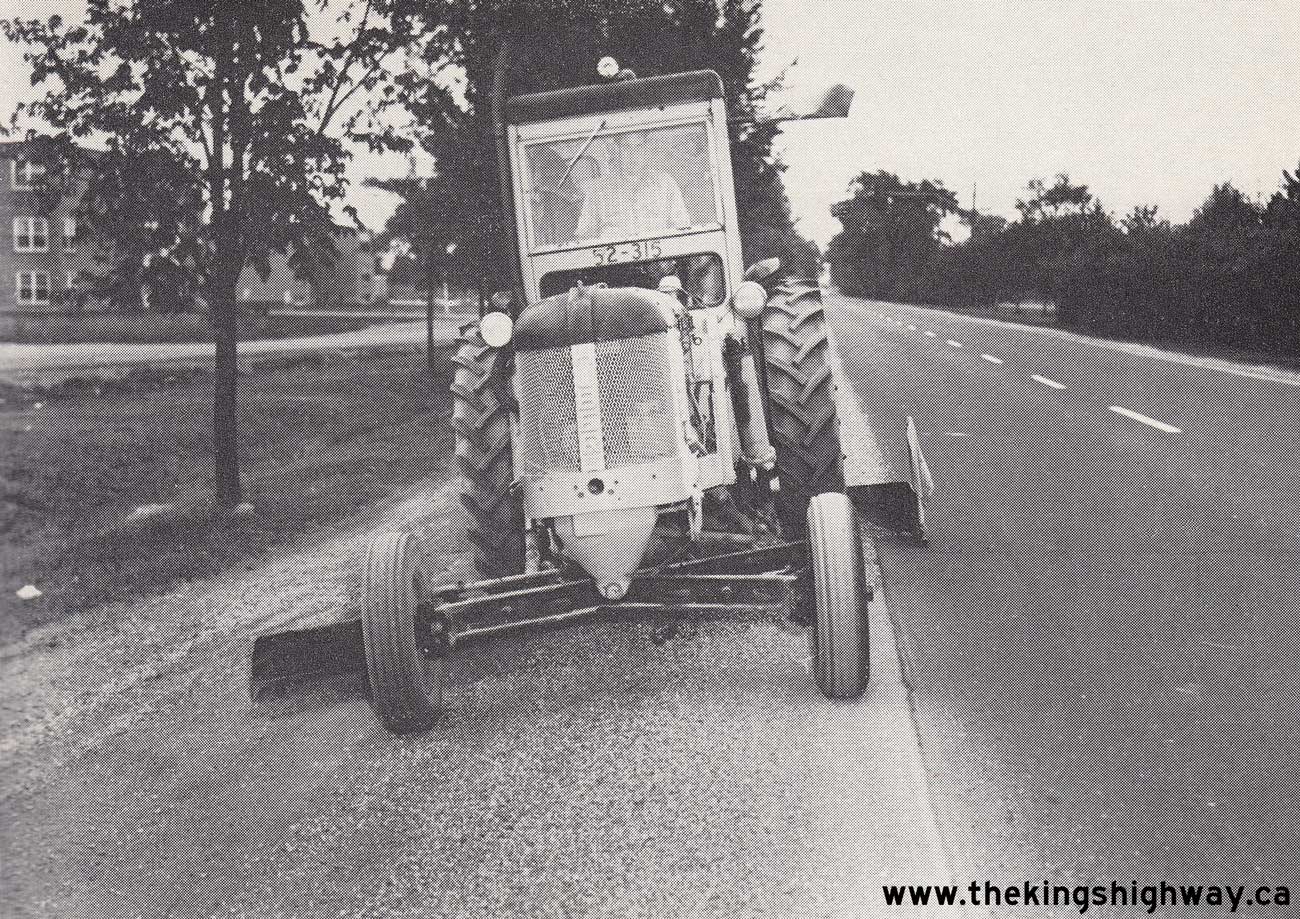
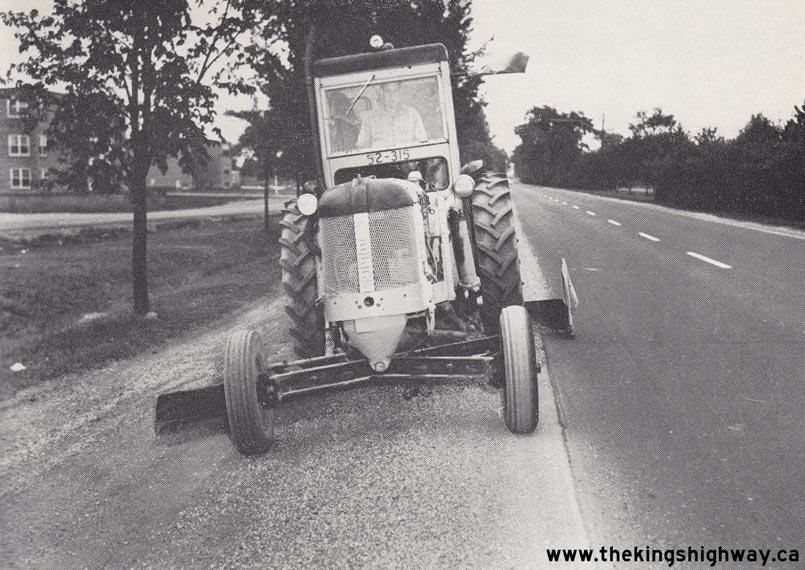
Enlarged Photo Here. Photo taken circa 1953. (Photo from Cameron Bevers' Historical Photograph Collection - Original Photographer Unknown) Right - Huber shoulder grader at work on the Queen Elizabeth Way west of Bronte. See an Enlarged Photo Here. Photo taken on September 29, 1953. (Photo courtesy of Ontario Ministry of Transportation - © King's Printer for Ontario, 1953) 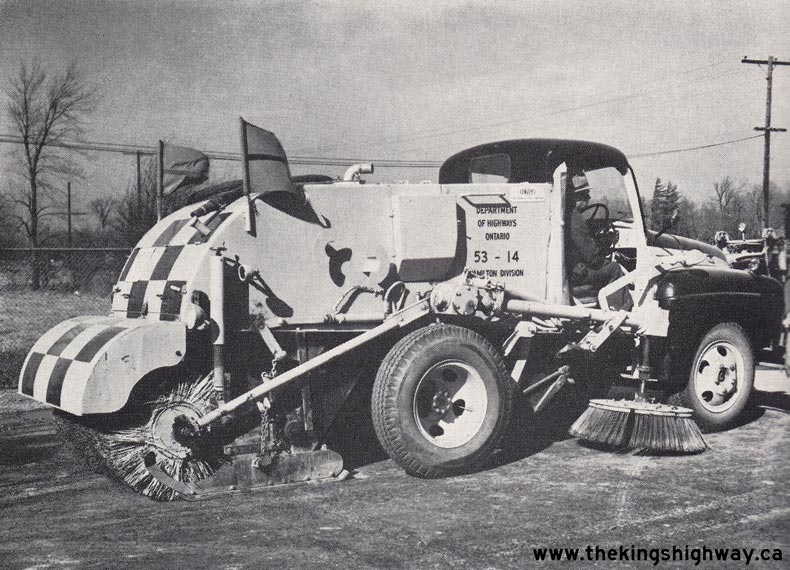
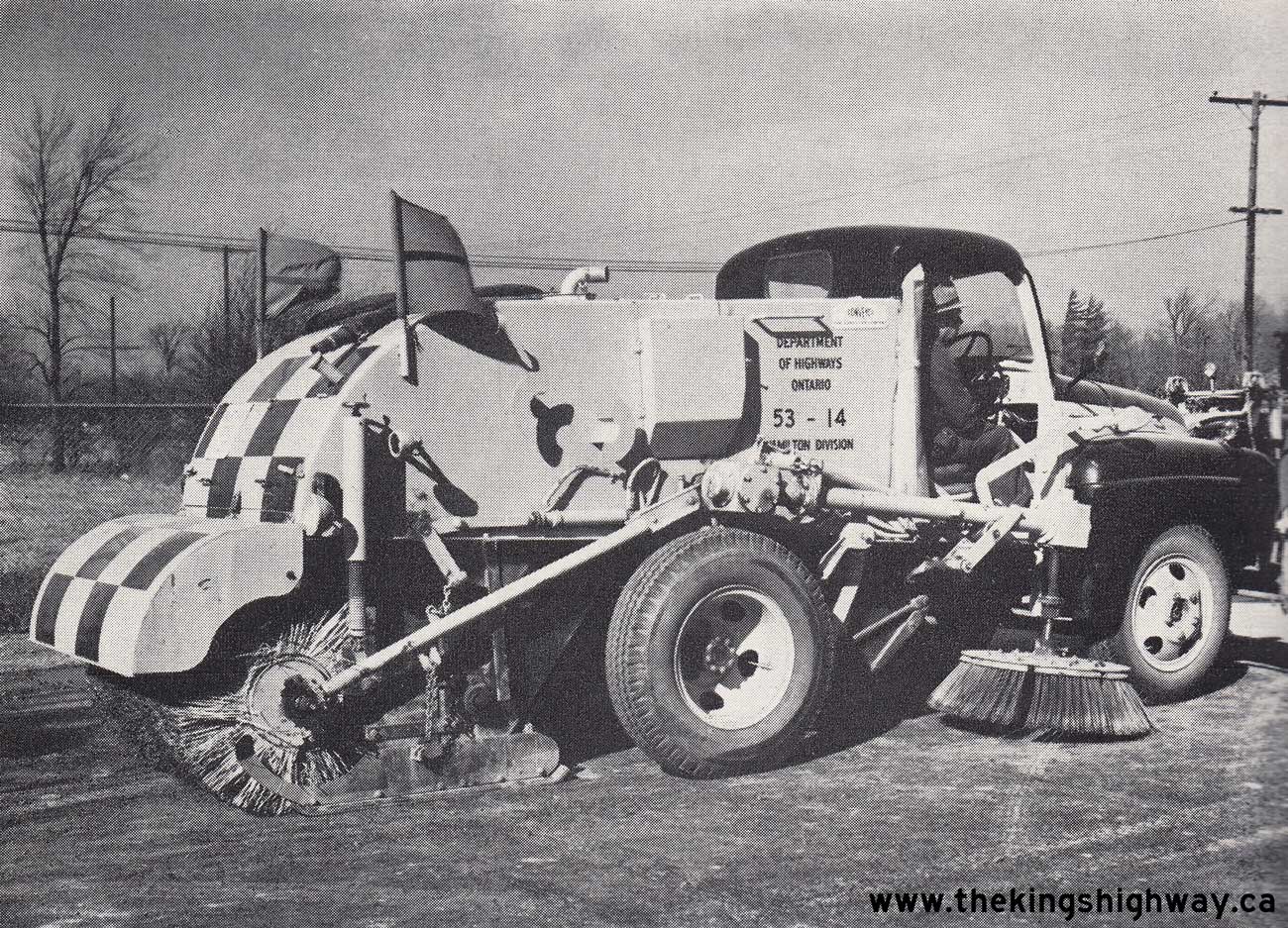
Left - Highway sweeper truck at work on the Queen Elizabeth Way between Hamilton and Winona in 1953. This was one of many new pieces of equipment added to the Department of
Highways' expanding fleet of specialized highway maintenance vehicles in the early 1950s. See an
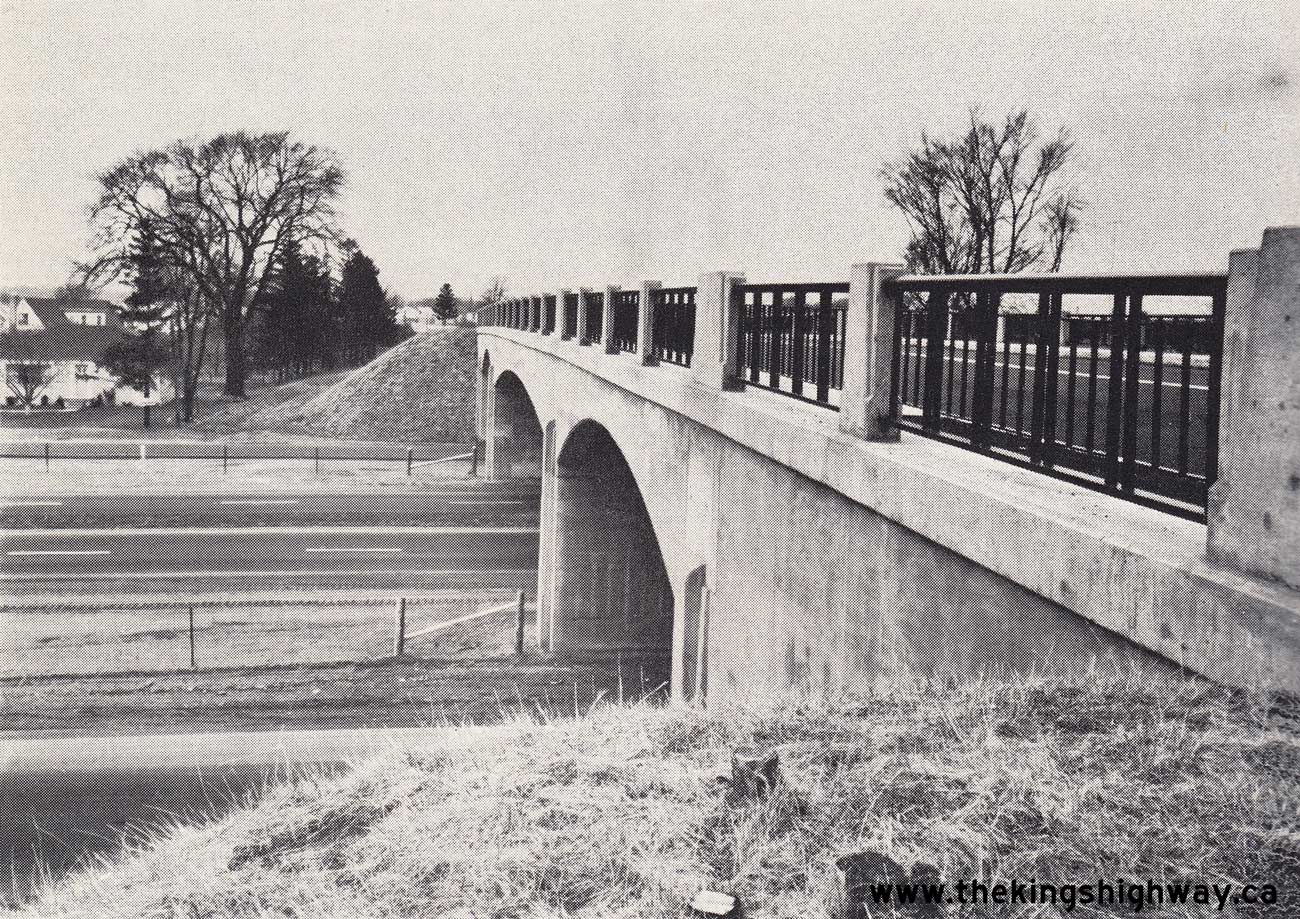
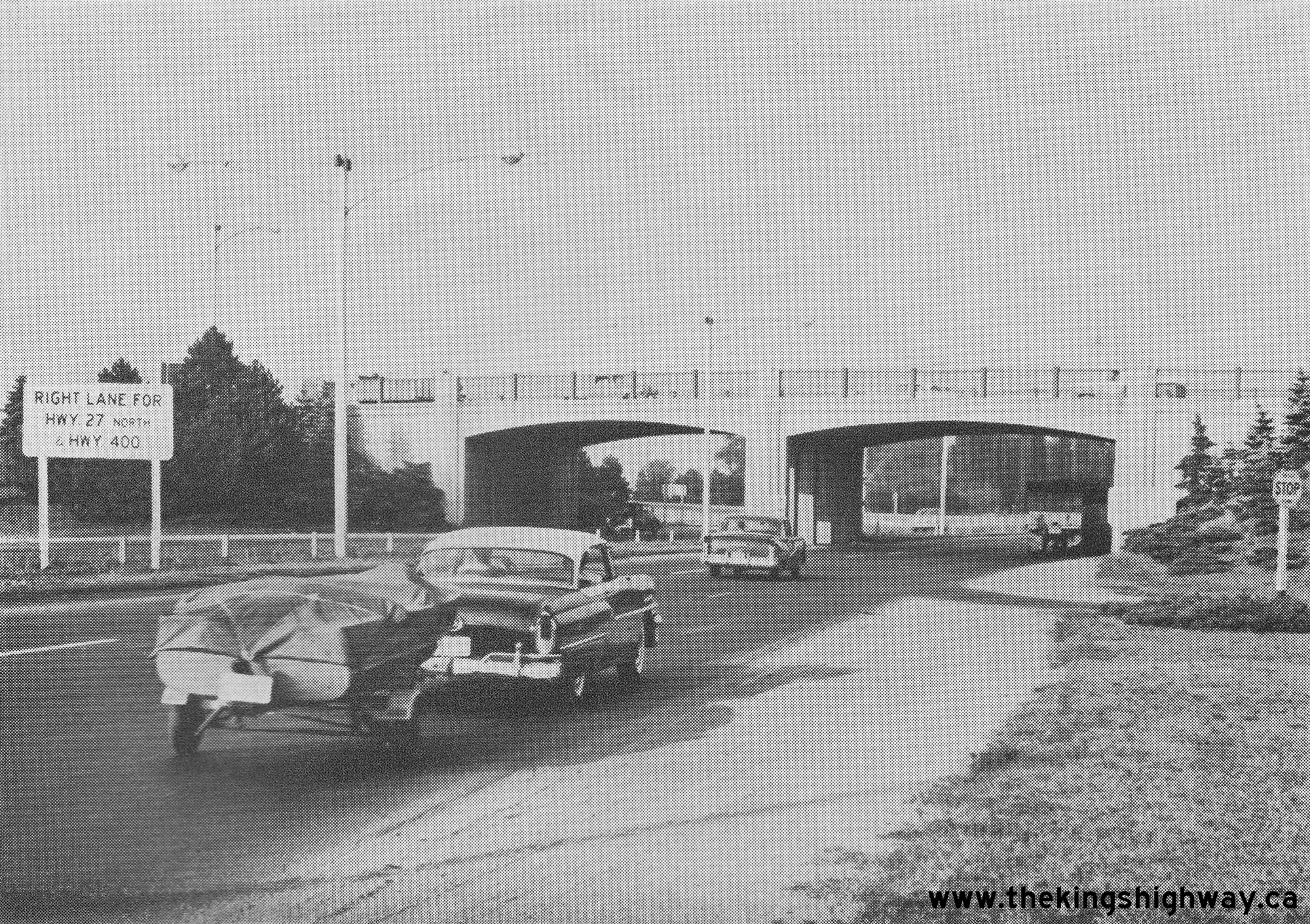
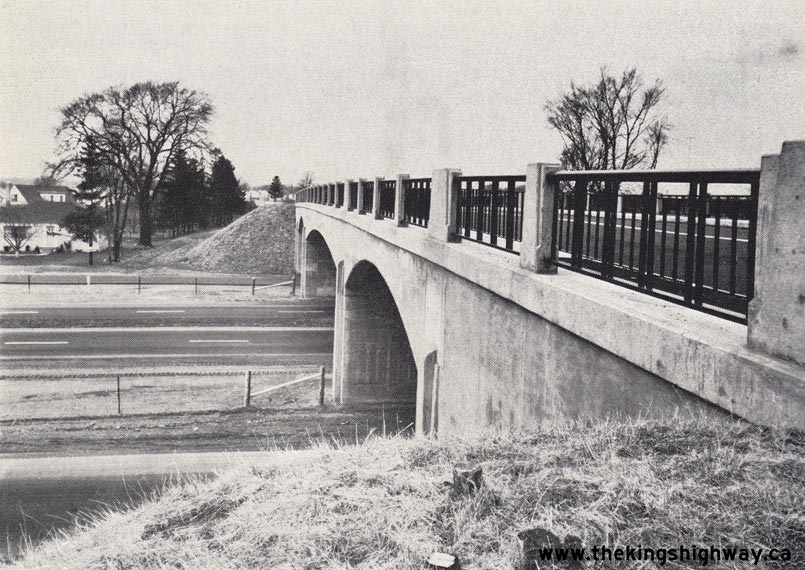
Enlarged Photo Here. Photo taken on November 2, 1953. (Photo courtesy of Ontario Ministry of Transportation - © King's Printer for Ontario, 1953) Right - New Dixie Road Overpass on the Queen Elizabeth Way between Toronto and Port Credit in 1953. The new overpass and service road system constructed at Dixie Road was the first major Post-War upgrade to the highway. Local access to the Queen Elizabeth Way was cut off through the construction of two service roads beside the highway, while the new structure carried local traffic safely across the dual highway. Prior to reconstruction of the junction, traffic had to cross the Queen Elizabeth Way via two closely spaced at-grade intersections. These offset intersections had a rather dubious safety record, so traffic signals were installed at the junction as an interim measure until the overpass could be completed. See an Enlarged Photo Here. Photo taken on November 13, 1953. (Photo courtesy of Ontario Ministry of Transportation - © King's Printer for Ontario, 1953) 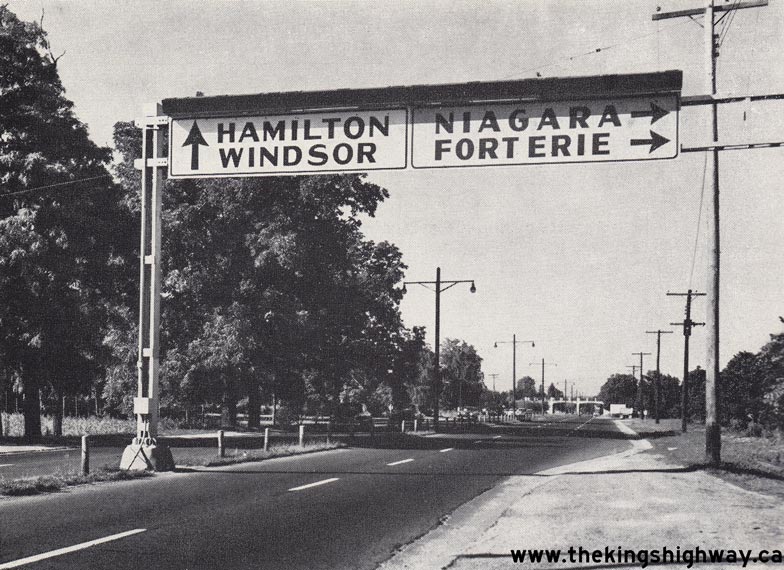
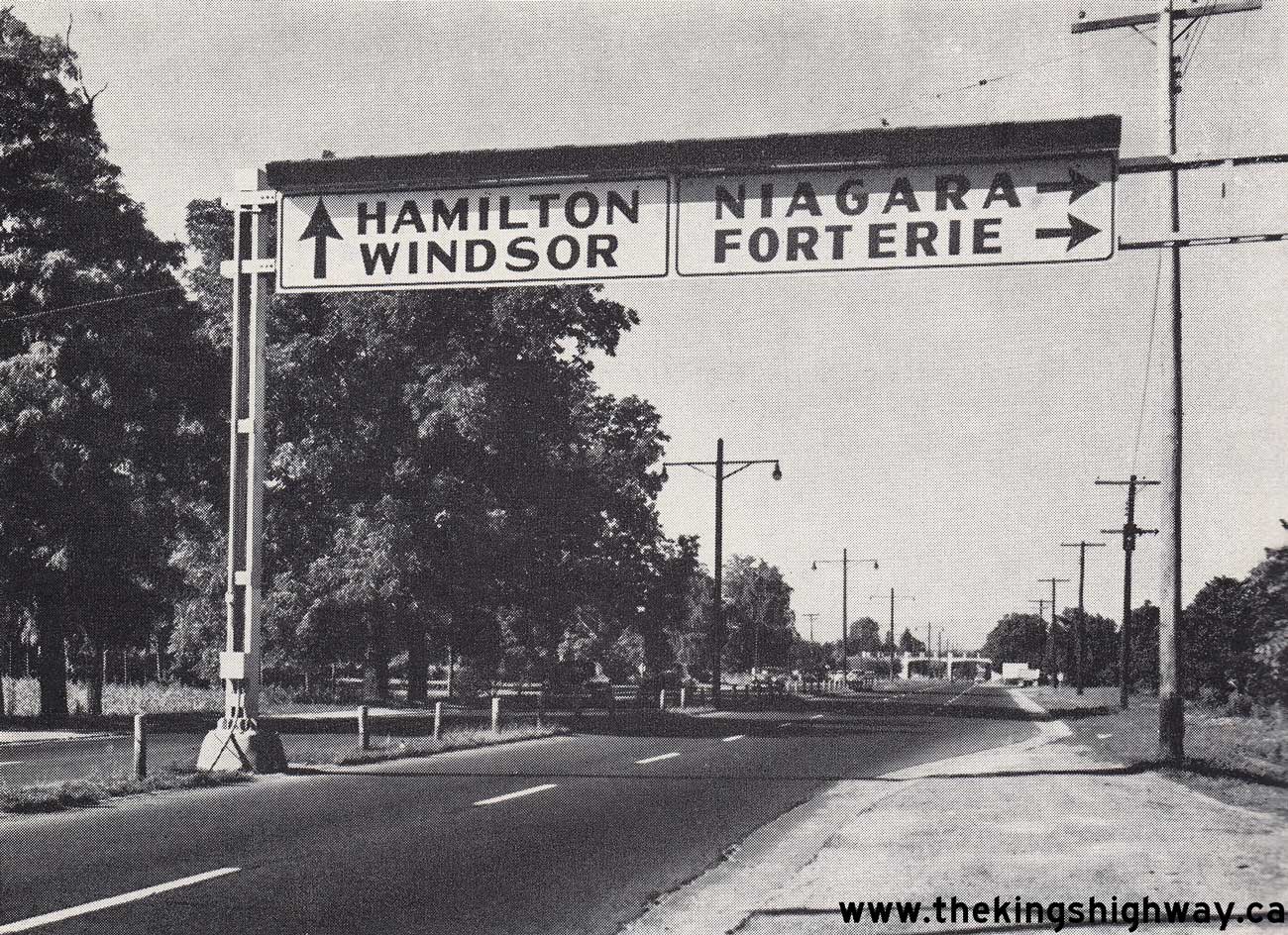
Left - Early overhead directional sign on the Queen Elizabeth Way approaching the Burlington Interchange. See an
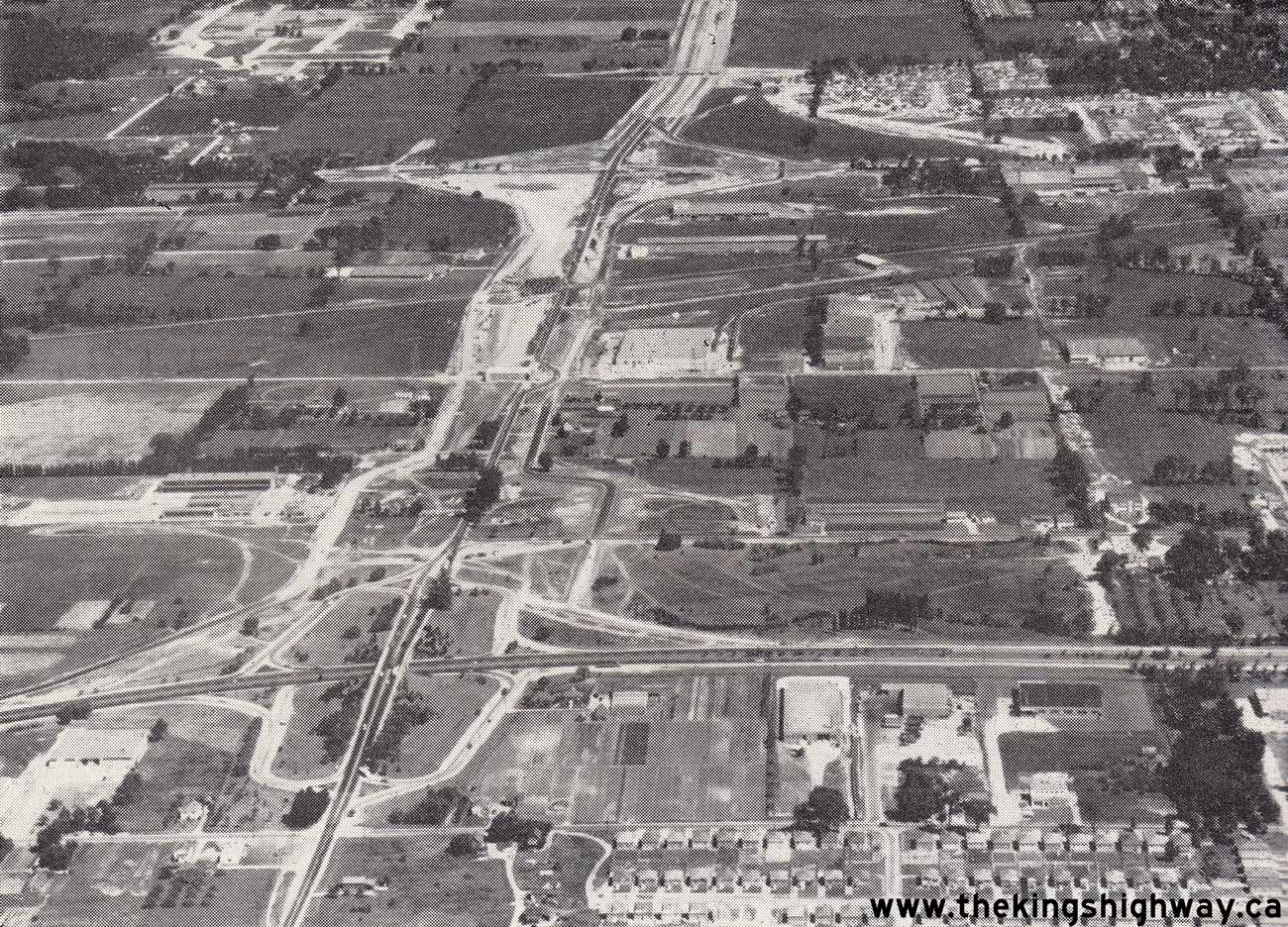
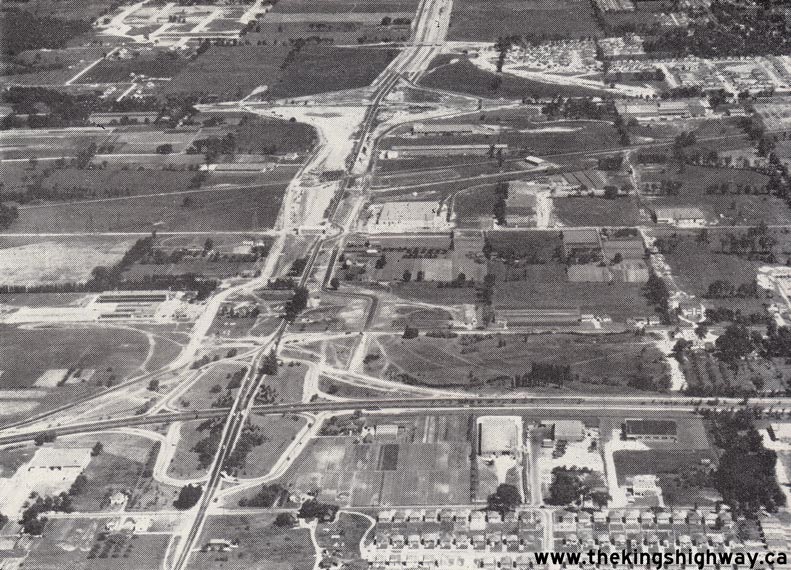
Enlarged Photo Here. Photo taken in 1953. (Photo courtesy of Ontario Ministry of Transportation - © King's Printer for Ontario, 1953) Right - Aerial view of the Queen Elizabeth Way & Hwy 27 Cloverleaf in Toronto in 1954, facing north. Note the reconstruction along Hwy 27 North, which eventually converted the two-lane highway into a freeway. This freeway was re-designated as Hwy 427 in 1972. See an Enlarged Photo Here. Photo taken on July 9, 1954. (Photo courtesy of Ontario Ministry of Transportation - © King's Printer for Ontario, 1954) 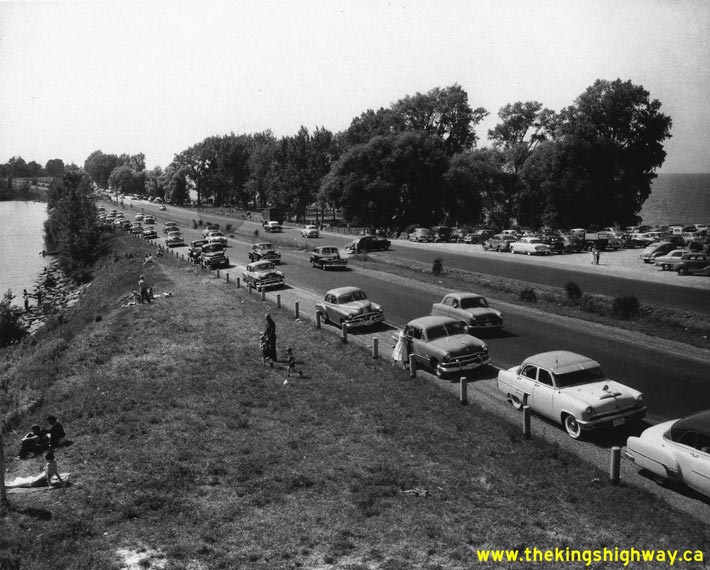
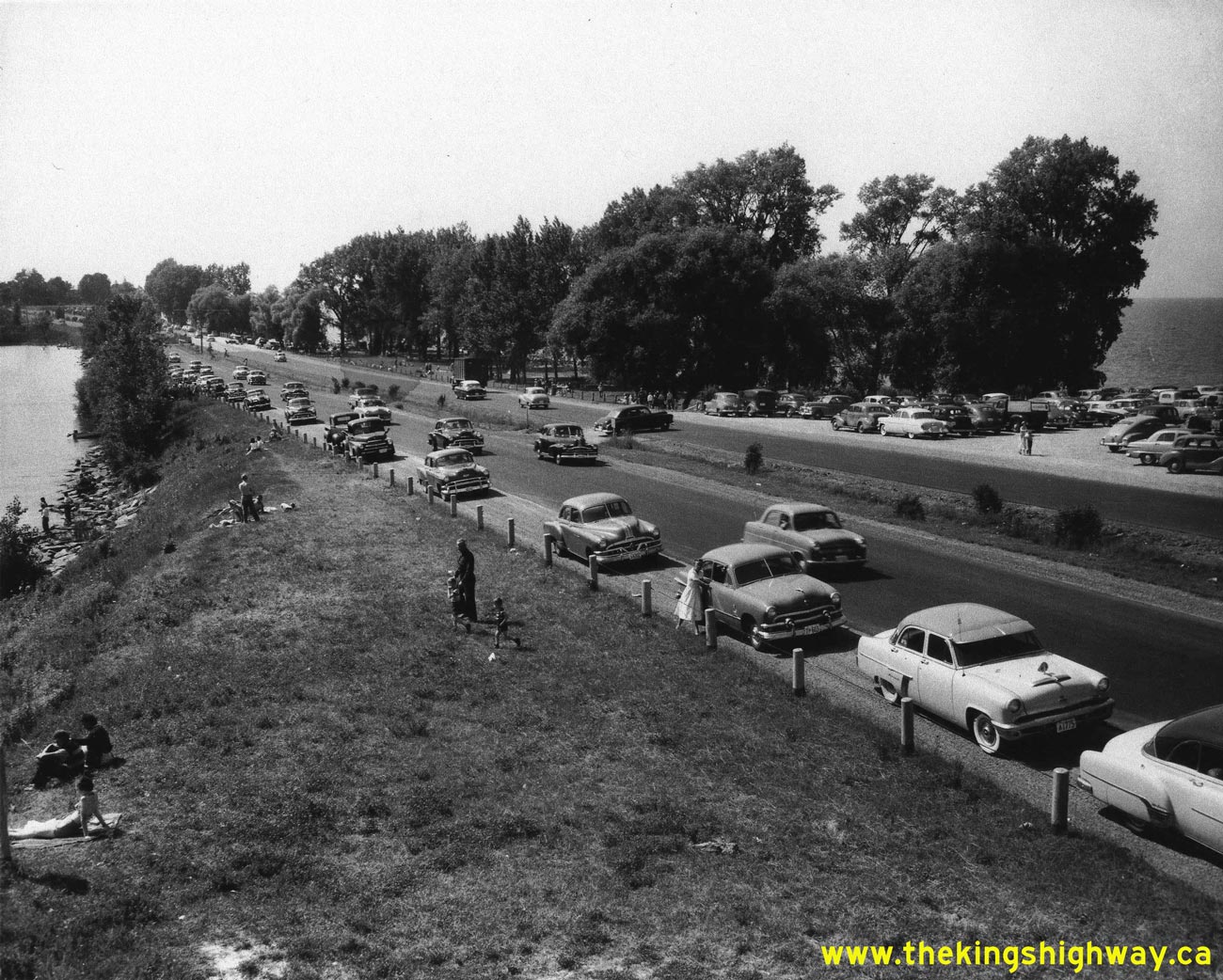
Left - Sunday traffic on the Queen Elizabeth Way at the Jordan Harbour Roadside Park near St. Catharines in 1954. As is evident in this photo, the Jordan
Harbour Roadside Park was a very popular weekend destination for Ontario motorists. Located on a causeway between Jordan Harbour and Lake Ontario, the park proved to
be an excellent picnic area, beach and fishing spot. See an Enlarged Photo Here. Photo taken on
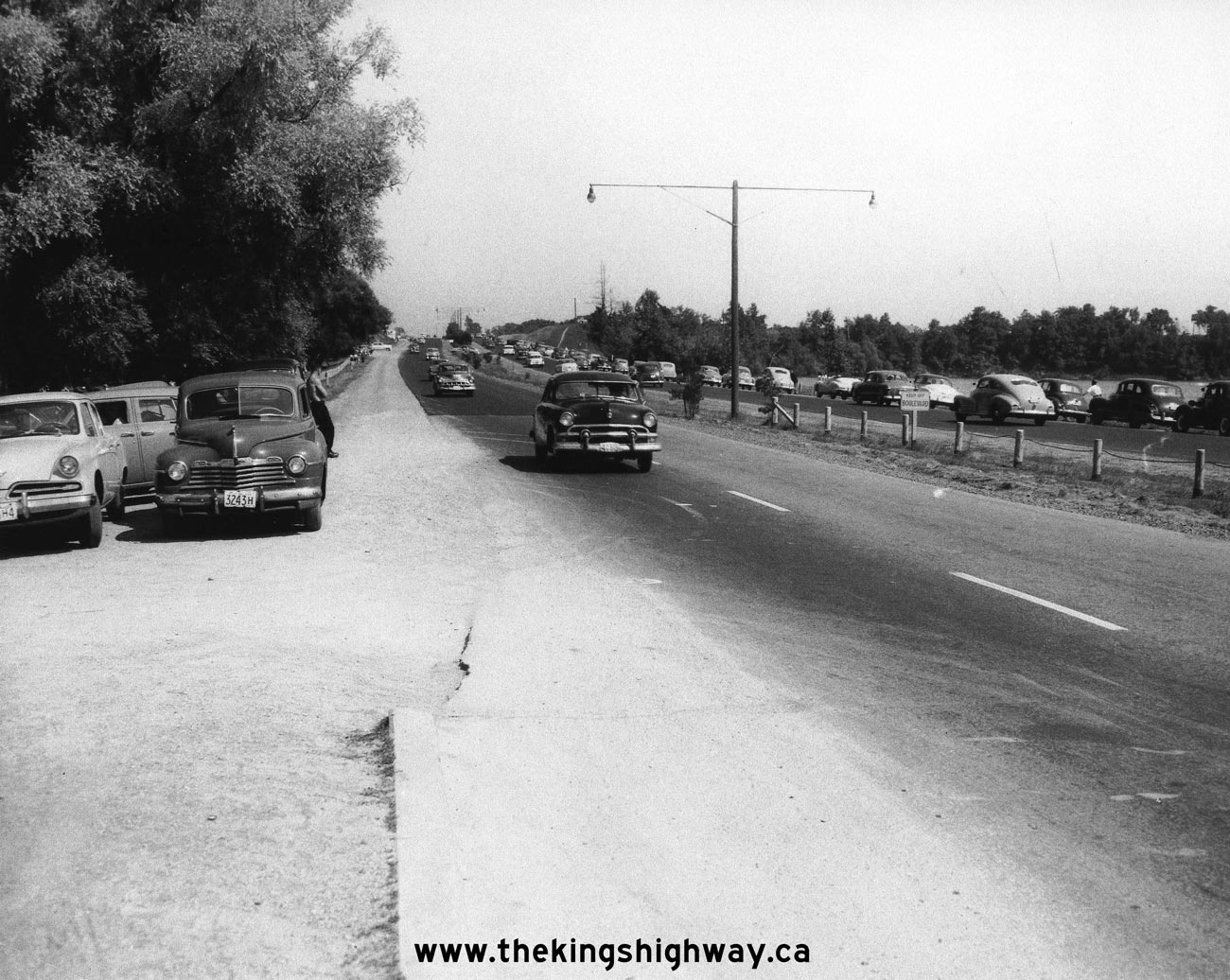
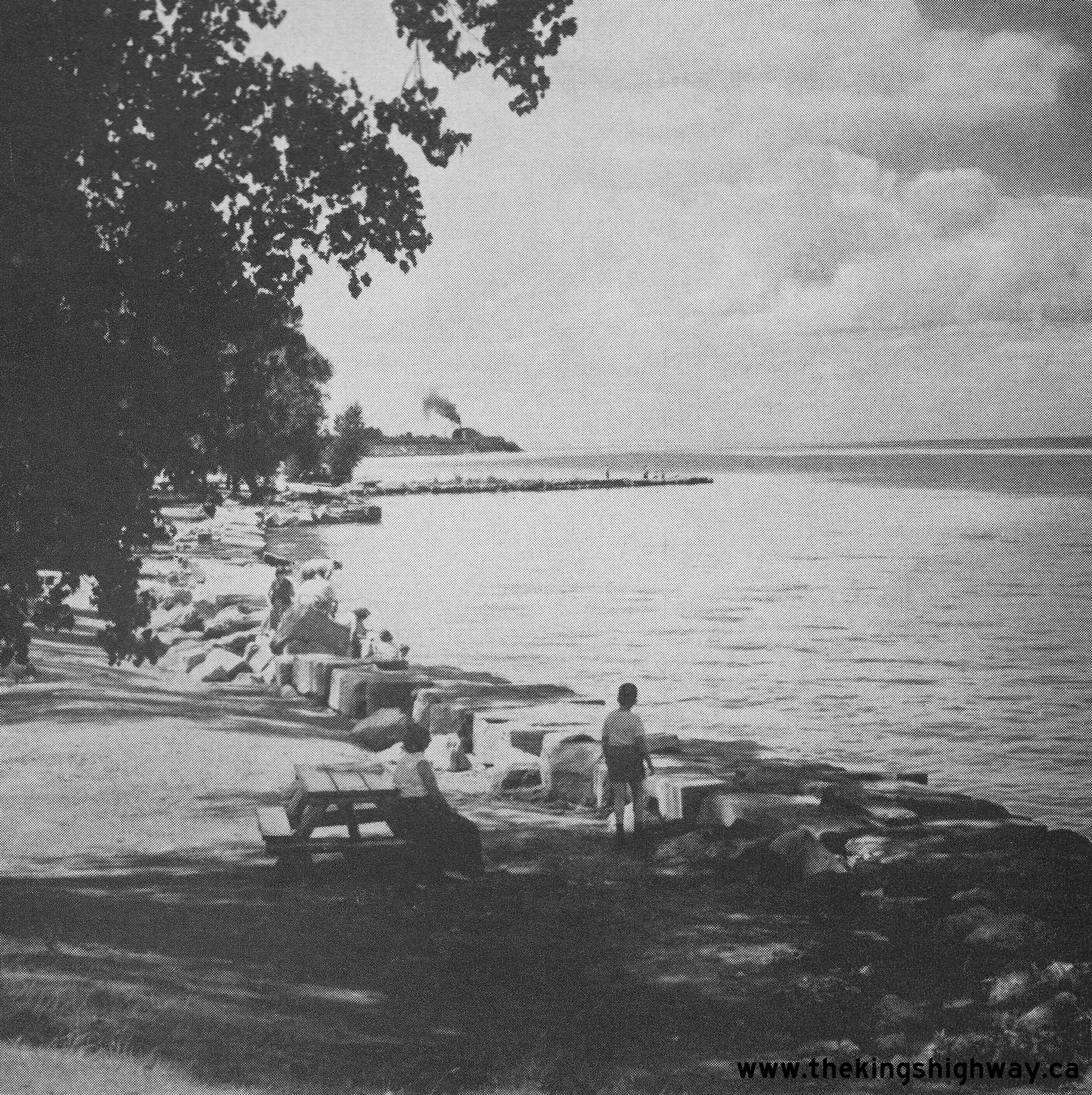
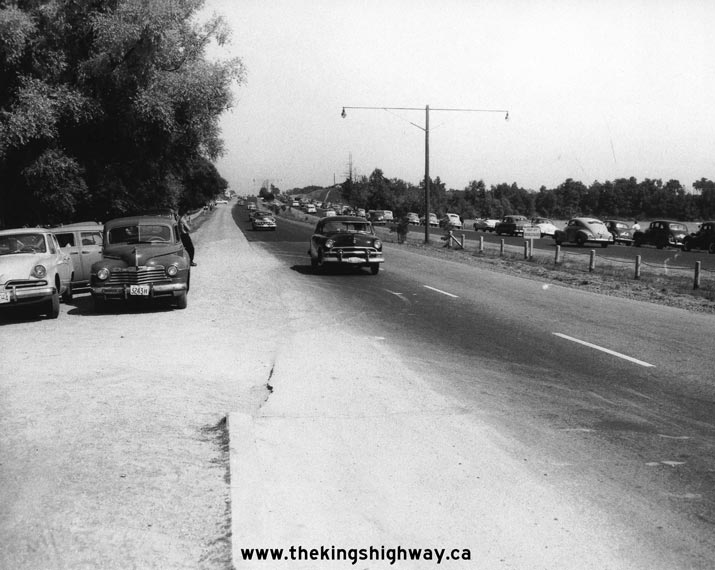
July 11, 1954. (Photo © Archives of Ontario - Series RG-14-162-2-27, Box B984, Photo #13) Right - Facing east along the Queen Elizabeth Way at the Jordan Harbour Roadside Park near St. Catharines in 1954. The Department of Highways established this roadside park beside Lake Ontario in 1940, for the convenience of motorists travelling between Toronto and Niagara Falls on the Queen Elizabeth Way. However, the lakeside park quickly became a popular destination of its own accord. Even in the 1940s, the small parking lot at the roadside park would fill to capacity on weekends, forcing people to park on the shoulders of the high-speed motorway. As traffic volumes on the highway grew and more Ontario residents had access to a car, the park ultimately became a victim of its own success. The lines of parked vehicles and the inevitable pedestrian traffic in the vicinity of the park started to become a safety problem. Sadly, the Jordan Harbour Roadside Park was closed when the Queen Elizabeth Way was converted into a Controlled-Access Highway in the 1960s, bringing with it an end to a colourful and fun period of the Queen Elizabeth Way's early history. See an Enlarged Photo Here. Photo taken on July 11, 1954. (Photo © Archives of Ontario - Series RG-14-162-2-27, Box B984, Photo #16) 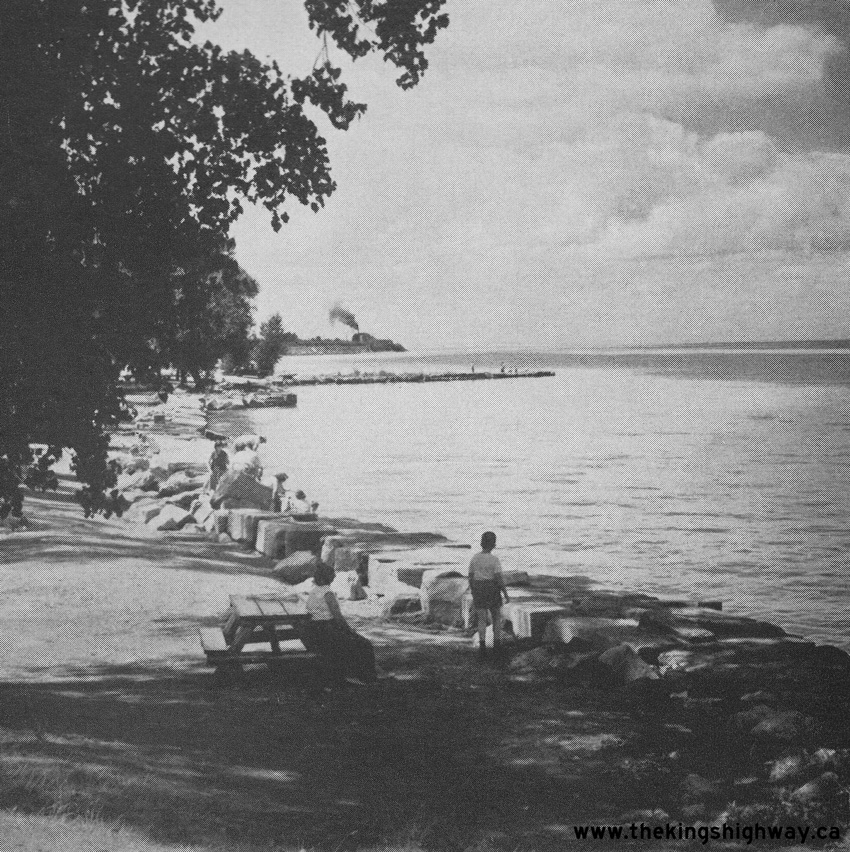 Above - View of the Lake Ontario side of the Jordan Harbour Roadside Park on the Queen Elizabeth Way west of St. Catharines in 1954. See an
Enlarged Photo Here. Photo taken on July 11, 1954. Above - View of the Lake Ontario side of the Jordan Harbour Roadside Park on the Queen Elizabeth Way west of St. Catharines in 1954. See an
Enlarged Photo Here. Photo taken on July 11, 1954.(Photo courtesy of Ontario Ministry of Transportation - © King's Printer for Ontario, 1954) 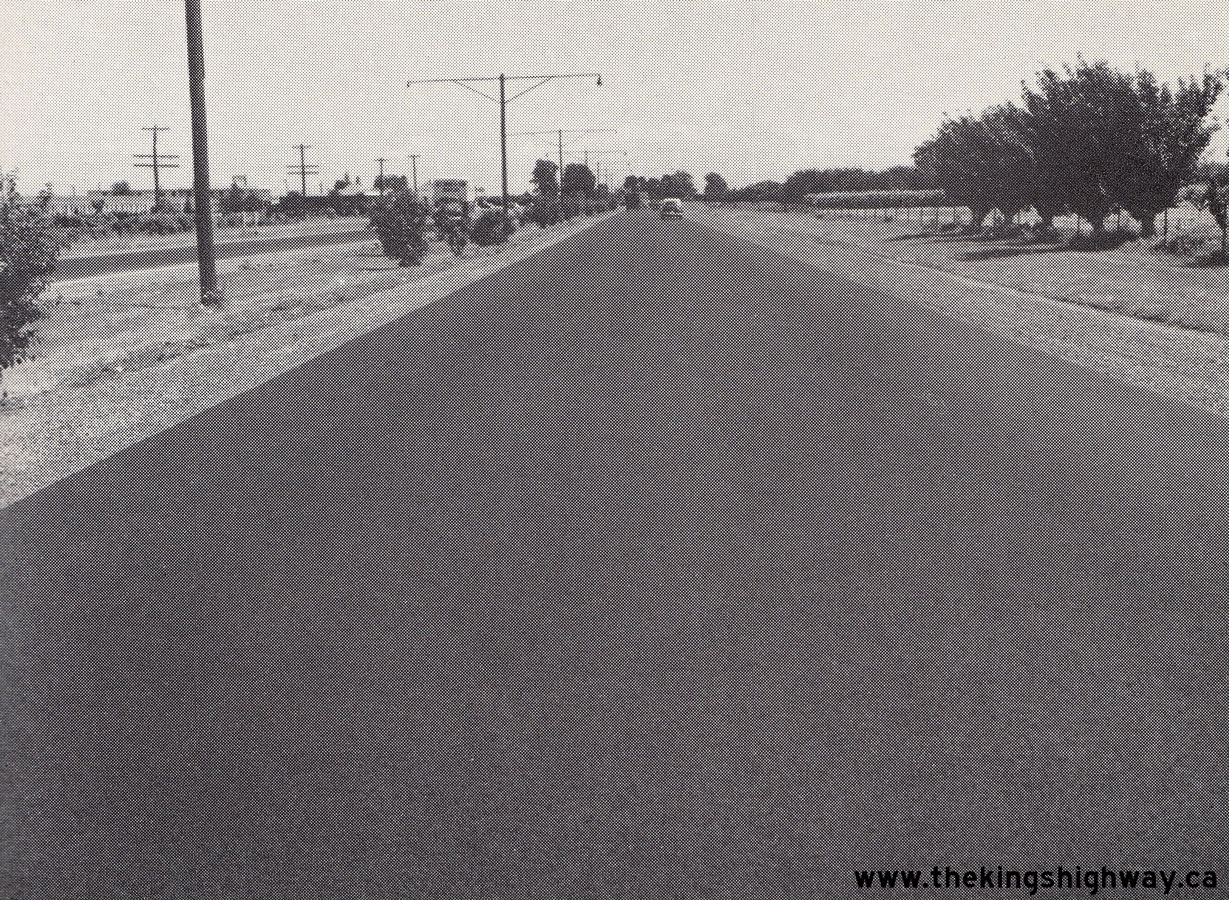 Above - Resurfaced section of the Queen Elizabeth Way, about 1/2 mile west of Vineland, Contract #1954-302. See an
Enlarged Photo Here. Photo taken on August 5, 1954. Above - Resurfaced section of the Queen Elizabeth Way, about 1/2 mile west of Vineland, Contract #1954-302. See an
Enlarged Photo Here. Photo taken on August 5, 1954.(Photo courtesy of Ontario Ministry of Transportation - © King's Printer for Ontario, 1954) 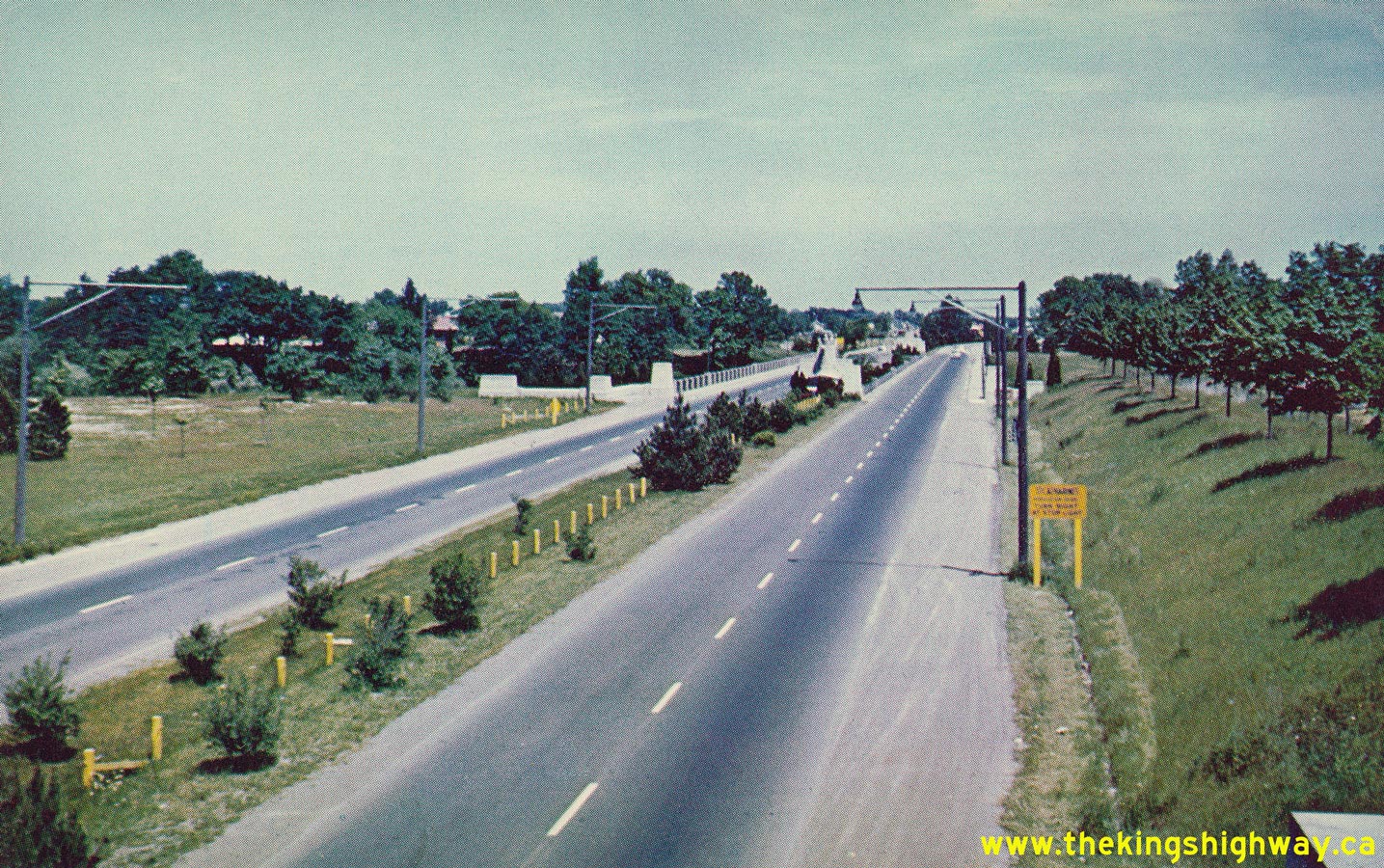 Above - Circa 1955 postcard view of the Queen Elizabeth Way at the Henley Bridge in St. Catharines. This colour photo provides an interesting glimpse of the
Queen Elizabeth Way's early blue-and-gold signing, which was incorporated into all traffic signs along the corridor - not just the highway route markers themselves.
The municipal boundary sign for St. Catharines in the background also bears an unusual message for motorists to "Turn Right at Stop Lights" in order to reach the city
centre. Although "stop light" is a commonly-used layperson's term, transportation professionals refer to these devices as "traffic control signals", or just "traffic
signals". It is rather surprising to see that this erroneous message made its way onto an official sign. Once Ontario adopted the Manual of Uniform Traffic Control
Devices (or MUTCD) in the 1950s, most of the old traffic signs along the Queen Elizabeth Way had to be removed as they were not compliant with MUTCD signing standards
- either due to their shape or colour schemes. See an Enlarged Photo Here. Photo taken circa
1955. Above - Circa 1955 postcard view of the Queen Elizabeth Way at the Henley Bridge in St. Catharines. This colour photo provides an interesting glimpse of the
Queen Elizabeth Way's early blue-and-gold signing, which was incorporated into all traffic signs along the corridor - not just the highway route markers themselves.
The municipal boundary sign for St. Catharines in the background also bears an unusual message for motorists to "Turn Right at Stop Lights" in order to reach the city
centre. Although "stop light" is a commonly-used layperson's term, transportation professionals refer to these devices as "traffic control signals", or just "traffic
signals". It is rather surprising to see that this erroneous message made its way onto an official sign. Once Ontario adopted the Manual of Uniform Traffic Control
Devices (or MUTCD) in the 1950s, most of the old traffic signs along the Queen Elizabeth Way had to be removed as they were not compliant with MUTCD signing standards
- either due to their shape or colour schemes. See an Enlarged Photo Here. Photo taken circa
1955.(Photo courtesy of Alex Wilson Publications Ltd, Dryden) 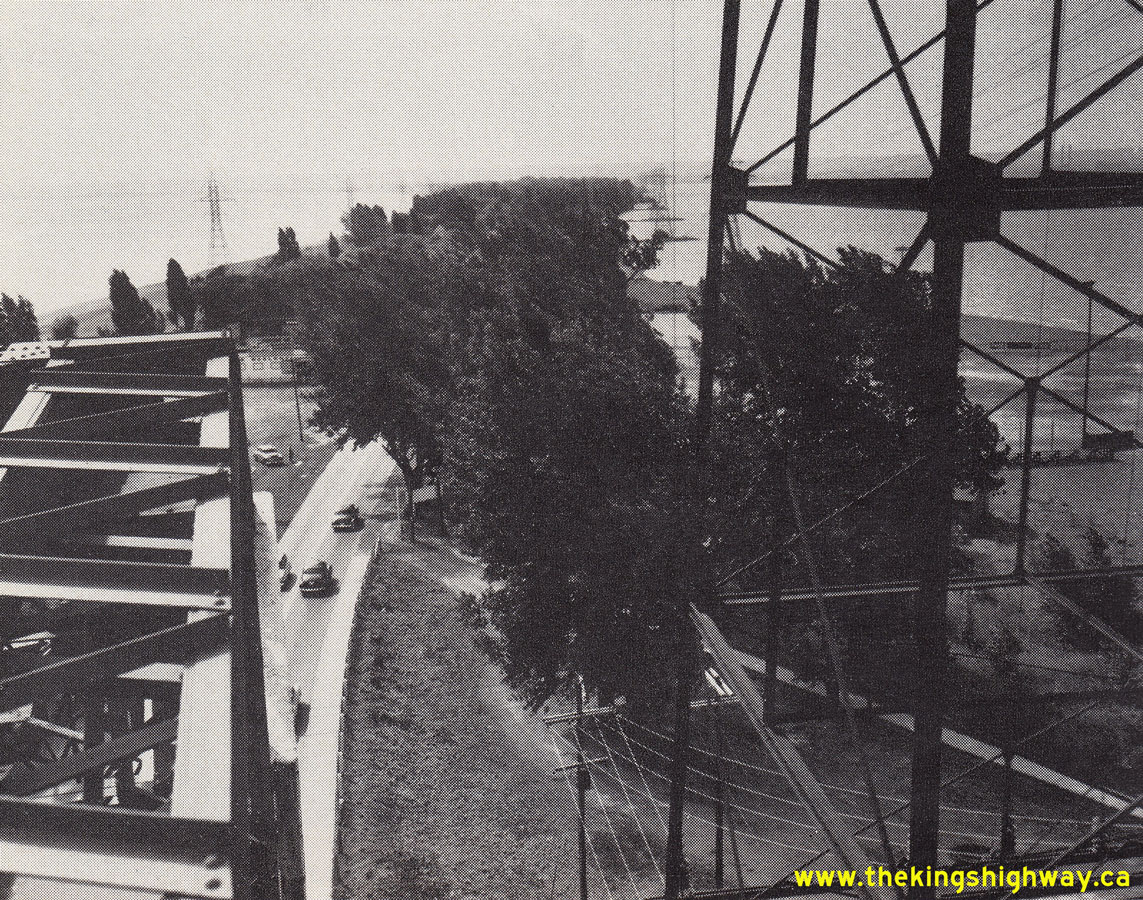 Above - View from the old Burlington Canal Lift Bridge on the Queen Elizabeth Way and Hwy 20, facing south towards Hamilton. Note the new filled-in areas at
right for the proposed Burlington Skyway. See an Enlarged Photo Here. Photo taken on July 4,
1955. Above - View from the old Burlington Canal Lift Bridge on the Queen Elizabeth Way and Hwy 20, facing south towards Hamilton. Note the new filled-in areas at
right for the proposed Burlington Skyway. See an Enlarged Photo Here. Photo taken on July 4,
1955.(Photo courtesy of Ontario Ministry of Transportation - © King's Printer for Ontario, 1955) 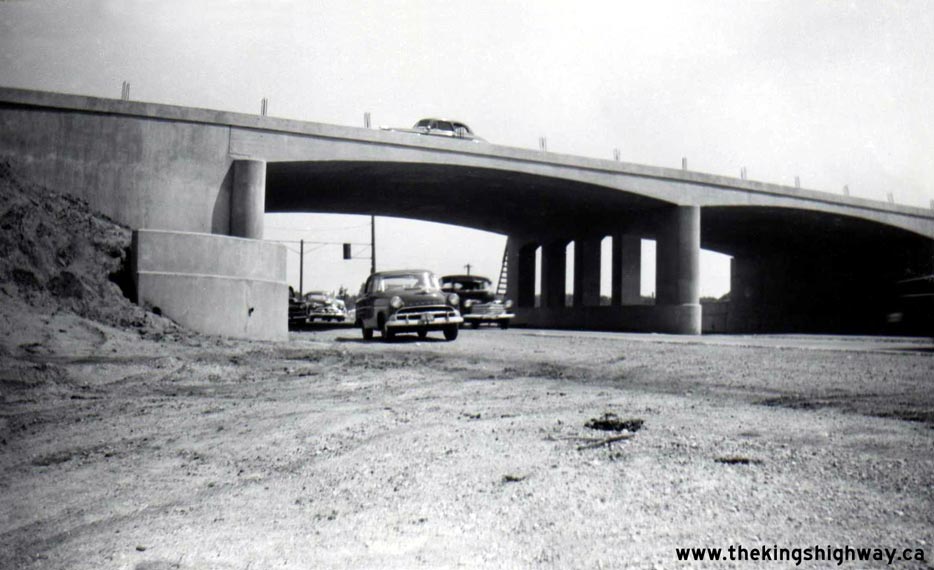
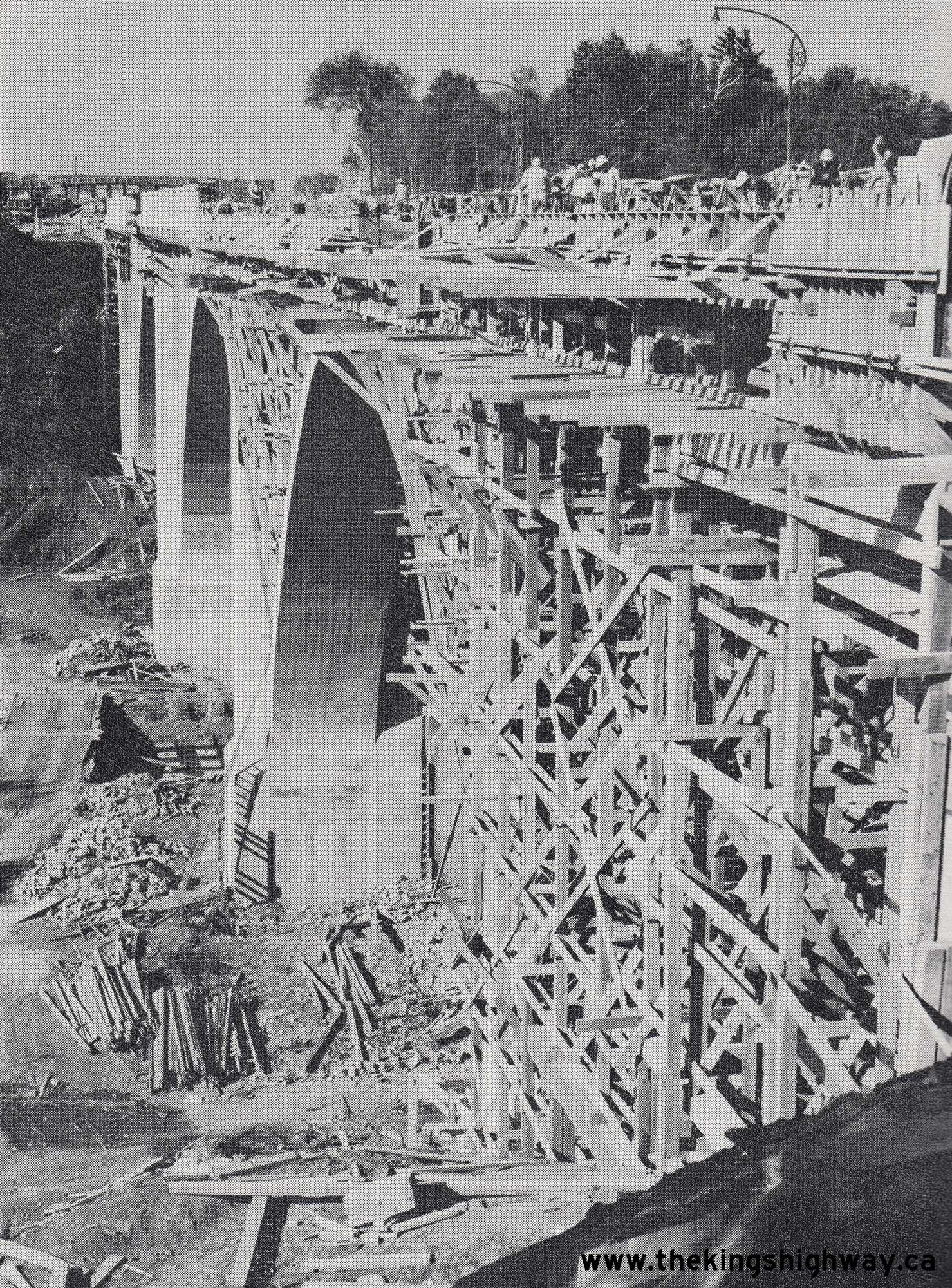
Above - Construction of the new Lake Street Overpass on the Queen Elizabeth Way in St. Catharines in 1955, Contract #1955-02. The Lake Street Interchange was
the first Post-War grade separation and interchange constructed along the Queen Elizabeth Way in the St. Catharines area. When the Queen Elizabeth Way was originally
built through St. Catharines in 1939, only Martindale Road, Niagara Street and Cushman Road had interchanges at the Queen Elizabeth Way. Until the Lake Street
Interchange was built, Lake Street crossed the Queen Elizabeth Way at an at-grade intersection with traffic signals. One of the intersection's traffic signal poles
can be seen in this photo on the far side of the new structure. Ongoing development in the northern portion of St. Catharines in the late 1940s and early 1950s
prompted the need to grade separate Lake Street somewhat earlier than some of St. Catharines' other arterial streets. See an
Enlarged Photo Here. Photo taken in August 1955. (Photo courtesy of Ontario Ministry of Transportation - © King's Printer for Ontario, 2014) 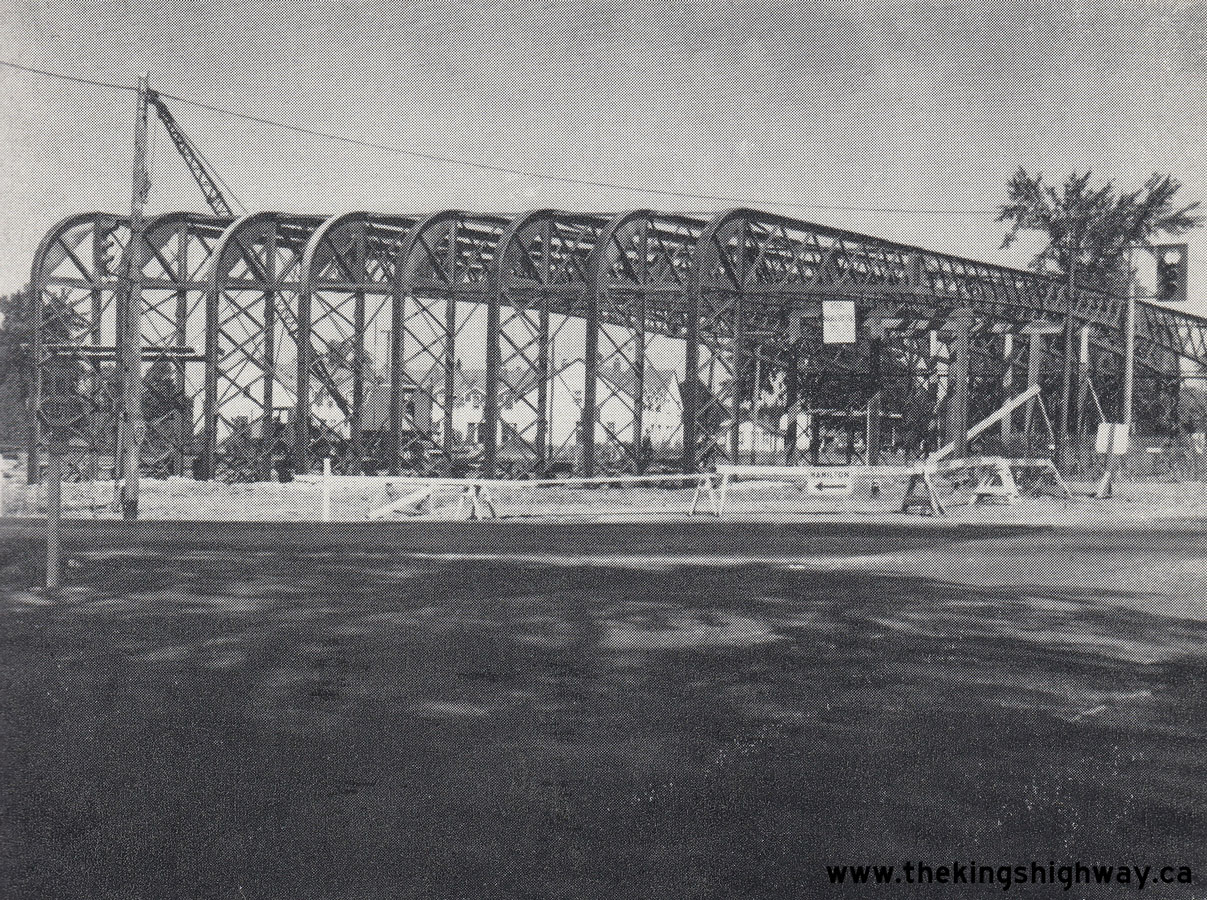
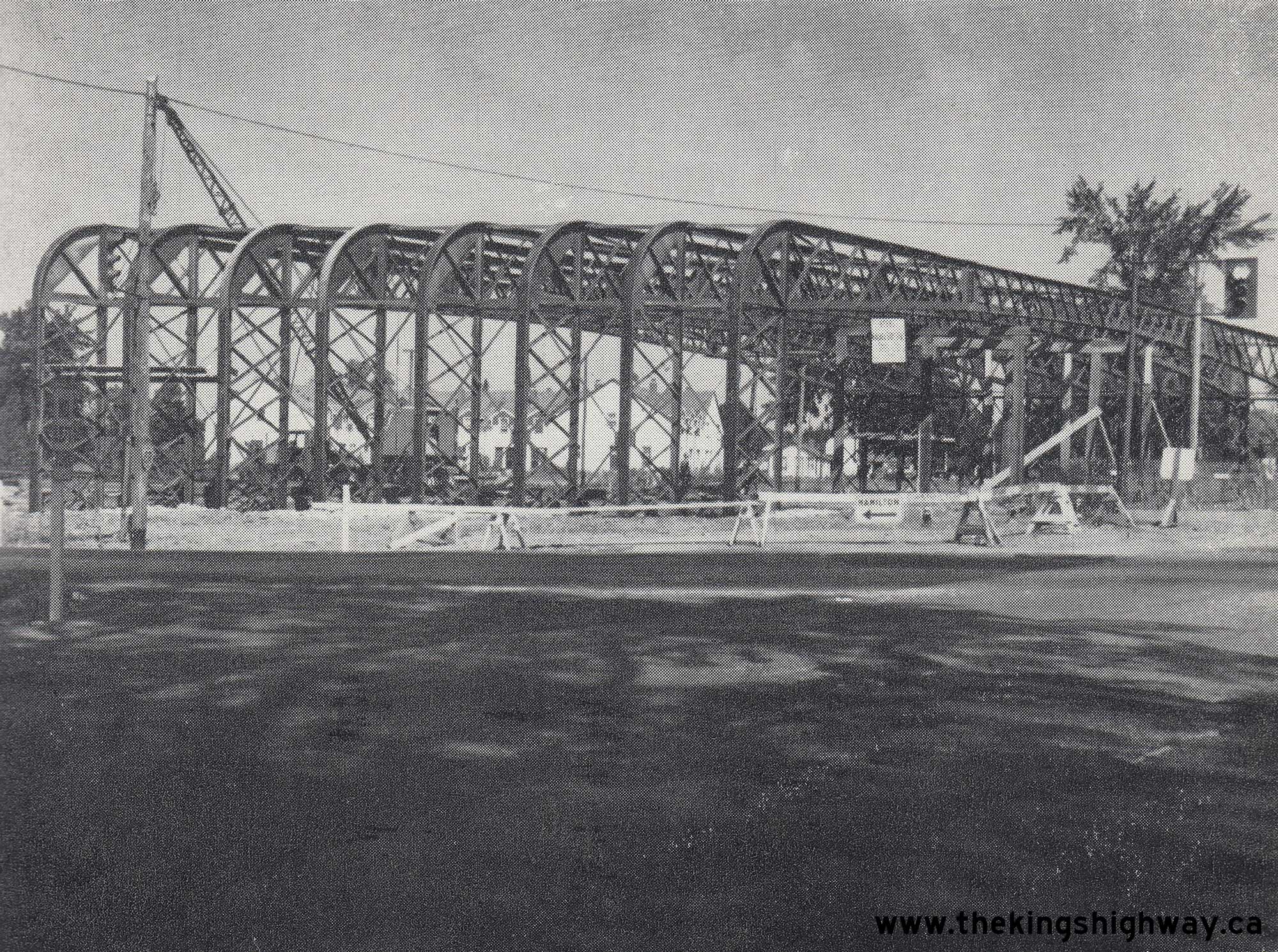
 Left - Assembled steel frame for the new Trafalgar Road Overpass on the Queen Elizabeth Way in Oakville, Contract #1955-10. See an
Enlarged Photo Here. Photo taken on June 5, 1955. Left - Assembled steel frame for the new Trafalgar Road Overpass on the Queen Elizabeth Way in Oakville, Contract #1955-10. See an
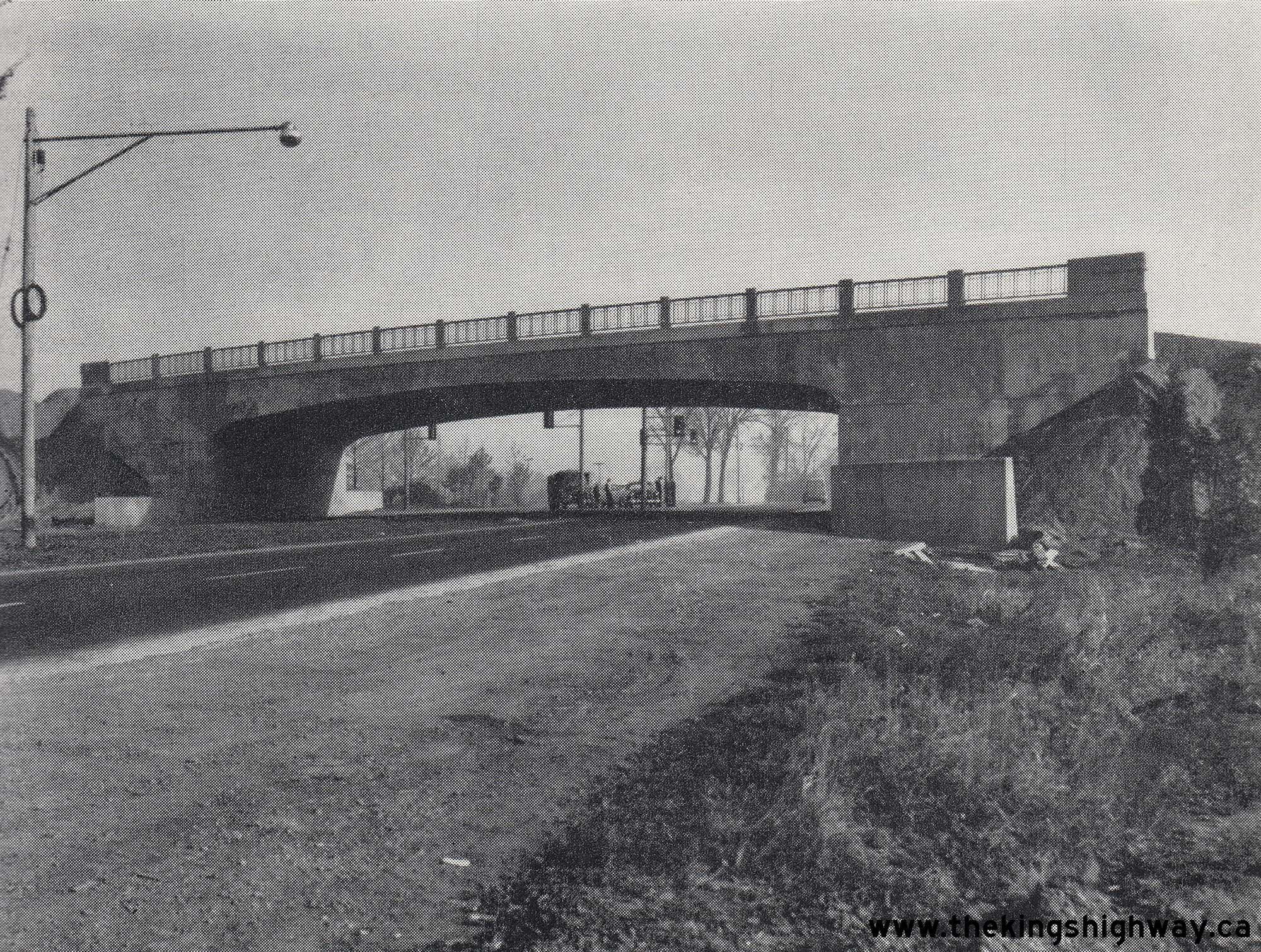
Enlarged Photo Here. Photo taken on June 5, 1955.(Photo courtesy of Ontario Ministry of Transportation - © King's Printer for Ontario, 1955) Right - Trafalgar Road Overpass on the Queen Elizabeth Way in Oakville nearing completion. This new grade-separated interchange replaced an old at-grade
signalized intersection along the Queen Elizabeth Way. Note the traffic signals at Trafalgar Road in the background. See an
Enlarged Photo Here. Photo taken on October 28, 1955.(Photo courtesy of Ontario Ministry of Transportation - © King's Printer for Ontario, 1955) 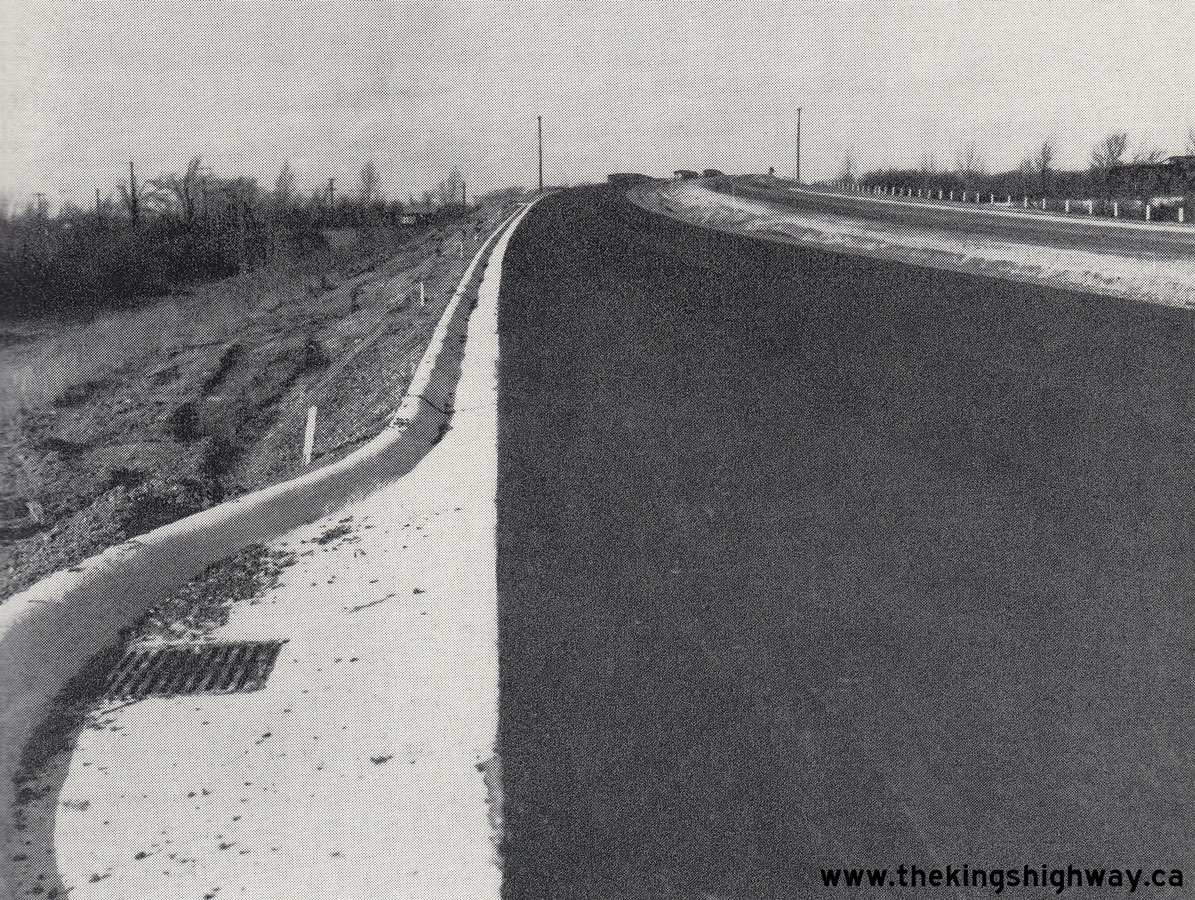 Above - New hot-mix asphalt paving on the Queen Elizabeth Way at the Welland River Bridge south of Niagara Falls, Contract #1955-25. The completion of paving
along the Fort Erie-bound carriageway of the Queen Elizabeth Way in 1955-1956 permitted all four lanes of the highway to be opened beyond Niagara Falls. Previously,
all traffic between Niagara Falls and Fort Erie used the Toronto-bound carriageway, with one lane provided for each direction of travel. See an
Enlarged Photo Here. Photo taken on November 28, 1955. Above - New hot-mix asphalt paving on the Queen Elizabeth Way at the Welland River Bridge south of Niagara Falls, Contract #1955-25. The completion of paving
along the Fort Erie-bound carriageway of the Queen Elizabeth Way in 1955-1956 permitted all four lanes of the highway to be opened beyond Niagara Falls. Previously,
all traffic between Niagara Falls and Fort Erie used the Toronto-bound carriageway, with one lane provided for each direction of travel. See an
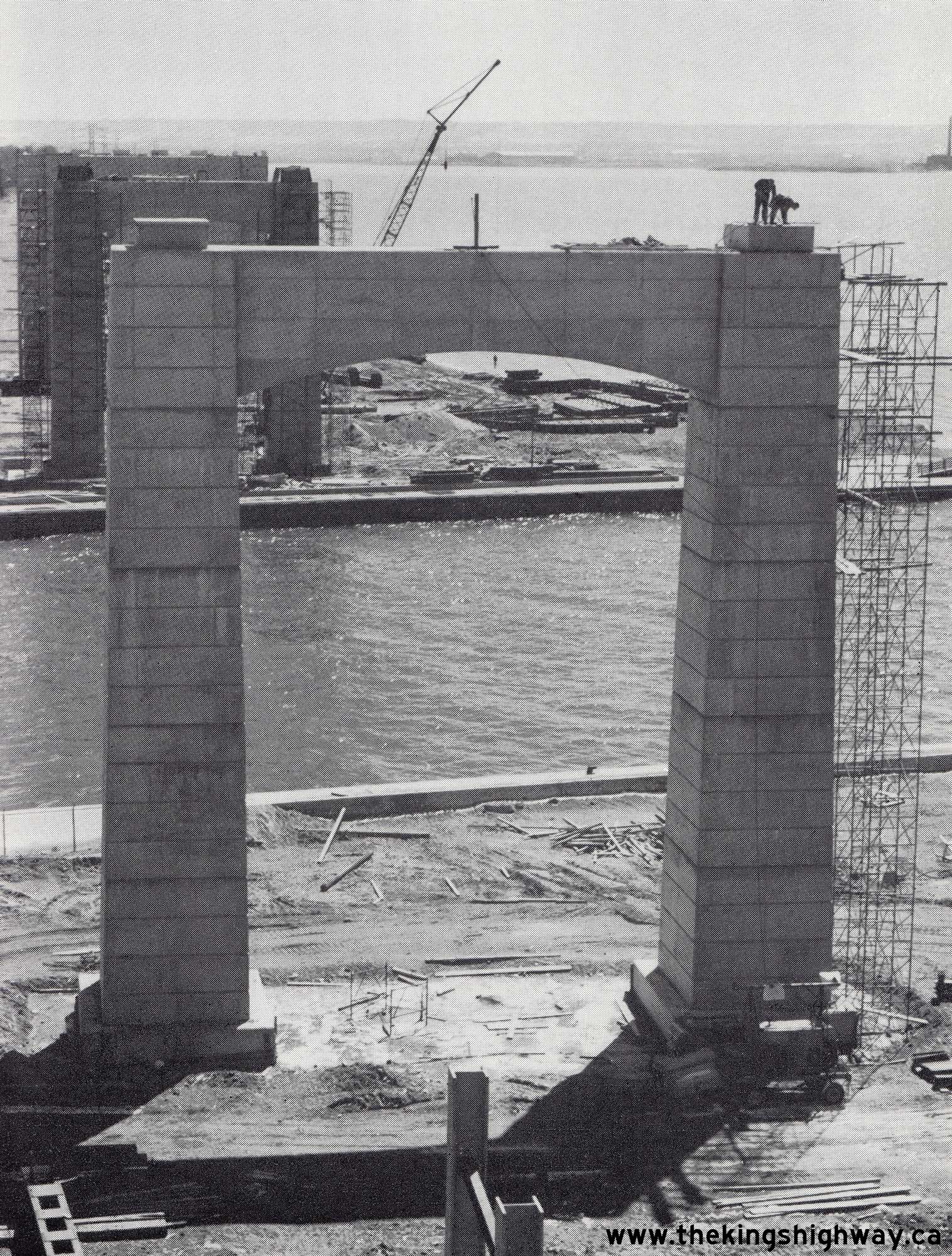
Enlarged Photo Here. Photo taken on November 28, 1955.(Photo courtesy of Ontario Ministry of Transportation - © King's Printer for Ontario, 1955) 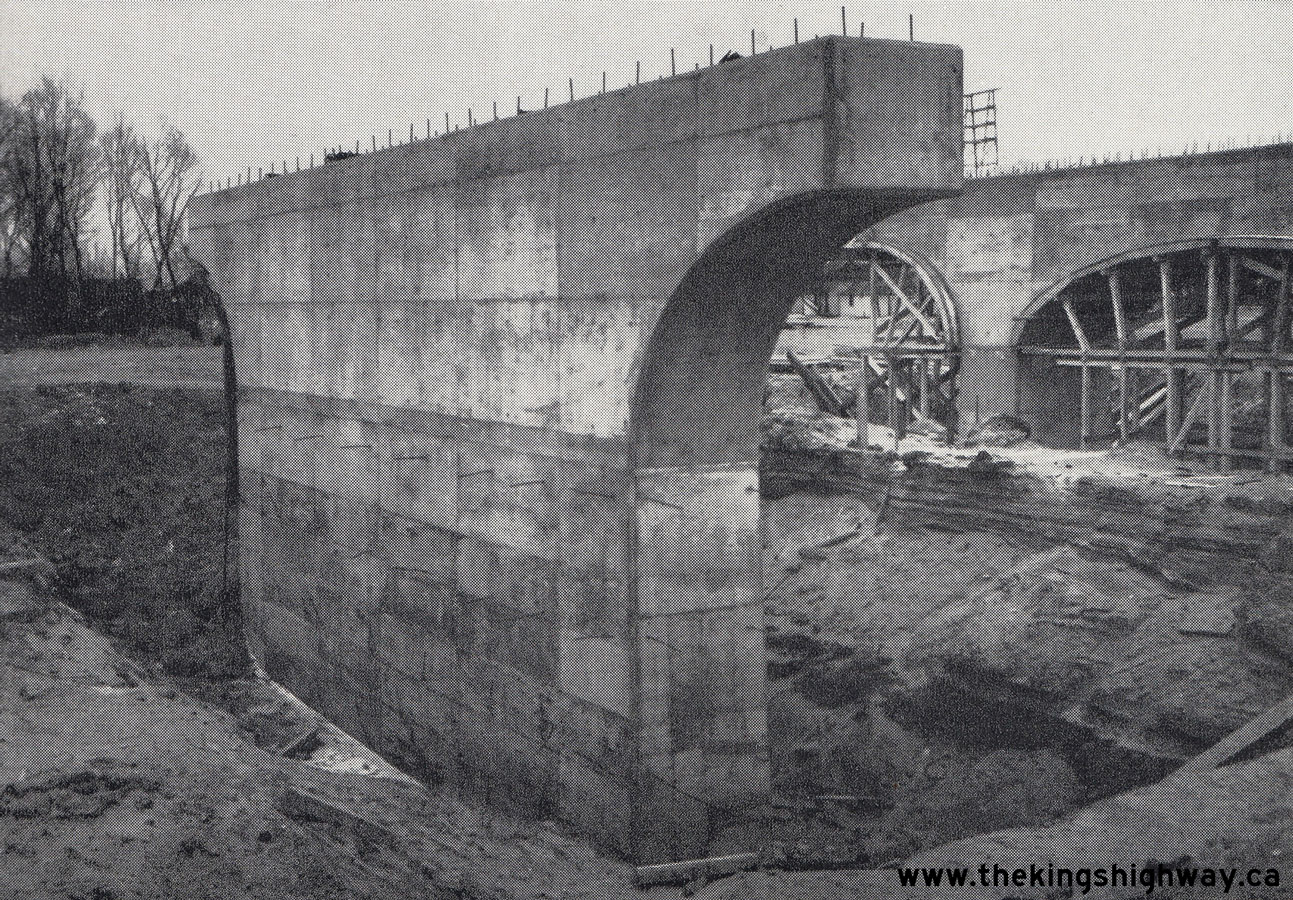 Above - Completed concrete support pier for the new Burlington Skyway on the Queen Elizabeth Way, Contract #1955-156. See an
Enlarged Photo Here. Photo taken on February 27, 1956. Above - Completed concrete support pier for the new Burlington Skyway on the Queen Elizabeth Way, Contract #1955-156. See an
Enlarged Photo Here. Photo taken on February 27, 1956.(Photo courtesy of Ontario Ministry of Transportation - © King's Printer for Ontario, 1956) 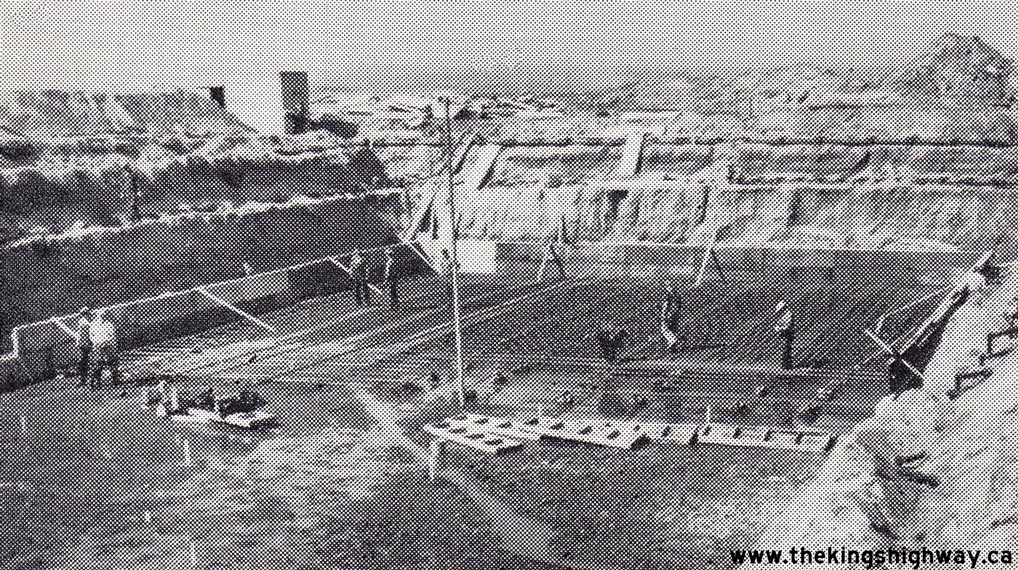
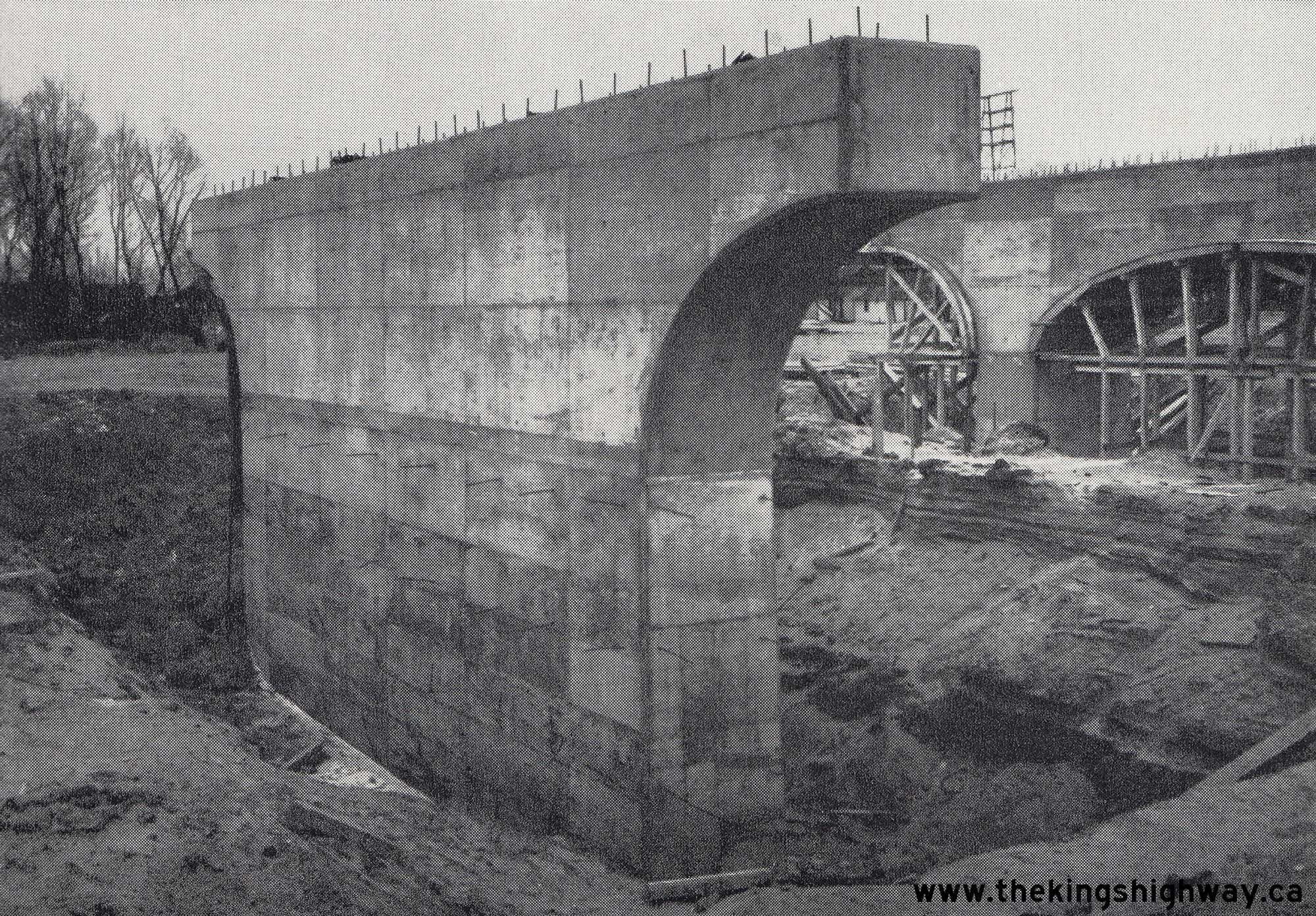
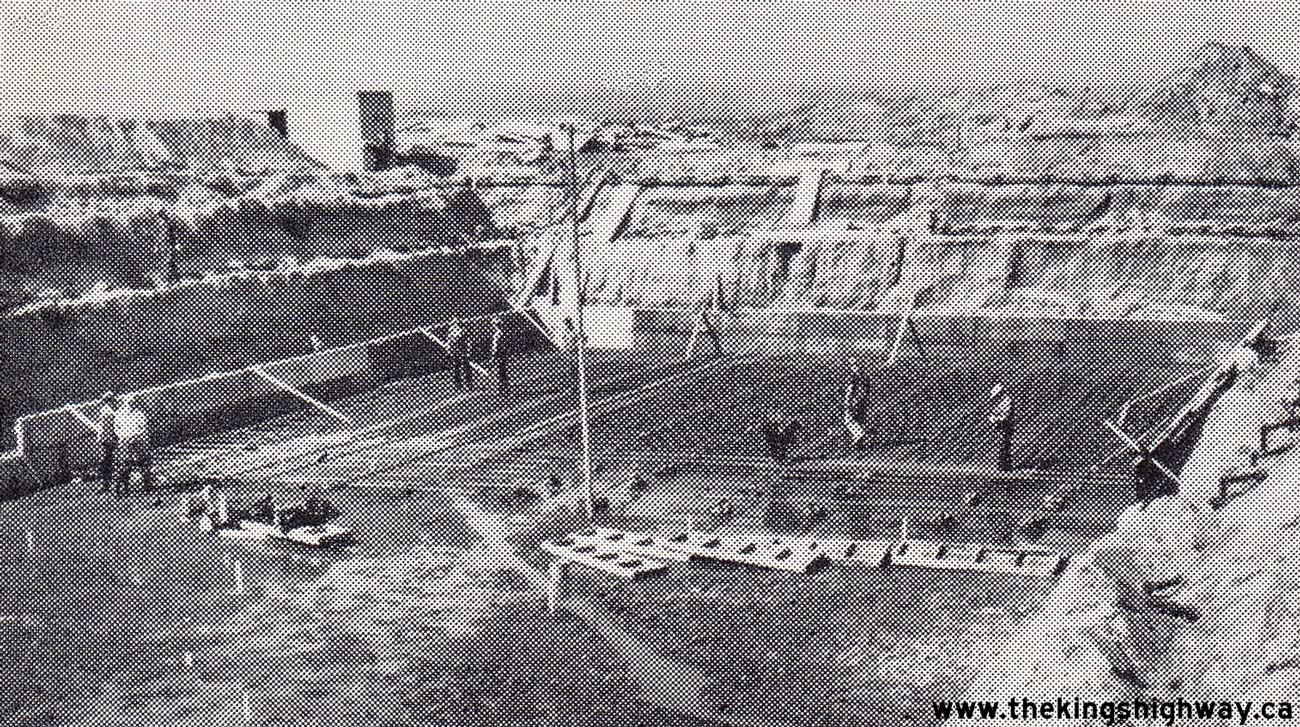
Above - Excavation for one of the main support piers for the new Burlington Skyway on the Queen Elizabeth Way. See an
Enlarged Photo Here. Photo taken on May 14, 1956. (Photo courtesy of Ontario Ministry of Transportation - © King's Printer for Ontario, 1956) 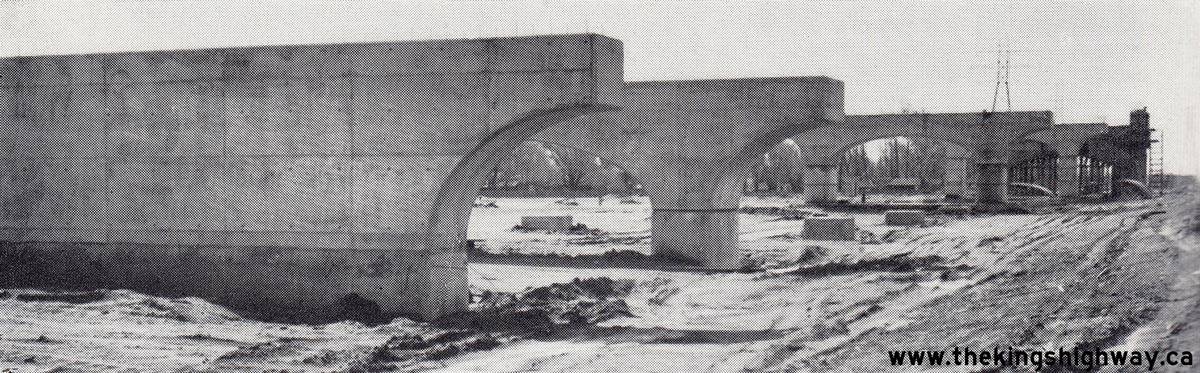
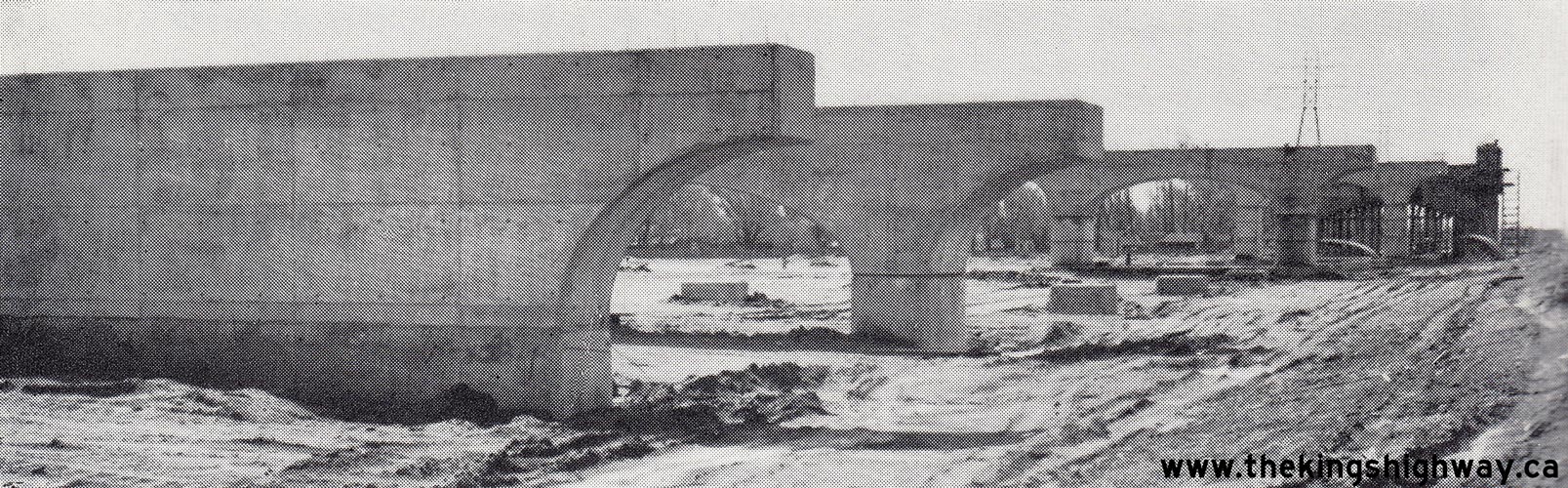
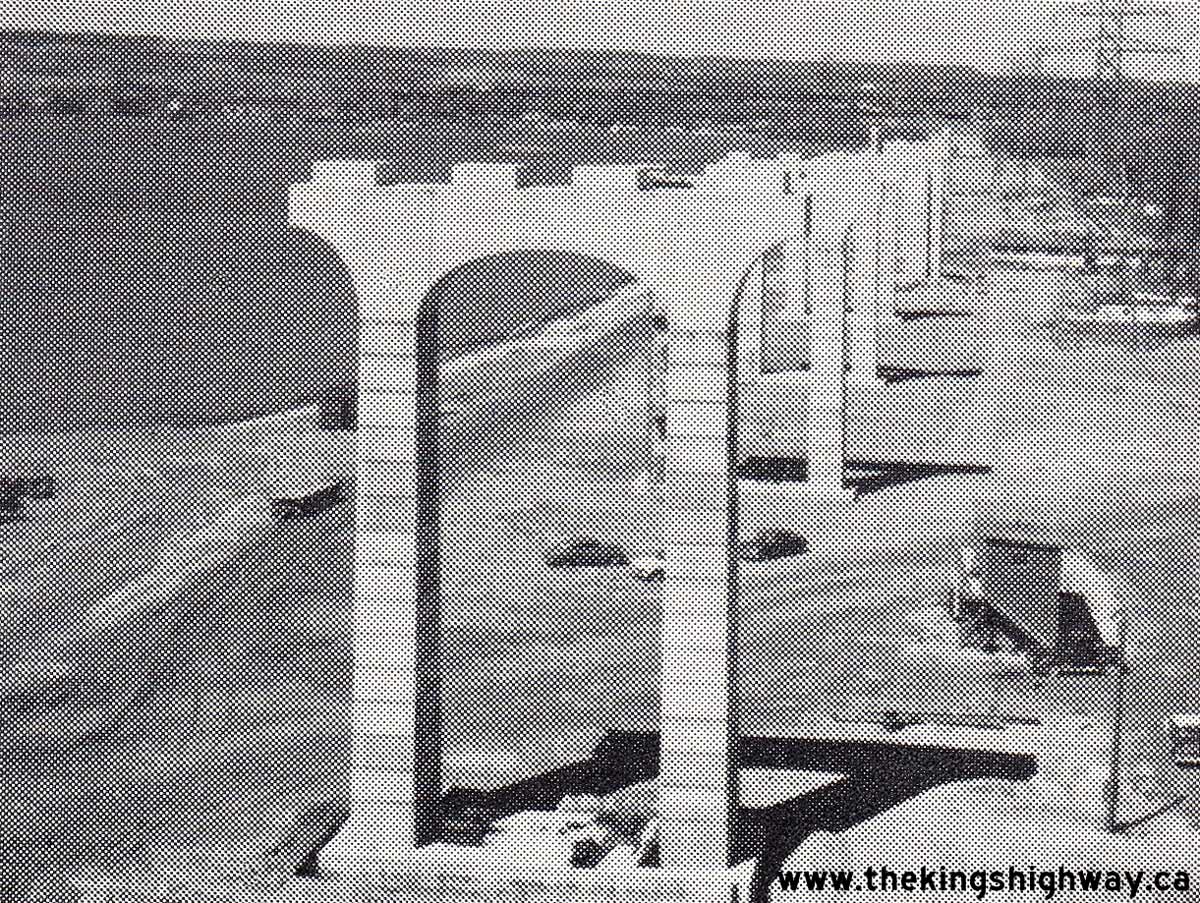
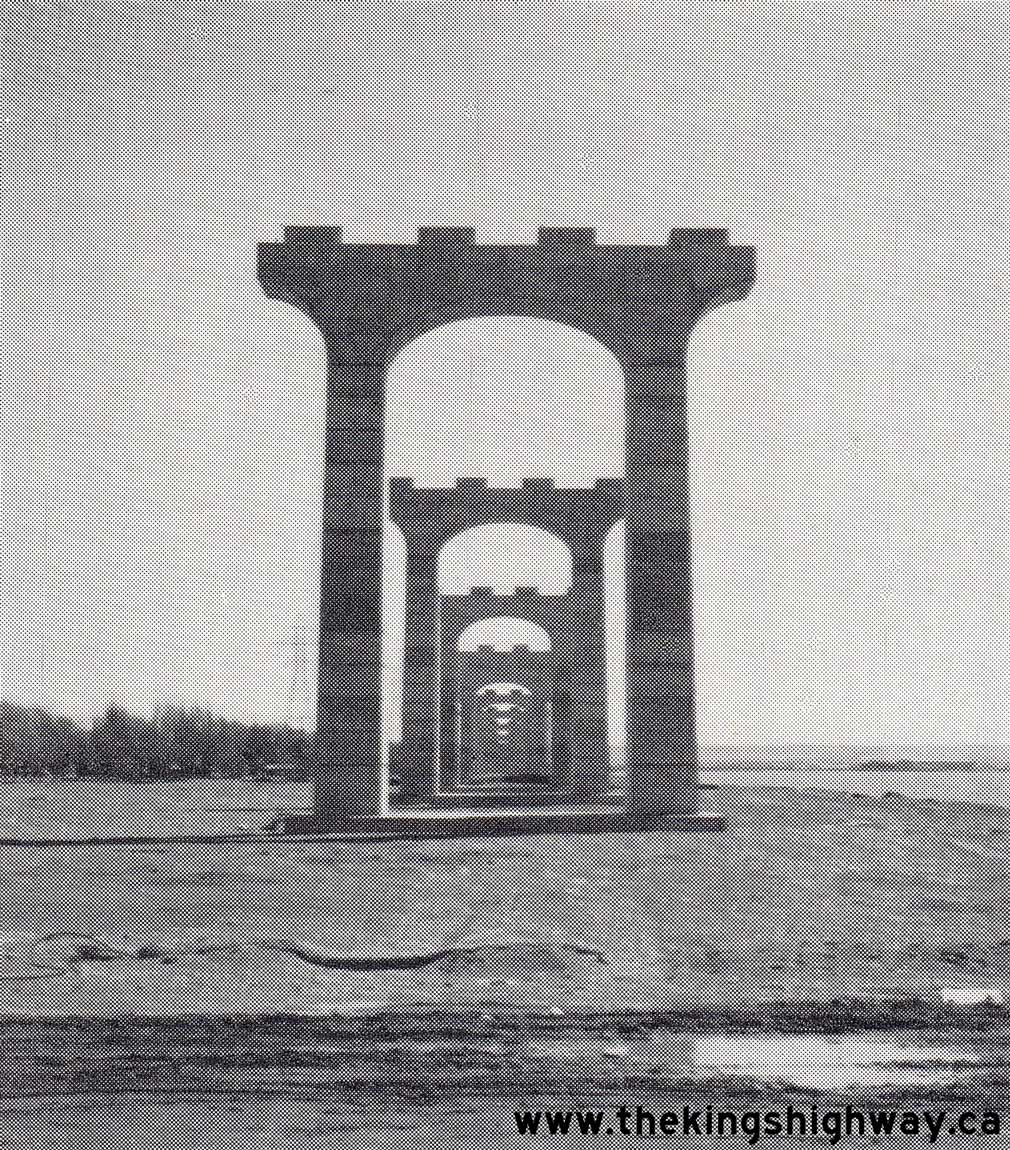
Above - Completed approach span piers for the new Burlington Skyway on the Queen Elizabeth Way. See an
Enlarged Photo Here. Photo taken on May 14, 1956. (Photo courtesy of Ontario Ministry of Transportation - © King's Printer for Ontario, 1956) 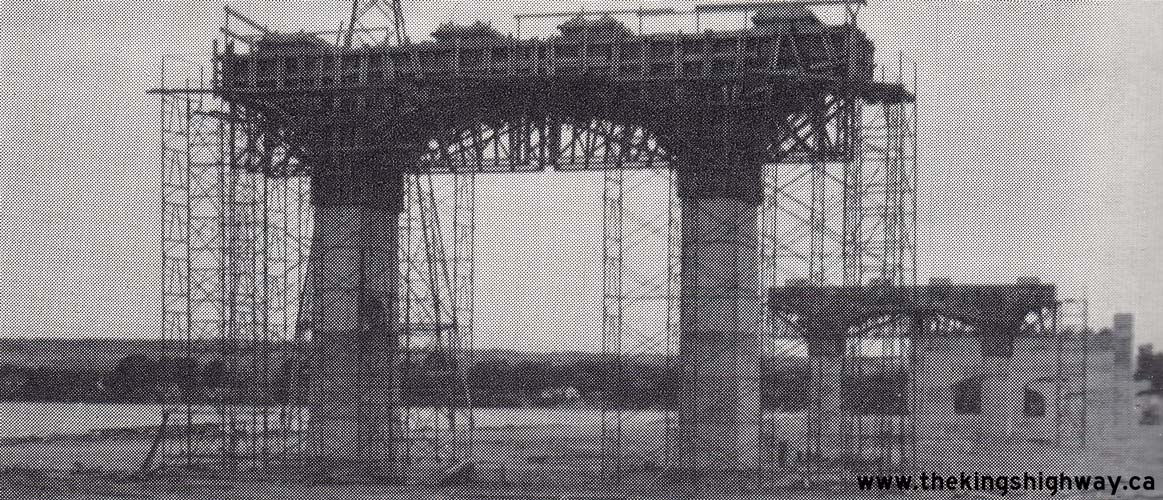
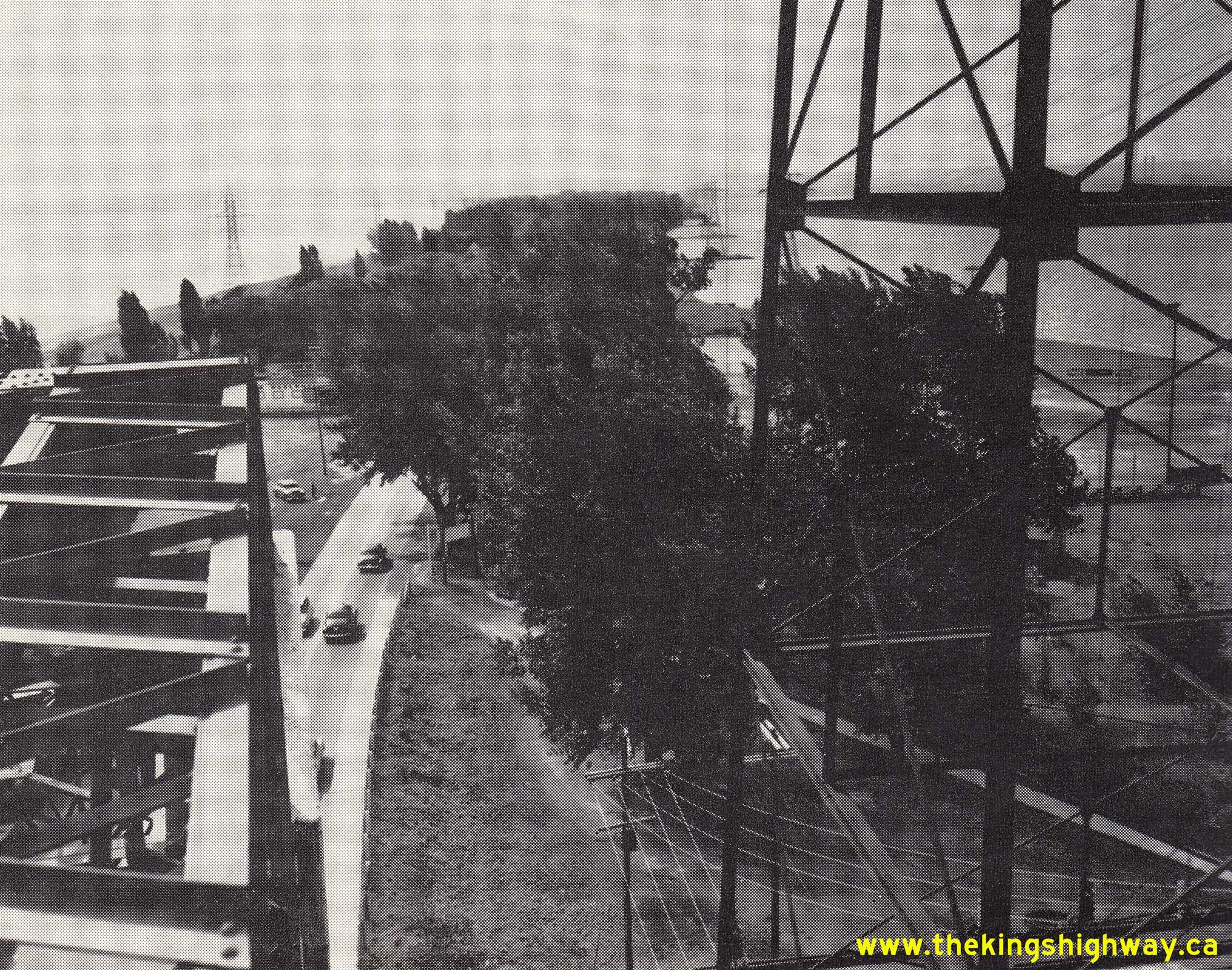
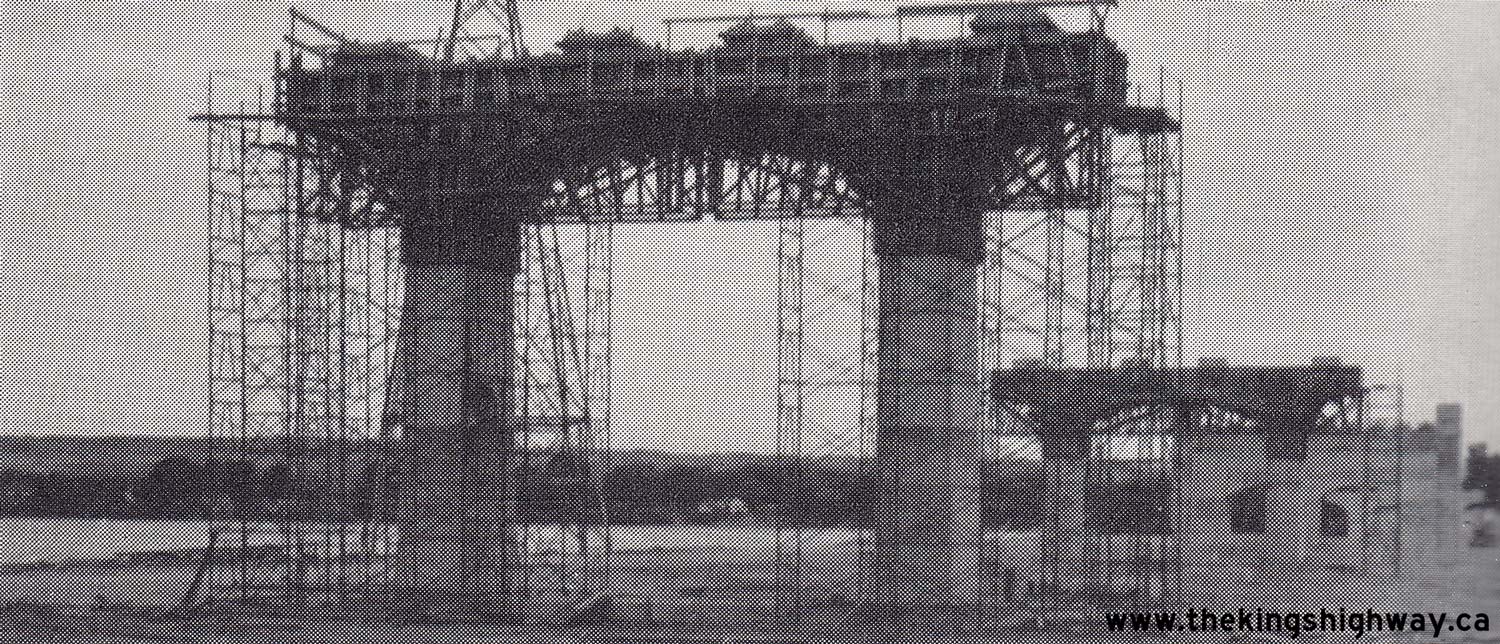
Above - Scaffolding and formwork for the construction of the pier caps on the Burlington Skyway approach on the Queen Elizabeth Way. See an
Enlarged Photo Here. Photo taken on July 4, 1956. (Photo courtesy of Ontario Ministry of Transportation - © King's Printer for Ontario, 1956) 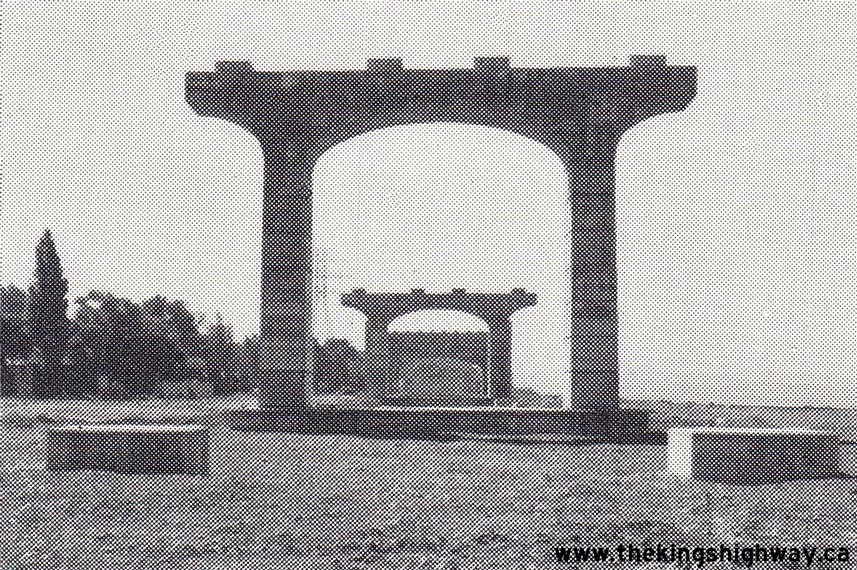
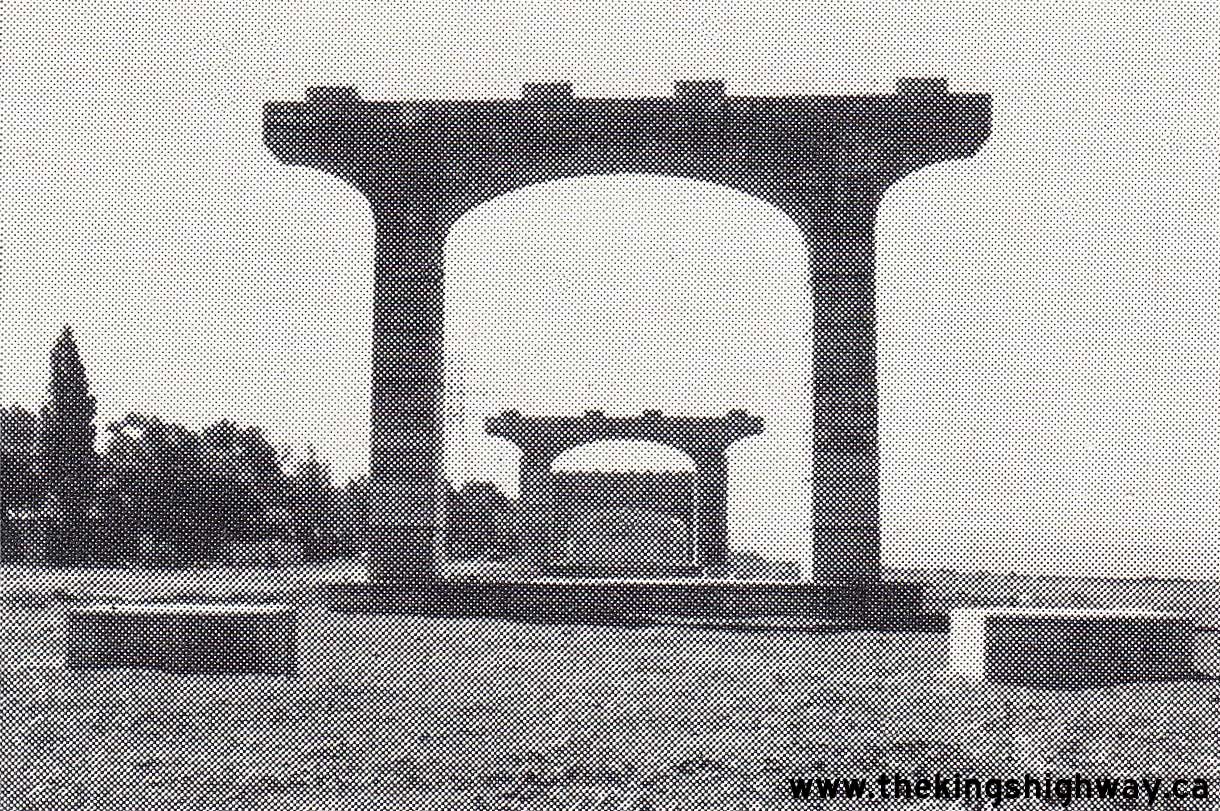
Above - Completed piers for the new Burlington Skyway on the Queen Elizabeth Way between Burlington and Hamilton. See an
Enlarged Photo Here. Photo taken on August 14, 1956. (Photo courtesy of Ontario Ministry of Transportation - © King's Printer for Ontario, 1956) 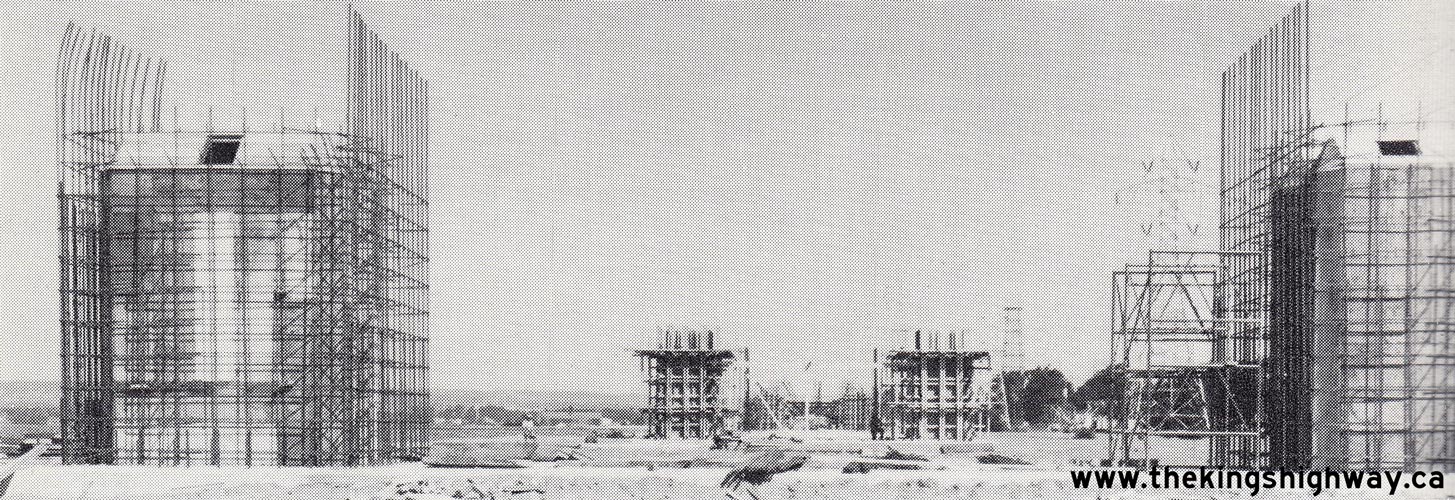
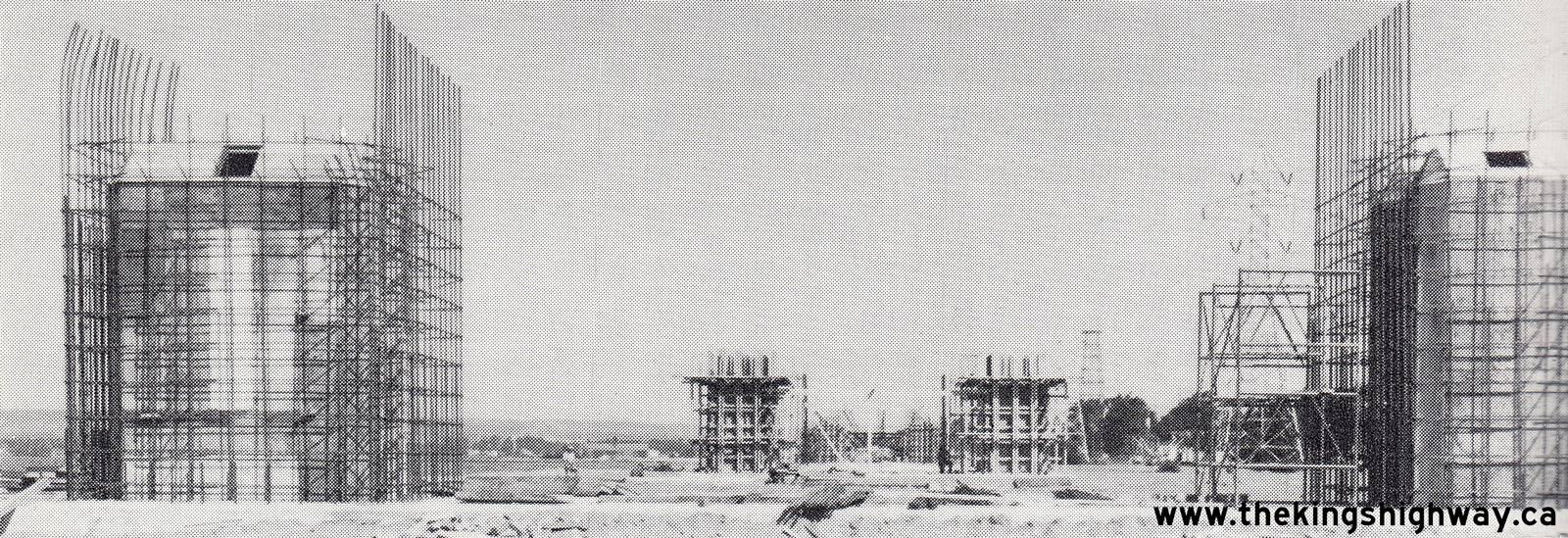
Above - Steel formwork for the main piers supporting the 1,045 foot centre section of the new Burlington Skyway on the Queen Elizabeth Way. See an
Enlarged Photo Here. Photo taken on August 14, 1956. (Photo courtesy of Ontario Ministry of Transportation - © King's Printer for Ontario, 1956) 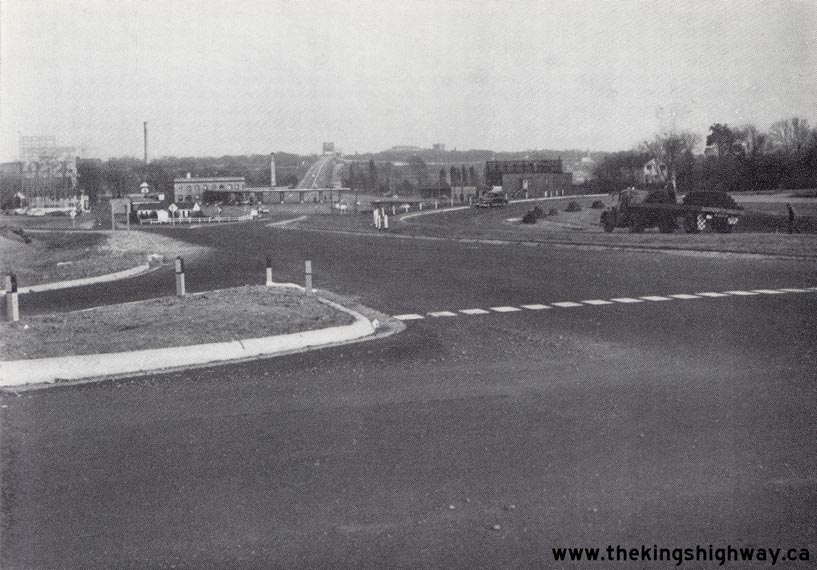
Left - Entrance to the Peace Bridge from the terminus of the Queen Elizabeth Way in Fort Erie. See an
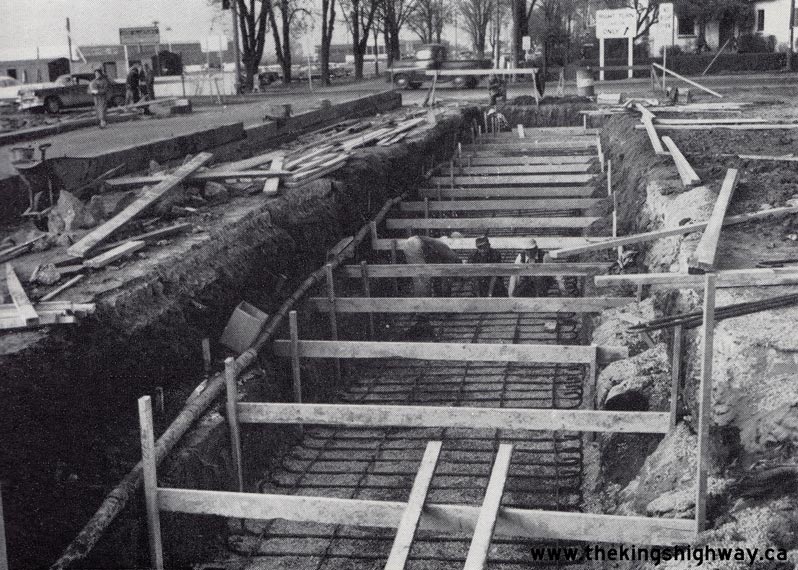
Enlarged Photo Here. Photo taken on October 31, 1956. (Photo courtesy of Ontario Ministry of Transportation - © King's Printer for Ontario, 1956) Right - Early work on the Geneva Street Underpass on the Queen Elizabeth Way in St. Catharines, Contract #1956-74. See an Enlarged Photo Here. Photo taken on November 5, 1956. (Photo courtesy of Ontario Ministry of Transportation - © King's Printer for Ontario, 1956) 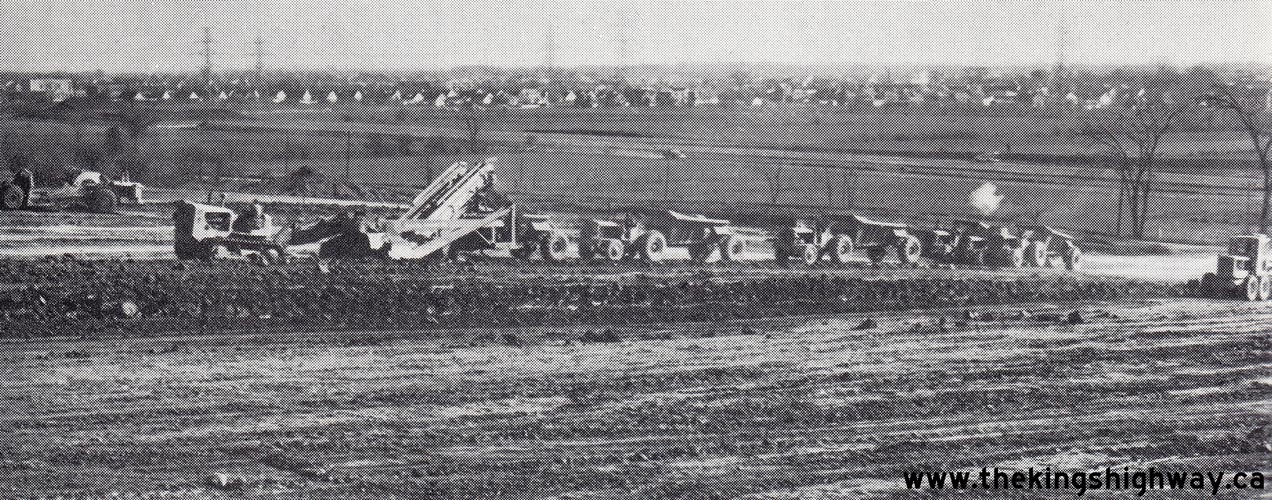
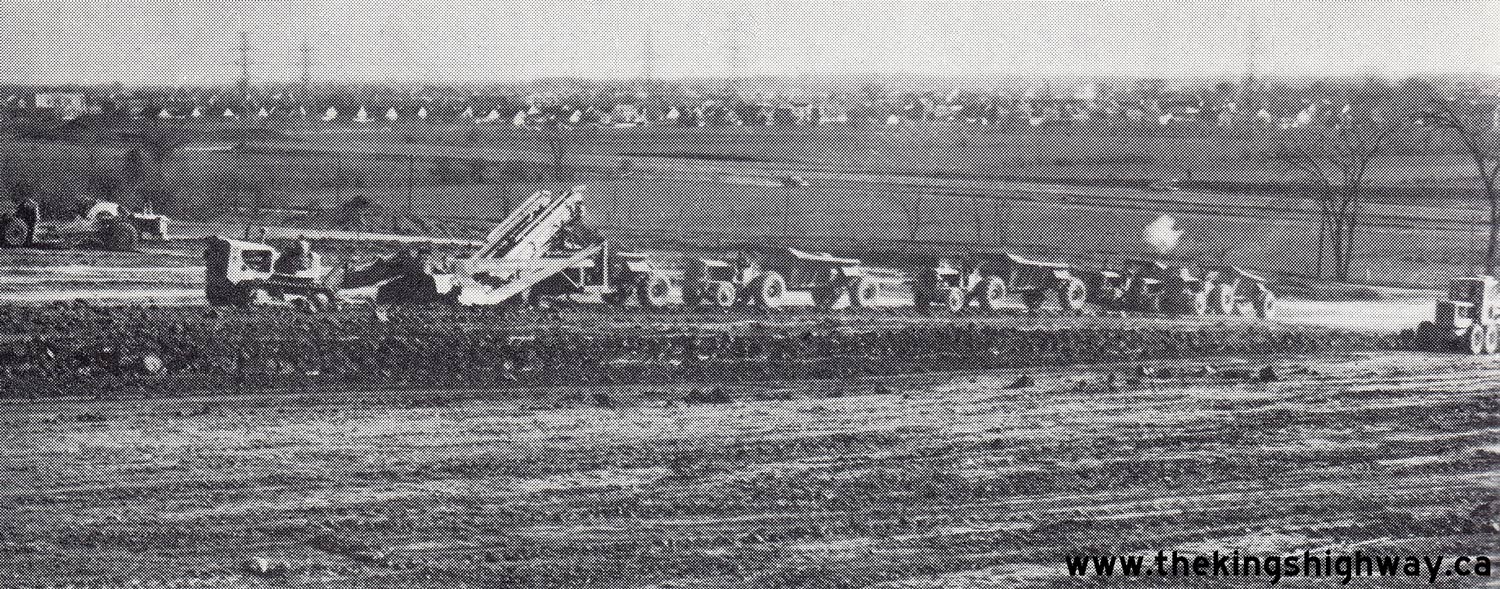
Above - Heavy grading at the proposed Freeman Interchange at the future junction of the Queen Elizabeth Way and Hwy 403 in Burlington. About 2 miles of the
Queen Elizabeth Way was relocated onto an improved alignment between Plains Road at Campbell's Corners and Guelph Line in the late 1950s. Known as the Freeman
Diversion, this relocated section of the Queen Elizabeth Way bypassed the community of Freeman situated at the intersection of Brant Street and Plains Road (the Old
Queen Elizabeth Way). See an Enlarged Photo Here. Photo taken on November 6, 1956. (Photo courtesy of Ontario Ministry of Transportation - © King's Printer for Ontario, 1956) 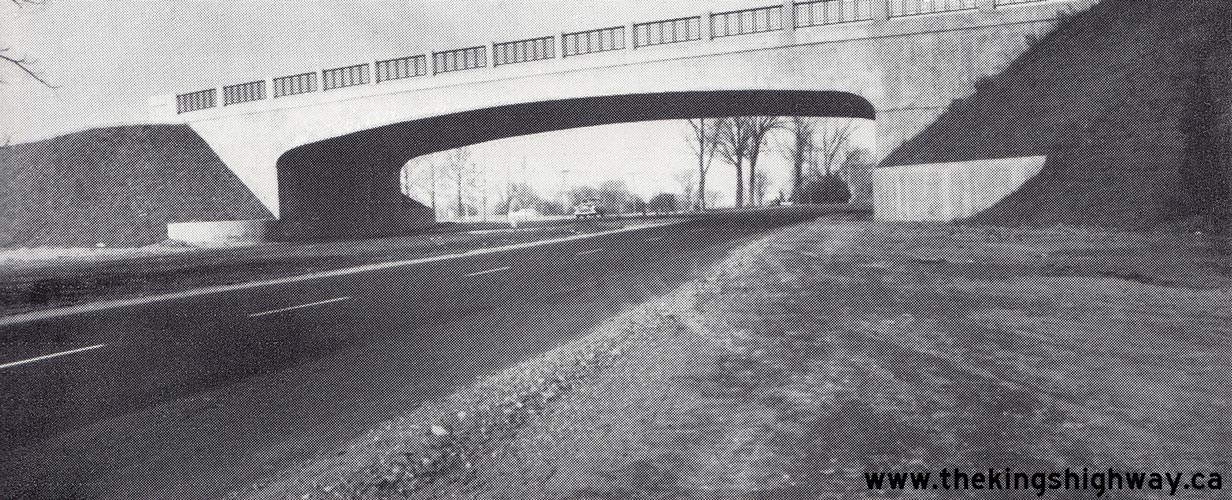
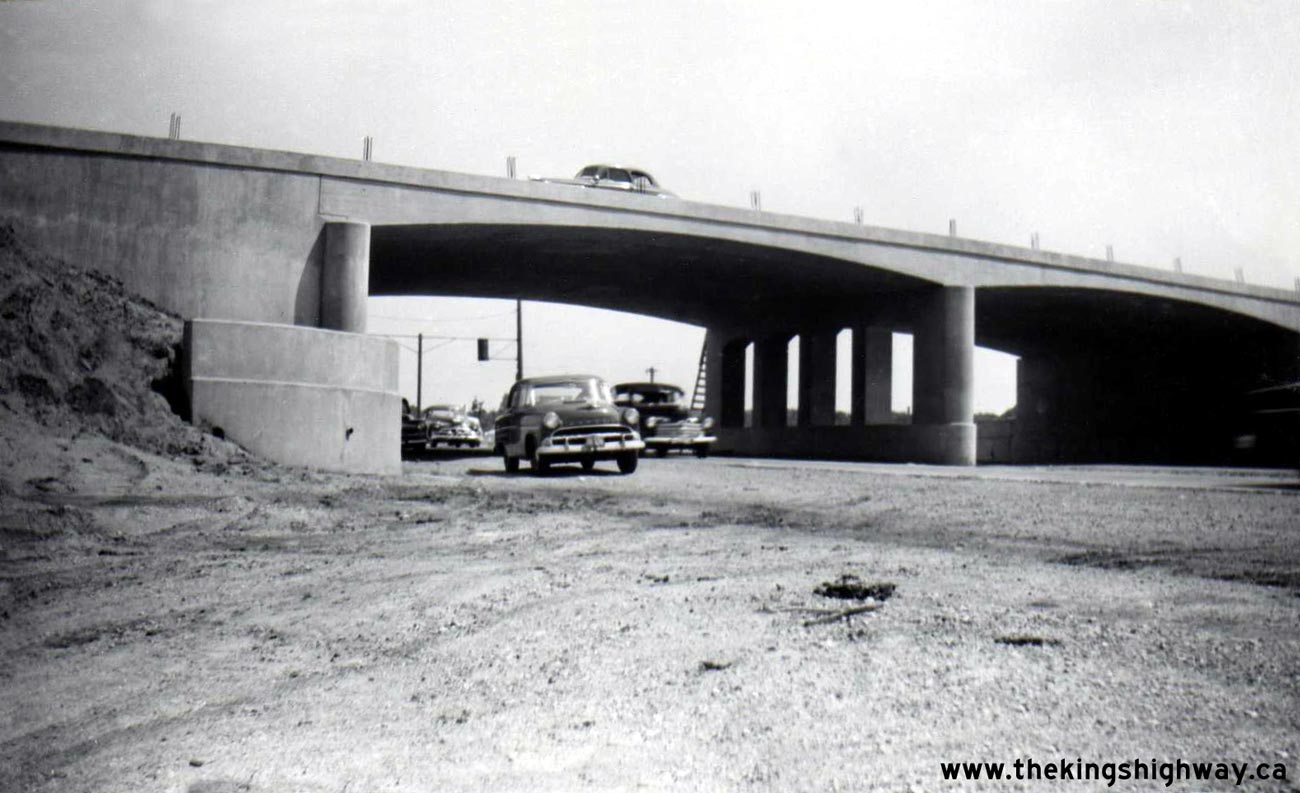
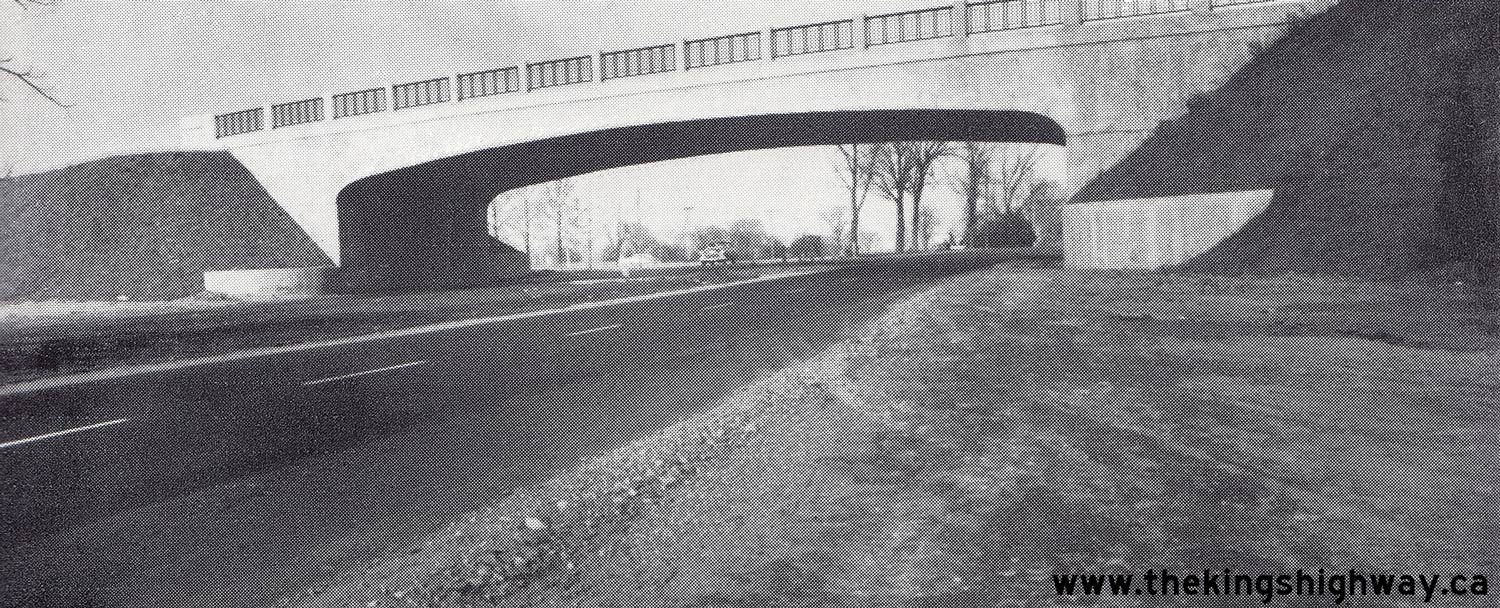
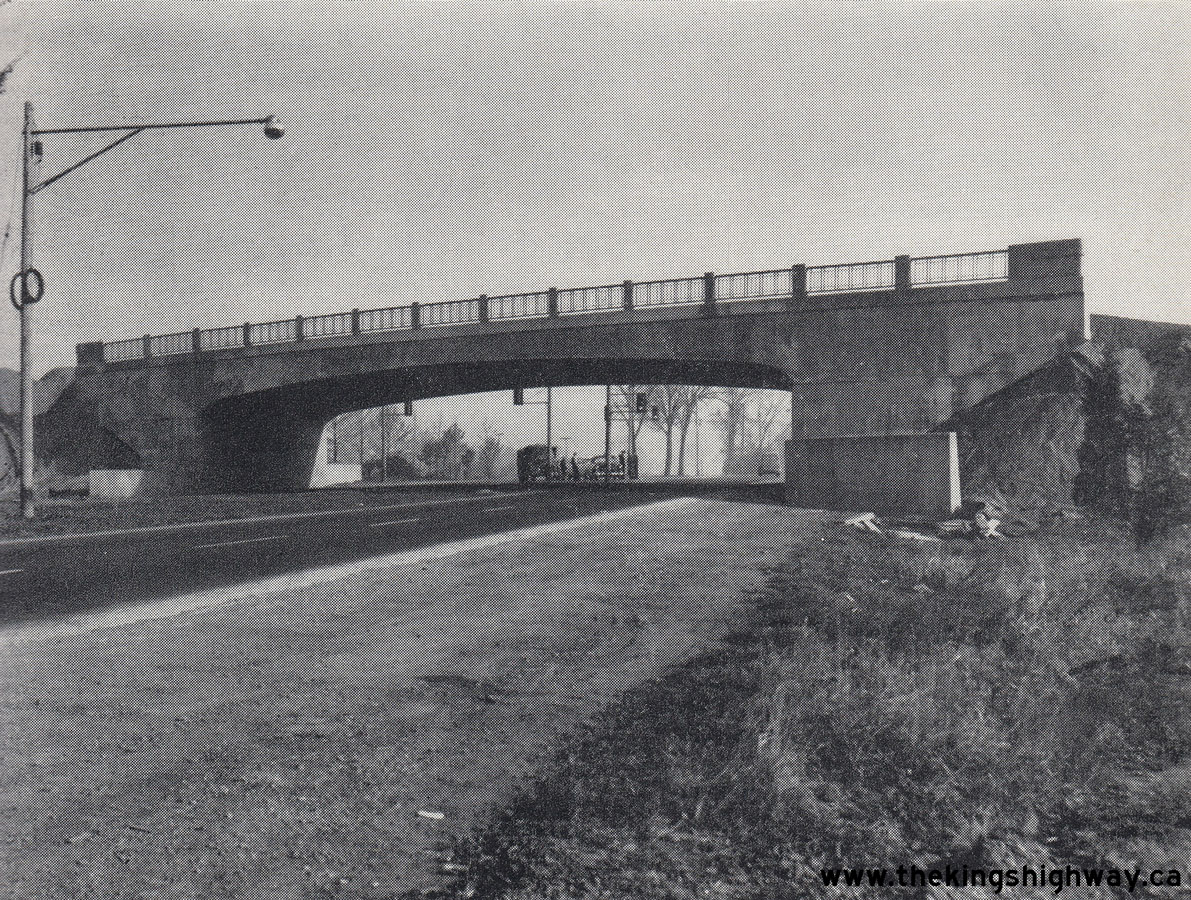
Above - Completed Trafalgar Road Overpass on the Queen Elizabeth Way in Oakville in 1956. The completion of this grade separation and interchange in 1955
removed one of the most hazardous at-grade intersections along the Queen Elizabeth Way. In fact, this intersection was so busy at times, that traffic signals had to
be installed here only a few months after the Middle Road (Queen Elizabeth Way) was completed and opened to traffic between Oakville and Burlington in 1937. The 1955
overpass seen here was demolished when a new interchange with a wider bridge was built at Trafalgar Road in 1979-1980. See an
Enlarged Photo Here. Photo taken on November 6, 1956. (Photo courtesy of Ontario Ministry of Transportation - © King's Printer for Ontario, 1956) 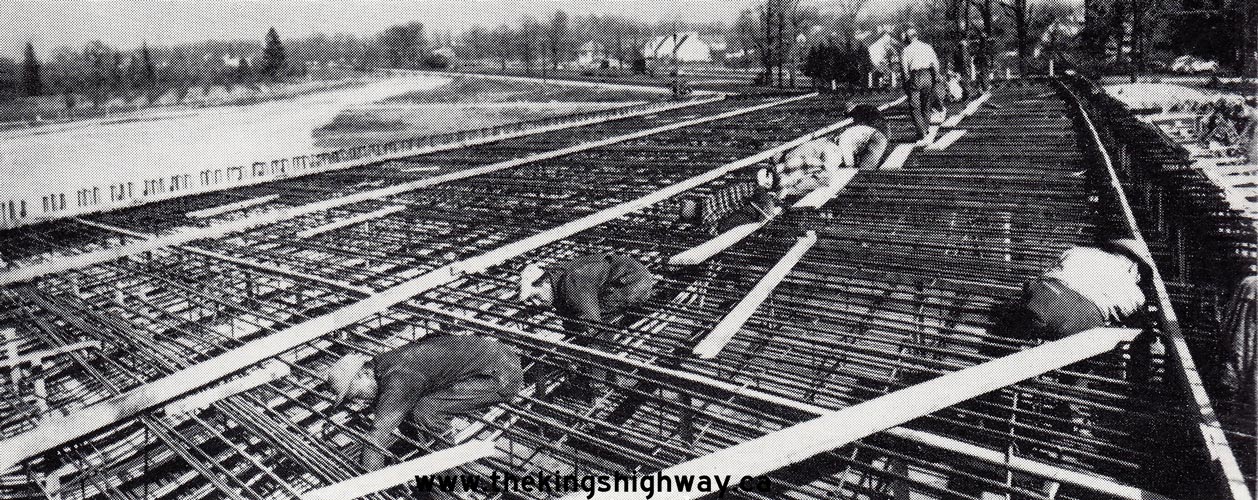
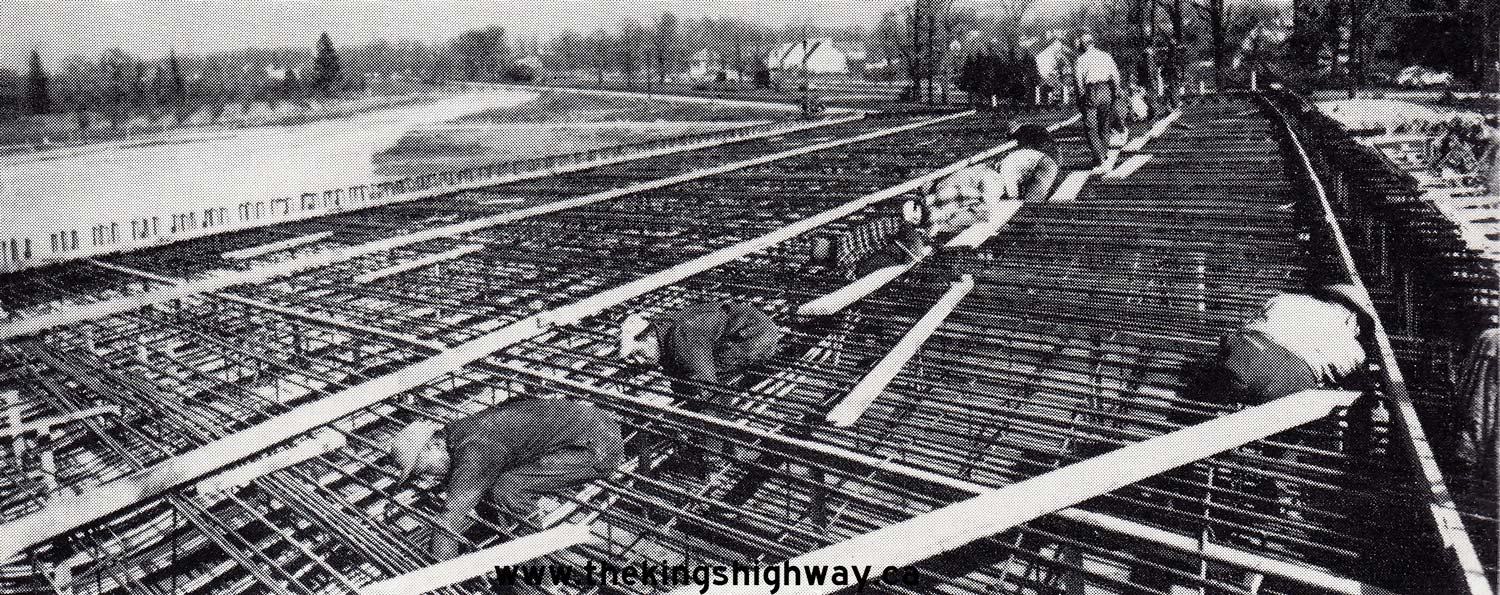
Above - Crew assembling steel reinforcing bars at a new bridge site on the Freeman Diversion of the Queen Elizabeth Way in Burlington. See an
Enlarged Photo Here. Photo taken on November 6, 1956. (Photo courtesy of Ontario Ministry of Transportation - © King's Printer for Ontario, 1956) 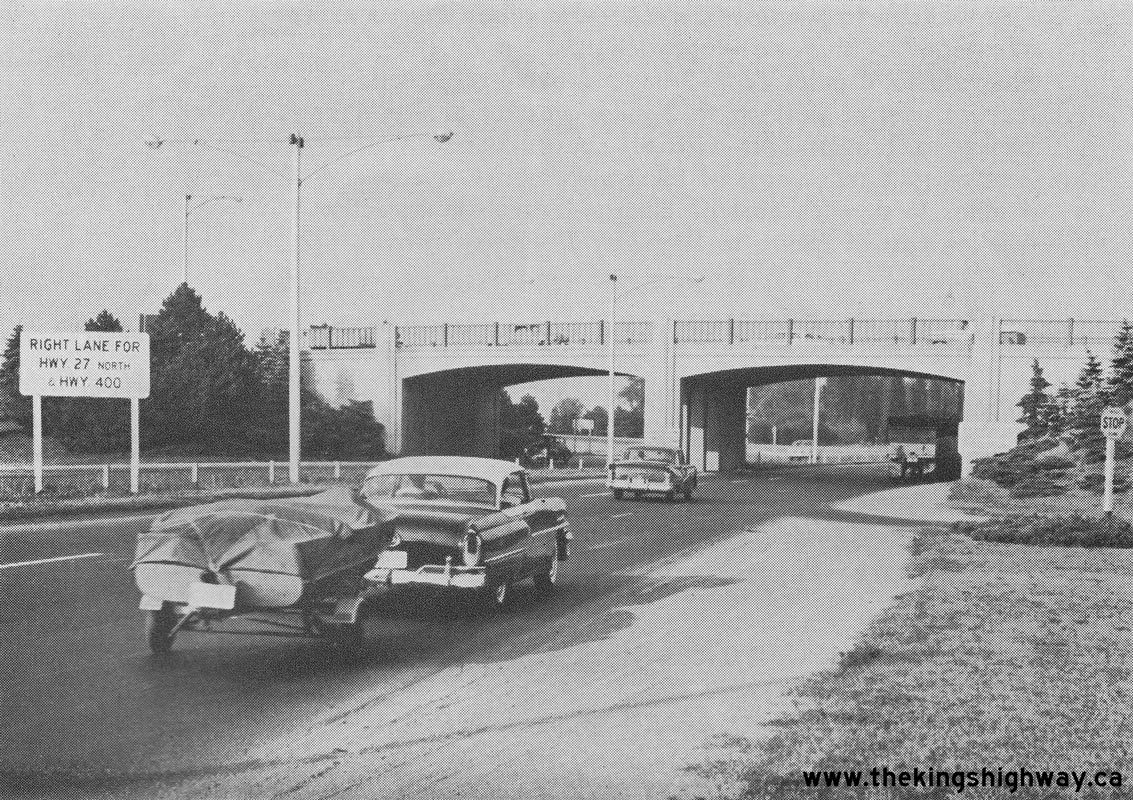
Left - Queen Elizabeth Way at the Hwy 27 Cloverleaf, facing east towards Toronto showing Friday evening traffic volumes at 6:30 pm. See an
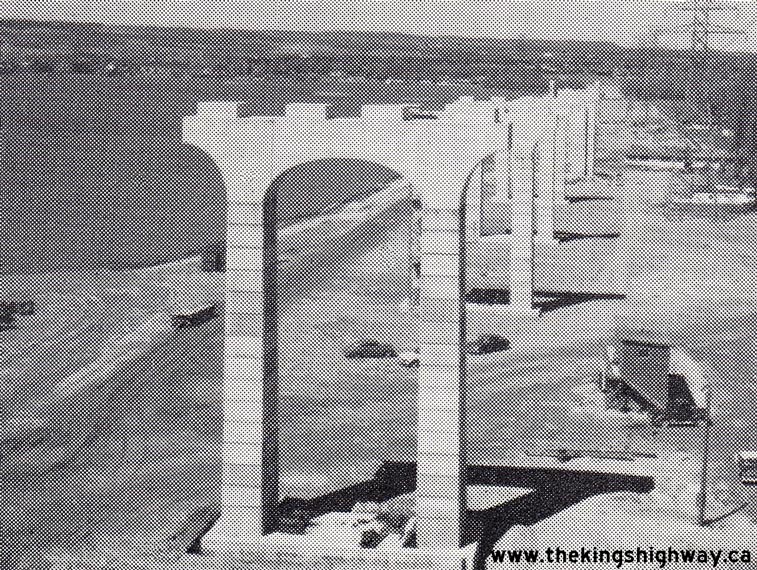
Enlarged Photo Here. Photo taken on August 17, 1956. (Photo courtesy of Ontario Ministry of Transportation - © King's Printer for Ontario, 1956) Right - New piers for the Burlington Skyway on the Queen Elizabeth Way between Burlington and Hamilton. See an Enlarged Photo Here. Photo taken on April 9, 1957. (Photo courtesy of Ontario Ministry of Transportation - © King's Printer for Ontario, 1957) 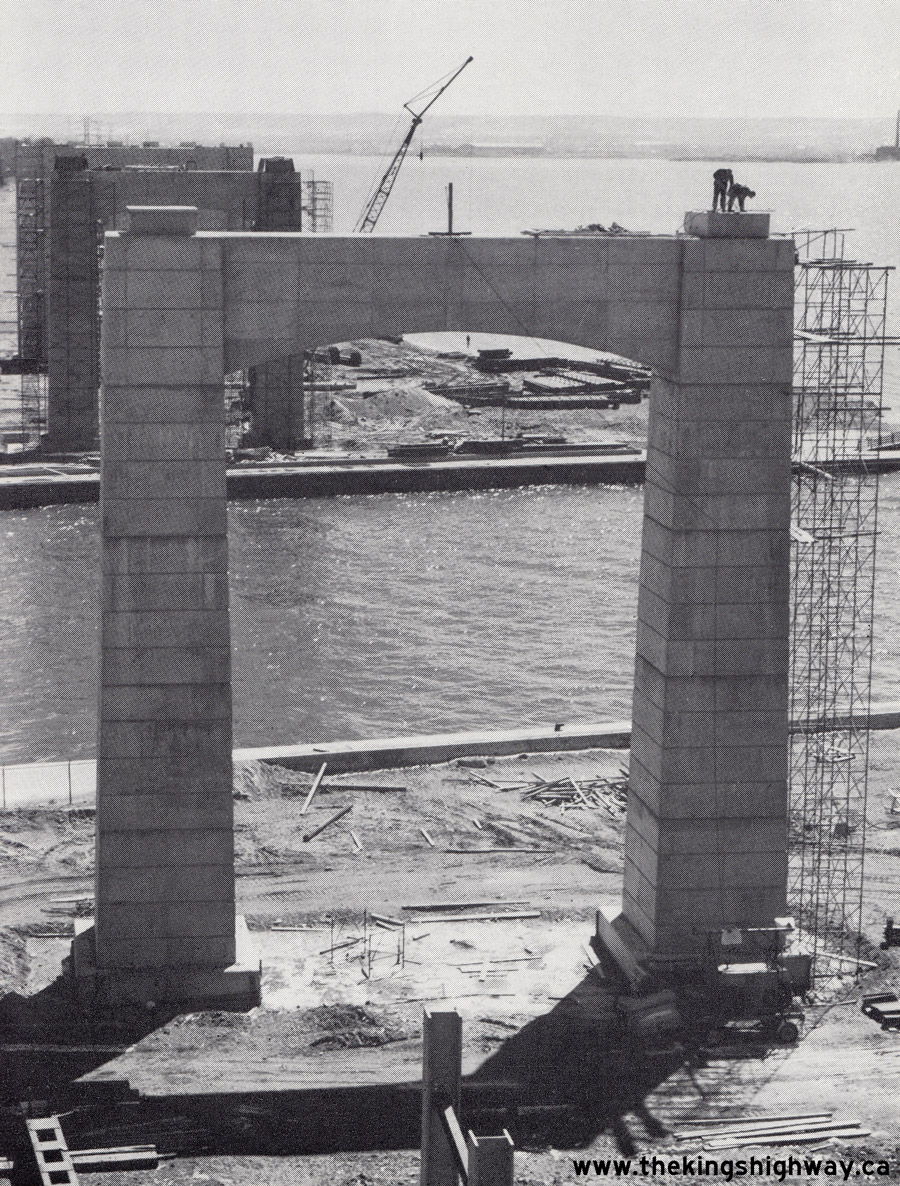 Above - Completed central pier for the new Burlington Skyway on the Queen Elizabeth Way, Contract #1955-155. See an
Enlarged Photo Here. Photo taken on April 9, 1957. Above - Completed central pier for the new Burlington Skyway on the Queen Elizabeth Way, Contract #1955-155. See an
Enlarged Photo Here. Photo taken on April 9, 1957.(Photo courtesy of Ontario Ministry of Transportation - © King's Printer for Ontario, 1957) 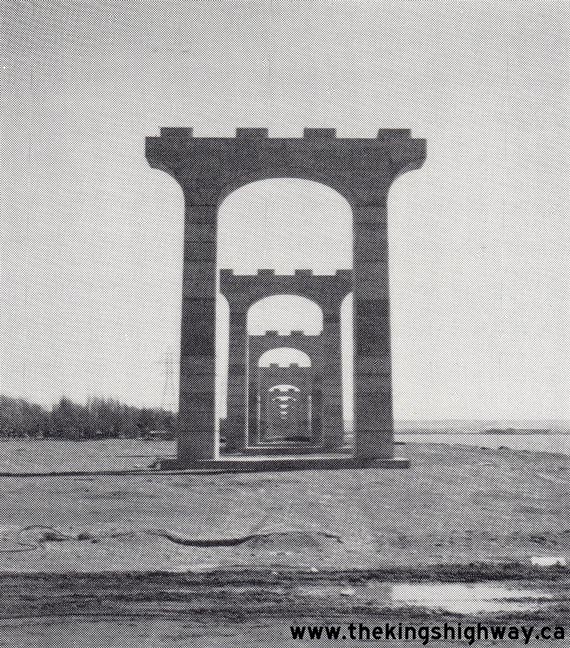
Above - Completed piers for the new Burlington Skyway on the Queen Elizabeth Way, facing south from the Burlington Bay Canal. See an
Enlarged Photo Here. Photo taken on April 9, 1957. (Photo courtesy of Ontario Ministry of Transportation - © King's Printer for Ontario, 1957) 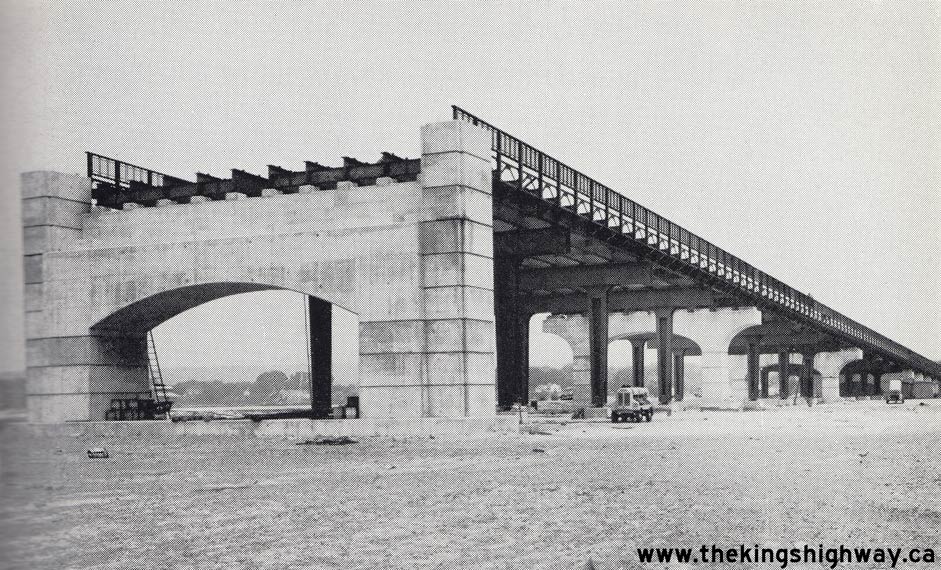
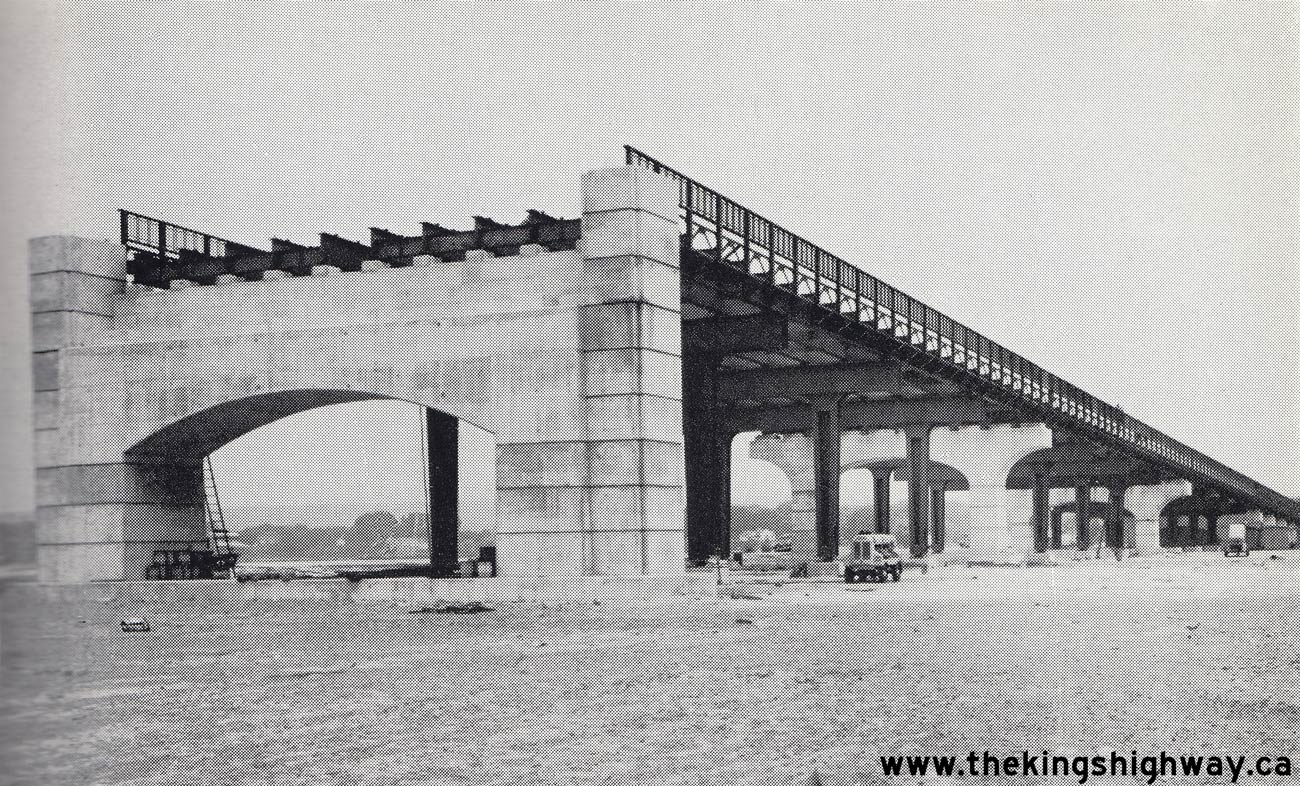
Above - Partially-completed north approach to the Burlington Skyway, Contract #1955-202. See an
Enlarged Photo Here. Photo taken on June 26, 1957. (Photo courtesy of Ontario Ministry of Transportation - © King's Printer for Ontario, 1957) 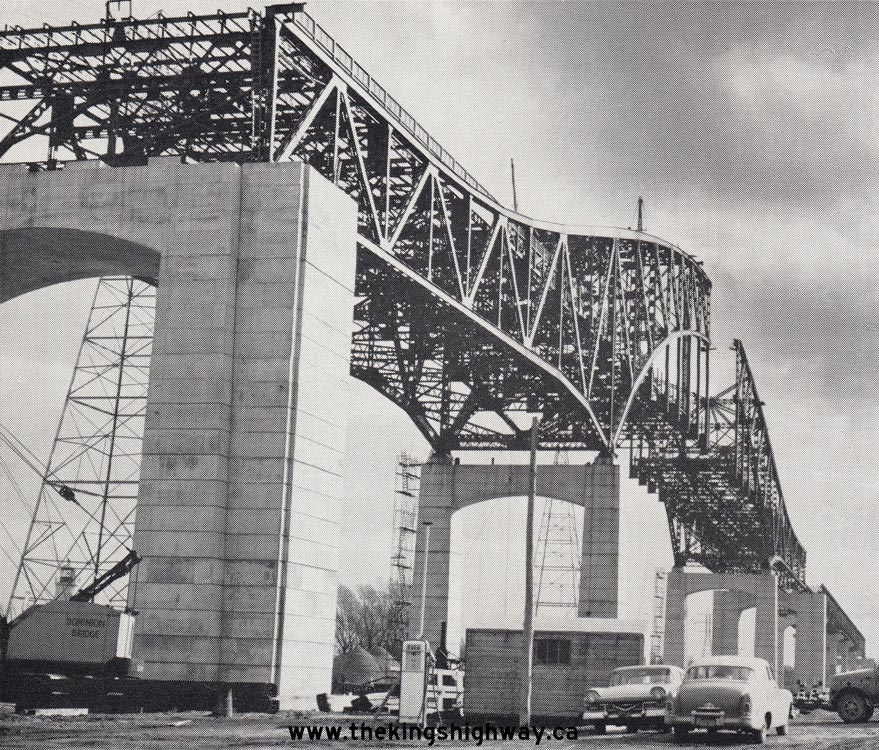
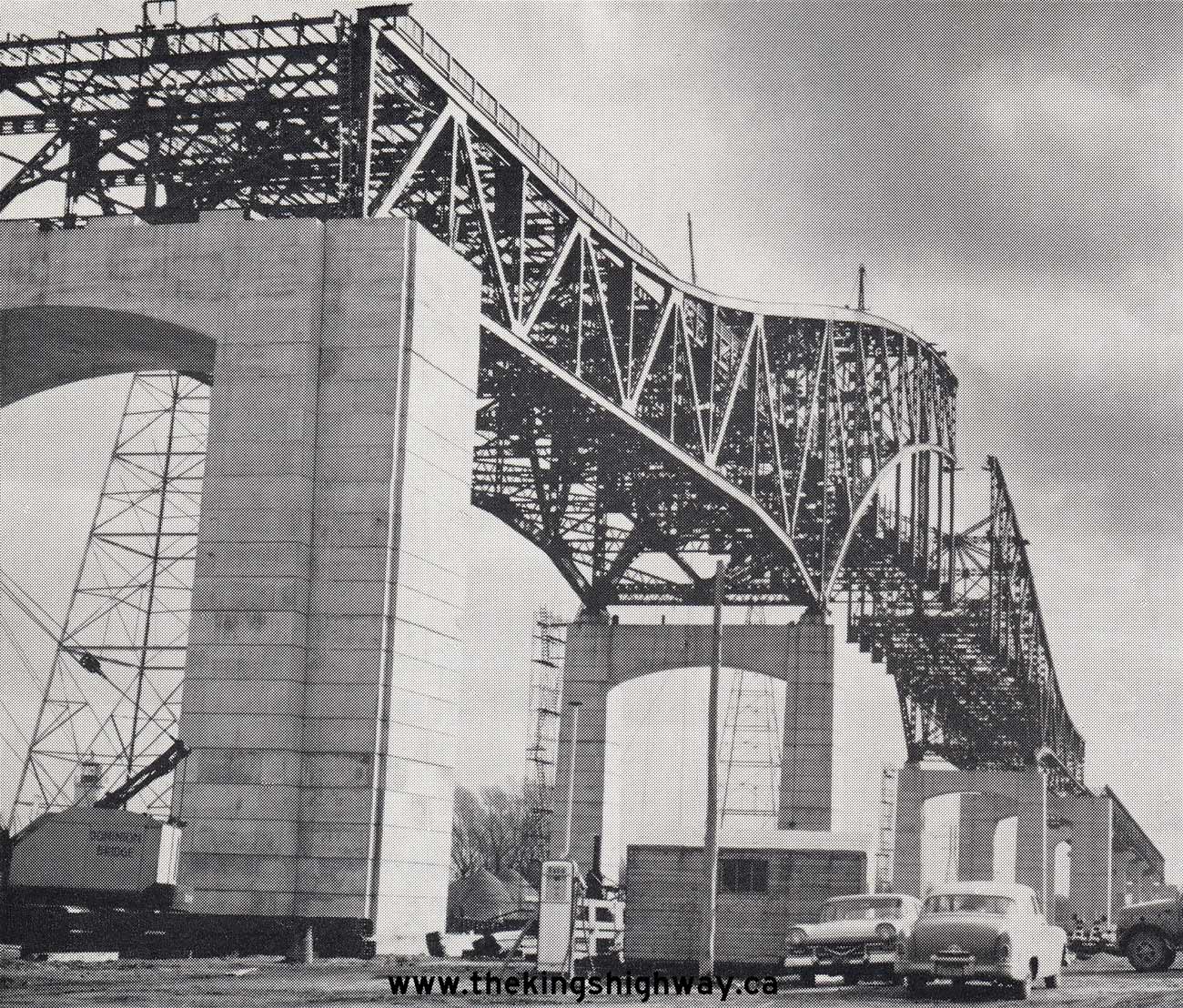
Above - Centre span of the Burlington Skyway nearing completion. See an
Enlarged Photo Here. Photo taken in November, 1957. (Photo courtesy of Ontario Ministry of Transportation - © King's Printer for Ontario, 1957) 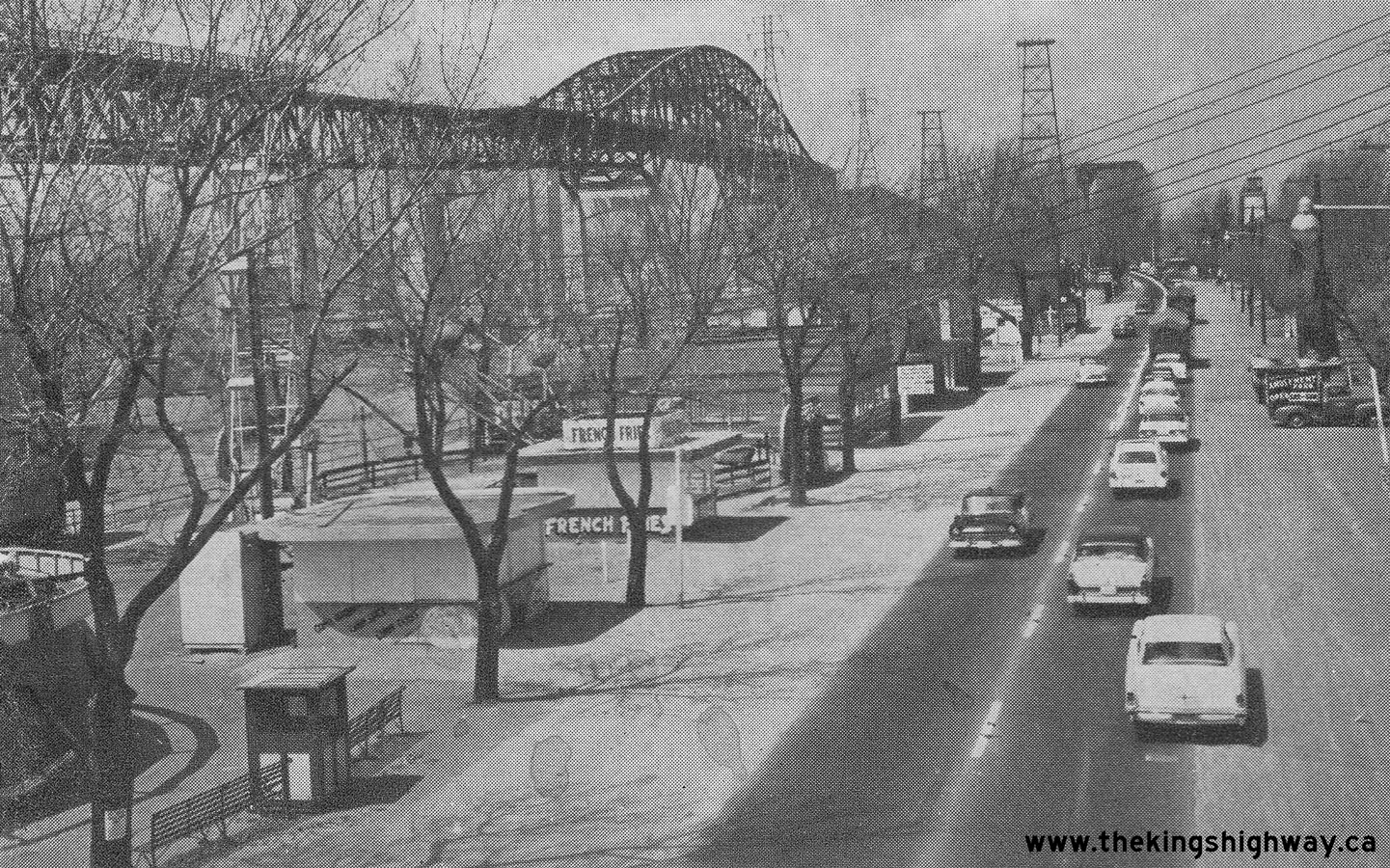
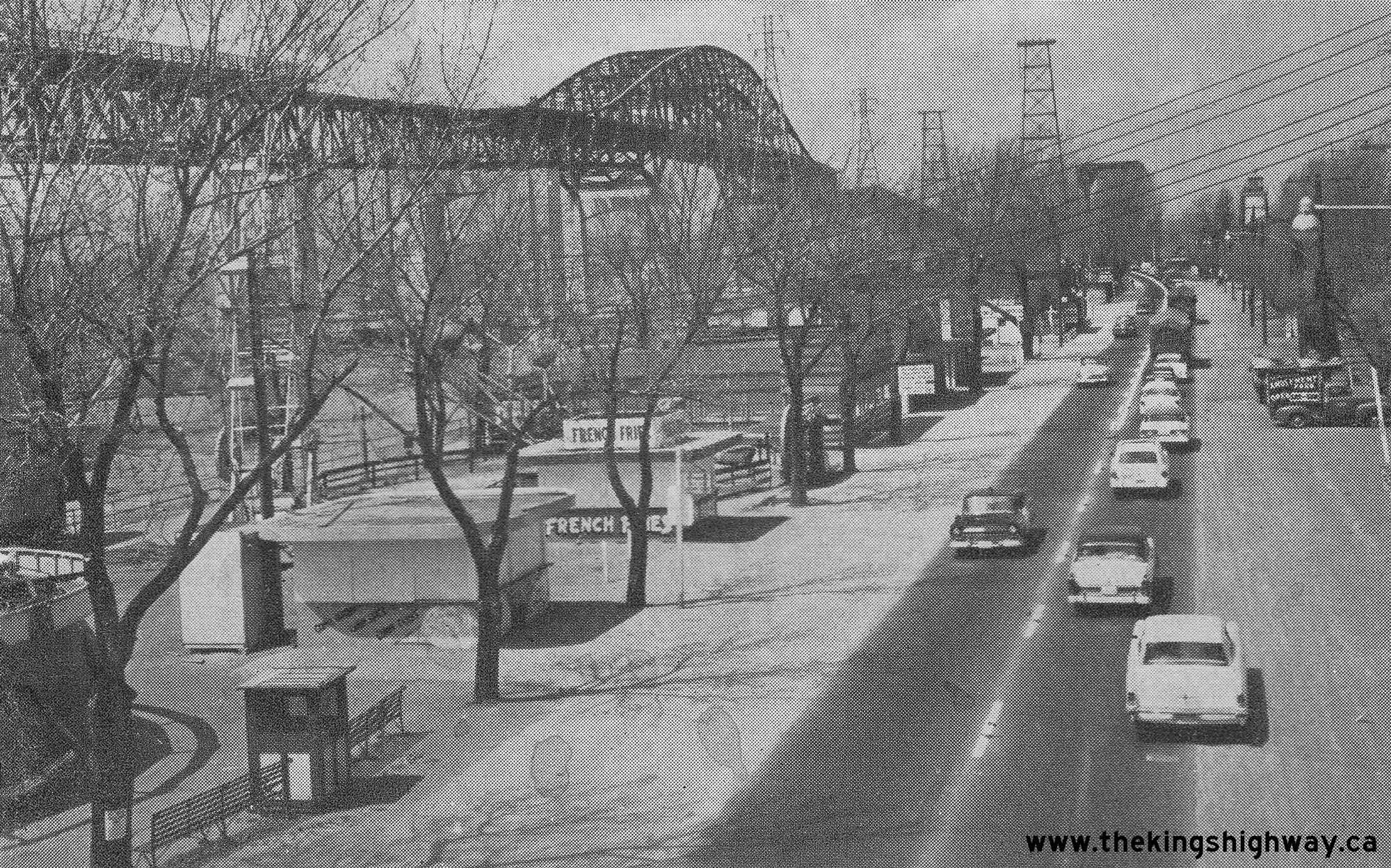
 Left - View of Beach Boulevard (Queen Elizabeth Way & Hwy 20) approaching the lift bridge at Hamilton Beach, prior to the Burlington Skyway's opening
in 1958. This photo was taken in the Spring of 1958, as the Burlington Skyway at left was nearing completion. See an
Enlarged Photo Here. Photo taken in 1958. Left - View of Beach Boulevard (Queen Elizabeth Way & Hwy 20) approaching the lift bridge at Hamilton Beach, prior to the Burlington Skyway's opening
in 1958. This photo was taken in the Spring of 1958, as the Burlington Skyway at left was nearing completion. See an
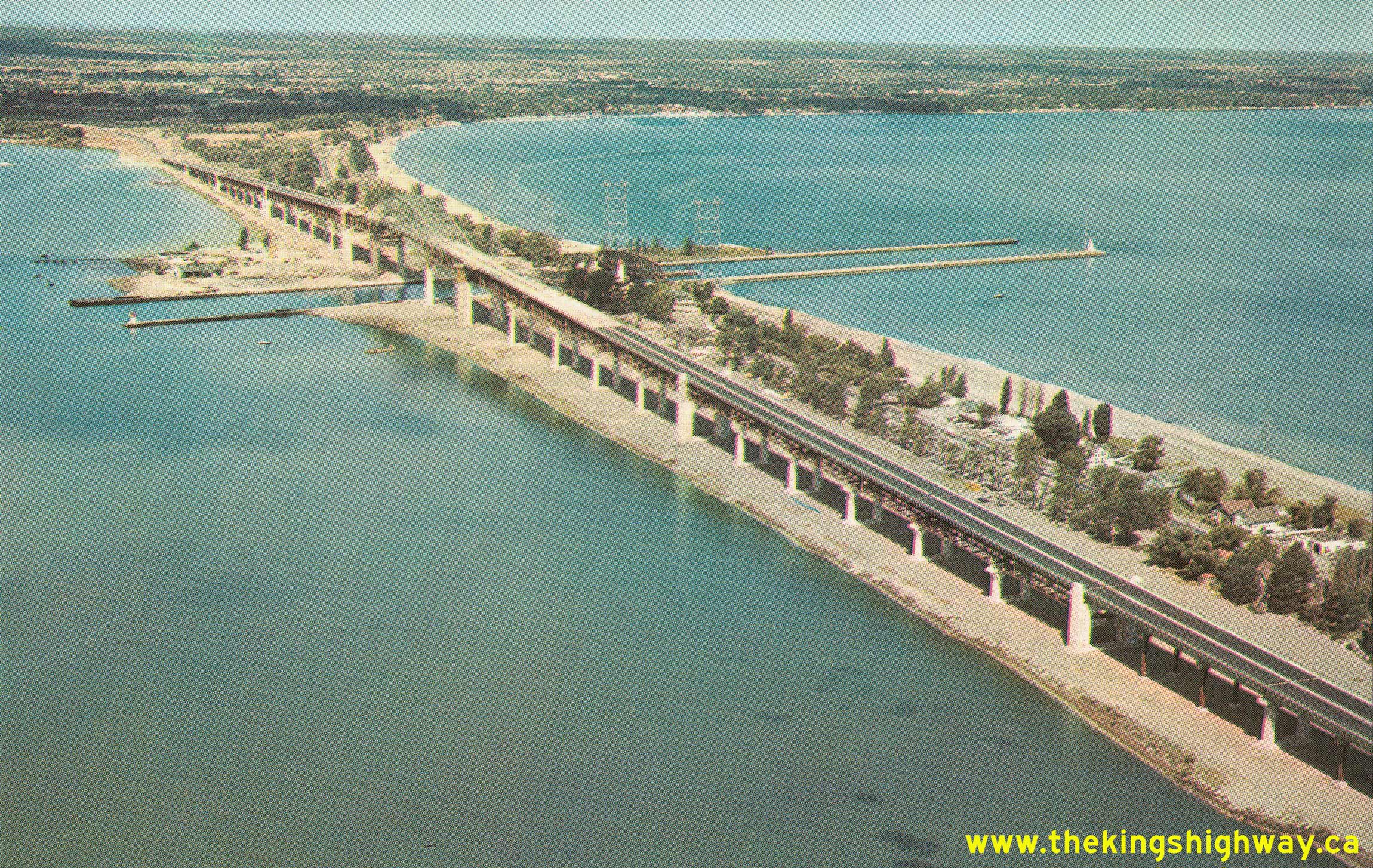
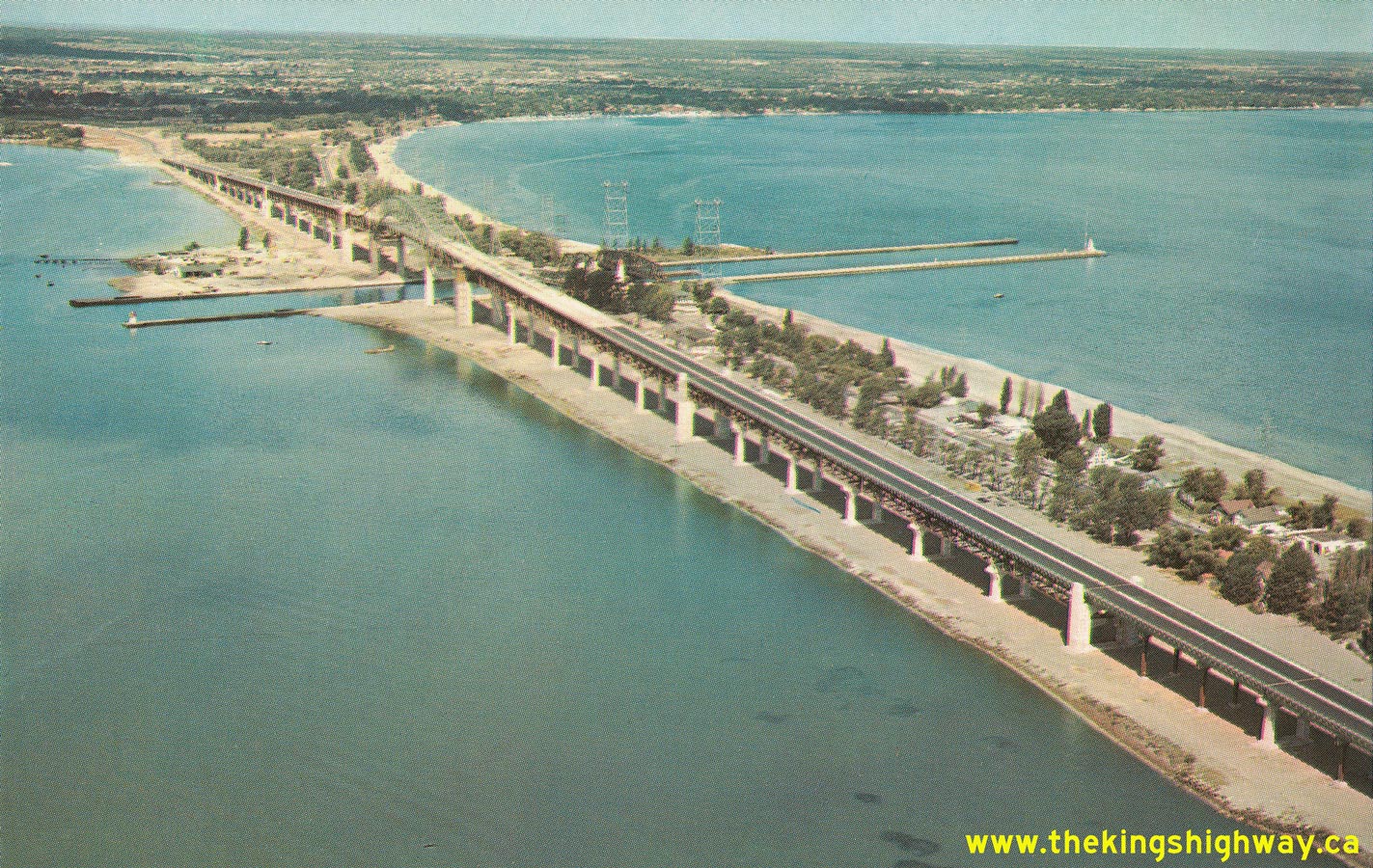
Enlarged Photo Here. Photo taken in 1958.(Photo courtesy of Ontario Ministry of Transportation - © King's Printer for Ontario, 1958) Right - Aerial postcard view of the new Burlington Bay Skyway on the Queen Elizabeth Way, facing northeast. This aerial photo was taken mid-summer 1958, shortly after the deck of the new skyway was completed, but before the new highway illumination system had been installed. See an Enlarged Photo Here. Photo taken in 1958. (Photo courtesy of Royal Specialty Sales, Toronto) 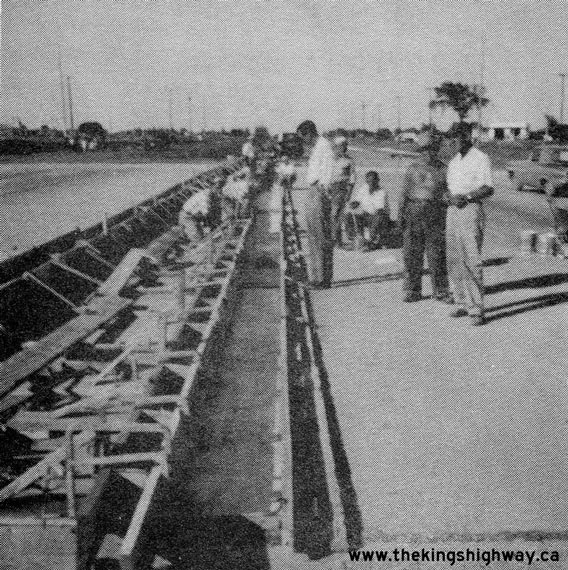
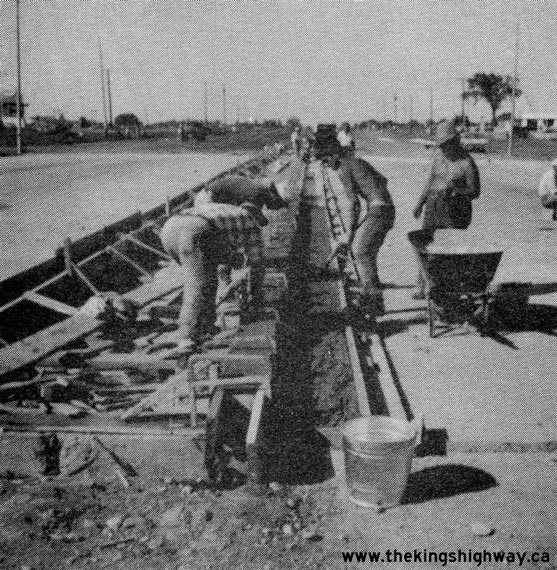
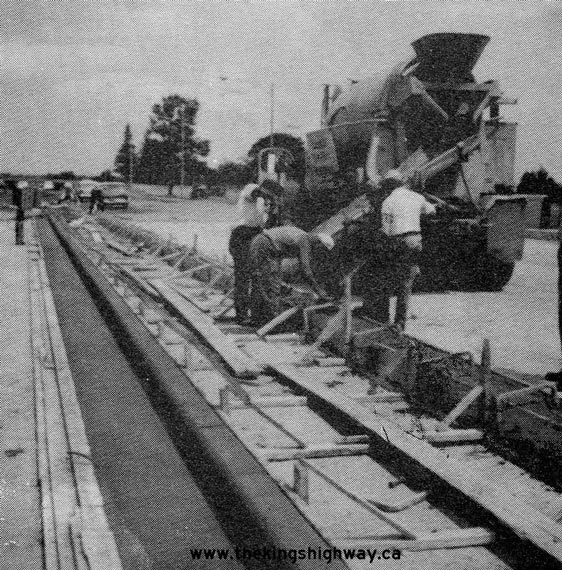
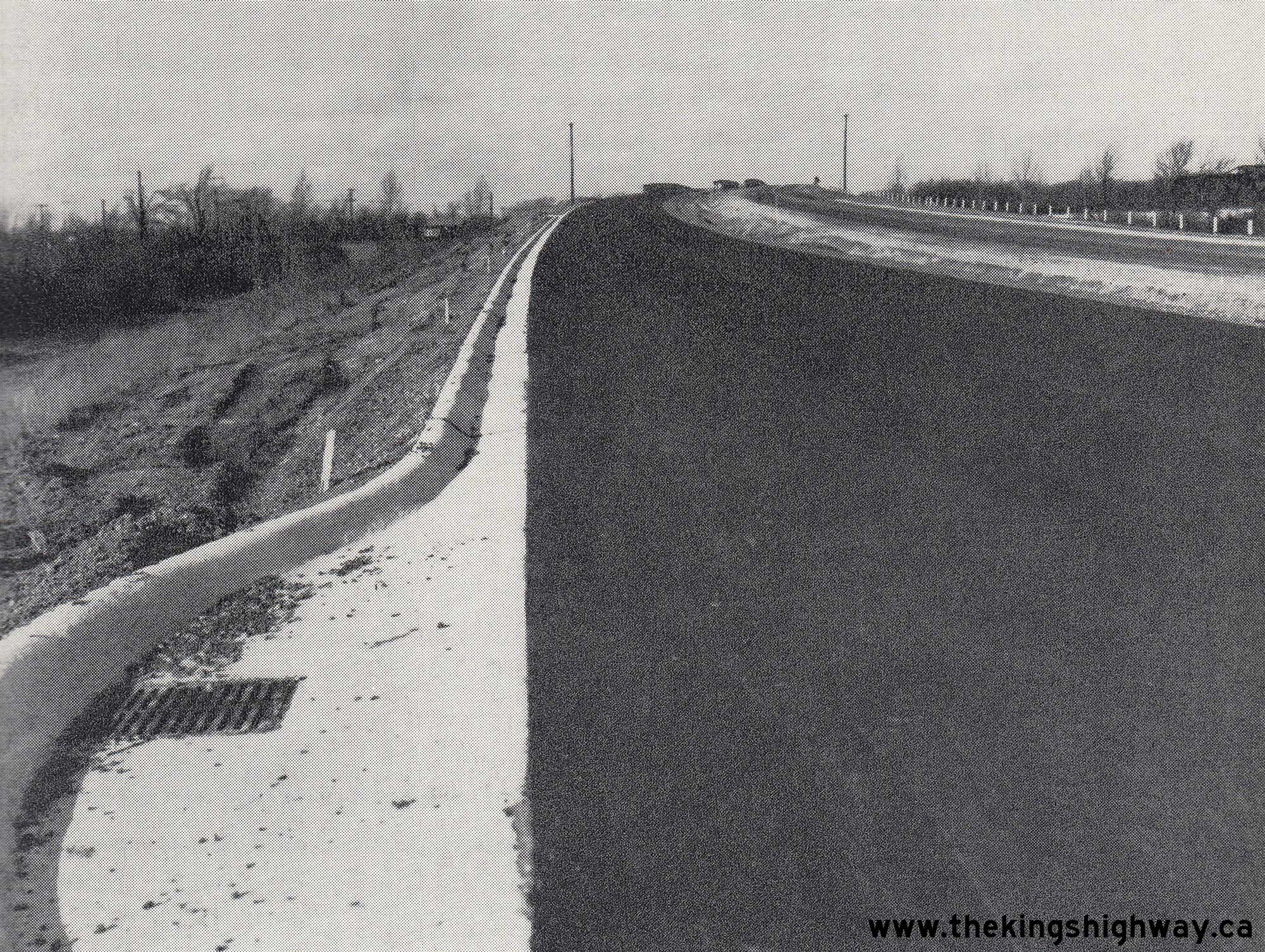
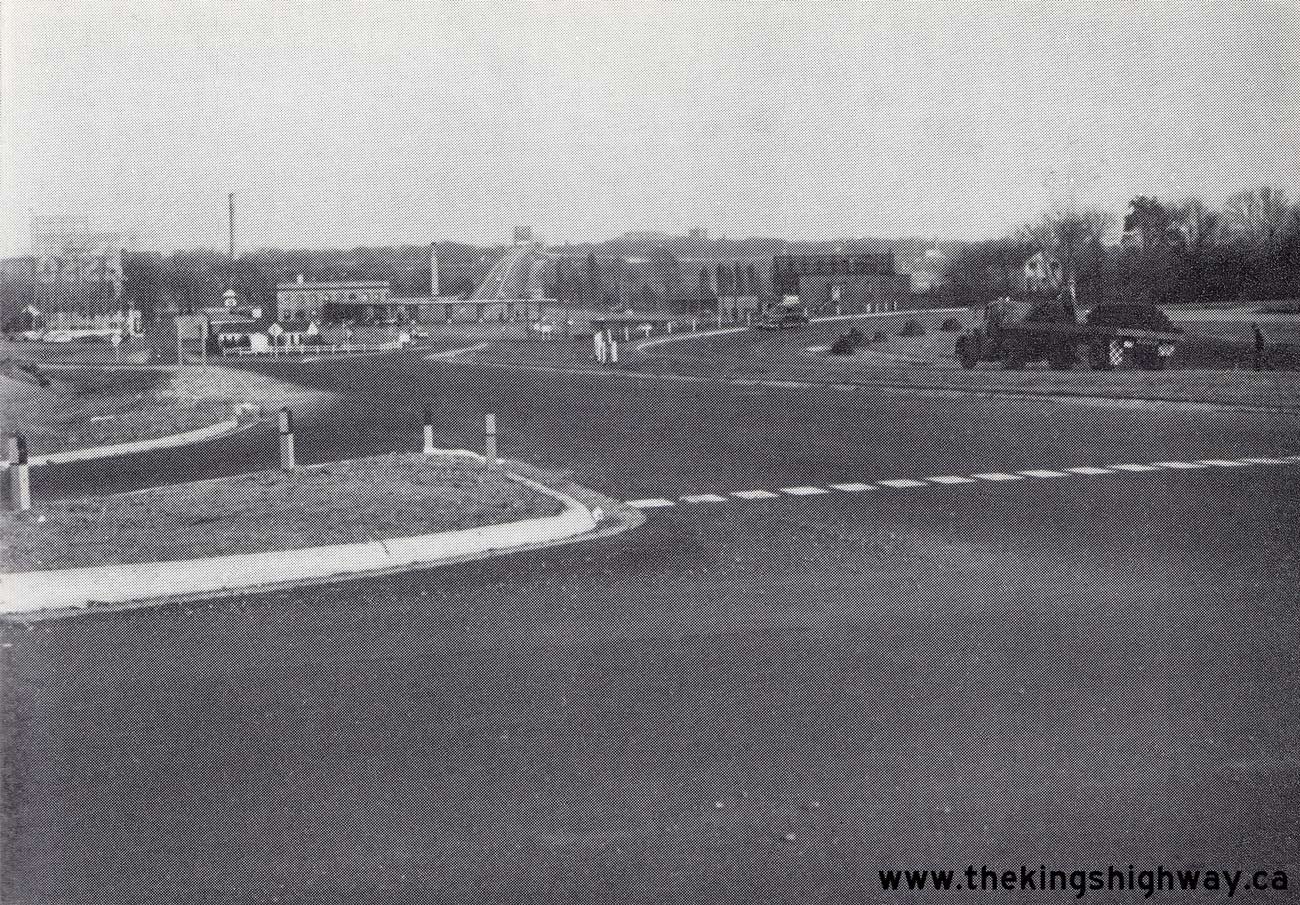
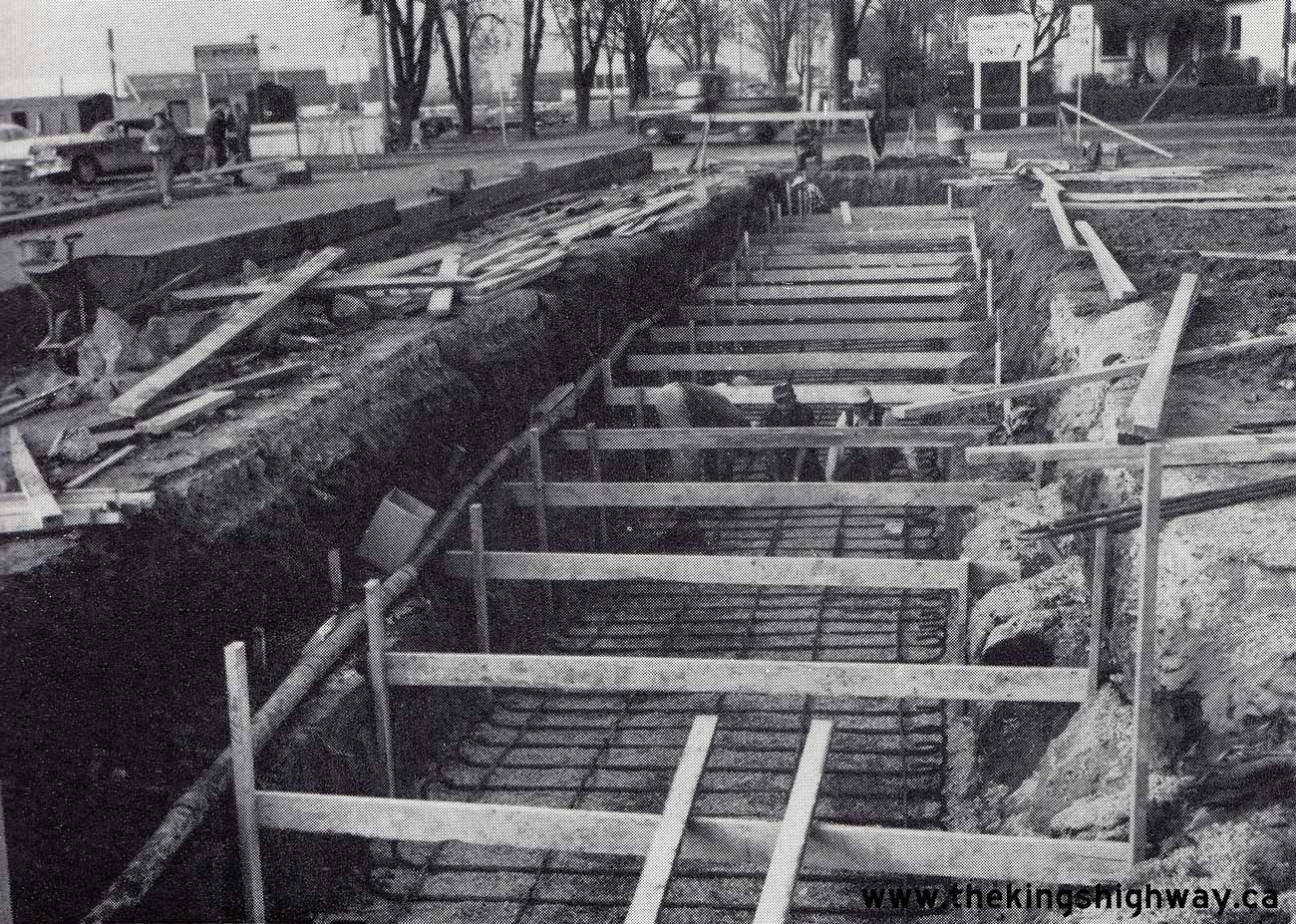
Left - Concrete form work for the new curbed median at the Shooks Hill Rotary Interchange on the Queen Elizabeth Way (1958) (Photo courtesy of Ontario Ministry of Transportation - © King's Printer for Ontario, 2014) Centre - Median construction on the Queen Elizabeth Way at the new Shooks Hill Rotary Interchange between Port Credit and Oakville (1958) (Photo courtesy of Ontario Ministry of Transportation - © King's Printer for Ontario, 2014) Right - Concrete pour for the new median curbs on the Queen Elizabeth Way at the new Shooks Hill Rotary Interchange west of Port Credit (1958) (Photo courtesy of Ontario Ministry of Transportation - © King's Printer for Ontario, 2014) 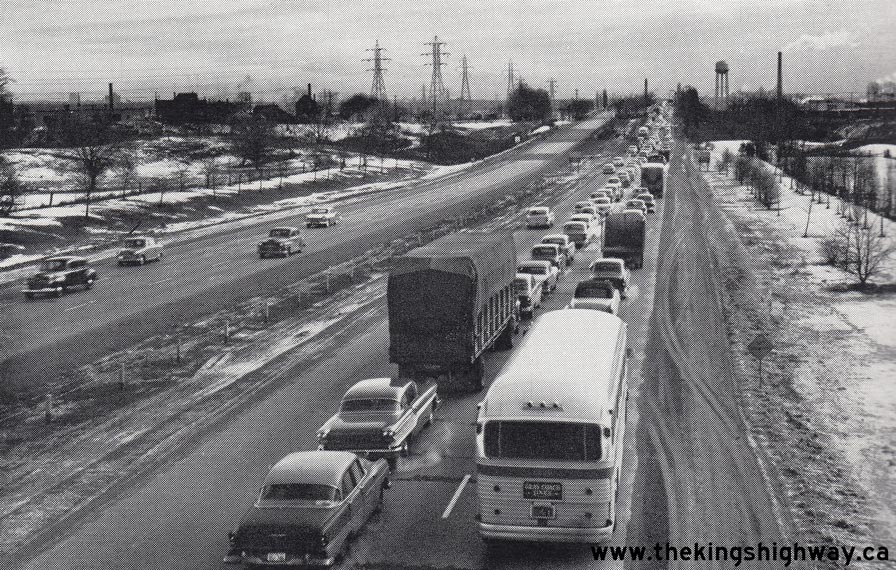
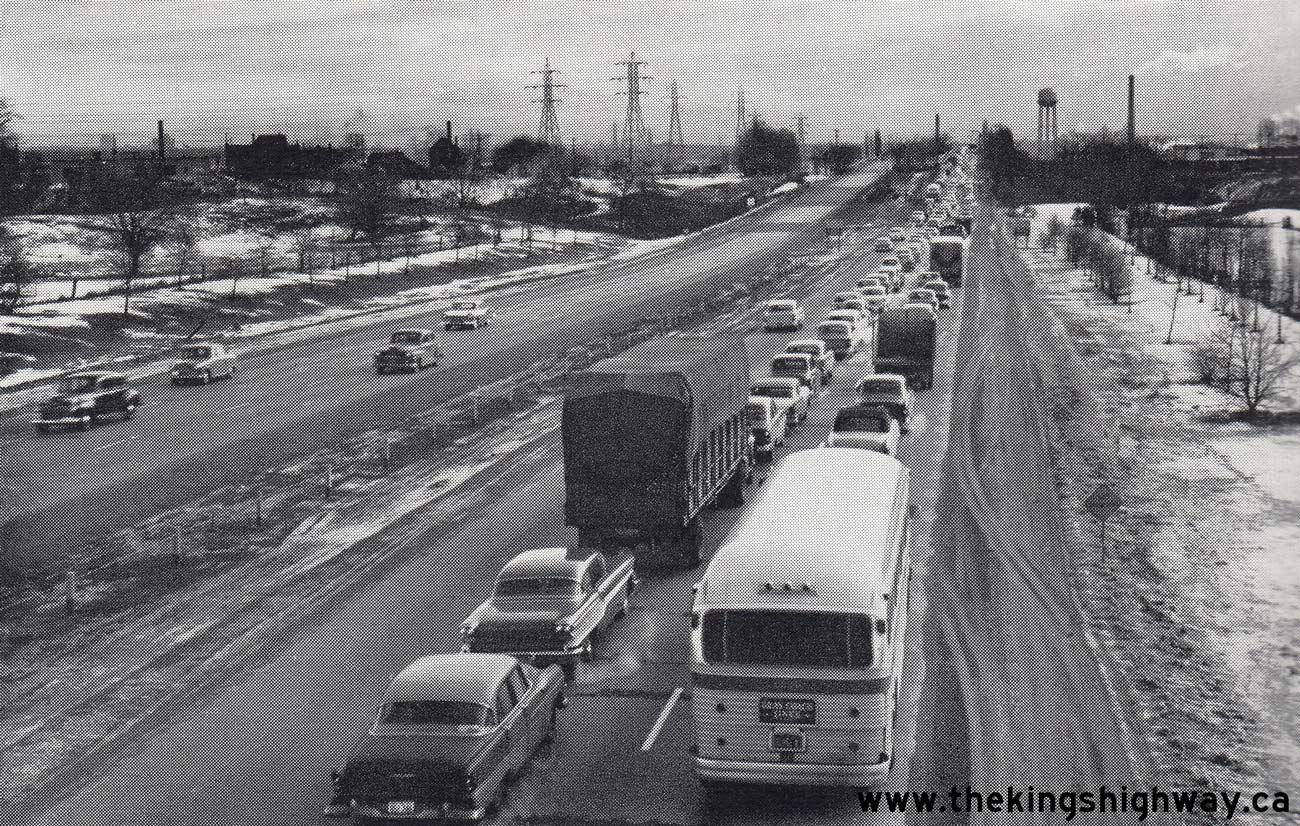
Left - Traffic congestion at 8:30 am on the Queen Elizabeth Way approaching Toronto in 1958. This interesting photo was taken from the Grand Avenue Overpass
near Mimico, and clearly illustrates Toronto's growing traffic woes. What is noteworthy is the near-absence of outbound traffic leaving the city. Although there is
still an imbalance in inbound and outbound traffic volumes on many Toronto-area highways today, the imbalance is nowhere near as pronounced as it was when this photo
was taken nearly 60 years ago. Downtown Toronto is no longer the primary employment centre it once was. Several significant employment centres have been established
in the suburban fringe surrounding Toronto over the past few decades, which has helped to balance inbound and outbound traffic volumes more evenly. Ultimately, this
shift in employment lands has resulted in a more efficient use of existing highway infrastructure. See an
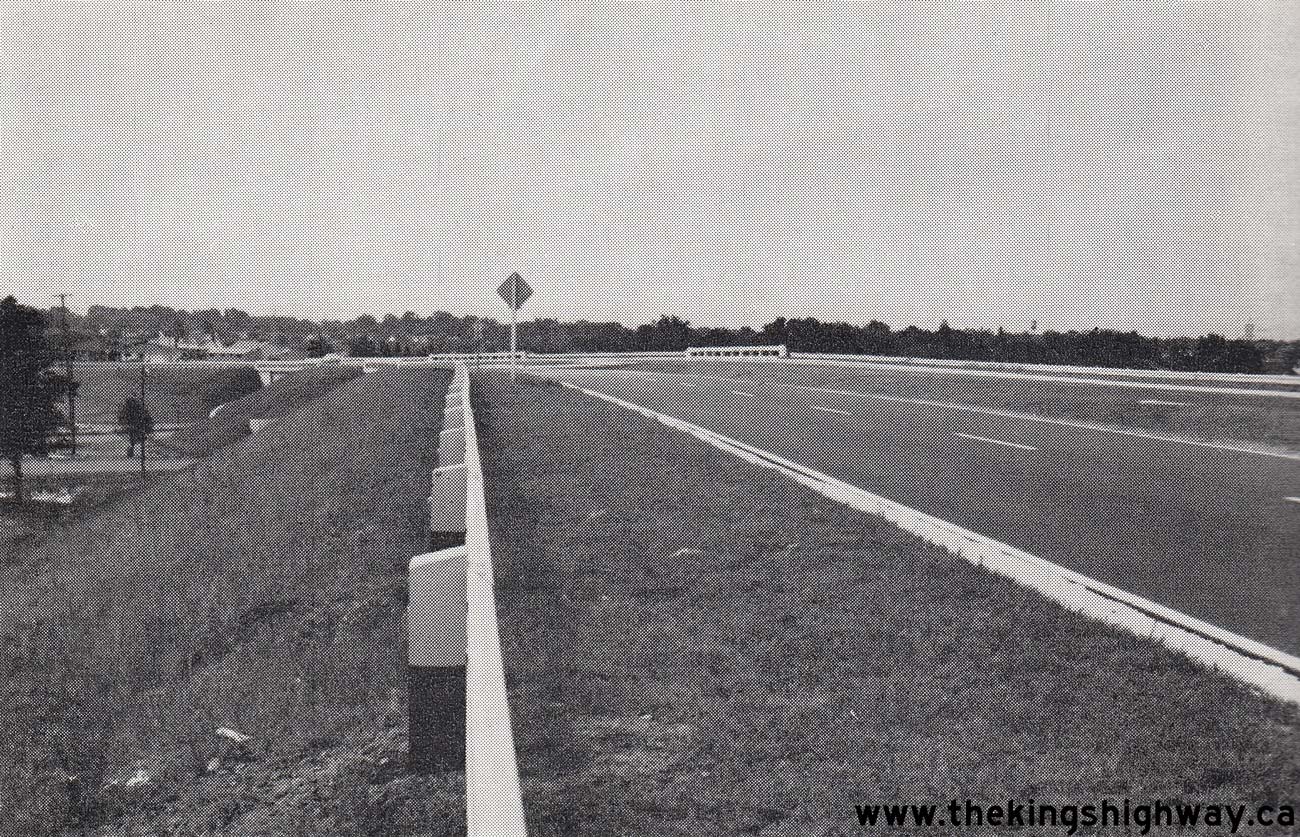
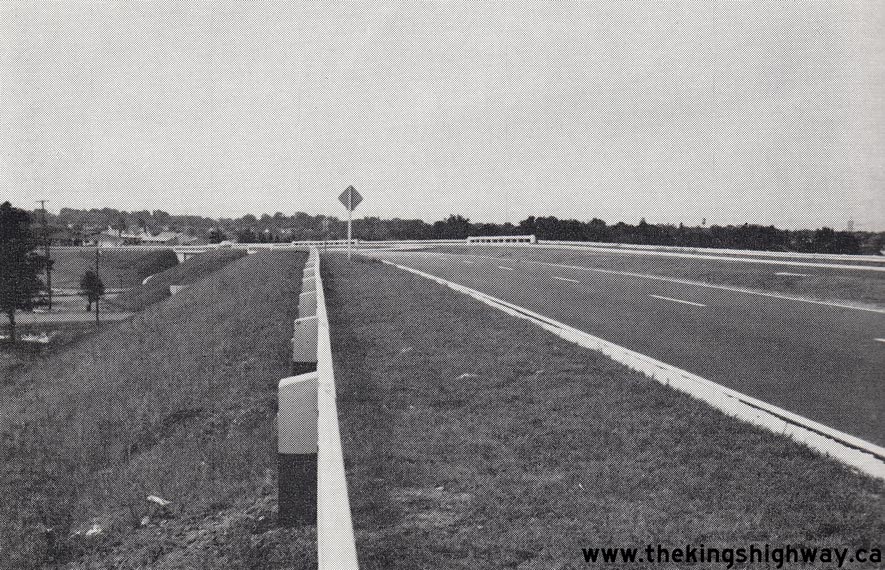
Enlarged Photo Here. Photo taken on February 3, 1958. (Photo courtesy of Ontario Ministry of Transportation - © King's Printer for Ontario, 1958) Right - Completed Freeman Diversion on the Queen Elizabeth Way at Plains Road in Burlington in 1958, facing south towards Hwy 2. The new Freeman Diversion bypassed a section of the Queen Elizabeth Way through Freeman along Plains Road, which had become rather built-up since the highway was first built in the late 1930s. The Freeman Diversion also bypassed the original Burlington Interchange which had served Queen Elizabeth Way traffic since 1937. The new Freeman Diversion provided a high-speed controlled-access highway route through Burlington and a new connection to the proposed route of Hwy 403 to Hamilton. See an Enlarged Photo Here. Photo taken in 1958. (Photo courtesy of Ontario Ministry of Transportation - © King's Printer for Ontario, 1958) 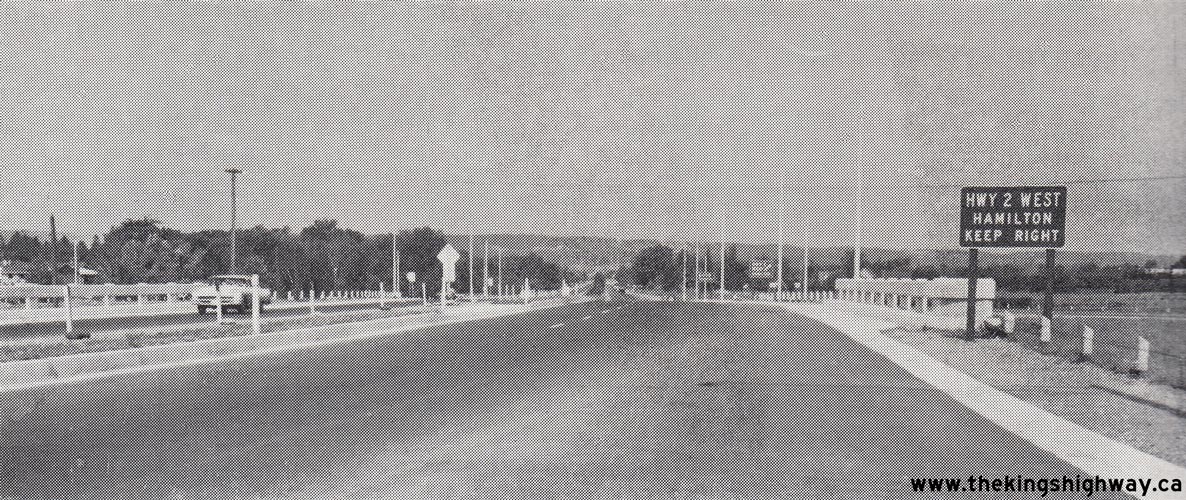
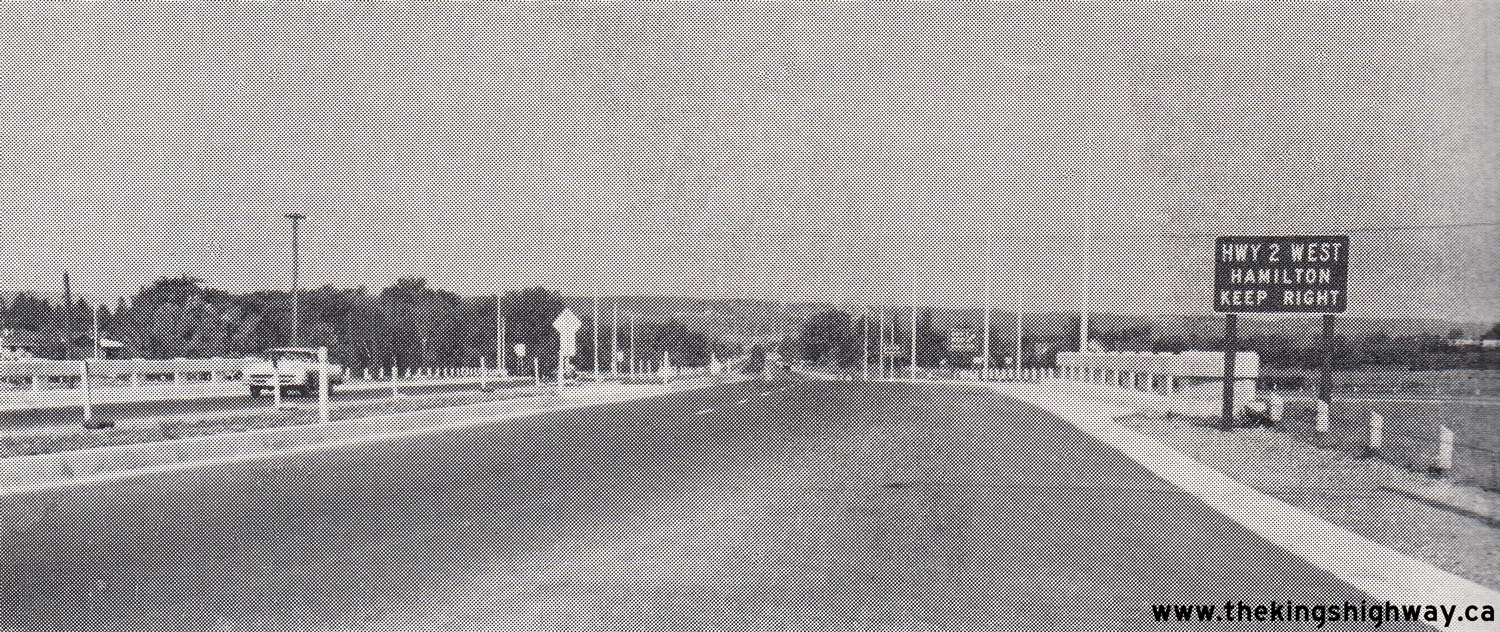
Above - Facing north along the Queen Elizabeth Way at the new Hwy 2 (North Shore Boulevard) Interchange in Burlington in 1958. Prior to the completion of the
underpass and interchange, Hwy 2 crossed the Queen Elizabeth Way at an at-grade intersection. Note the small plywood guide sign at right, advising motorists of the
upcoming Hwy 2 West exit ramp. In an effort to improve on sign legibility on Ontario's freeways, small plywood guide signs such as this example were phased out and
replaced with ground-mounted extruded aluminum signs in the late 1960s and early 1970s. See an
Enlarged Photo Here. Photo taken on September 5, 1958. (Photo courtesy of Ontario Ministry of Transportation - © King's Printer for Ontario, 1958) 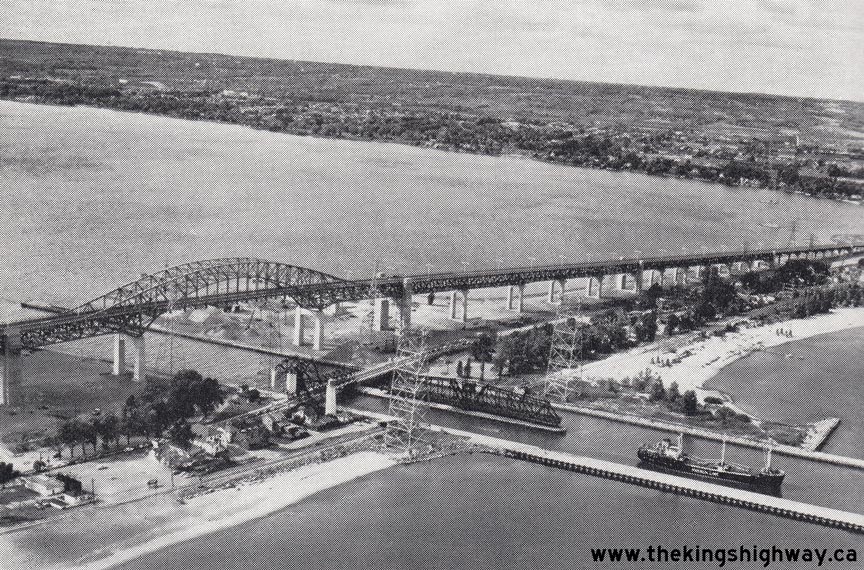
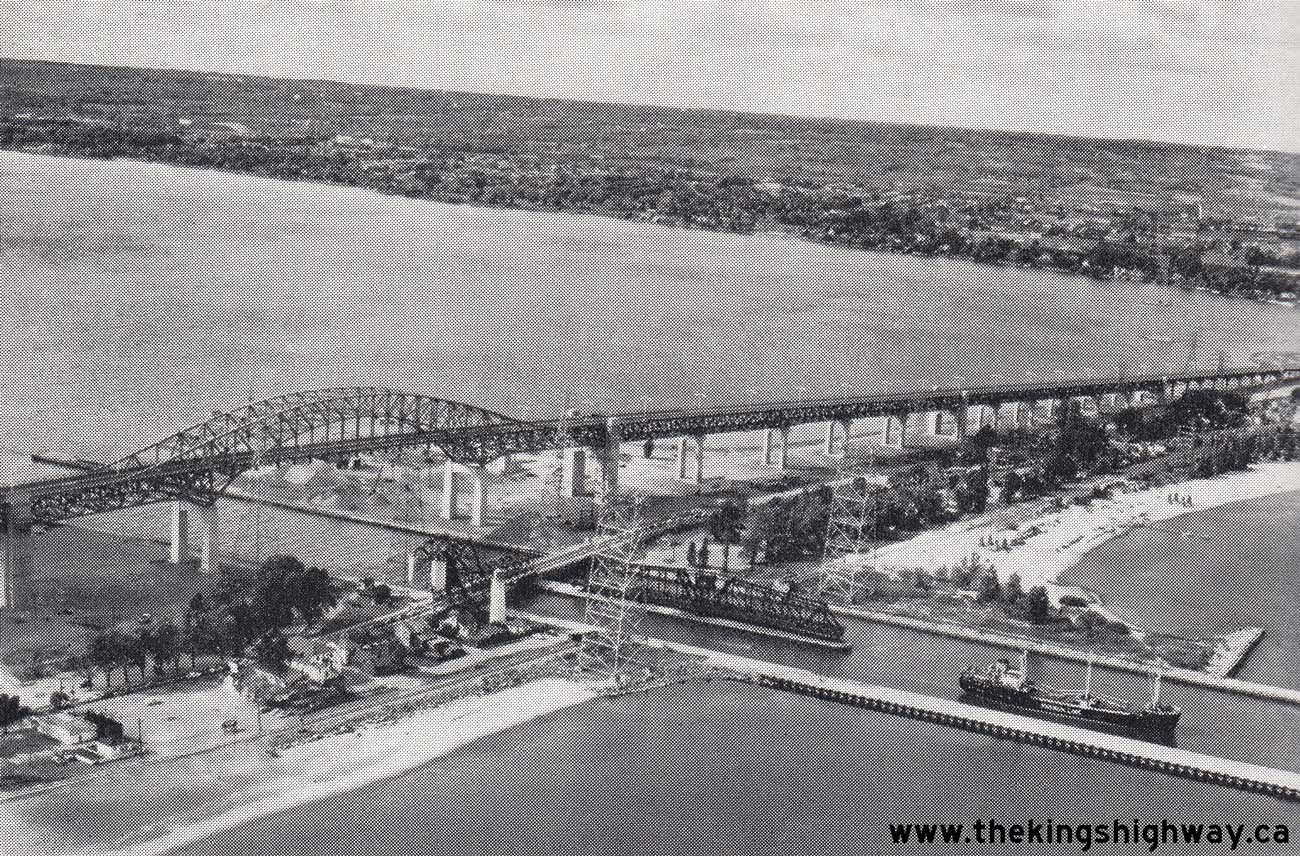
Above - Aerial photo of the nearly-completed Burlington Skyway in mid-1958. As an outbound ship leaves Hamilton Harbour, highway traffic on the Queen Elizabeth
Way and Hwy 20 waits for the old Beach Boulevard Lift Bridge to lower back into position. Before the Burlington Skyway opened to traffic on October 30, 1958, long
queues of traffic would result on Beach Boulevard each time the old lift bridge was hoisted to allow for passage of marine traffic. See an
Enlarged Photo Here. (Photo courtesy of Ontario Ministry of Transportation - © King's Printer for Ontario, 1958) 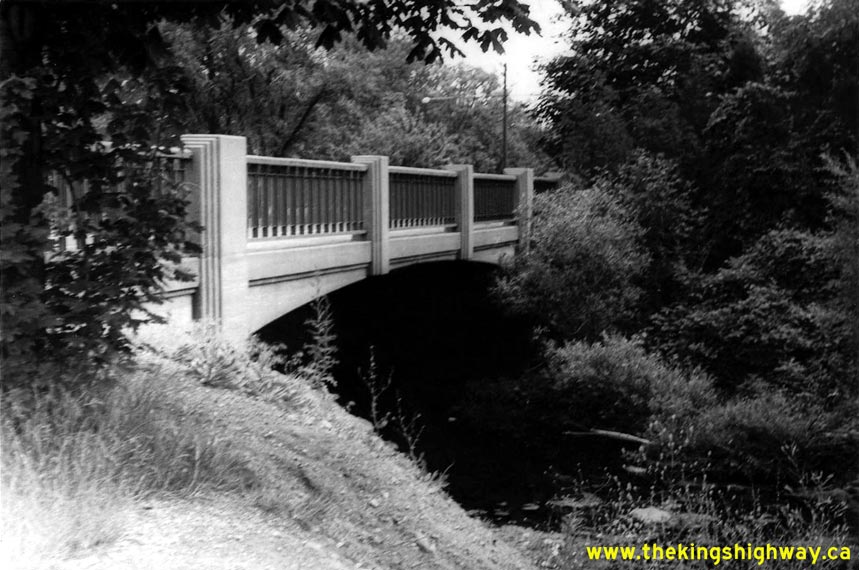
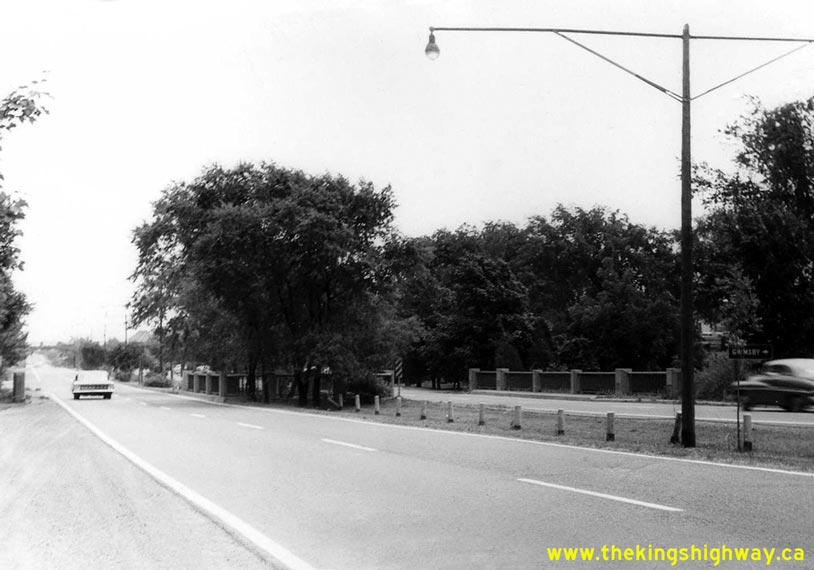
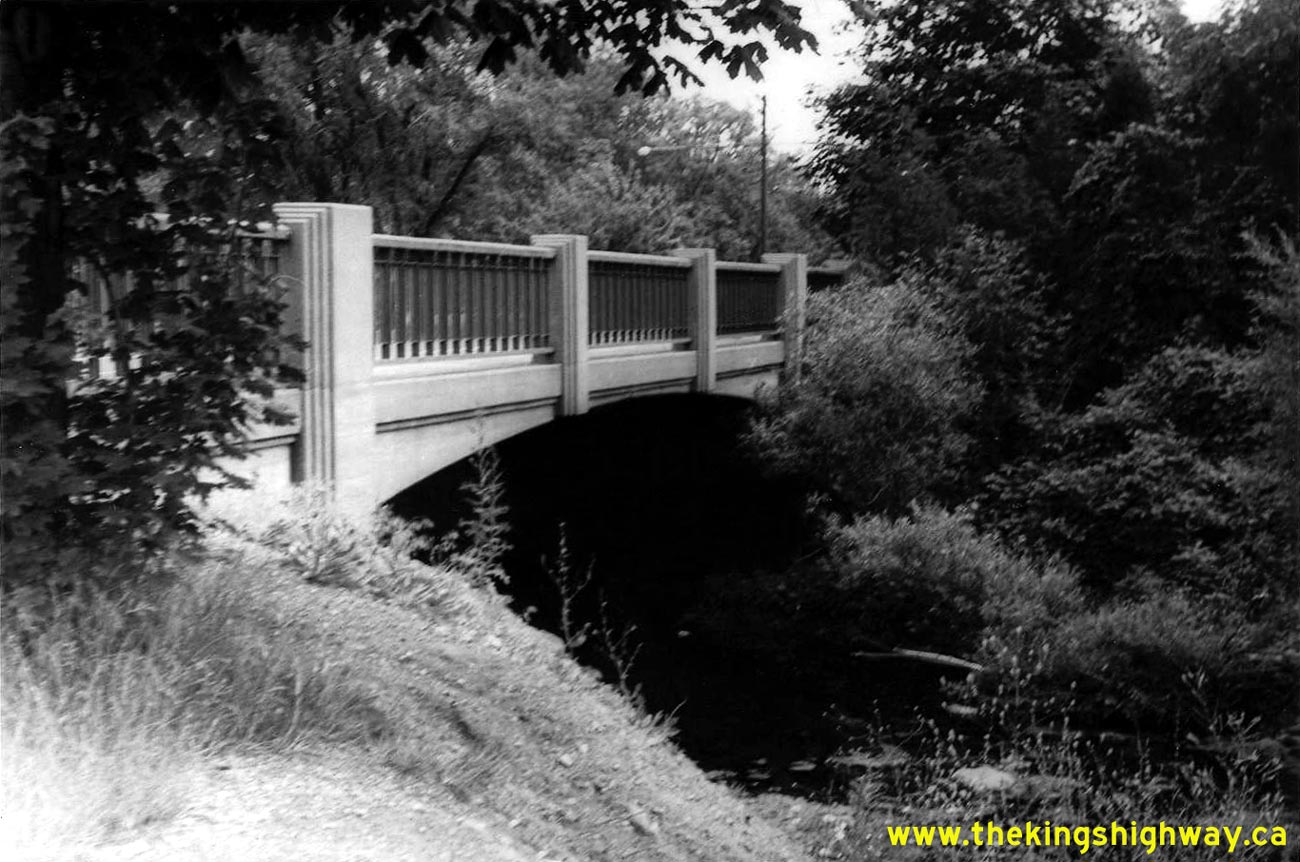
Left - 40 Mile Creek Bridge on the Queen Elizabeth Way in Grimsby. See an
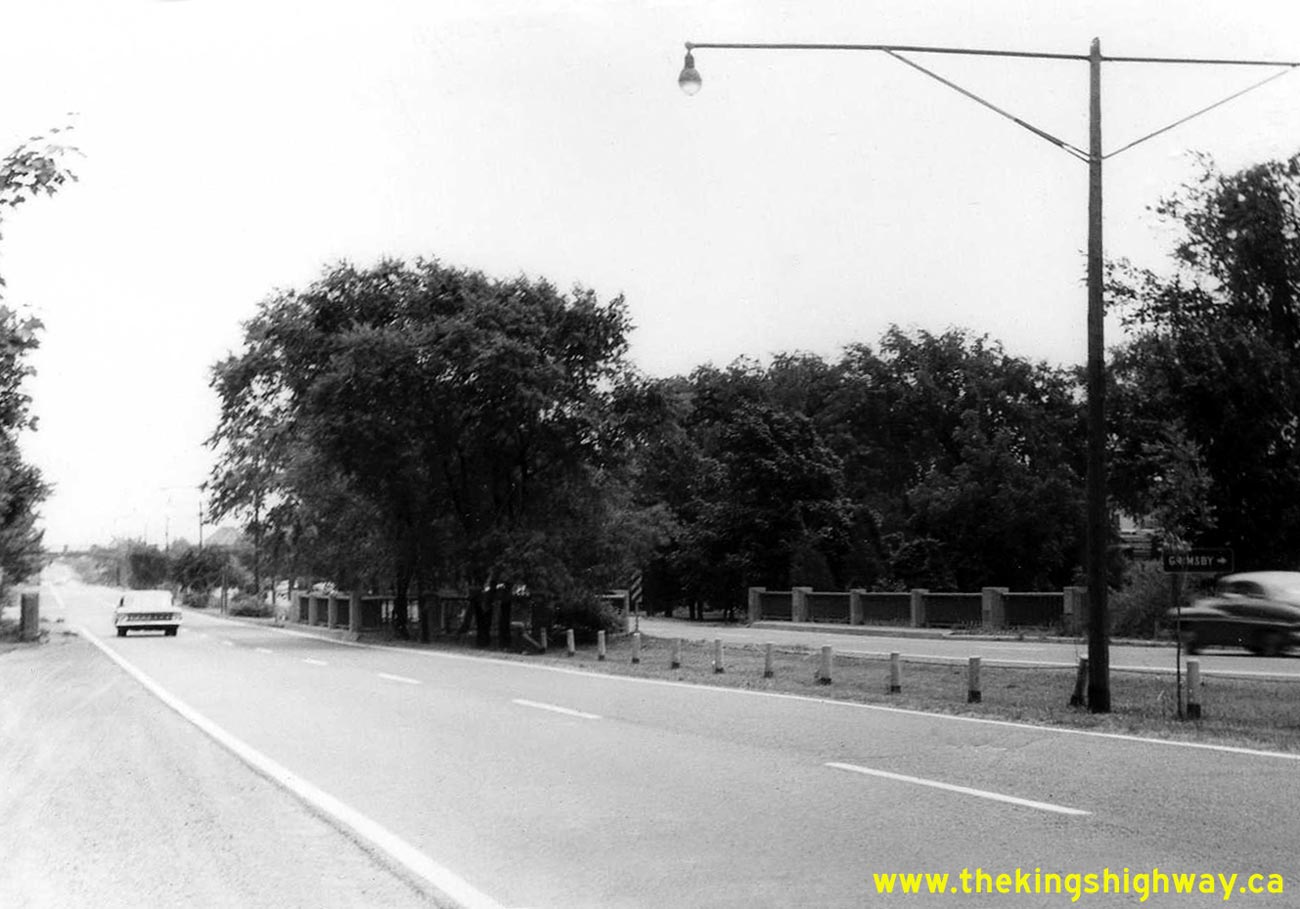
Enlarged Photo Here. Photo taken on July 13, 1959. (Photo courtesy of Ontario Ministry of Transportation - © King's Printer for Ontario, 2014) Right - Facing east along the Queen Elizabeth Way towards the 40 Mile Creek Bridge and Ontario Street in 1959. This photo shows a portion of the bizarre original 1938 Grimsby Interchange configuration at Ontario Street, Elizabeth Street and Robinson Street. Up until 1973, all access to and from Grimsby from the Niagara-bound Queen Elizabeth Way was via two sets of "J" ramps which connected to Elizabeth Street and Robinson Street. Note the "Grimsby" turn-off guide sign beside the highway at right, indicating the upcoming ramp to Elizabeth Street. No access was provided to or from the Queen Elizabeth Way at the Patton Street (now Christie Street) or Maple Avenue grade separations. Toronto-bound traffic on the Queen Elizabeth Way accessed Ontario Street via a rather crude partial "A-2" cloverleaf on the eastern side of the overpass. A single "diamond" ramp on the western side of the Ontario Street structure provided westbound access only to the Toronto-bound Queen Elizabeth Way. Please see the oblique 1944 Aerial Photo above, which shows the original Grimsby Interchange configuration. In 1972-1973, the original 1938 Grimsby Interchange was replaced with the current elongated diamond interchange. The new interchange provided access between the Queen Elizabeth Way and Christie Street (Formerly Patton Street), Ontario Street and Maple Avenue. The ramps to Elizabeth Street and Robinson Street were closed permanently during the interchange reconstruction. See an Enlarged Photo Here. Photo taken on July 13, 1959. (Photo courtesy of Ontario Ministry of Transportation - © King's Printer for Ontario, 2014) 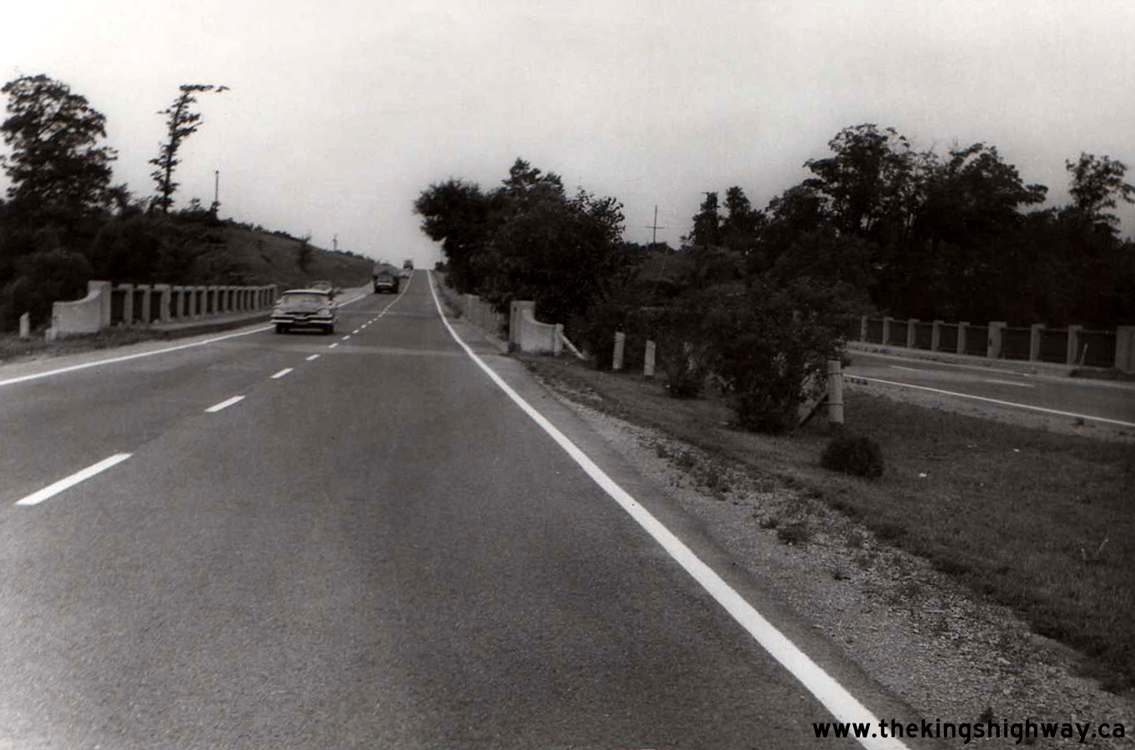
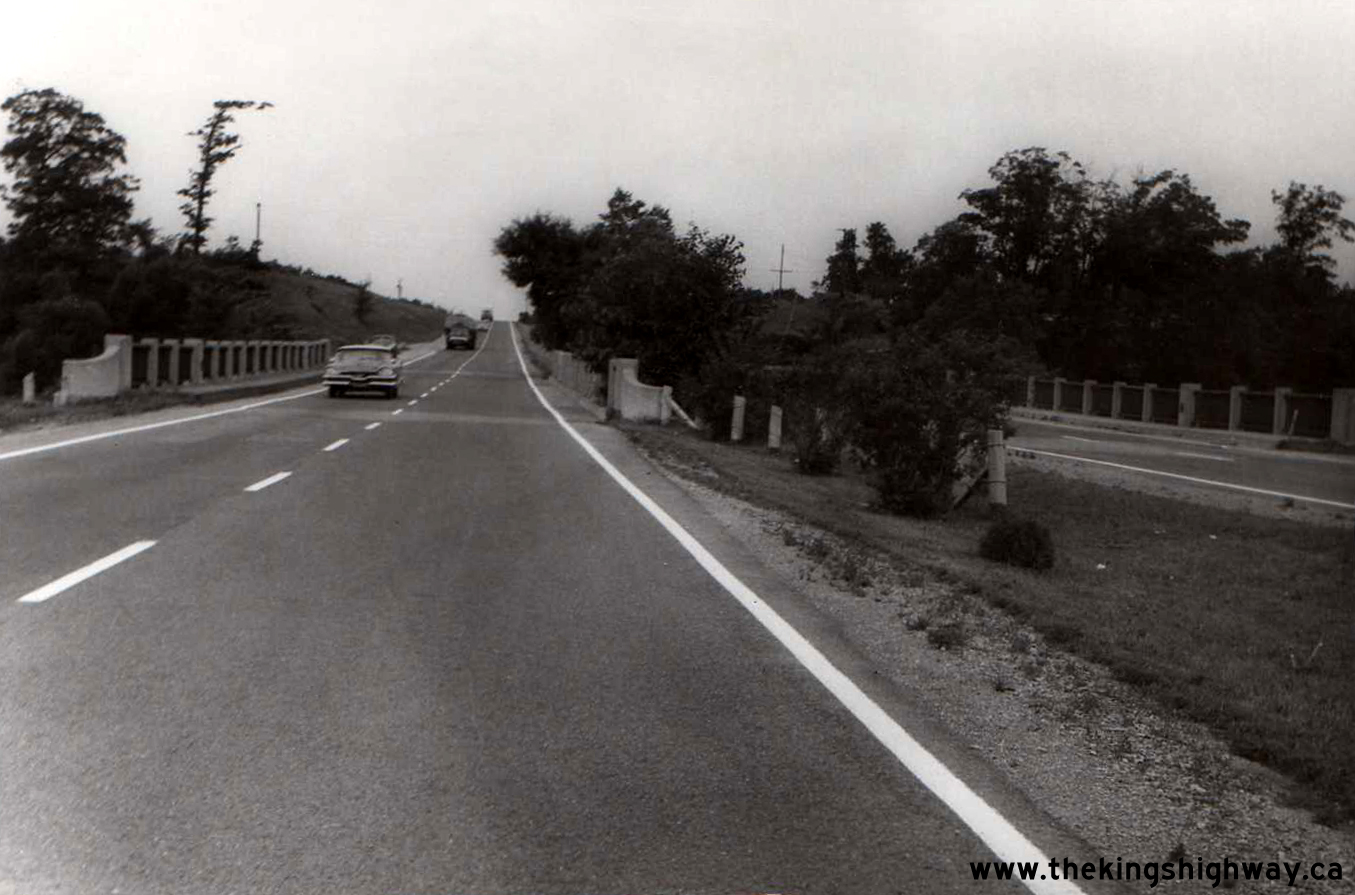
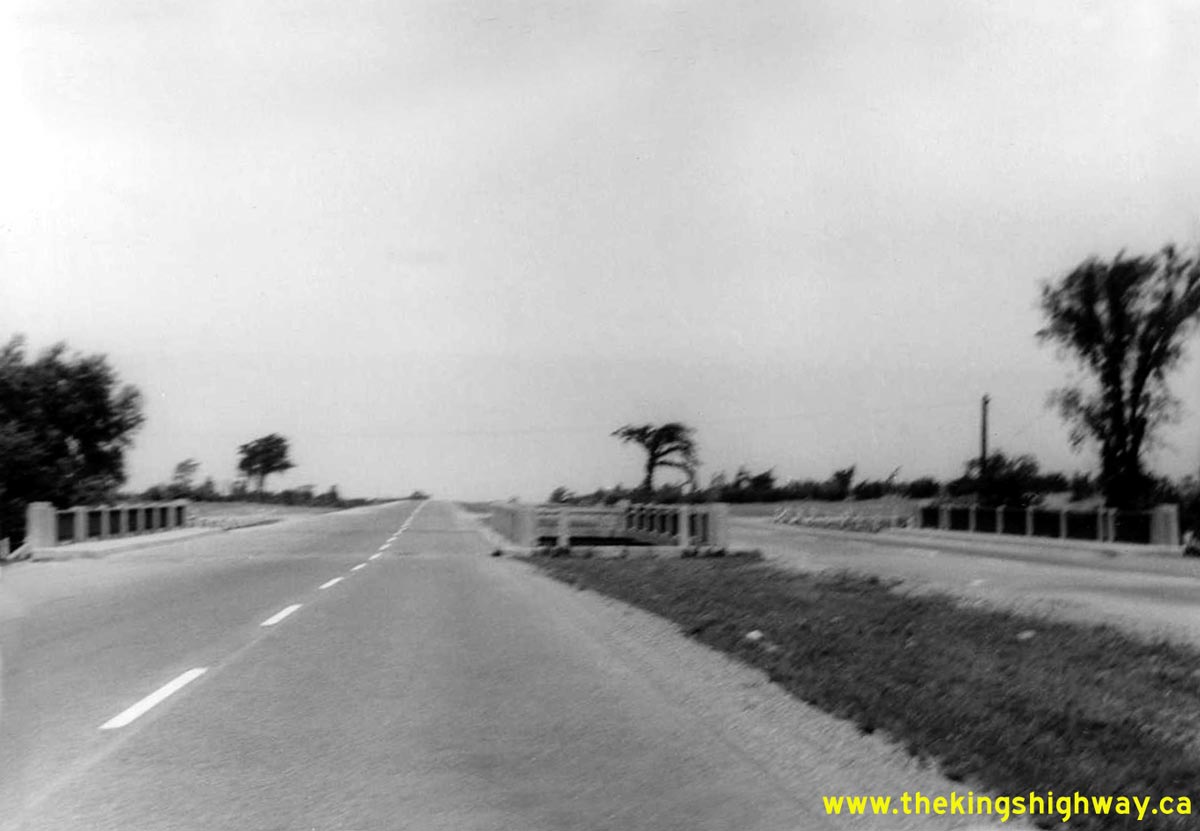
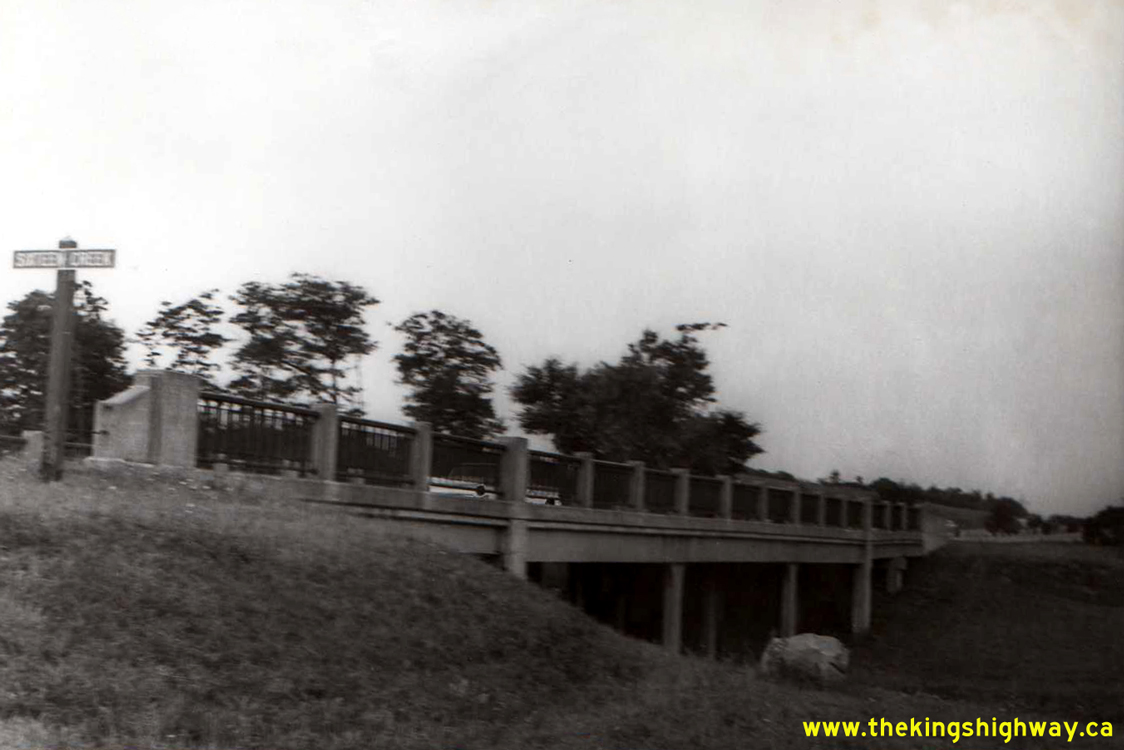 Left - View of the Queen Elizabeth Way at the 16 Mile Creek Bridge between Grimsby and St. Catharines. See an
Enlarged Photo Here. Photo taken in July 1959. Left - View of the Queen Elizabeth Way at the 16 Mile Creek Bridge between Grimsby and St. Catharines. See an
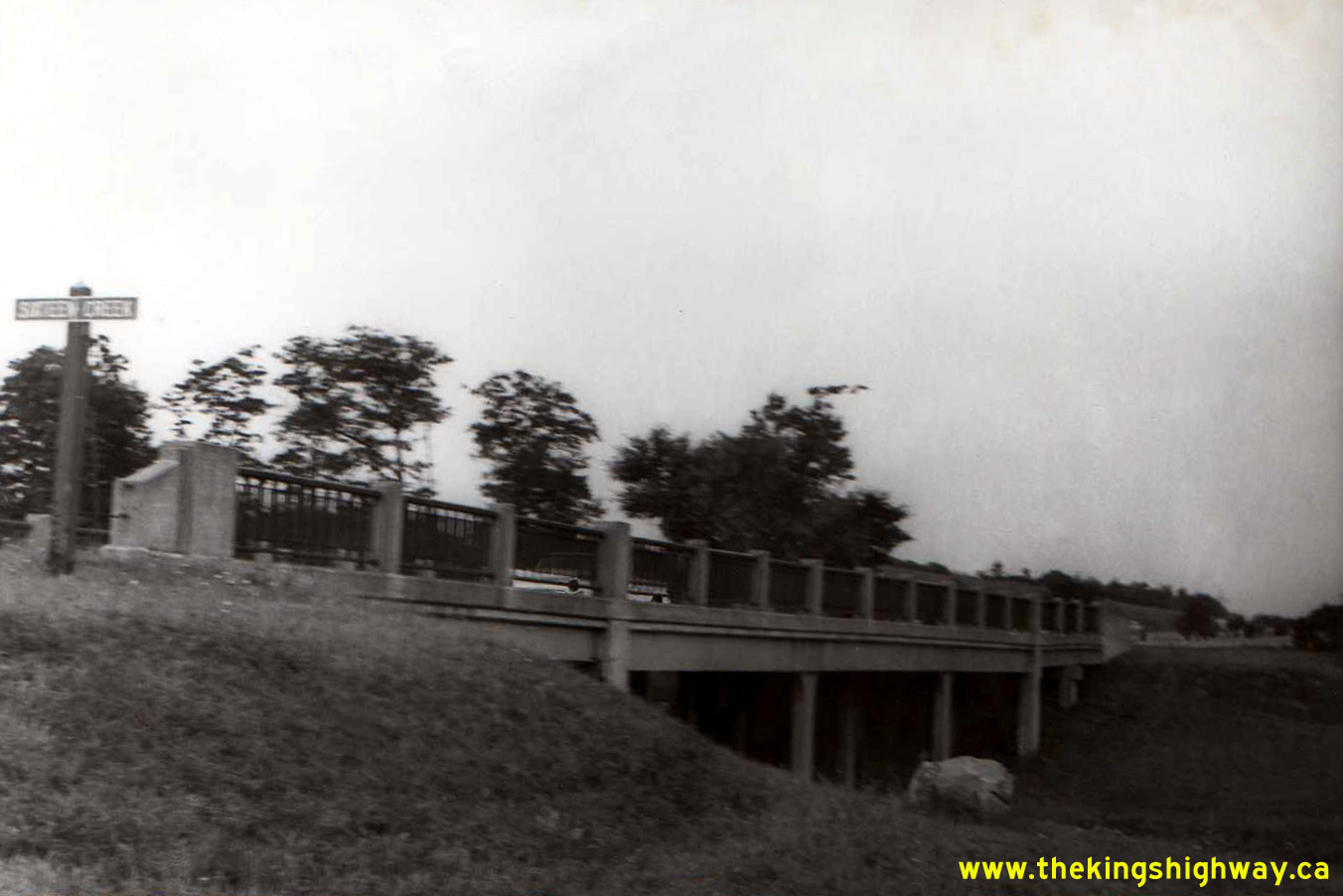
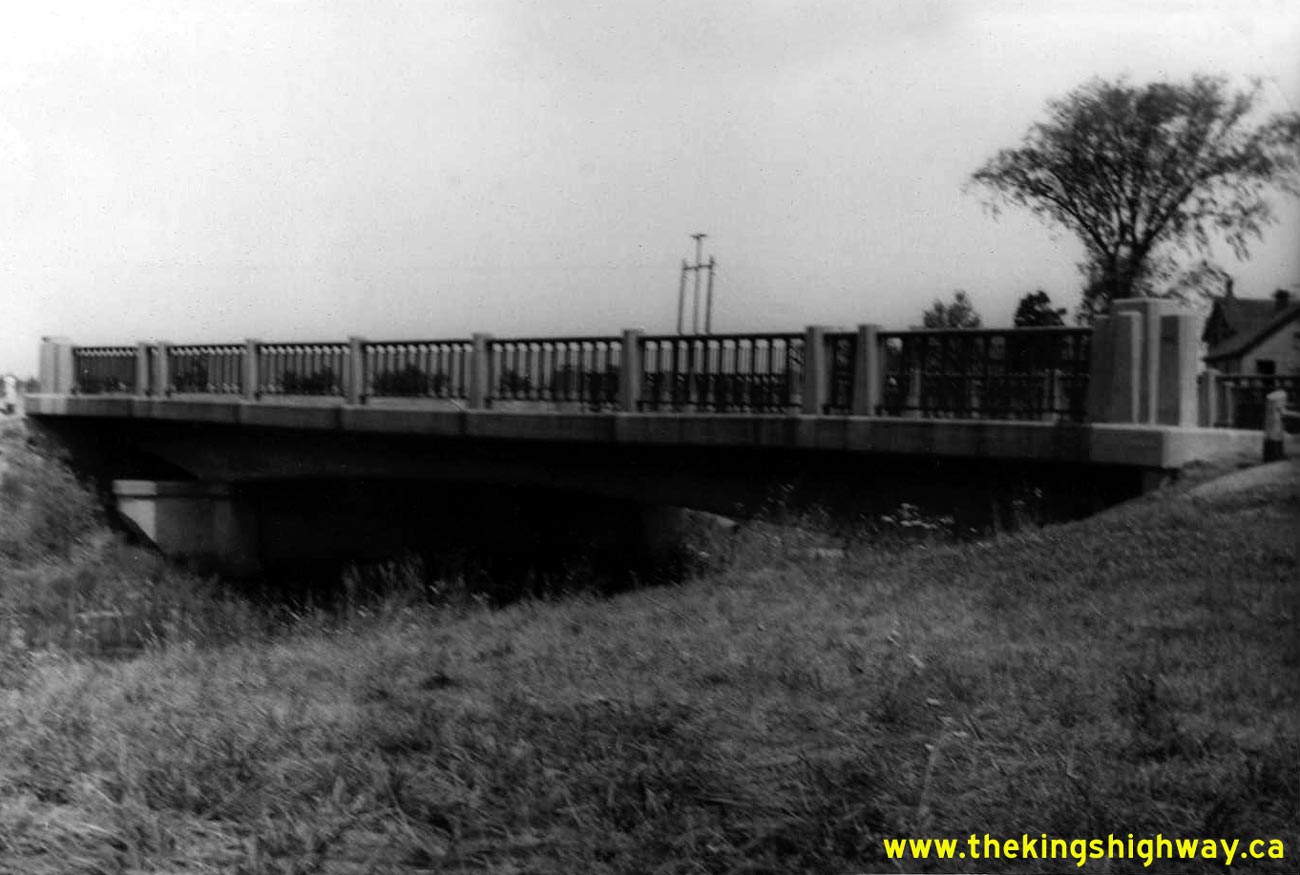
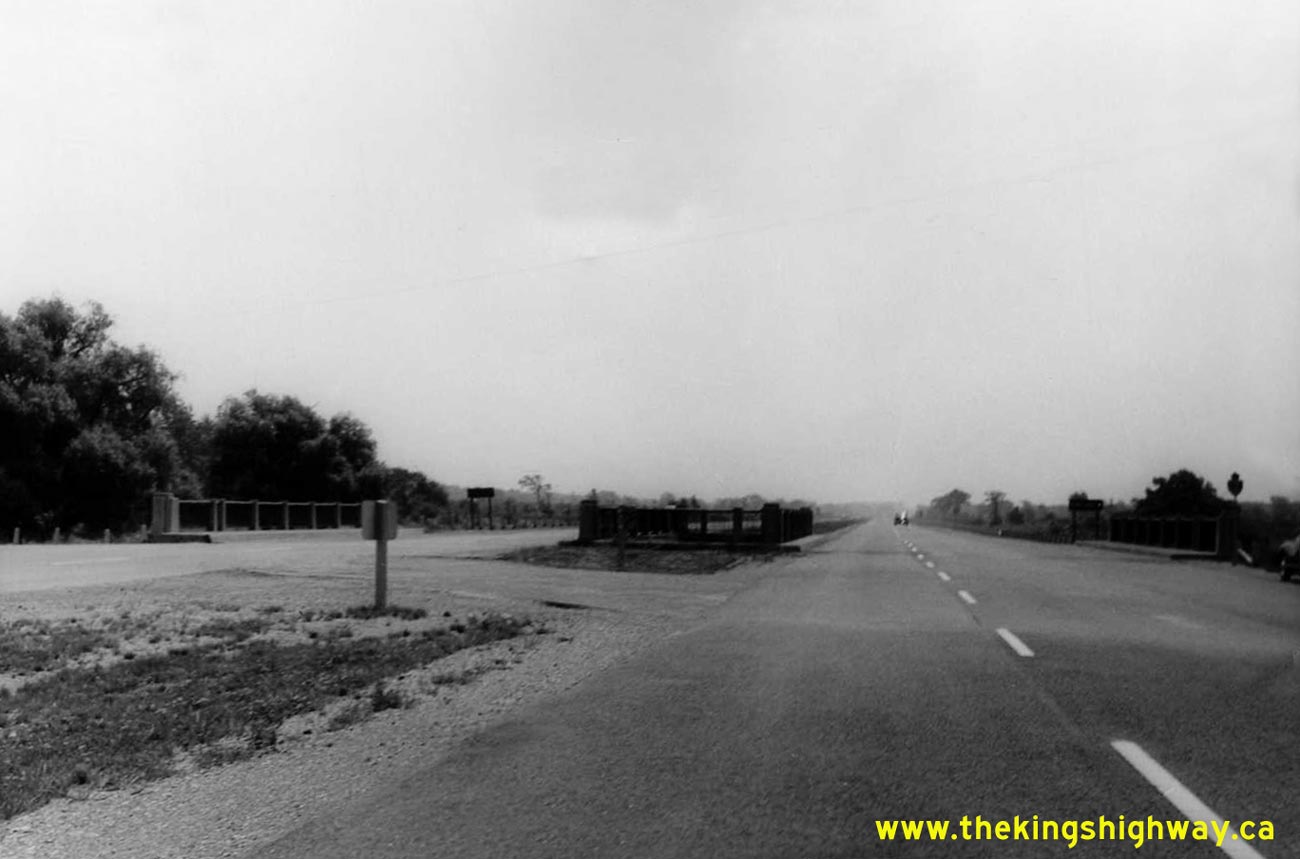
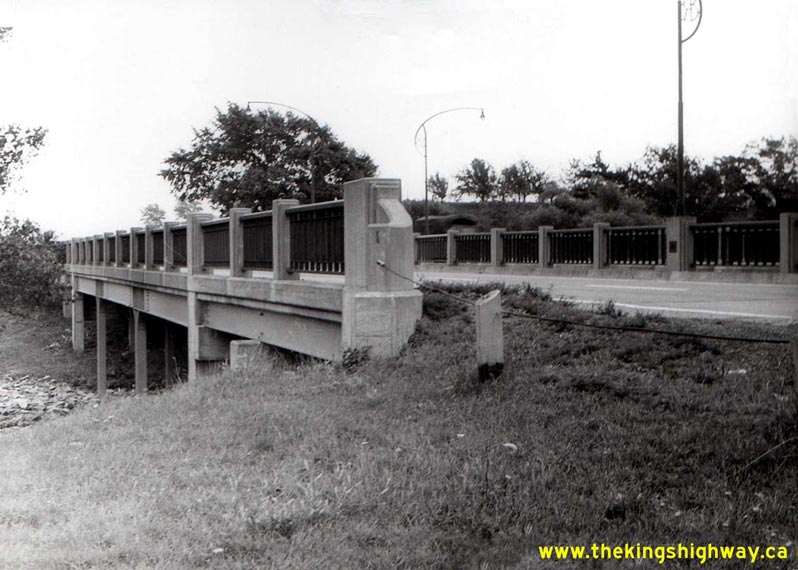
Enlarged Photo Here. Photo taken in July 1959.(Photo courtesy of Ontario Ministry of Transportation - © King's Printer for Ontario, 2026) Right - Side view of the 16 Mile Creek Bridge on the Queen Elizabeth Way west of St. Catharines. This 7-span steel rigid frame structure was built under
Contract #1938-26 and was completed in 1939. A nearly identical structure was built over 15 Mile Creek, located a short distance to the east. See an
Enlarged Photo Here. Photo taken in July 1959.(Photo courtesy of Ontario Ministry of Transportation - © King's Printer for Ontario, 2026) 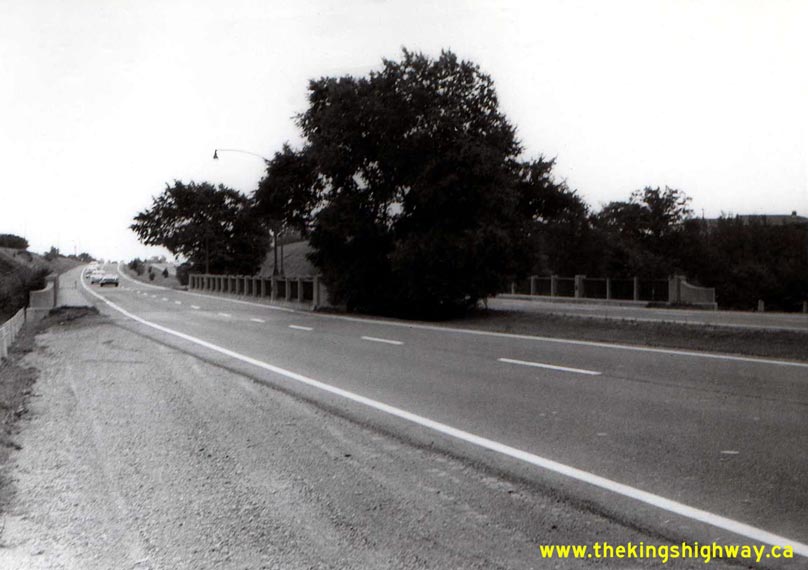
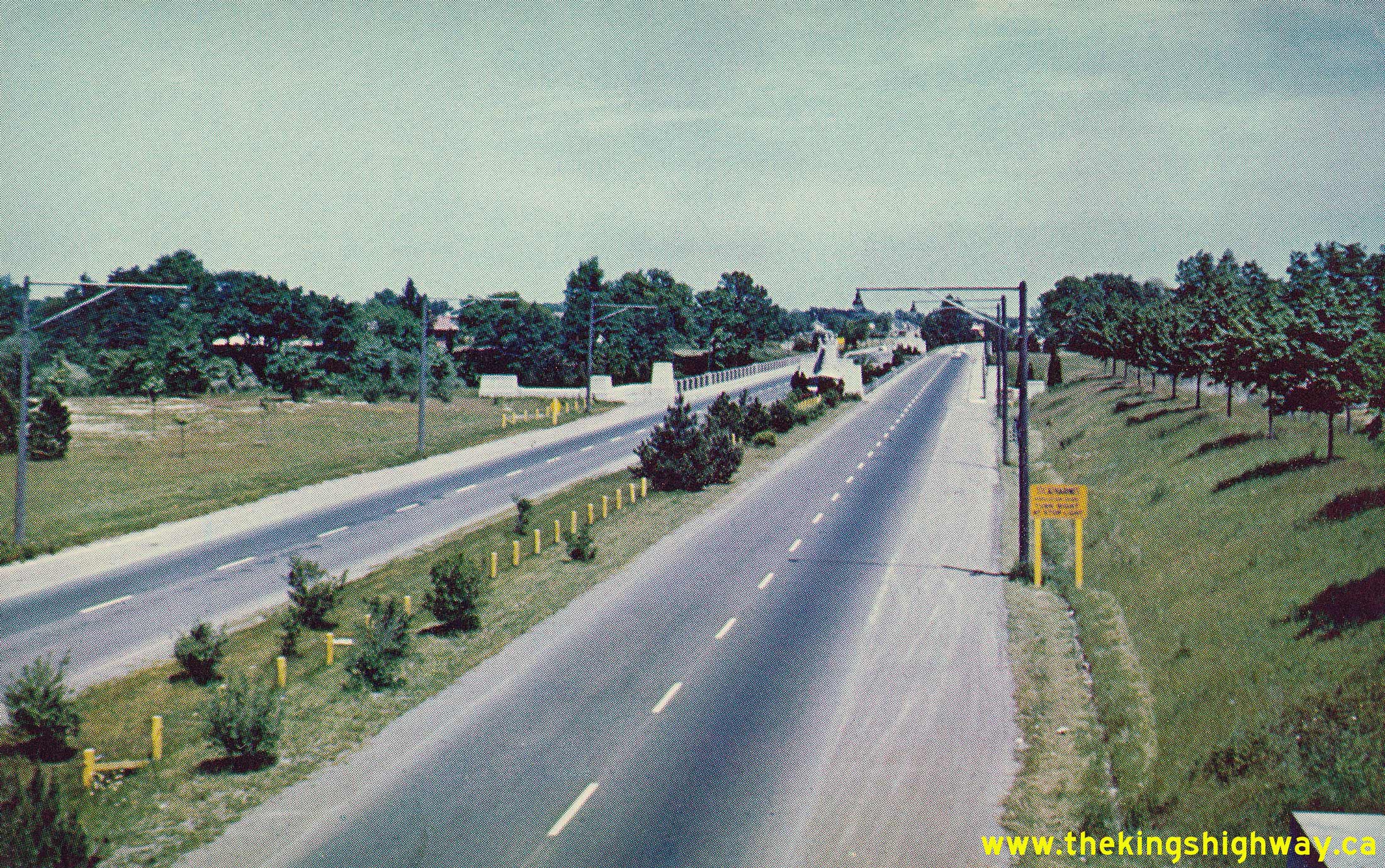
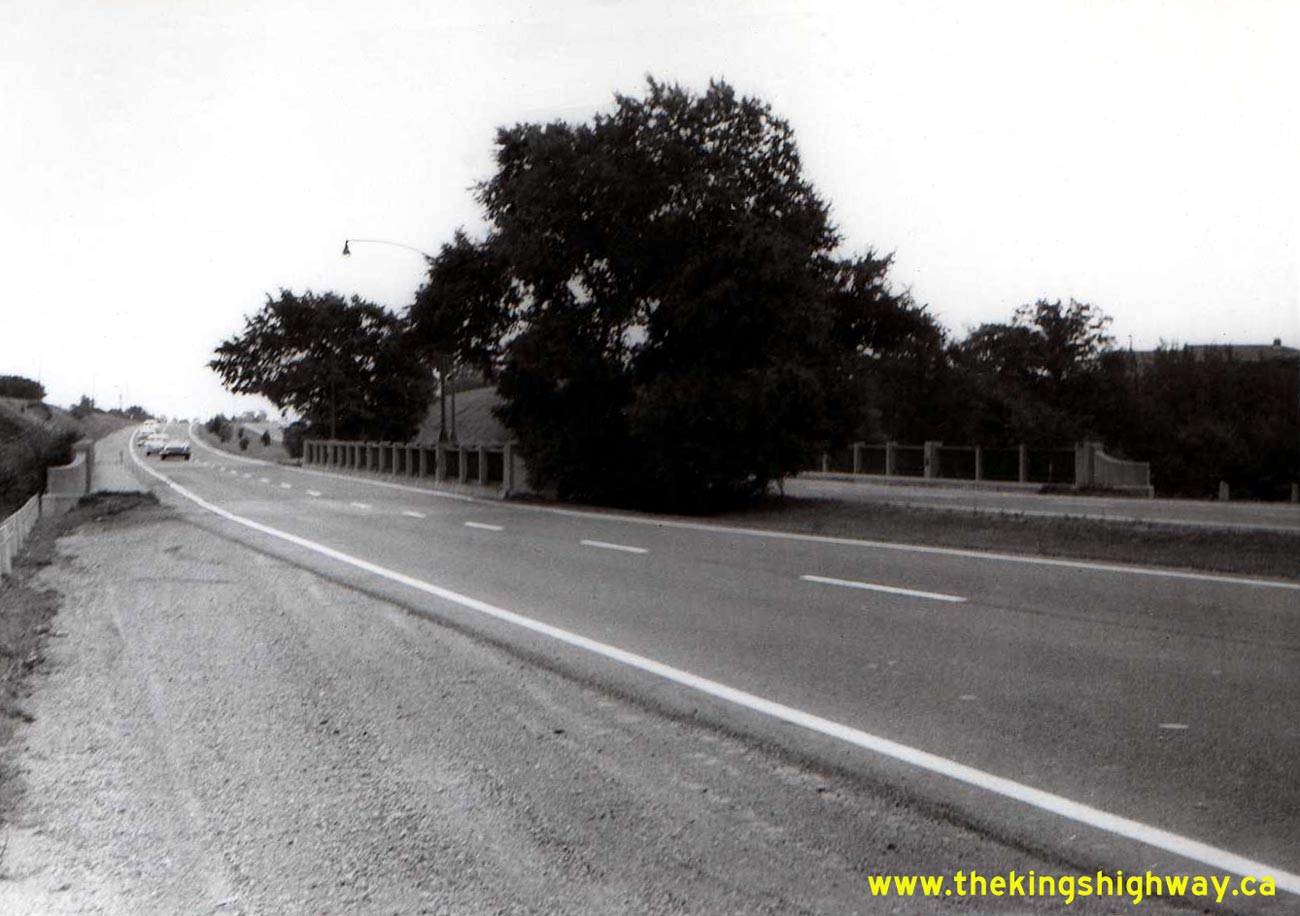
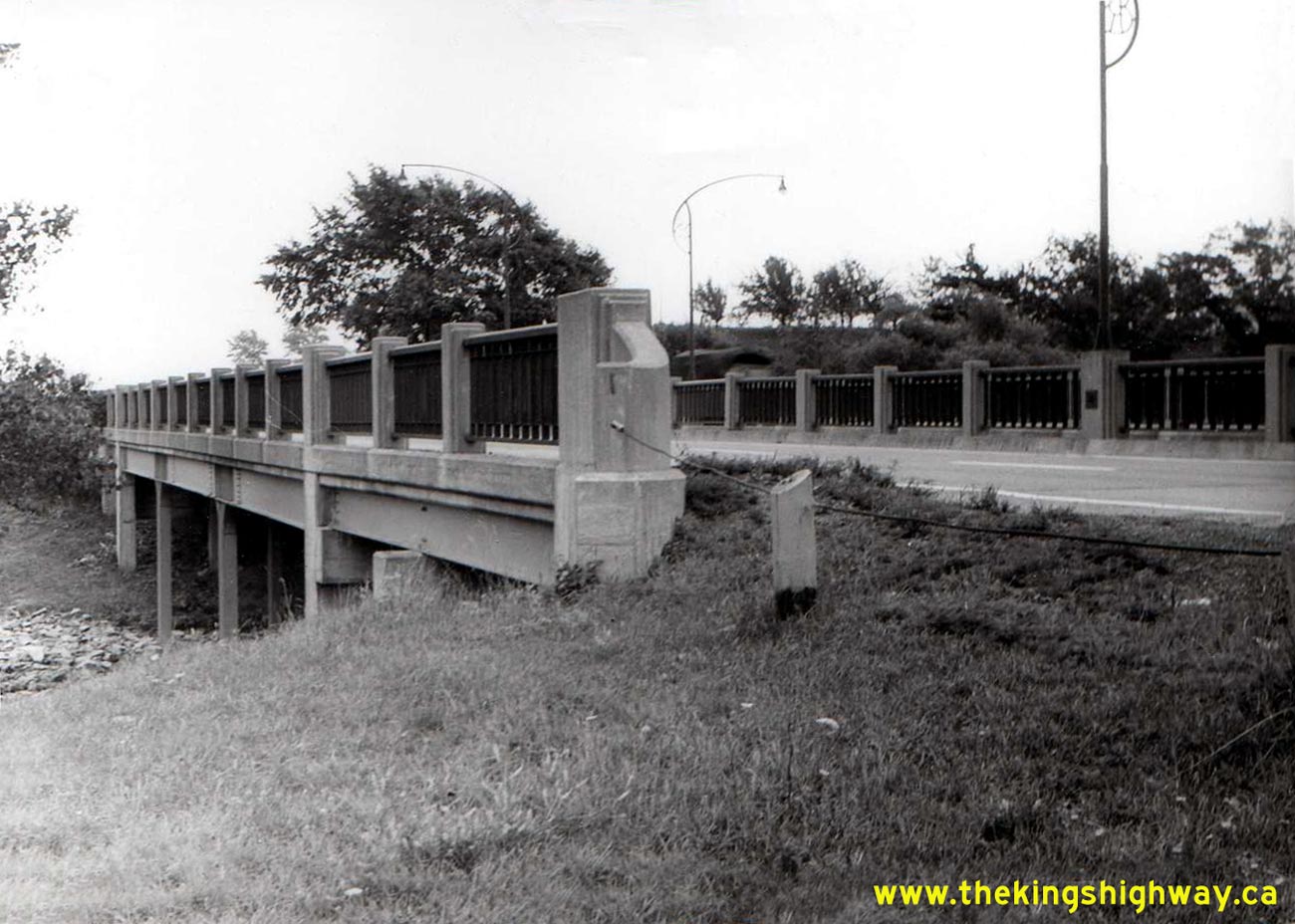
Left - View of the Queen Elizabeth Way at the 15 Mile Creek Bridge between Grimsby and St. Catharines in 1959, facing east. This early photo of the Queen
Elizabeth Way shows the area around Seventh Street before the North and South Service Roads were built in the 1960s and early 1970s. Note the landscaped highway
median and old 1930s-era "ER" Elizabeth Regina luminaires across the dual 15 Mile Creek Bridges. See an
Enlarged Photo Here. Photo taken in July 1959. (Photo courtesy of Ontario Ministry of Transportation - © King's Printer for Ontario, 2014) Right - Side view of the 15 Mile Creek Bridge on the Queen Elizabeth Way west of St. Catharines. See an Enlarged Photo Here. Photo taken in July 1959. (Photo courtesy of Ontario Ministry of Transportation - © King's Printer for Ontario, 2014) 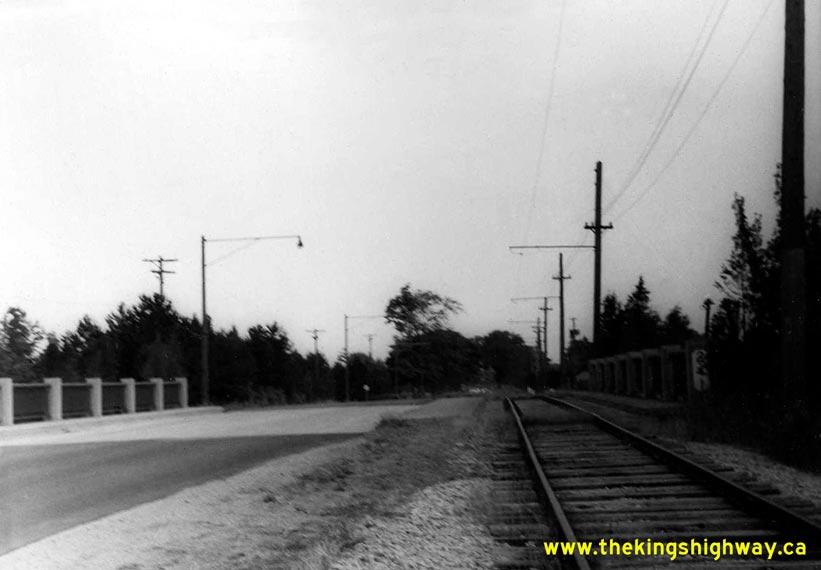
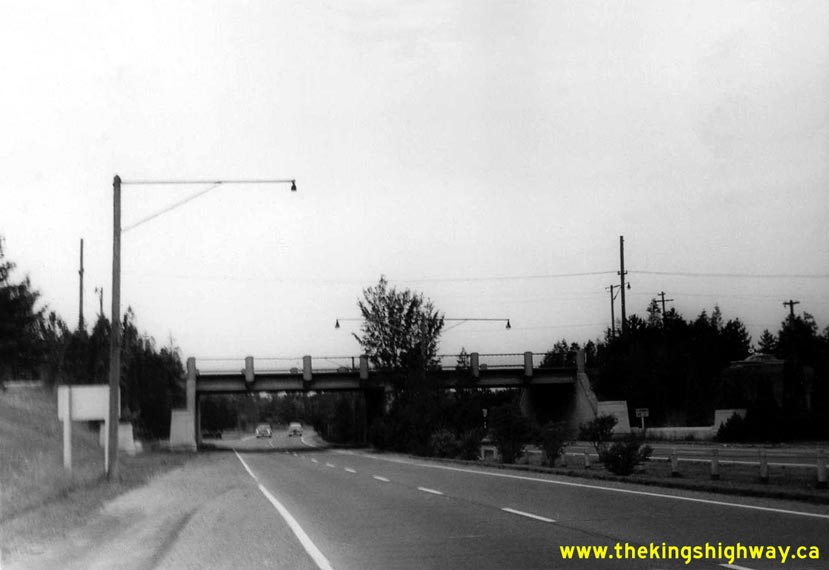
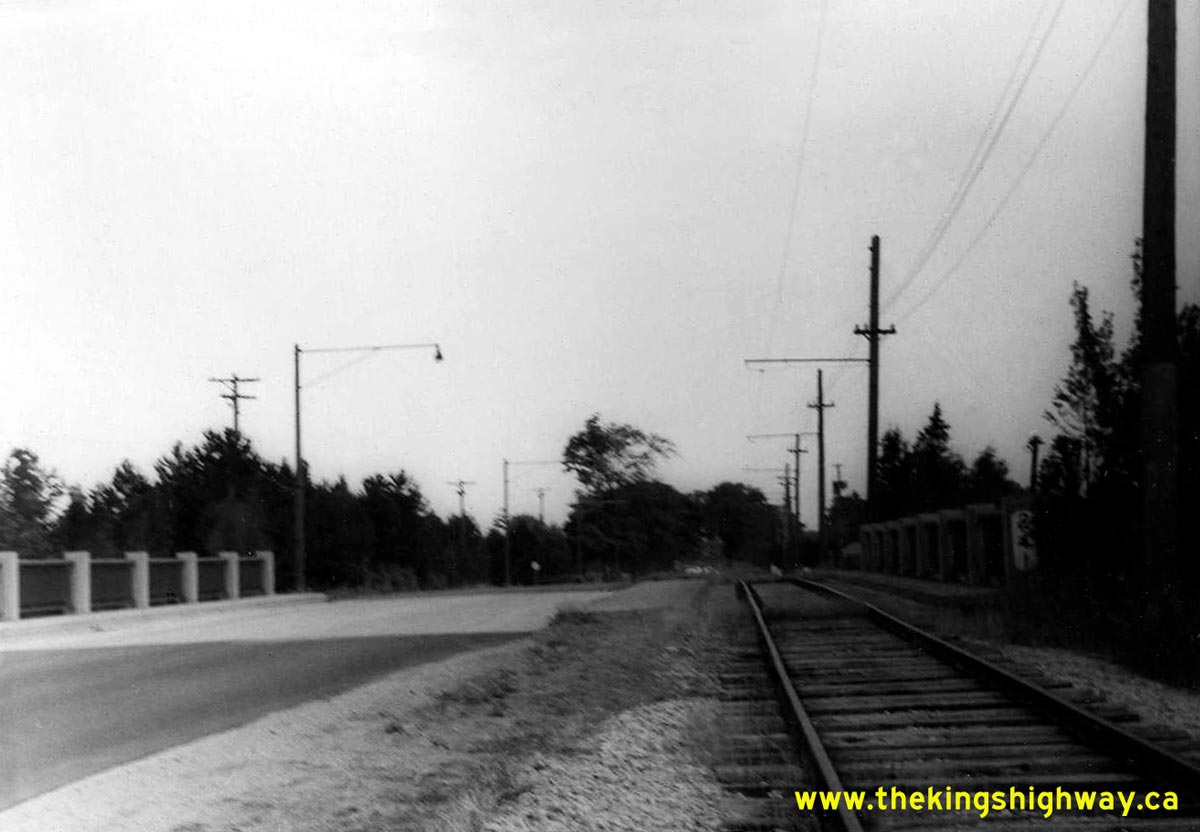
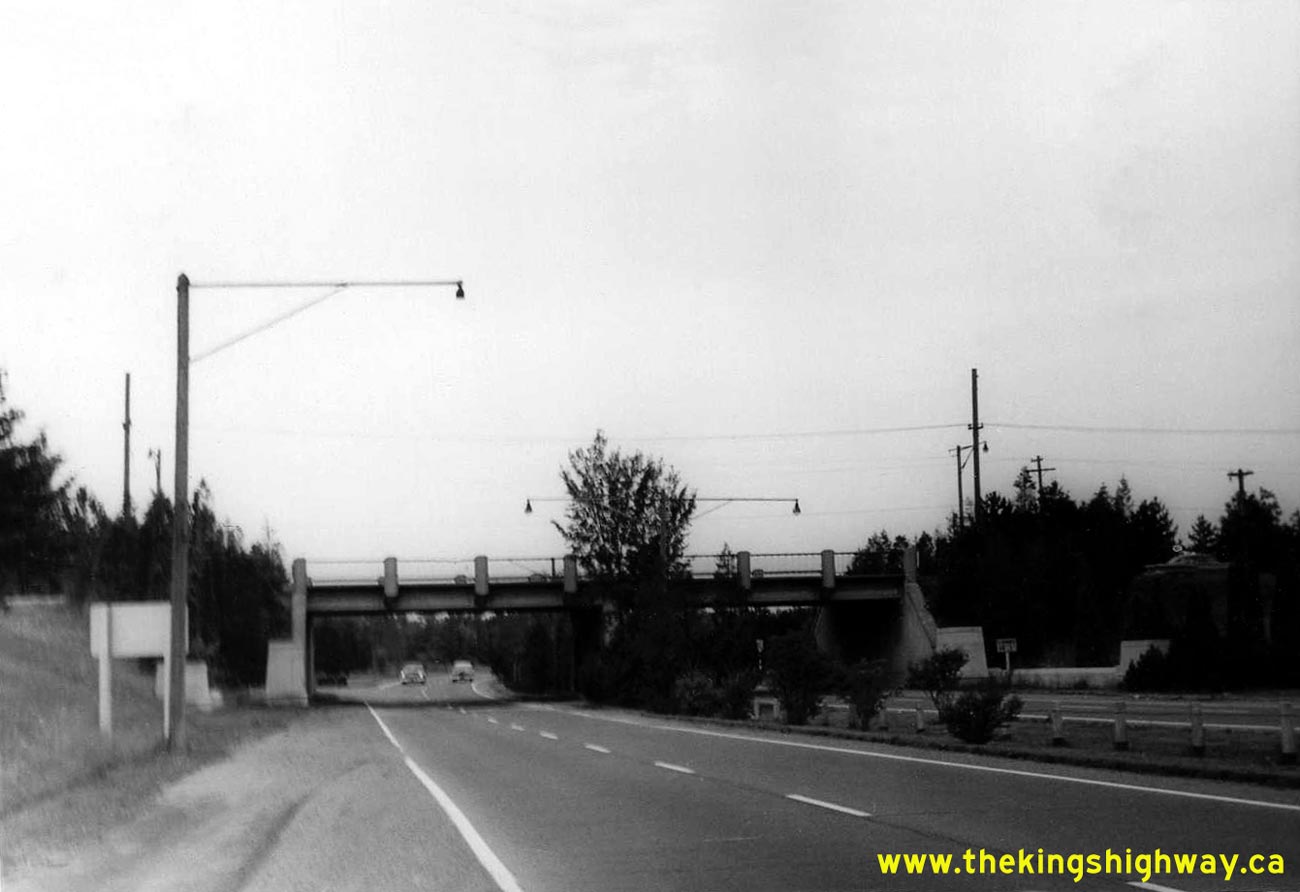
Left - Martindale Road Overpass on the Queen Elizabeth Way in St. Catharines in 1959, facing north towards Port Dalhousie. This original grade separation over
the Queen Elizabeth Way was built in 1939. The structure carried both Martindale Road and the Niagara Falls, St. Catharines & Toronto (N.S. & T.) Railway
across the Queen Elizabeth Way, immediately west of the Henley Bridge. The tracks of this abandoned railway line were removed from the Martindale Road structure
after this photo was taken in the late 1950s. See an Enlarged Photo Here. Photo taken in July
1959. (Photo courtesy of Ontario Ministry of Transportation - © King's Printer for Ontario, 2014) Right - Approaching the Martindale Road Cloverleaf on the Queen Elizabeth Way in St. Catharines in 1959, facing west from the Henley Bridge. Although the original Martindale Road Interchange was substantially reconfigured in the early 1980s to make way for the new Hwy 406 Interchange, the overpass itself survived until 2009, when it was demolished to make way for a widened Queen Elizabeth Way through St. Catharines. See an Enlarged Photo Here. Photo taken in July 1959. (Photo courtesy of Ontario Ministry of Transportation - © King's Printer for Ontario, 2014) 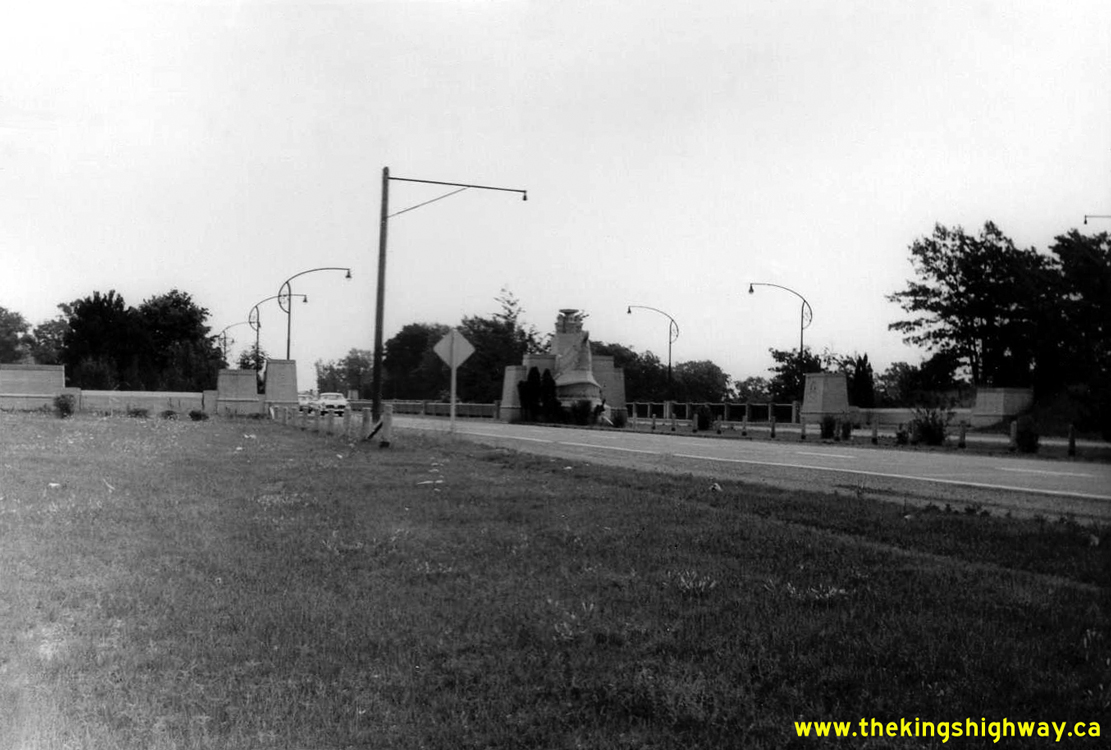
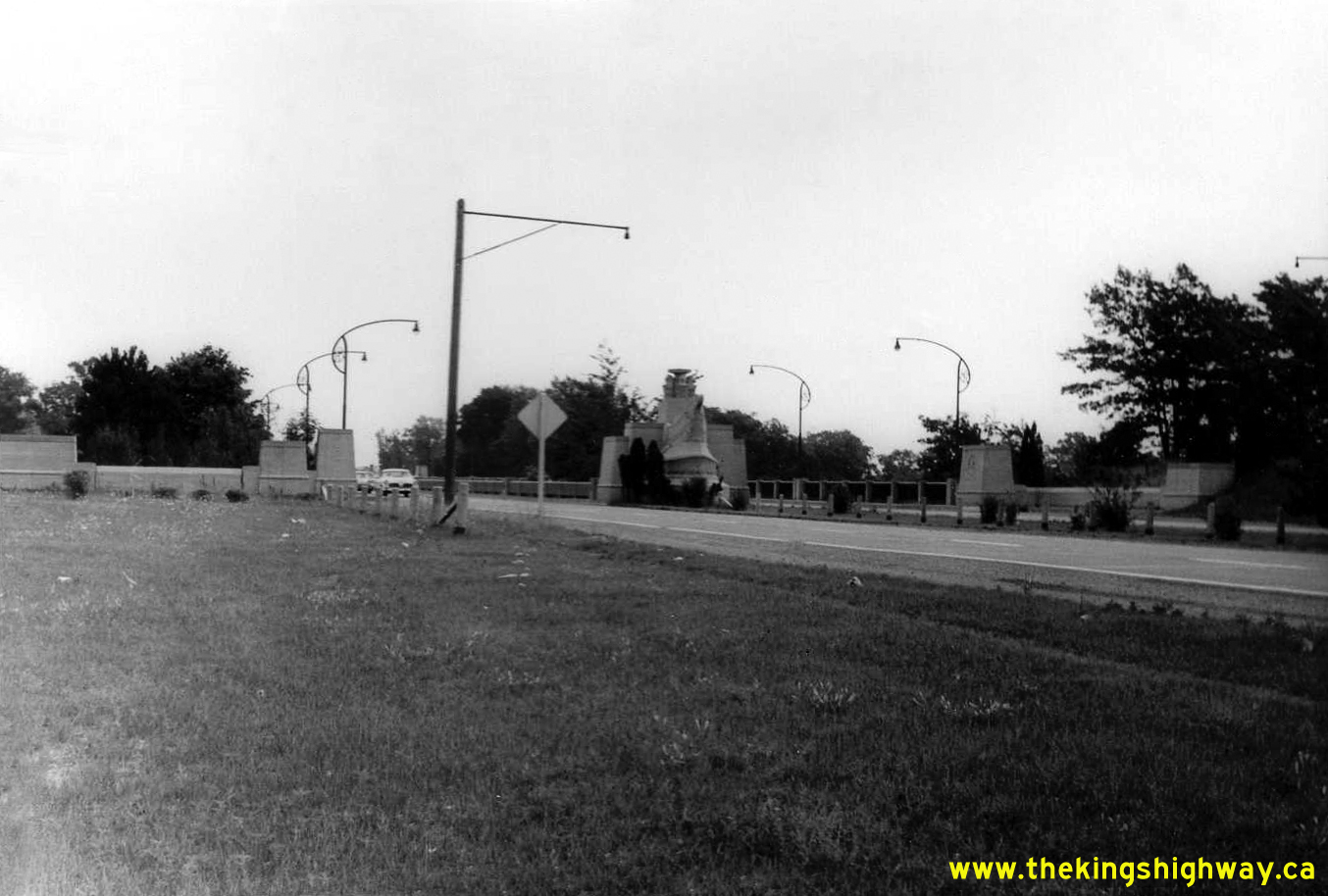
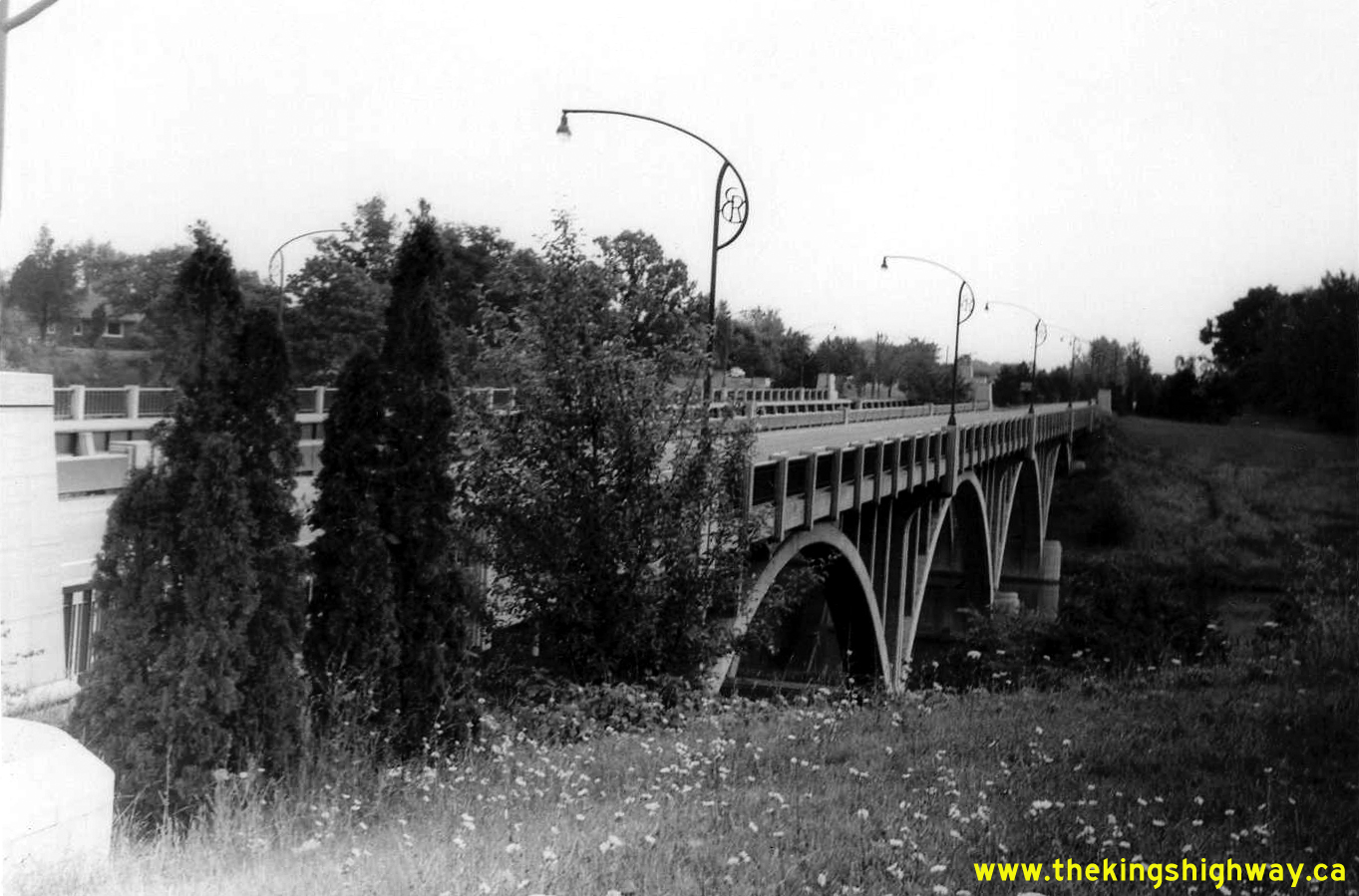
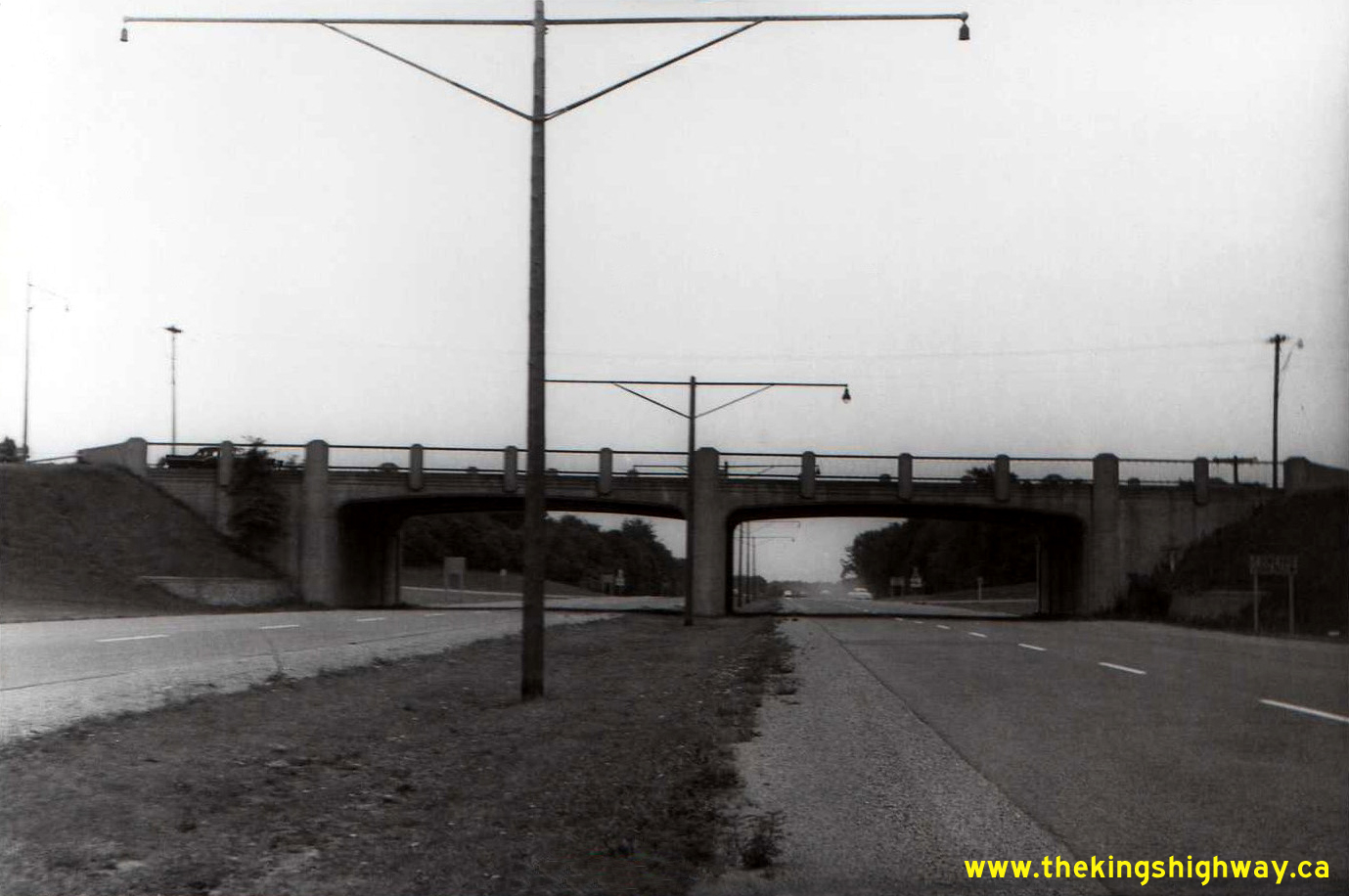
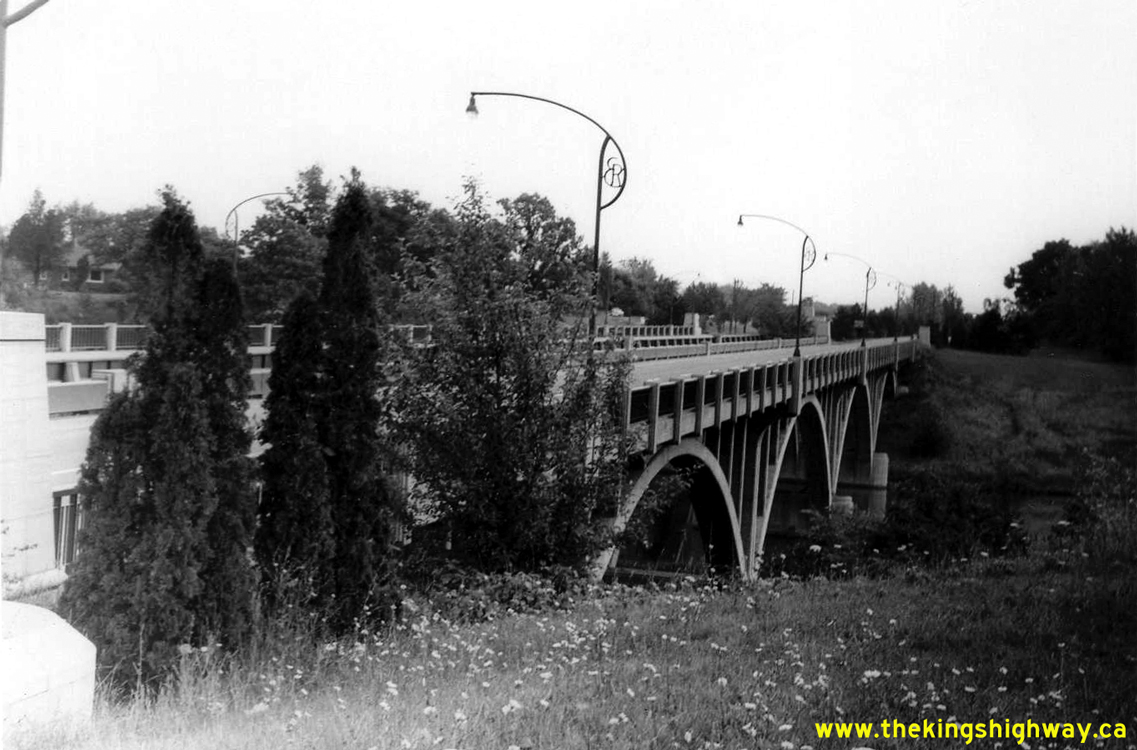 Left - Henley Bridge on the Queen Elizabeth Way at the western entrance to St. Catharines. See an
Enlarged Photo Here. Photo taken in July 1959. Left - Henley Bridge on the Queen Elizabeth Way at the western entrance to St. Catharines. See an
Enlarged Photo Here. Photo taken in July 1959.(Photo courtesy of Ontario Ministry of Transportation - © King's Printer for Ontario, 2026) Right - Side view of the Henley Bridge on the Queen Elizabeth Way in St. Catharines. See an
Enlarged Photo Here. Photo taken in July 1959.(Photo courtesy of Ontario Ministry of Transportation - © King's Printer for Ontario, 2026) 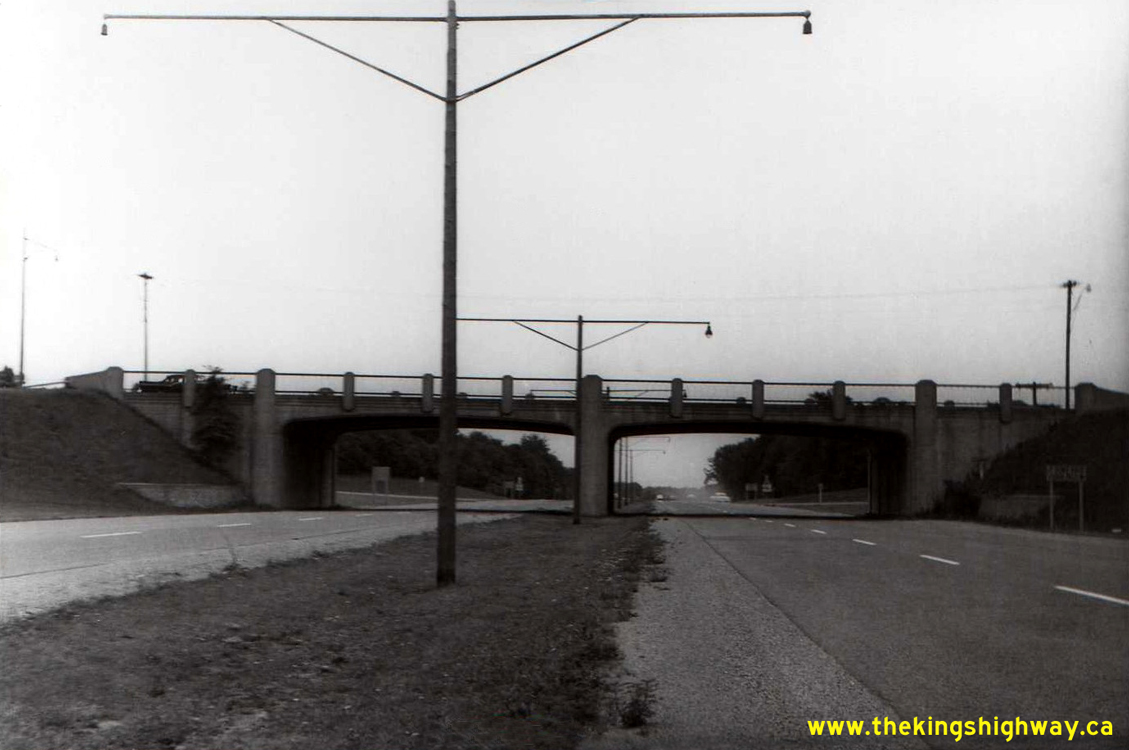
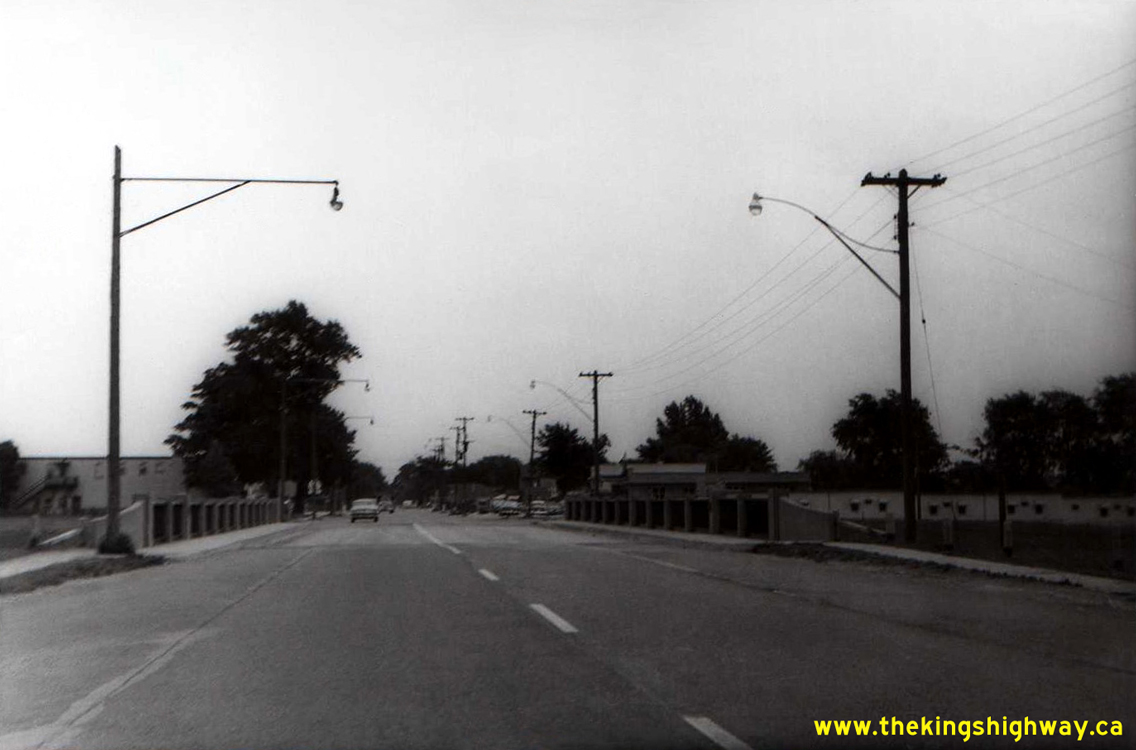
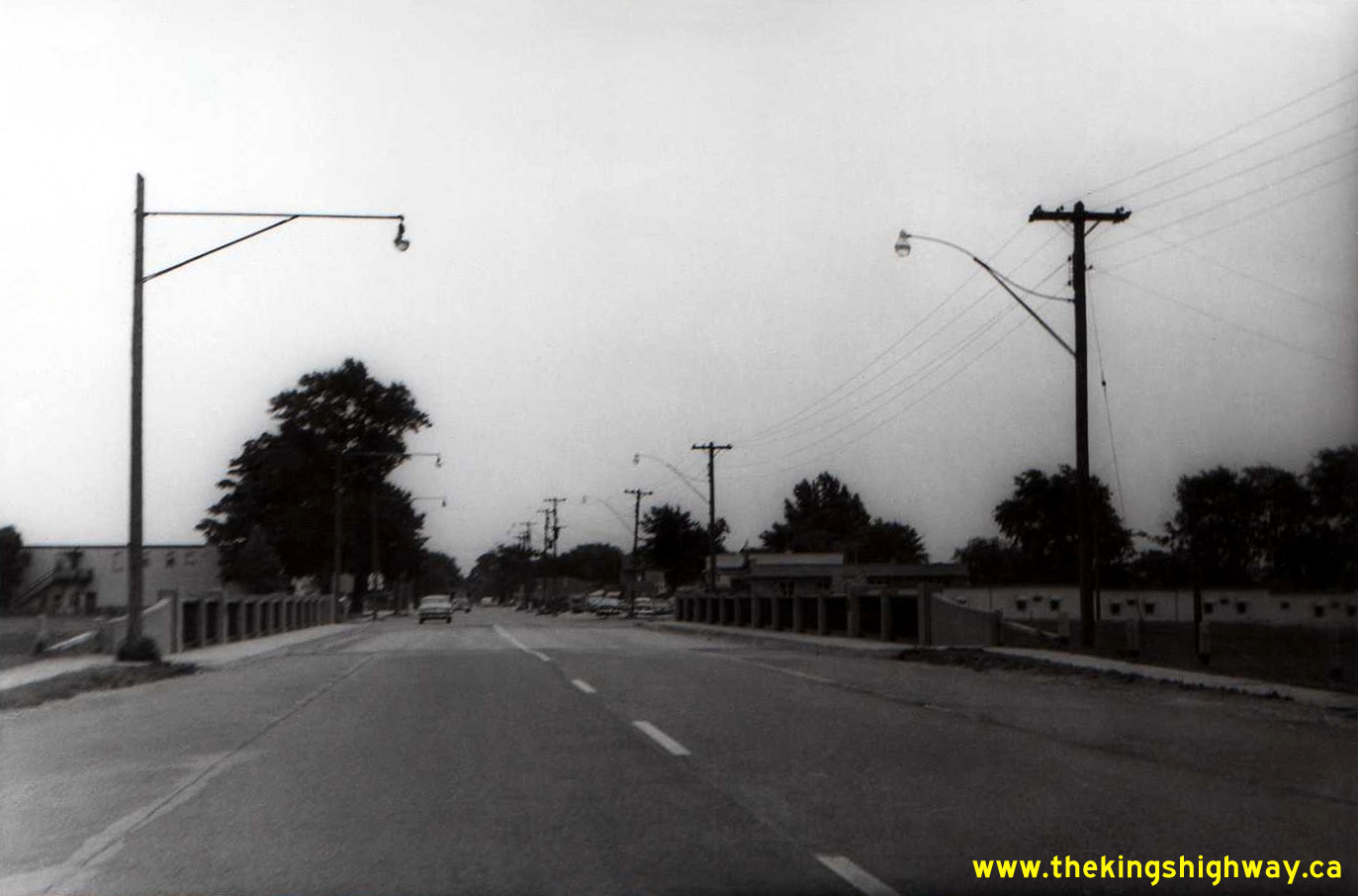
Left - Approaching the Hwy 3A & Hwy 20 (Lundy's Lane) Cloverleaf on the Queen Elizabeth Way in Niagara Falls, facing south. See an
Enlarged Photo Here. Photo taken in July 1959. (Photo courtesy of Ontario Ministry of Transportation - © King's Printer for Ontario, 2011) Right - Facing east along Hwy 3A & Hwy 20 (Lundy's Lane) towards Niagara Falls at the Queen Elizabeth Way Interchange in 1959. This photo shows Lundy's Lane prior to widening. During the mid-1960s, the highway was widened to four lanes with a centre median across the QEW structure. During this project, the original 1940 QEW luminaries were removed along Lundy's Lane and replaced with a new fluorescent tube lighting system. The cloverleaf interchange itself lasted into the early 1970s, when it was removed to make way for the new multi-level interchange at Hwy 420. See an Enlarged Photo Here. Photo taken in July 1959. (Photo courtesy of Ontario Ministry of Transportation - © King's Printer for Ontario, 2011) 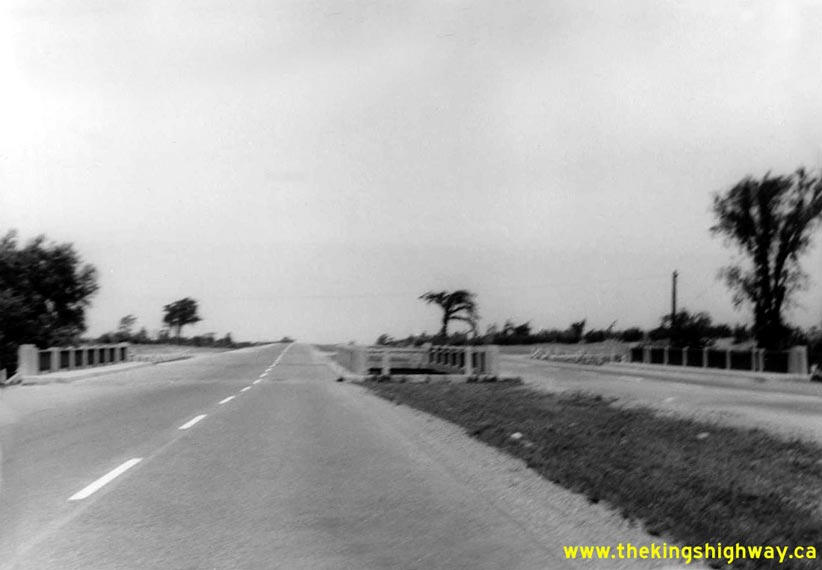
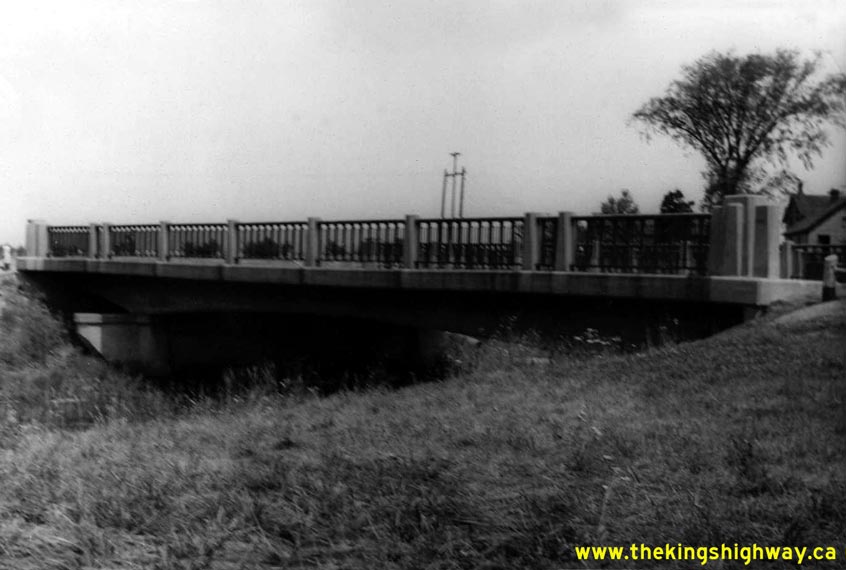
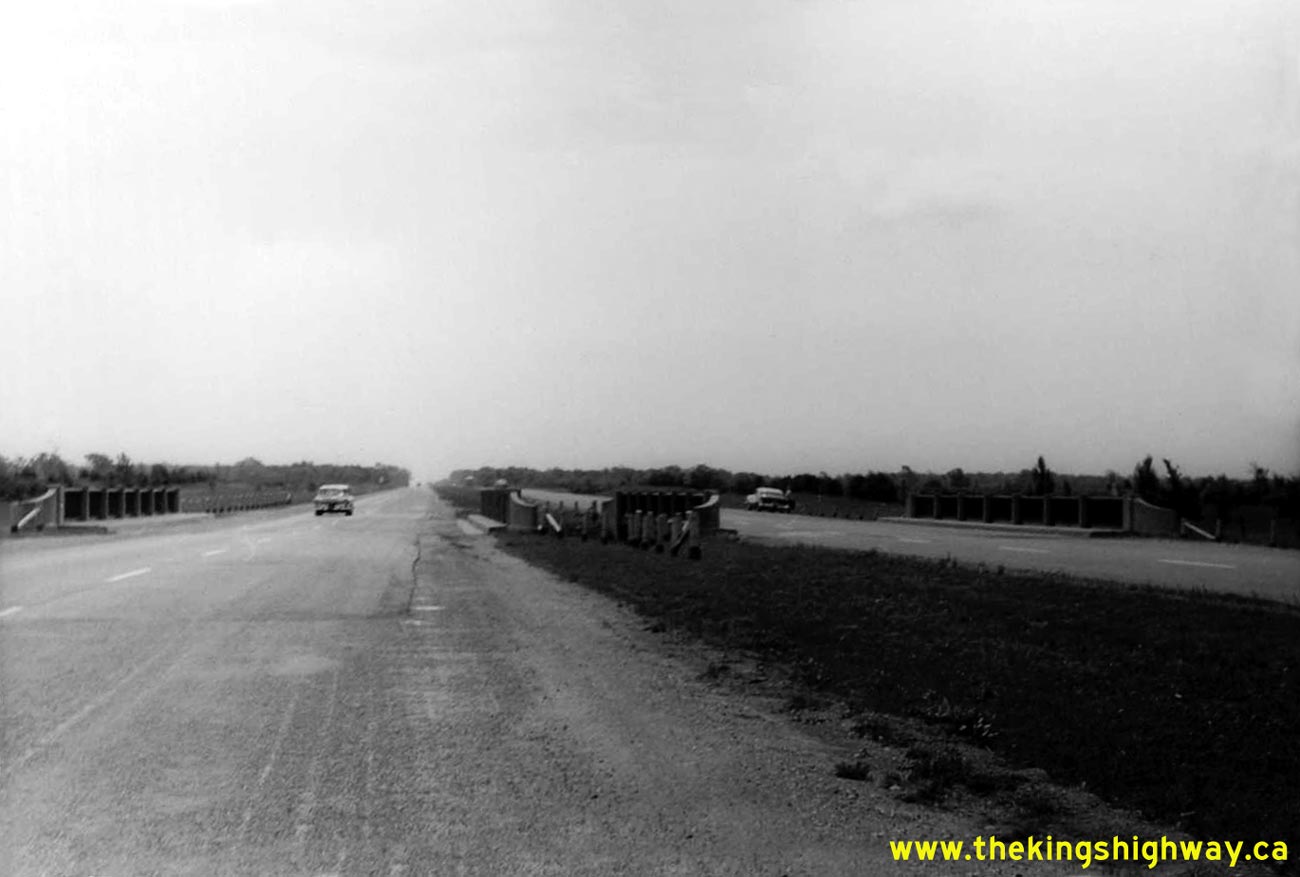
Left - Queen Elizabeth Way at the Lyons Creek Bridge between Niagara Falls and Fort Erie in 1959, facing north. At the time this photo was taken, Lyons Creek
Road intersected the Queen Elizabeth Way at-grade, immediately north of the Lyons Creek Bridge. This at-grade intersection was removed in 1973, when a new grade
separation and interchange was built at a relocated Lyons Creek Road a short distance to the north. See an
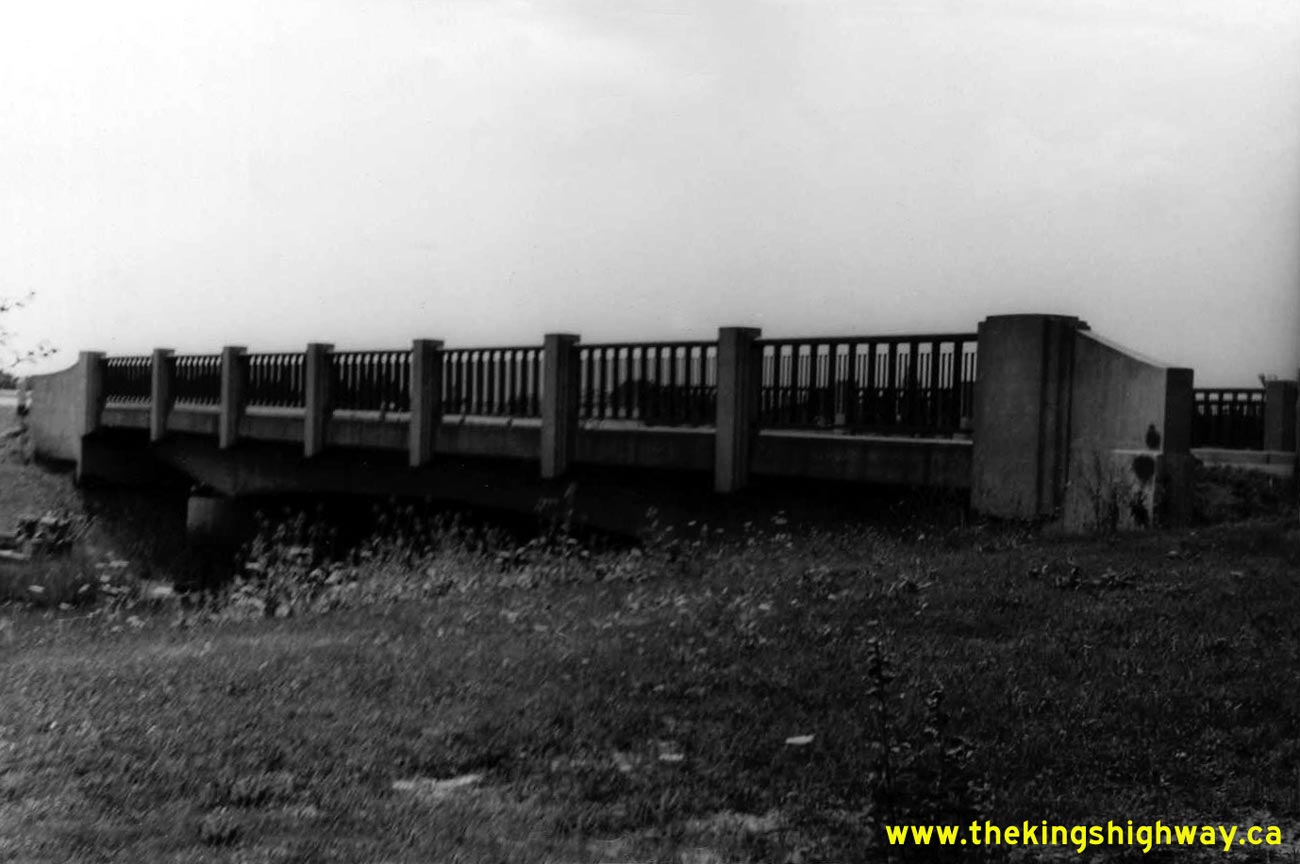
Enlarged Photo Here. Photo taken in July 1959. (Photo courtesy of Ontario Ministry of Transportation - © King's Printer for Ontario, 2014) Right - Lyons Creek Bridge on the Queen Elizabeth Way south of Niagara Falls. See an Enlarged Photo Here. Photo taken in July 1959. (Photo courtesy of Ontario Ministry of Transportation - © King's Printer for Ontario, 2014) 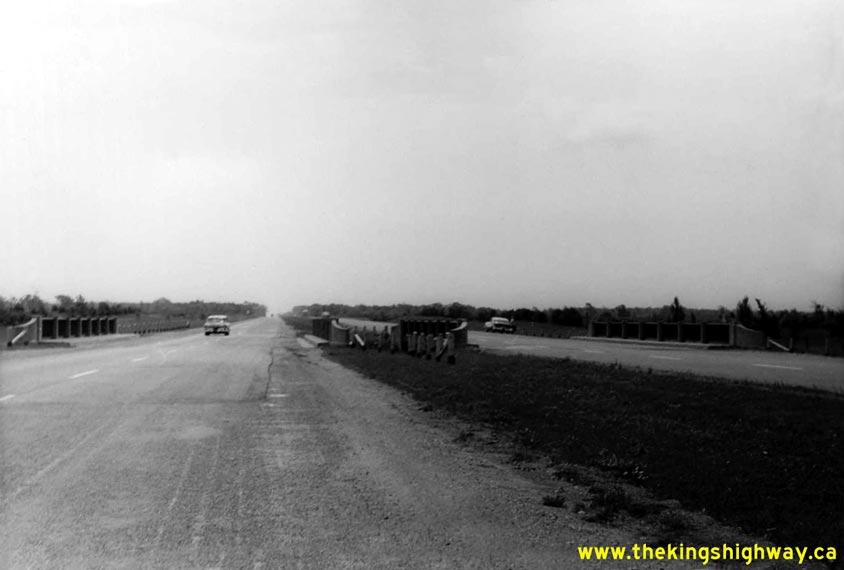
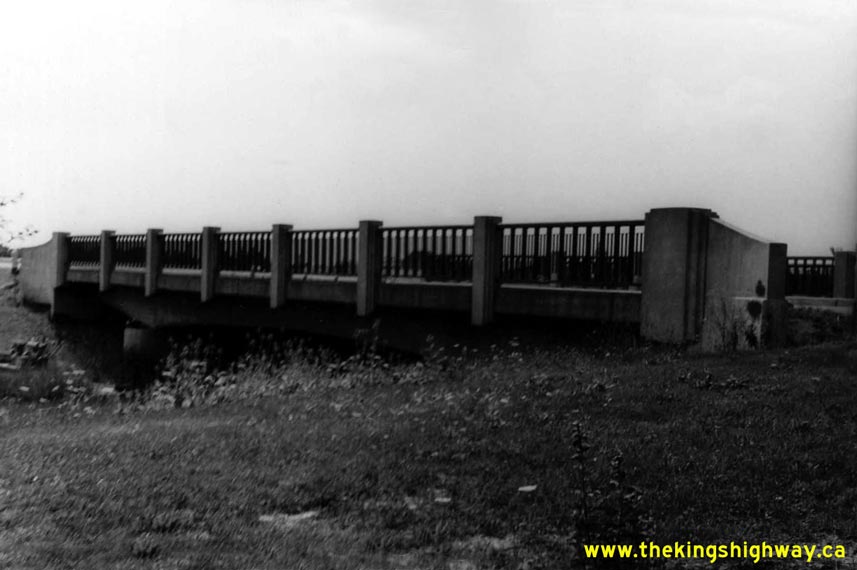
Left - Queen Elizabeth Way at the Tea Creek Bridge between Niagara Falls and Fort Erie, facing south. See an
Enlarged Photo Here. Photo taken in July 1959. (Photo courtesy of Ontario Ministry of Transportation - © King's Printer for Ontario, 2014) Right - Tea Creek Bridge on the Queen Elizabeth Way south of Niagara Falls. See an Enlarged Photo Here. Photo taken in July 1959. (Photo courtesy of Ontario Ministry of Transportation - © King's Printer for Ontario, 2014) 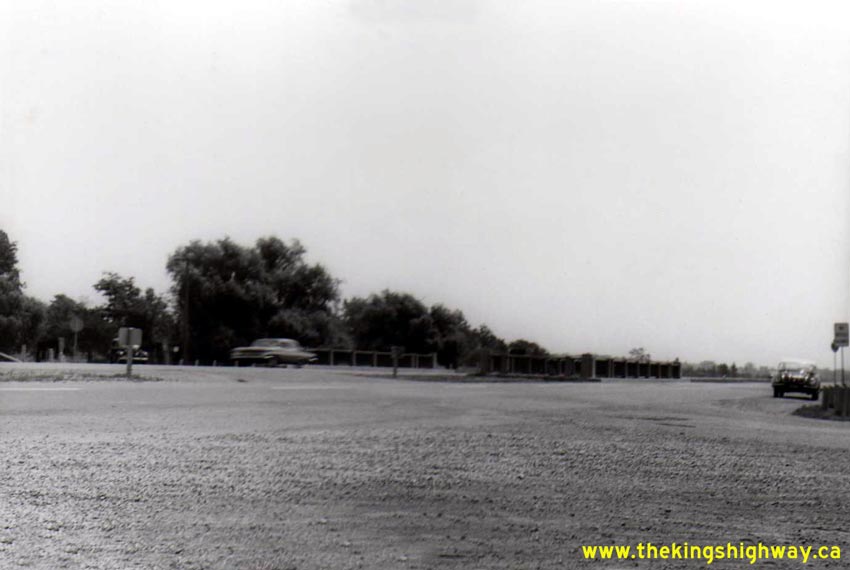
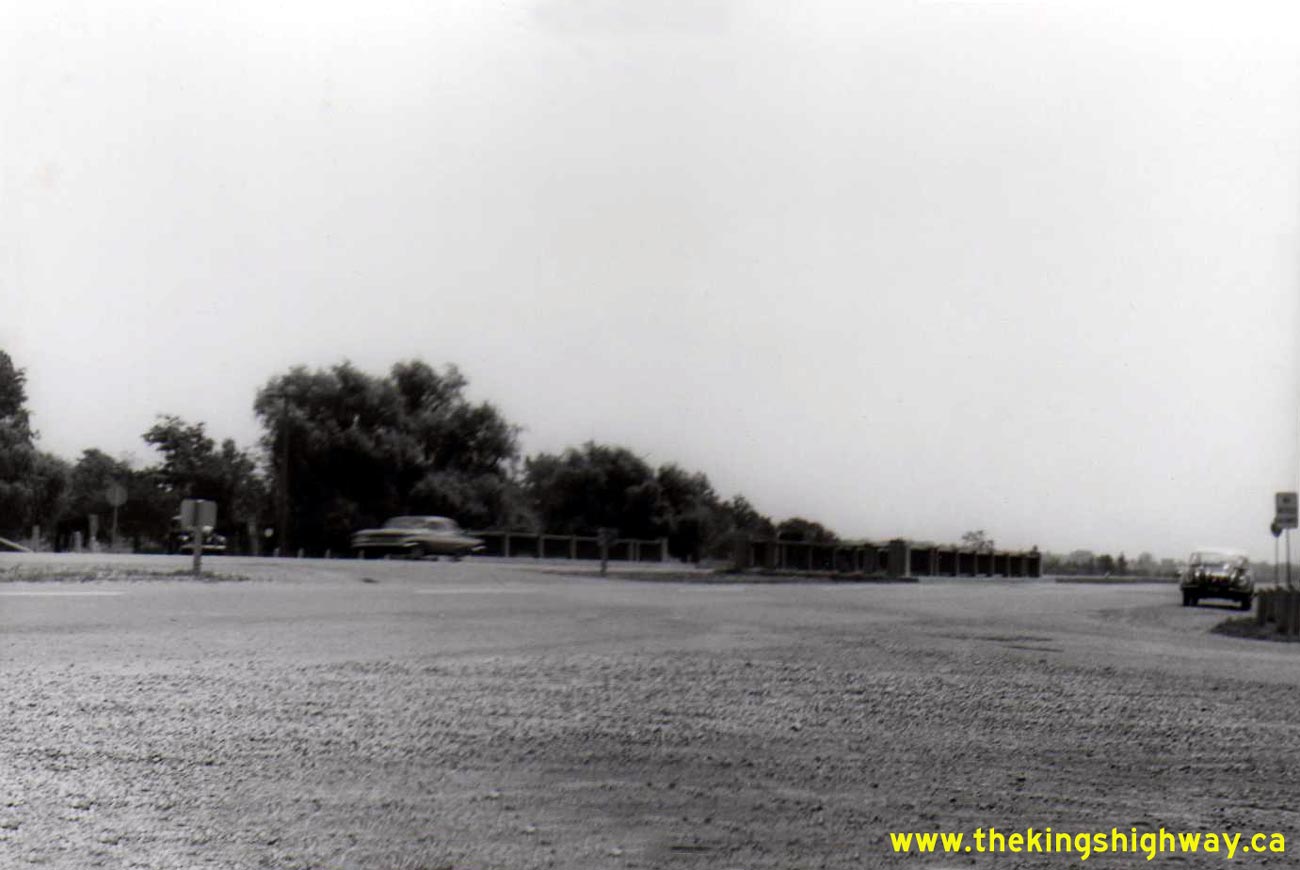
Above - Intersection of Townline Road on the Queen Elizabeth Way between Niagara Falls and Fort Erie in 1959, facing south. At the time this photo was taken,
Townline Road intersected the Queen Elizabeth Way at-grade, immediately north of the Black Creek Bridge. In 1977, this at-grade intersection was removed when a new
grade separation was built at Townline Road. See an Enlarged Photo Here. Photo taken in July
1959. (Photo courtesy of Ontario Ministry of Transportation - © King's Printer for Ontario, 2014) 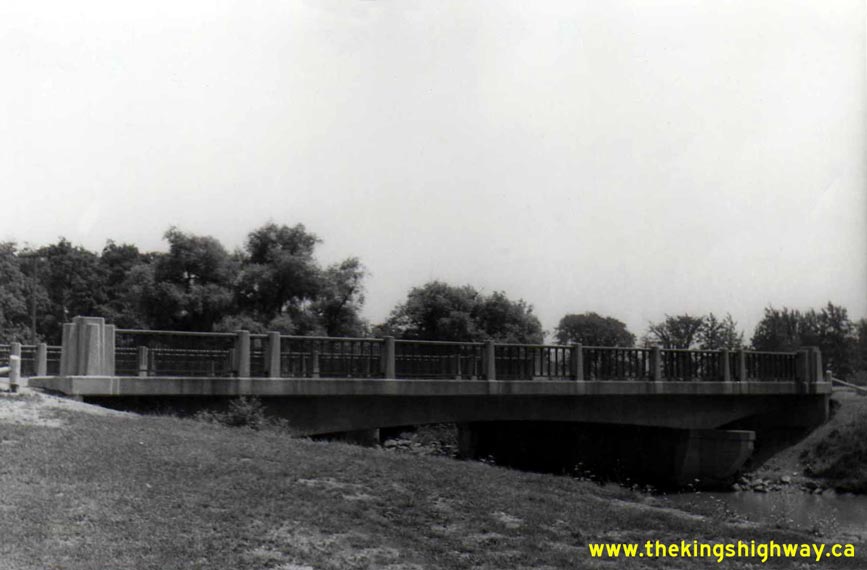
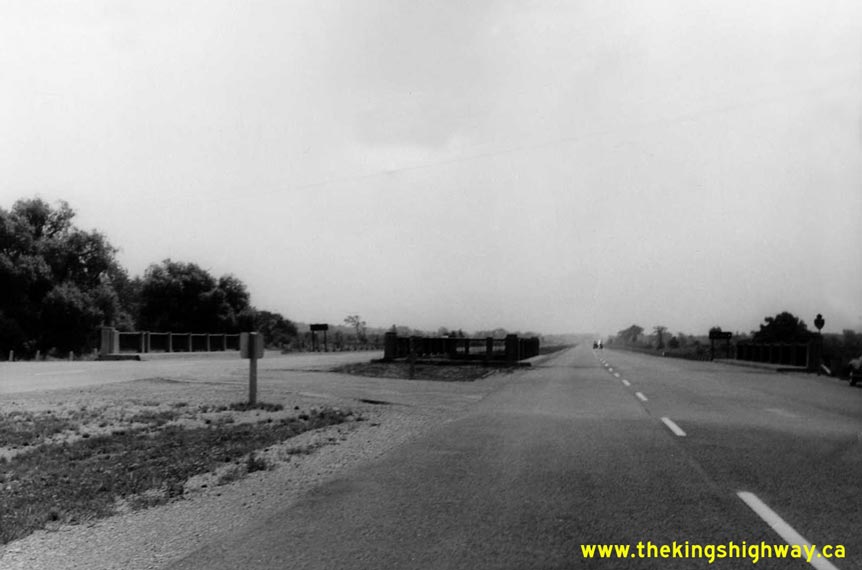
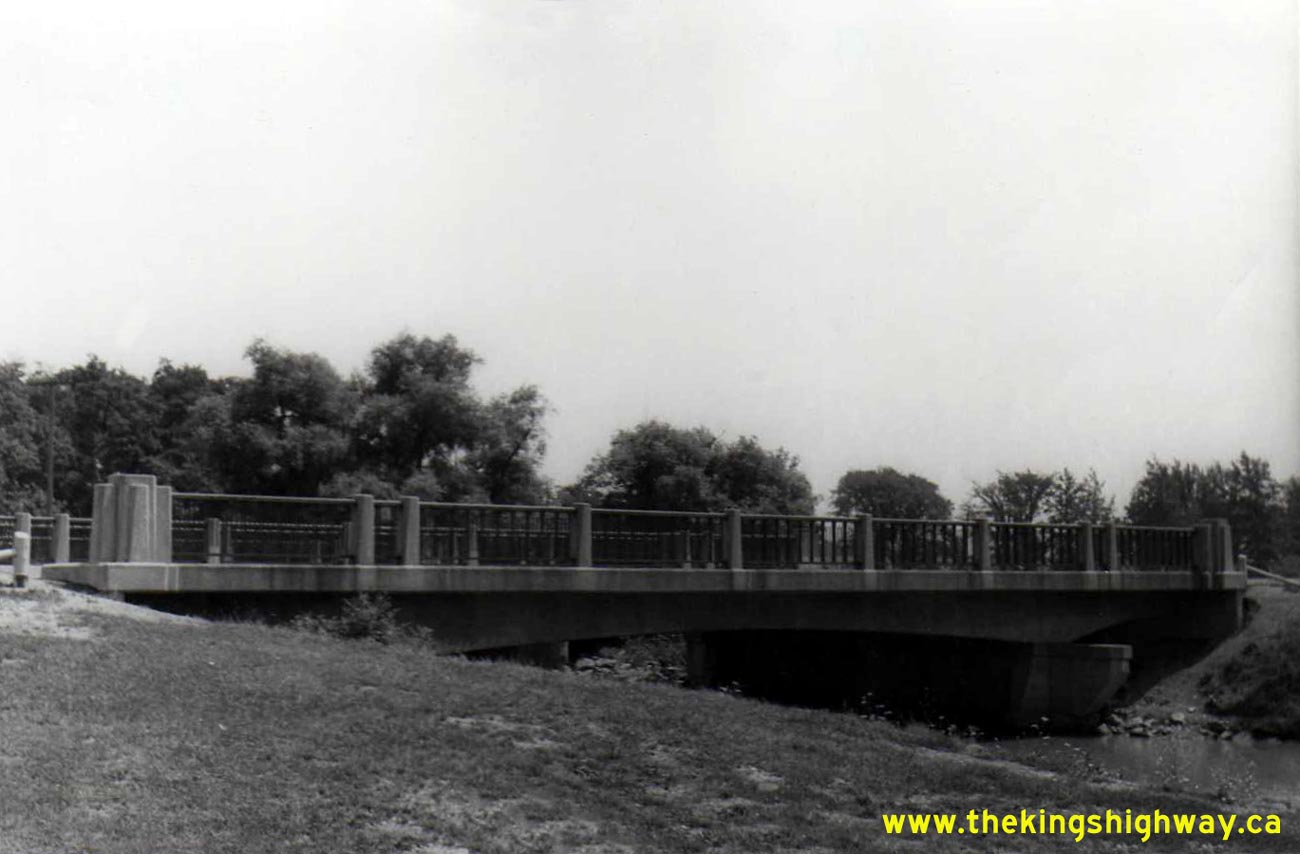
Left - Black Creek Bridge on the Queen Elizabeth Way north of Fort Erie. See an
Enlarged Photo Here. Photo taken in July 1959. (Photo courtesy of Ontario Ministry of Transportation - © King's Printer for Ontario, 2014) Right - Facing south along the Queen Elizabeth Way towards the Black Creek Bridge from Townline Road. See an Enlarged Photo Here. Photo taken in July 1959. (Photo courtesy of Ontario Ministry of Transportation - © King's Printer for Ontario, 2014) 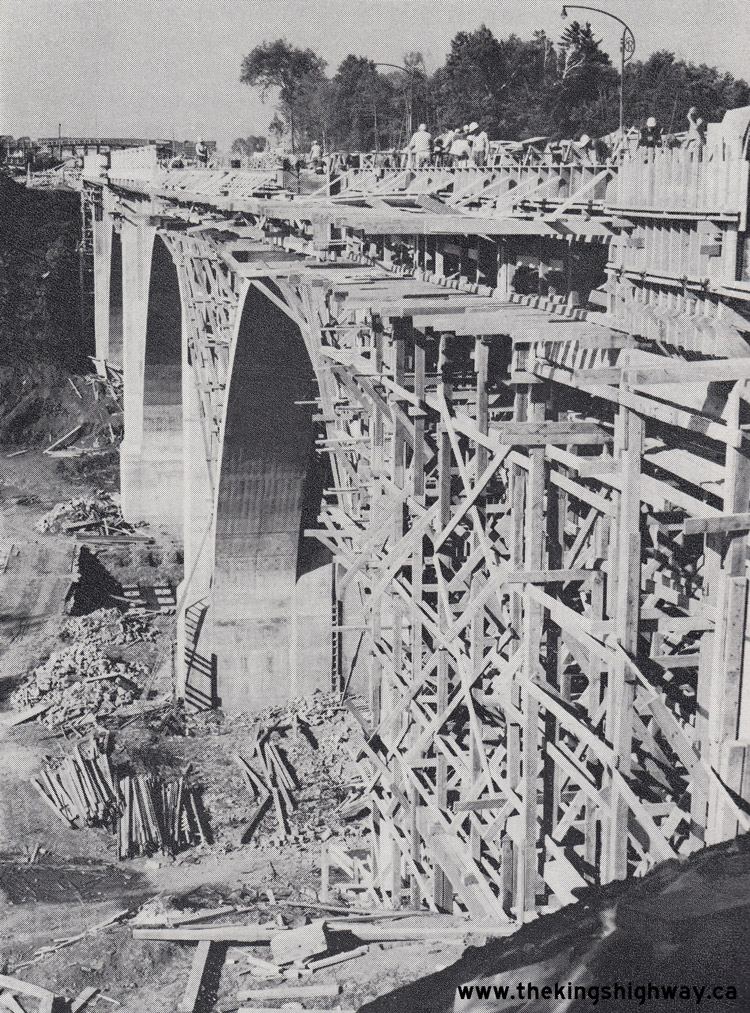 Above - Widening underway on the Bronte Creek Bridge on the Queen Elizabeth Way between Oakville and Burlington, Contract #1958-216. The original bridge built
across Bronte Creek in 1936 consisted of an undivided four-lane pavement. During the bridge widening, a new median barrier was installed to separate the Toronto-bound
and Niagara-bound lanes of the highway. The Bronte Creek Bridge was also widened to permit the future construction of a six-lane freeway. See an
Enlarged Photo Here. Photo taken on August 11, 1959. Above - Widening underway on the Bronte Creek Bridge on the Queen Elizabeth Way between Oakville and Burlington, Contract #1958-216. The original bridge built
across Bronte Creek in 1936 consisted of an undivided four-lane pavement. During the bridge widening, a new median barrier was installed to separate the Toronto-bound
and Niagara-bound lanes of the highway. The Bronte Creek Bridge was also widened to permit the future construction of a six-lane freeway. See an
Enlarged Photo Here. Photo taken on August 11, 1959.(Photo courtesy of Ontario Ministry of Transportation - © King's Printer for Ontario, 1959) 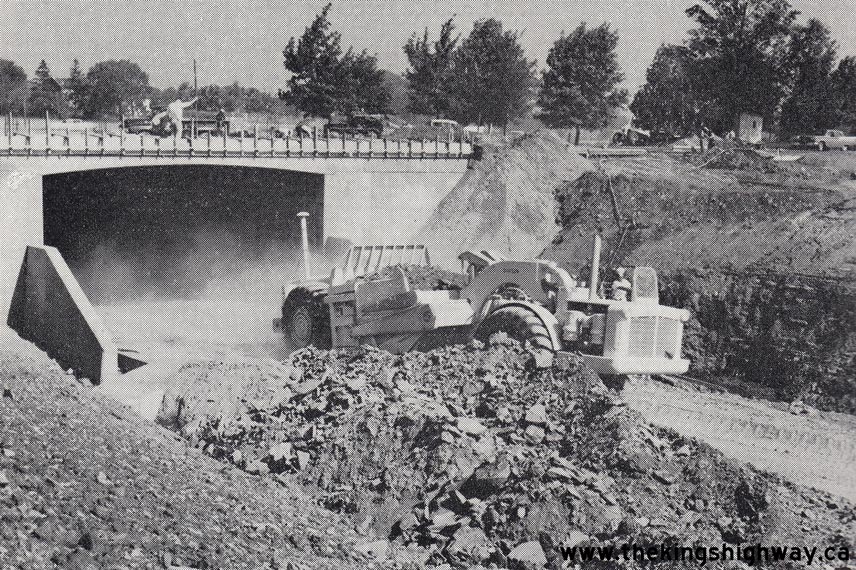
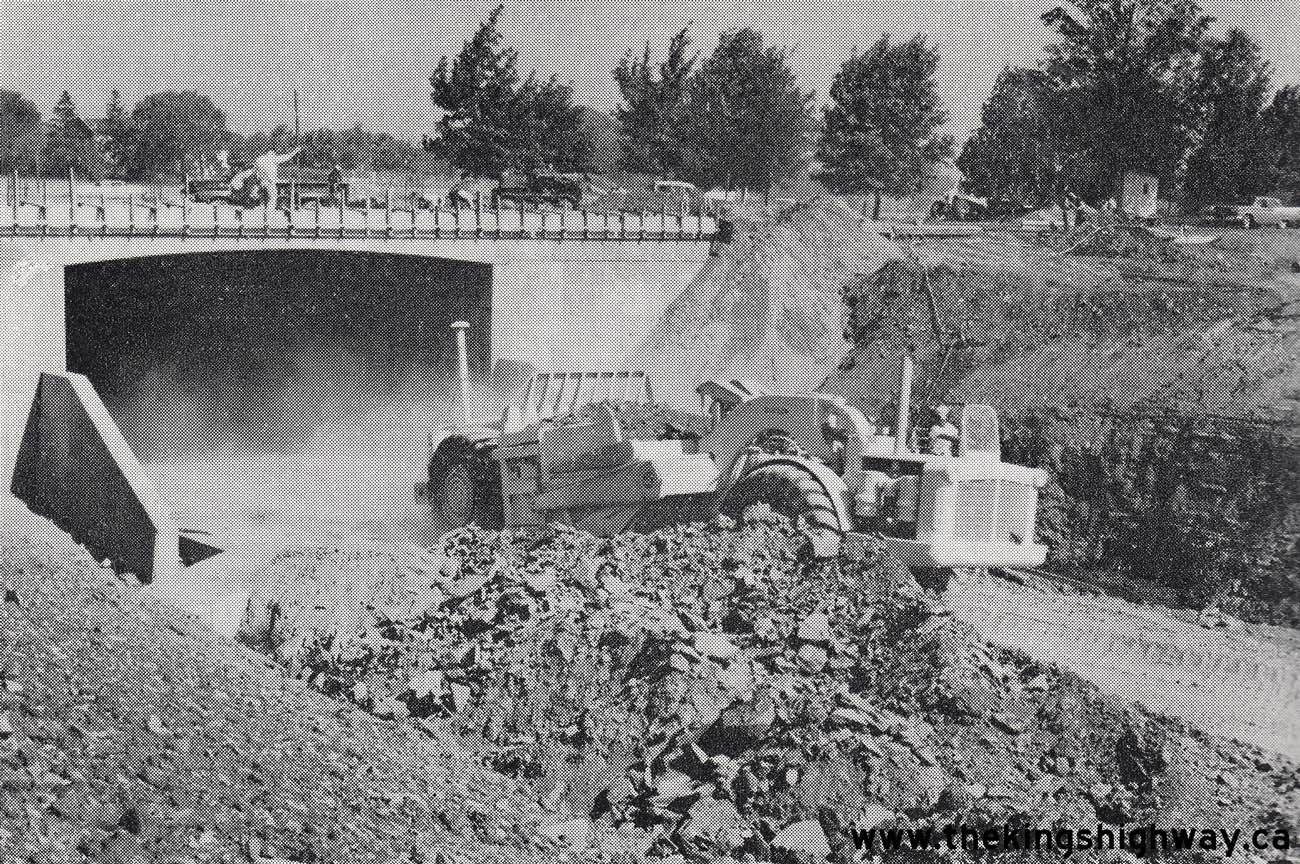
Above - Underpass construction on the Queen Elizabeth Way at 3rd Line between Oakville and Burlington, Contract #1958-610. See an
Enlarged Photo Here. Photo taken on August 12, 1959. (Photo courtesy of Ontario Ministry of Transportation - © King's Printer for Ontario, 1959)
Continue on to Queen Elizabeth Way Historical Photos from 1960-1964
|
|---|
Links to Adjacent King's Highway Photograph Pages:
Back to King's Highway 427 Photos /
Queen Elizabeth Way History /
On to Secondary Highway 500 Photos
Ontario Highway History - Main Menu / Back to List of Highways Website contents, photos & text © 2002-2026, Cameron
Bevers (Webmaster) - All Rights Reserved / Contact Me
|
|---|